
Down the street from their main gallery, Carroll/Fletcher’s project space features some of Rafael Lozano-Hemmer’s smaller-scaled works, which sketch out the complex relations between measurement, statistics, surveillance, participation and play at stake in his oeuvre. A digital display reads “1984,” spelled out in continually changing numbers culled from Google Street View (Nineteen Eighty-Four, 2014). Each digit of the ominous date switches, sampling from a different address, according to a pre-set rhythm which visitors can alter by turning a dial. (Similarly, they can enter any four-digit code into a keypad and watch the display count up or down to 1984.) The piece isolates, and obsessively repeats, a mythological force threaded into numerical fabric: the persistence (we might say ubiquity) of Orwell’s novel as a touchstone in articulating the tonal fabric of the surveillance state, as felt by individual subjects.
Surveillance, of course, has changed since Orwell envisioned it. As Manuel de Landa and Karl Palmås have noted, surveillance today might best be understood as panspectric, rather than panoptic.1 1 - See Manuel de Landa, War in the Age of Intelligent Machines (New York: Zone Books, 1991) and Karl Palmås, “Predicting What You’ll Do Tomorrow: Panspectric Surveillance and the Contemporary Corporation,” Surveillance and Society 8, 3: 338-354. Big data, whether collected by governmental bodies like the National Security Agency or by any of a host of private analytics and information companies (such as Quantcast, Factual and Experian), relies on a much broader spectrum of information than the merely visual: records of correspondence and search history, algorithmically-deduced personal identities based solely on online activity,2 2 - See John Cheney-Lippold, “A New Algorithmic Identity: Soft Biopolitics and the Modulation of Control,” Theory Culture Society 28, 6: 164-181. arsenals of past purchases, GPS coordinates gleaned from smartphones, and many other mechanisms for producing citizen – consumers as quantified selves.3 3 - I am borrowing this term from the Quantified Self movement, which seeks to incorporate insights from data acquisition into daily life. For more, see www.quantifiedself.com.
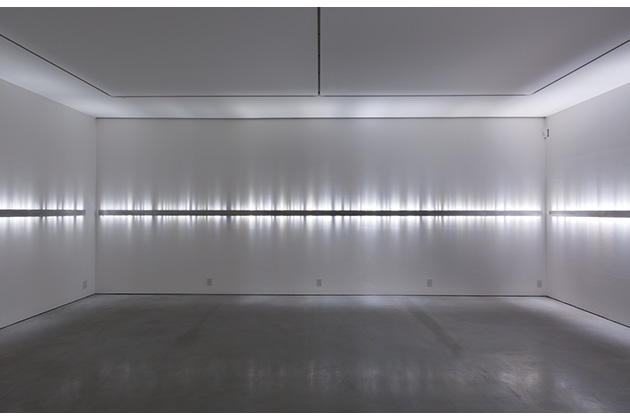
Voice Array, 2011 (Top), Sphere Packing, 2014 (Bottom), Exhibition Views, Obra Sonora, Carroll/Fletcher Gallery, London.
Photo : Grace Storey, courtesy of the artist & Carroll/Fletcher Gallery, London
Quantified selves come into being through ongoing and self-modifying processes of correlative mapping that understand personal data by comparing it to contextual information and statistical norms. But who has access to such comparisons, and who remains merely their object? Since Edward Snowden’s NSA revelations of 2013, such questions have taken on greater visibility. Given these immense shifts, Lozano-Hemmer’s work straddles many fault lines. The best of his recent works activate these, exploring the complex and constantly shifting politics of measuring and retaining information: the problems and potentials associated with measurement’s inextricable arbitrariness, its inclusions and its exclusions.
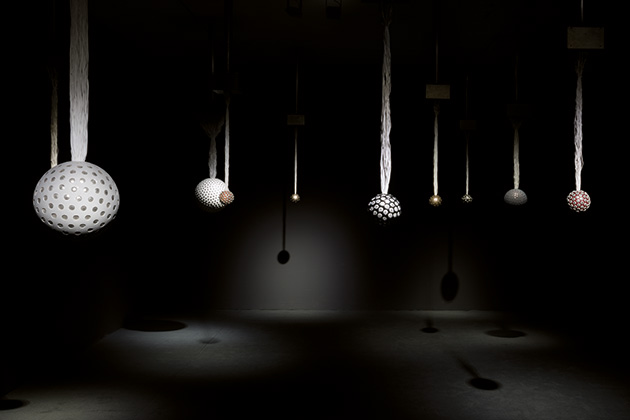
Voice Array, 2011 (Top), Sphere Packing, 2014 (Bottom), Exhibition Views, Obra Sonora, Carroll/Fletcher Gallery, London.
Photo : Grace Storey, courtesy of the artist & Carroll/Fletcher Gallery, London
Voice Array (2011), in the main space, perhaps best shows how volatile such fault lines can be. The piece, a long, linear array of LED lights embedded in a metal strip that circumvents a room (with custom hardware and software), invites visitors to record a sample of their voice by pressing a button and speaking into a small microphone. The recorded voice, then, lights up a succession of LED lights that travel around the room. As the lights travel, a murmur of the 288 voices stored by the piece’s memory erupts, until finally, for the last time, one individual recording plays before it is pushed out of the system by the new voice. This structure of finite storage takes on a new significance given, for instance, the European Court of Justice’s May 2014 decision to require Google to remove certain search results upon request, to protect a citizen’s right to be forgotten. This is one of a host of recent events revealing how anxiety-inducing the thought of data’s seeming unwillingness to die can be. Lozano-Hemmer’s decision to produce a data-set with a finite lifespan draws attention to how data’s ostensibly infinite life can put pressure on the biological, finite lifespans of the individuals to which they refer.
Zero Noon (2013), in the project space, is a clock that counts the hours according to a vast array of internet-refreshed statistics, which reset at zero each noon. At the press of a button, users can switch between various units of measurement: the number of pistols manufactured in the U.S. since noon, the number of tobacco-related deaths since noon, the number of tortillas (in tons) consumed in Mexico since noon. In a talk at Carroll/Fletcher, Lozano-Hemmer spoke of this piece in light of his interest in archaic, associative forms of measurement: the practice of measuring, say, a journey from one village to another in raindrops. This line of thought brings to mind French Fluxus artist Robert Filliou’s 8 Measurement Poems (1966), in which the artist produced his own measuring sticks by lining up various mass-produced objects as “units”: insoles, mousetraps, whistles, tea bags. In such examples, the relationship between the unit of measurement and the thing measured might have both metonymic and poetic dimensions. Distance takes on the haptic qualities of felt raindrops encountered on a particular trajectory through the countryside; space borrows the concept of infusion from the tea bag. Zero Noon asks users to consider the relationships between such poetic dimensions of measurement and the particular kind of truth claim taken on by statistical data, which both purports to accurately represent something of a collective state of affairs, and to generalize about how that very state of affairs intersects with any given swath of time. We become immersed in the act of imagining human activity on an unimaginably large scale, while all the while being acutely aware of the generalization within statistics: the dubiousness of their having an exact claim on the present based on their analyses of the past, however oft-refreshed these statistics might be.
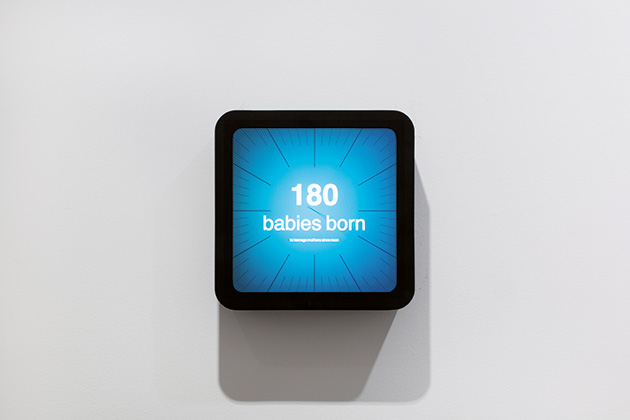
Zero Noon, 2013.
Photo : Callum Leo Hughes, courtesy of the artist & Carroll/Fletcher Gallery, London
In Sphere Packing (2014), Lozano-Hemmer compresses the complete works of various composers into 3D-printed spheres housing speakers, which quietly play each work in the composer’s oeuvre. The spheres, suspendend from clusters of speaker wire, vary in size; Bach’s sphere contains 1128 speakers, while Monteverdi’s contains 17. As viewers approach the spheres, their indiscriminate hum gives way to the faint sound of a specific composition emanating from the nearest speaker. This piece stages a complex encounter between qualitative and quantitative conceptions of musicality. The act of quantifying a composer’s output gives way to many new qualitative dimensions of listening, which must now navigate intricate textures of quietly clashing rhythms, tones and expressions.
Pan-Anthem (2014) makes use of a similar clash of compositions. Lozano-Hemmer arranges a set of movable, magnetic speakers loaded with anthems from every nation. (He includes an extra wall of almost-countries: Québec, Scotland and other areas aspiring to an as-yet unrealized independence.) At Carroll/Fletcher, the speaker-nations are arranged according to military spending per capita. Countries with no military, such as Grenada, are on the far left of the wall, while countries with stupendous military budgets, such as the U.S., Israel and Singapore, are on the right. As viewers approach, sensors pick up their presence, triggering the anthems. By giving viewers an interactive, embodied, playful experience of statistical information, Lozano-Hemmer questions the supposed passivity of the quantified subject, and draws attention to the malleability of information’s relationships to power.


