Photo: courtesy of the artist
The regime under which religion — any religion — functions in contemporary secular, democratic Western societies is freedom of belief. After the victory of the Enlightenment, faith became a private affair. Freedom of belief means that everybody is free to believe what he or she chooses to believe, and also that everybody is free to organize his or her personal, private life according to his or her beliefs. But at the same time it means that it is forbidden to impose one’s own faith on public life and state institutions. The work of the Enlightenment resulted not in the complete disappearance of religion but in its privatization, its withdrawal into the private sphere. Under the conditions of the contemporary secularized world, religion has become a matter of private taste — it functions in a way that is analogous to the functioning of art and design. This does not mean that religion is not publicly discussed. However, the place of religion in its relationship with public discussion is the same as the place of art as it was described by Kant in his Critique of Judgment: religion can be publicly discussed, but such a discussion cannot result in any conclusion that would become binding for the participants in this discussion or for society as a whole. The commitment to this or that religious faith is a matter of a personal, private, sovereign decision that cannot be dictated by any public authority — and that includes any democratically legitimized authority. Even more important, such a decision — as is the case for art — does not need to be publicly argued for and legitimized. Rather, it is supposed to be socially accepted without any further explanation. The legitimacy of personal faith is based not on its persuasive power but on the sovereign right of the individual to accept or reject this faith.
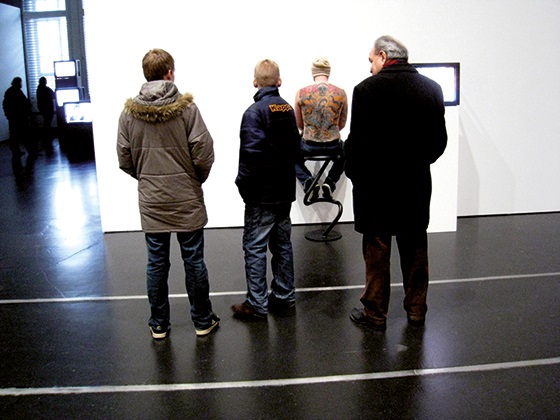
Tim, exhibition view, medium religion, zkm | Centre D’art Et De Technologie Des Médias, Karlsruhe, 2008. © Wim Delvoye / Sodrac (2014)
Photo: Tobias Efthymiades, courtesy of the artist
Now, science is, on the contrary, a public affair. Knowledge that is obtained, formulated, and presented scientifically is central to the governing of contemporary enlightened, liberal Western democracies. As Michel Foucault repeatedly stressed, under the conditions of modernity scientific knowledge equals power. Modern technology is based on sciences such as physics and biology. Modern governing practice is based on the positive sciences, such as law, political science, economics, psychology, and sociology. All this means that there can be no freedom of science in the same sense as there is freedom of belief. I n the context of a scientific discussion, every opinion can and must be argued for, substantiated or falsified by certain facts, proved according to certain rules. Every participant in such a discussion is certainly free — at least theoretically — to formulate his or her own positions and to argue in their favour. But one cannot insist on a certain scientific opinion without any justification, against all proof and evidence to the contrary, without producing any arguments that would make one’s position plausible and persuasive to others.
So there are today two types of freedom operating on our culture. Freedom of scientific opinion is conditional. It is conditioned by one’s ability to justify, to legitimize, one’s opinion according to certain publicly established rules. Freedom of belief is an unconditional, sovereign freedom because there is no possibility of proving that someone’s faith is wrong — just as there is no possibility of proving that someone’s faith is true. Or to put it a different way: every religion functions as a social and political representation of individual, private non-knowledge. The ideology of the Enlightenment tends to suggest that the whole sphere of non-knowledge will eventually be replaced by all-encompassing knowledge, or to put it another way, in the future, science will find appropriate answers to all possible questions.
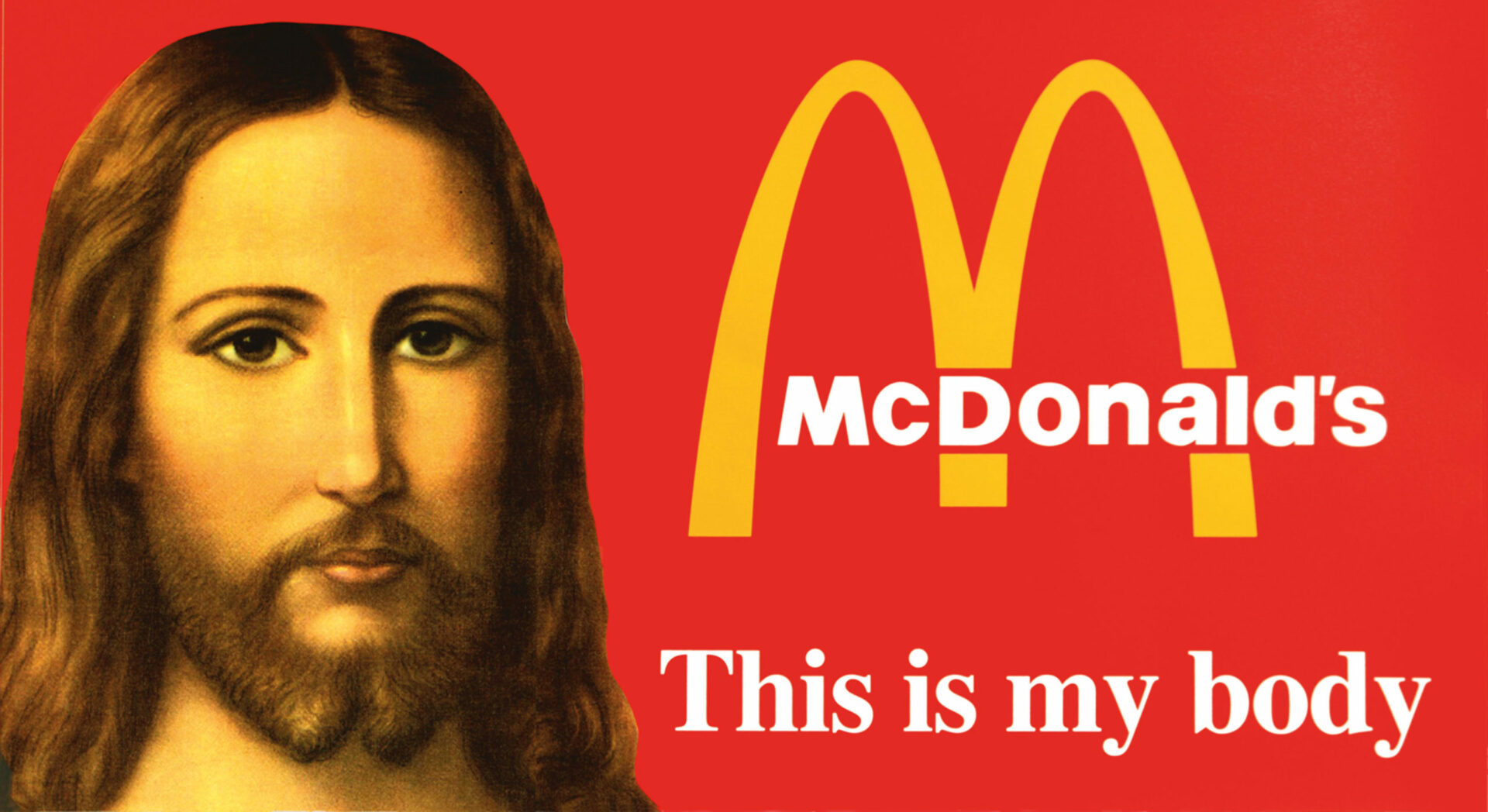
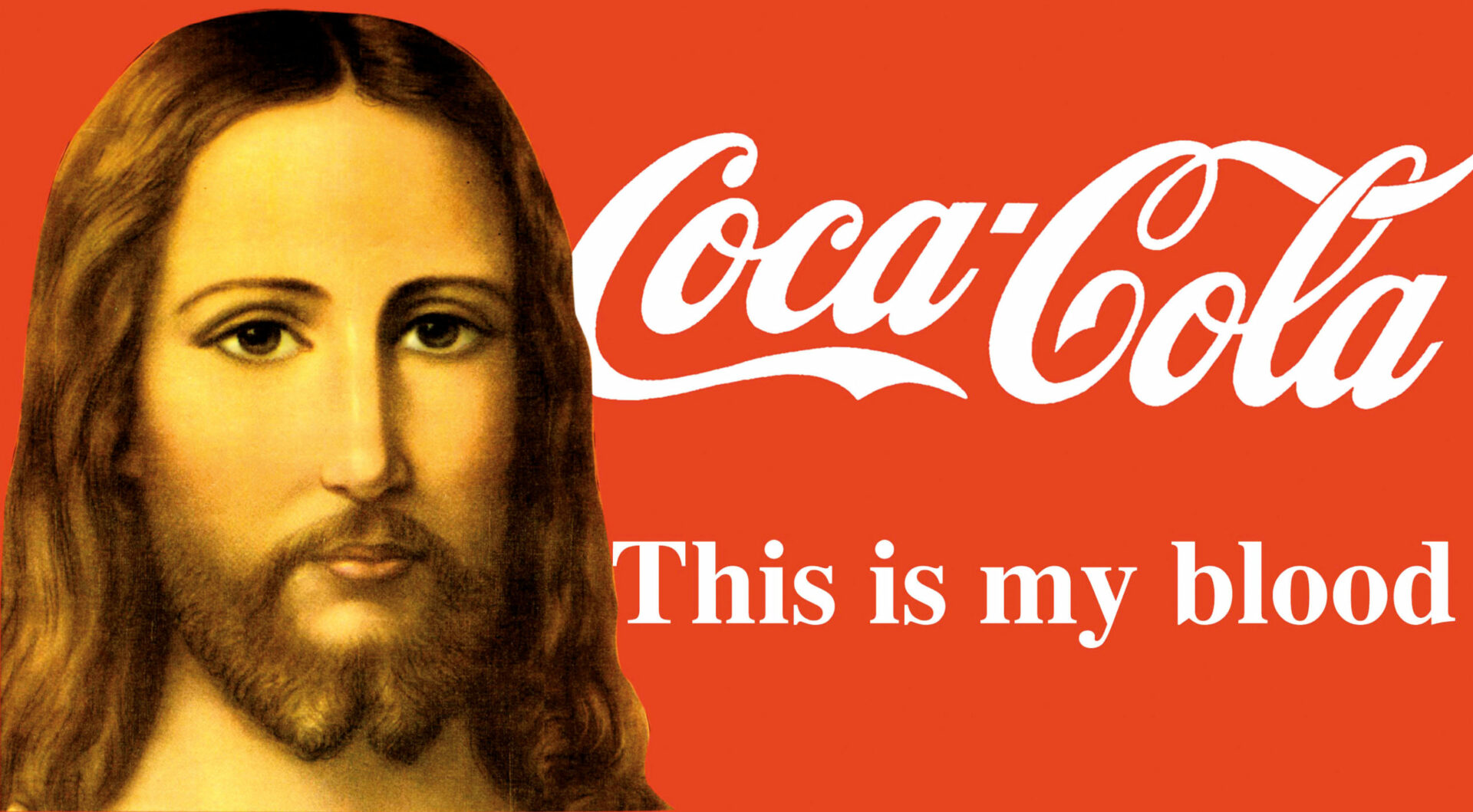
This is my body, This is my blood, 2002.
© Alexander Kosolapov / SODRAC (2014)
Photos: courtesy of the artist
Religion, on the contrary, does not seek to overcome non-knowledge. Instead, it perceives non-knowledge as the ultimate, unsurpassable horizon of human existence. Indeed, there can be no knowledge of God and His will. God exceeds any rationality because He is sovereign and does not need to explain or to justify His acts and decisions (Book of Job.) This divine sovereign free will undermines all the certainties, evidences, and convictions of reason. Therefore, only the religious subject is truly skeptical — he does not believe even in direct evidence, and he does not submit it to the power of a better argument. For a religious subject the face of the world is not the surface of an object that should be scientifically investigated, but an interface — a surface behind which divine subjectivity is hidden. The relationship of the religious subject with God is the same as the relationship of a spectator with an artist. One likes an artwork precisely because one does not understand it. A leap of faith functions in the same way as a decision of taste.
The difference between science and religion can therefore be described as the difference between production of truth and consumption of truth. This explains why the religious attitude has become so popular in contemporary society, which is, after all, predominantly a society of consumption. Today we are more in the position of Abraham than in the position of Plato. And indeed, today we are beyond the time when an individual was offered no truth at all, or a couple of publicly recognized truths and traditions, as in the time of Plato or the early Enlightenment. The contemporary subject is addressed, even attacked, from all directions by truths of every description. These truths are not simply waiting quietly somewhere to be found, to be discovered, to be engaged. Not at all. They are aggressive, they are pushy, they are busy advertising themselves — and they are often terrifying. They tell us that the earth is warming and we will all die together in the near future. And if not together, then everybody will die alone from smoking, from cholesterol, from Islamist terrorism, or from other things. These and other truths are produced and distributed today by impersonal agencies and organizations.
The truths that demand our acceptance are mostly truths that are brought to us by the media — above all, today, by the Internet. The Internet has become the main source of our knowledge about the contemporary world and the main medium of communication with this world. At the same time, the Internet is not controlled by any public agency. Rather, it is a public space occupied by private interests and private, sovereign commitments. The information that is brought to us by the Internet is not a result of any rational public discussion. Each individual user has a completely sovereign right to put every personal opinion and any unchecked information on the Web, without being obliged to justify this information. Today, the Internet is the main vehicle by which the private invades the public space. Moreover, the Internet does not differentiate between religious or scientific truths. The same can be said about all contemporary mass media.
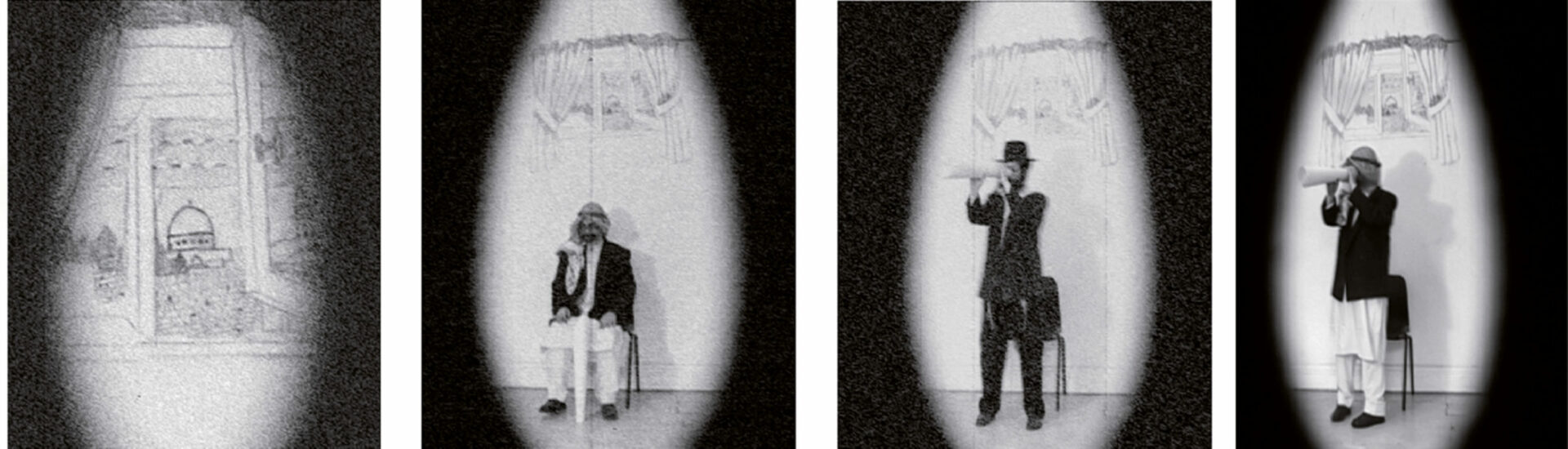
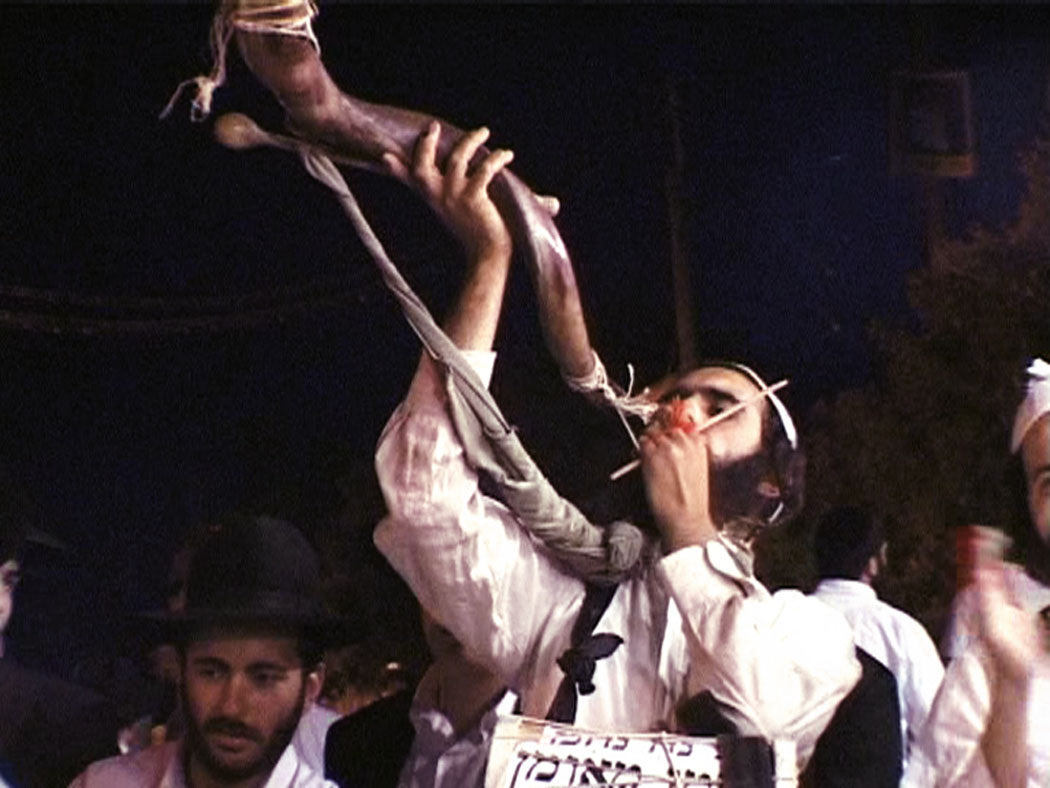
Oh Jerusalem, video stills, 2005.
Photos: courtesy of the artist
The new religious movements operate primarily through the Internet by means of digital, and not mechanical, reproduction. In recent decades, video has become the chosen medium of contemporary religious propaganda, and it is distributed through TV channels, the Internet, commercial video stores, and other means. This is especially so in the case of the most recent, most active, aggressive religious movements. Confession videos by suicide bombers, and many other kinds of video production reflecting the mentality of radical Islam, have become familiar. The new evangelical movements operate through the same medium of video. If one asks those responsible for public relations in these movements to provide information, one is initially sent a video. This use of video as the major medium of self-presentation among different religious movements is a relatively new phenomenon. The standard traditional media were once scripts, books, painted images, and sculptures. Islam is an especially good example here. It famously forbids the production of images of living persons — but it does not forbid their reproduction, the use of already-existing images. It (indirectly) forbids individual authorship of such images but de facto allows the practices of appropriation and the ready-made. It has become a banality to say that Islam is not modern — but it is obviously postmodern.
At this point, I would argue that contemporary religious movements’ use of video as the principal medium is intrinsic to these movements’ message. Nor is it extrinsic to the understanding of the religious, as such, that underlies this use. This is not to suggest, following Marshall McLuhan, that here the medium is the message; rather, I would argue, the message has become the medium — a certain religious message has become the digital code.
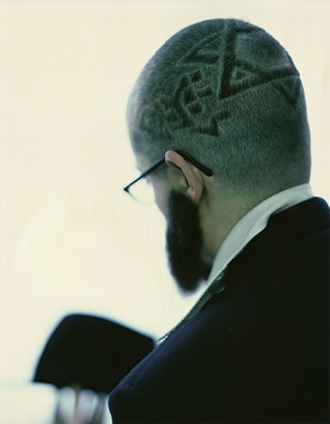
Self-portrait as Marcus Fisher II, 2000.
Photo: courtesy of the artist
Digital images have the propensity to be generated, multiplied, and distributed almost anonymously through the open fields of the contemporary means of communication. The origin of these messages is difficult, or even impossible, to locate, much like the origin of divine, religious messages. At the same time, digitization seems to guarantee a literal reproduction of a text or an image more effectively than any other known technique. Of course, it is not so much the digital image itself as the image file, the digital data, that remains identical through the process of its reproduction and distribution. However, the image file is not an image — an image file is invisible. The digital image is an effect of the visualization of the invisible image file, of the invisible digital data. Only the protagonists of the movie Matrix(1999) were able to see the image files, the digital code as such. The average spectator, however, does not have the magic pill that would allow him or her, like the protagonists of Matrix, to enter the invisible space otherwise concealed behind the digital image for the purpose of directly confronting the digital data. And such a spectator is not in command of the technique that would enable him or her to transfer the digital data directly into the brain and to experience them in the mode of pure, non-visualizable suffering as depicted by the protagonist of another movie, Johnny Mnemonic (1995). (Actually, pure suffering is, as we know, the most adequate experience of the invisible.) Digital data should be visualized, should become an image that can be seen. Here, we have a situation in which the perennial spirit – matter dichotomy is reinterpreted as a dichotomy between the digital file and its visualization, or between “immaterial” information and “material” image, including visible text. In more theological terms, the digital file functions as an angel — as an invisible messenger transmitting a divine command. But a human being remains external to this message, to this command, and thus is condemned to contemplate only its visual effects. We are confronted here with a transposition of a dichotomy between the divine and the human, from a metaphysical to a technical level — a transposition that, as Martin Heidegger would argue, is possible only by virtue of this dichotomy being implicitly technical from the outset.
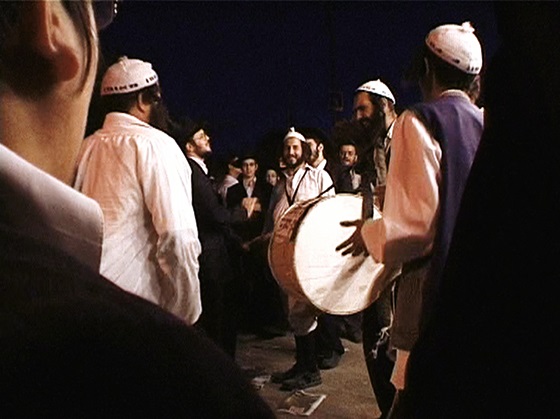

Dancing With Men, video stills, 2003.
Photos: courtesy of the artist

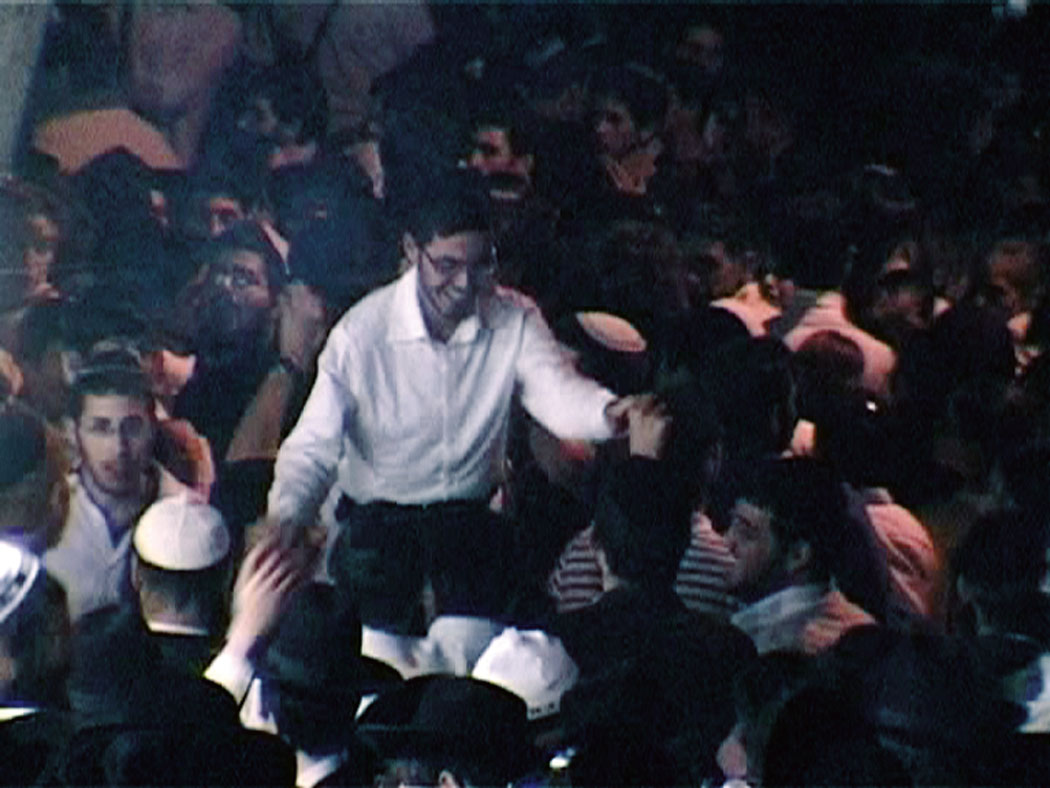
By extension, a digital image that can be seen cannot be merely exhibited or copied (as an analogue image) but always only staged or performed. Here, the image begins to function as a piece of music, whose score, as is generally known, is not identical to the piece of music — the score being not audible, but silent. For the music to resound, it has to be performed. One could argue that digitization turns visual arts into performing arts. To perform something, however, means to interpret it, betray it, distort it. Every performance is an interpretation, and every interpretation is a misuse. The situation is especially difficult in the case of the invisible original. If the original is visible it can be compared to a copy — so the copy can be corrected and the feeling of distortion reduced. But if the original is invisible no such comparison is possible, and any visualization remains uncertain in its relationship with the original; one could even say that every such performance itself becomes an original.
Moreover, today information technology is in a state of perpetual change — hardware, software, simply everything. For this reason alone, the image is transformed with each act of visualization that uses a different and new technology. Today we think of technology in terms of generations: we speak of computer generations, of generations of photographic and video equipment. But where generations are involved, so too are generational conflicts, Oedipal struggles. Anyone attempting to transfer old text or image files to new software experiences the power of the Oedipus complex over current technology — many data are destroyed, evaporate in the void. The biological metaphor says it all: it is not only life that is notorious in this respect, but technology as well; technology, supposedly opposing nature, has now become the medium of non-identical reproduction. Benjamin’s central assumption in his famous essay “The Work of Art in the Age of Mechanical Reproduction” (1936) — that an advanced technology can guarantee the material identity between original and copy — was not borne out by later technological developments. Real technological development went in the opposite direction, toward diversification of the conditions under which a copy is produced and distributed and, accordingly, diversification of the resulting visual images. And even if technology were to guarantee the visual identity between the different visualizations of the same data, those data would still remain non-identical due to the changing social contexts of their appearances.
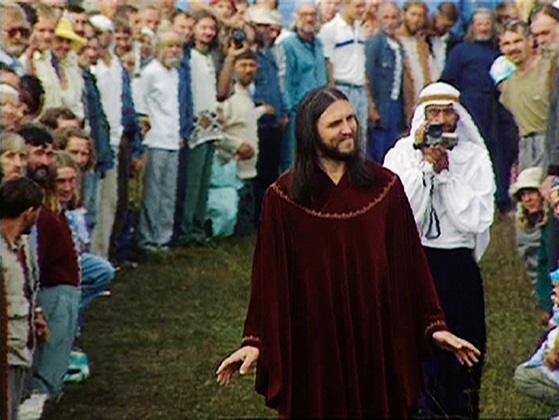
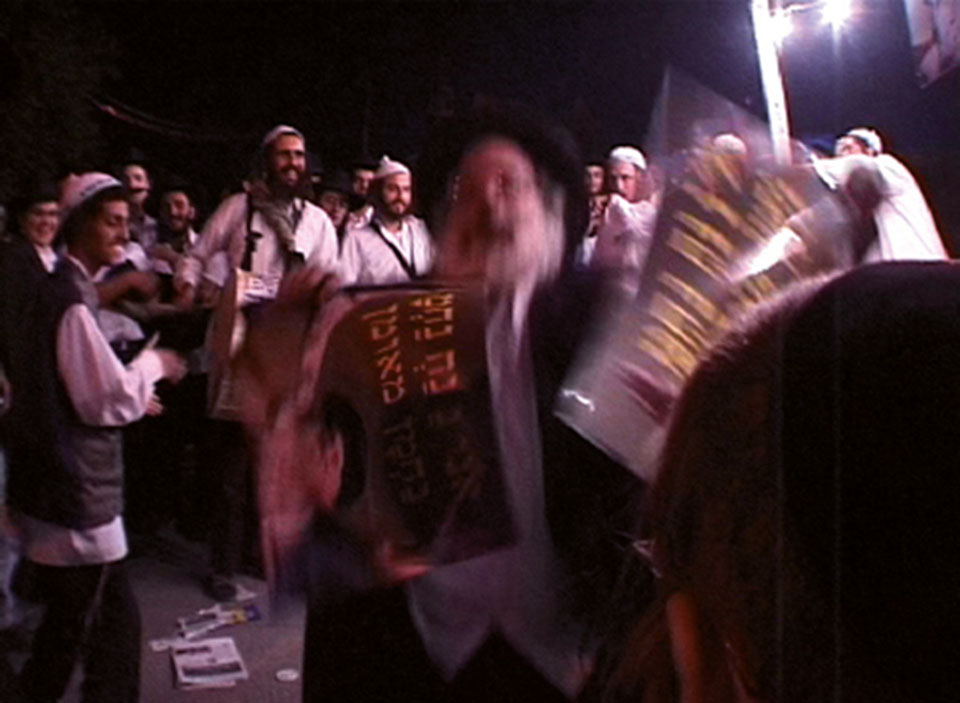
Dancing With Men, video stills, 2006.
Photos: courtesy of the artist
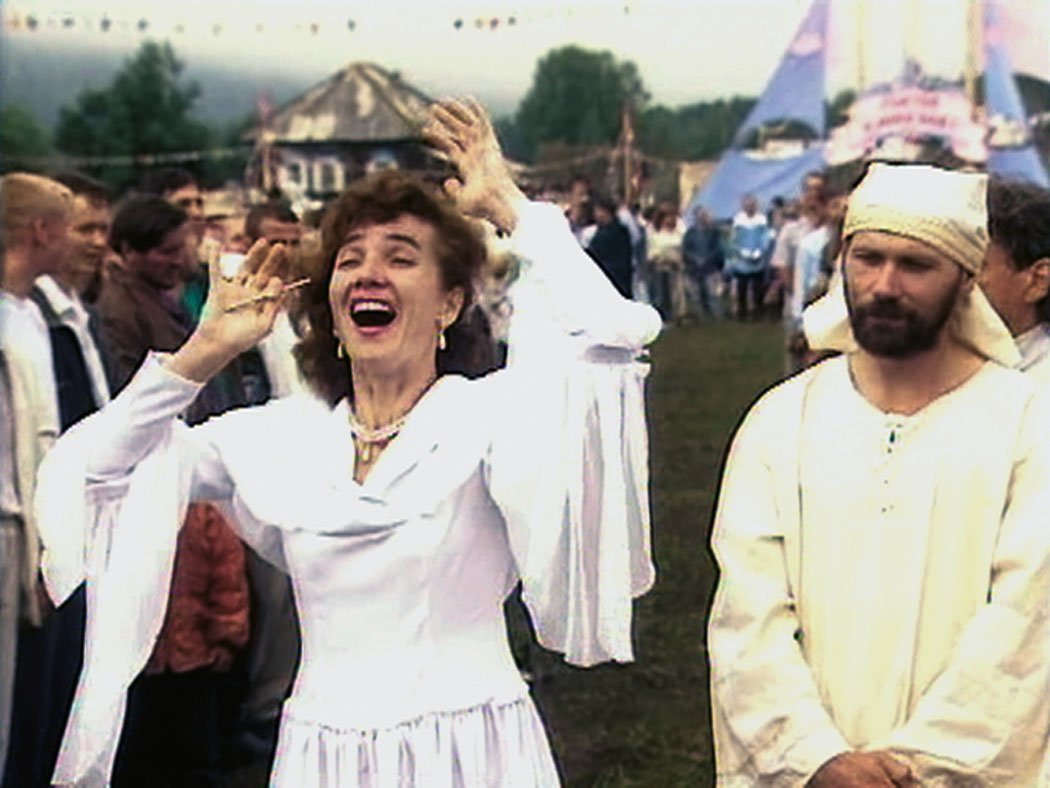
The act of visualizing invisible digital data is thus analogous to the appearance of the invisible inside the topography of the visible world (biblically speaking, signs and wonders) that generates religious rituals. In this respect, the digital image functions like a Byzantine icon — as a visible representation of invisible digital data. The digital code seems to guarantee the identity of different images that function as visualizations of this code. The identity is established here not at the level of spirit, essence, or meaning but on the material and technical level. Thus, it is in this way that the promise of literal repetition seems to acquire a solid foundation; the digital file, after all, is supposed to be something more material and tangible than an invisible God. However, the digital file does remain invisible, hidden. What this signifies is that its self-identity remains a matter of faith. Indeed, we are compelled to believe that each act of visualization of certain digital data amounts to a revelation of the same data, much as we obliged to believe that every performance of a certain religious ritual refers to the same invisible God. And this means that opinion about what is identical and what is different, or what is original and what is a copy, is an act of belief, an effect of a sovereign decision that cannot be fully justified empirically or logically.
Digital video replaces the spiritual guarantees of immortality allegedly waiting for us beyond this world with the technical guarantees of potentially eternal repetition inside this world — a repetition that becomes a form of immortality because of its ability to interrupt the flow of historical time. It is this new prospect of materialist, technically guaranteed immortality that the new religious movements de facto offer their followers, beyond the metaphysical uncertainties of their theological past. Placing human actions in loop, both practices — ritual and video — realize the Nietzschean promise of a new immortality: the eternal return of the same. However, this new technical guarantee remains a matter of belief and sovereign decision. To recognize two different images as copies of the same image or as visualizations of the same digital file means to value immortality over originality. To recognize them as different means to prefer originality in time to the prospect of immortality. Both decisions are necessarily sovereign — and both are acts of faith.