Mehdi-Georges Lahlou

With his French-Moroccan dual citizenship, and with a Muslim father and a Catholic mother, Mehdi-Georges Lahlou easily crosses lines in multicultural societies. In both his performances and his visual works, he challenges specific aesthetics, especially those associated with Islam, and addresses broader questions, such as identity — religious, cultural, and sexual.
“The representation of symbols linked to Muslim religious practice is very problematic today, even though images, especially advertising images, are now fairly well assimilated in countries such as Morocco. It is taboo to use or appropriate the religious aesthetic. This is one of the reasons my work may be misunderstood and seen as scandalous. Indeed, appropriation, association, representation, parody, and other uses of the symbols of Islam form a central issue in my work. There are practically no studies of this type in Muslim countries. Given this lack, my work questions whether there is a need to establish such research in these cultures. If the answer is yes, are Western theories, instituted generally by feminists, adequate? Let’s not forget that homosexuality and other ‘deviant’ sexualities are banned and repressed in most Muslim societies and under their ideologies. Social sexuality is the most dangerous subject in new contemporary Islamic societies.” Excerpt of an interview with Frédéric Herbin, available online at academia.edu/9623423/Entretien_avec_Mehdi-Georges_Lahlou.
[Translated from the French by Käthe Roth]
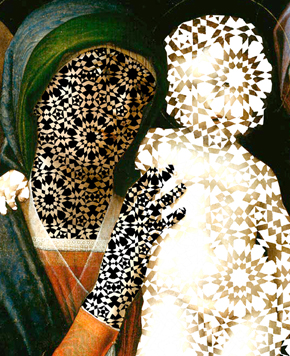
It’s more sexy ou vierge à l’enfant 8, détail | detail 18, 2010.
Photo : © mehdi-georges lahlou, permission de | courtesy of Galerie dix9 Hélène Lacharmoise, Paris
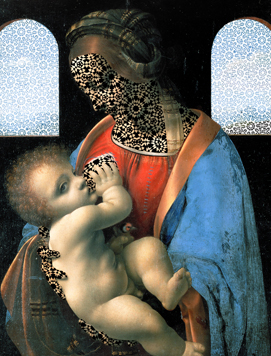
It’s more sexy ou vierge à l’enfant 8, détail | detail 18, 2010.
Photo : © mehdi-georges lahlou, permission de | courtesy of Galerie dix9 Hélène Lacharmoise, Paris
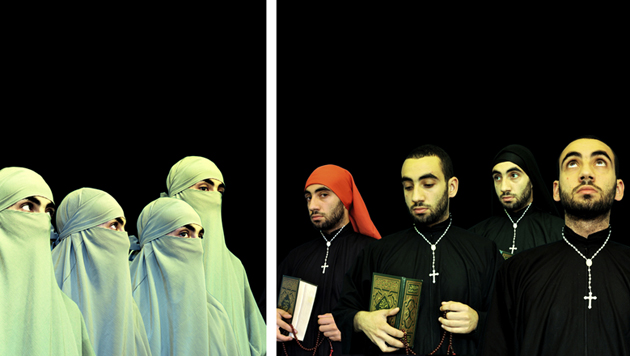
The meeting, détail | detail, 2010.
Photo : © mehdi-georges lahlou, permission de | courtesy of Galerie dix9 Hélène Lacharmoise, Paris
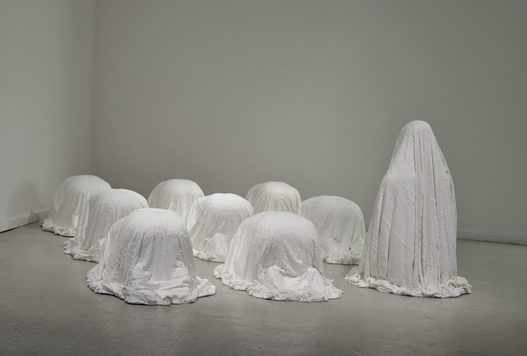
Sâlat ou autoportrait dirigé, 2011-2012.
Photo : © Mehdi-Georges Lahlou, permission de | courtesy of Galerie Dix9 Hélène Lacharmoise, Paris
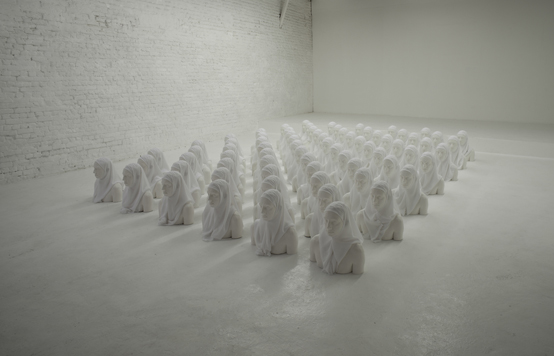
72 vierges, 2012.
Photo : © Mehdi-Georges Lahlou, permission de | courtesy of Galerie Dix9 Hélène Lacharmoise, Paris


