
Photo : MCH Messe Schweiz (Basel) AG, © Tadashi Kawamata
On June 14, 2013, Swiss police used tear gas and rubber bullets to disperse demonstrators occupying Favela Café and, in doing so, (involuntarily) made visible some of the tensions inherent in an aesthetic of precarious construction. Favela Café is a grouping of eighteen huts interconnected by footbridges; a hamlet that seems to have been cobbled together from planks and rusted scrap metal, it acts as a café and public patio. It is also a work by Tadashi Kawamata and is representative of the forms that the Japanese artist has developed all over the world for more than twenty years. Kawamata’s interventions, most often made with low-grade materials or those salvaged on site — the assemblage of raw, screwed-together planks has practically become a signature — are articulated in the sites they occupy and contribute to their transformation and redefinition. They divert and reconfigure existing architectures: the work is thus simultaneously a commentary, a transformation, and a re-creation of the site. In this sense, rather than being an autonomous and independent construction, Kawamata’s work is allied with a form of renovation or critical reactivation of spatial configurations from which it cannot be separated.
Favela Café was commissioned by the organizing committee of Art Basel, probably the largest commercial contemporary art fair in the world, and stood before the entrance to the building in which the event was held. Ostensibly, it was immediately obvious that the materials used, all salvaged from Basel’s port, were determined not by economic necessity but by aesthetic choice; before becoming a recreational space, Kawamata’s work is determined by its status as an artwork. Thus, Favela Café does not pretend to be a real café in a favela, but is an image — a symbolic form that, like any symbolic production or artwork, is ambiguous by definition. Although Kawamata’s explicit position is clear, it does not suppress this ambiguity; it is the principle of construction that interests the artist — the materials, scale, organization, processes — and not the clichés of the poor habitat. Favela Café is not meant, therefore, to be a complacent illustration of the world’s misery, but it risks being (mis)taken for one because it is situated at the crossroads of various significant markers. It is simultaneously utilitarian, formal, and symbolic, and is positioned more or less explicitly in relation to the interests of its sponsor (Art Basel). This tension is not, in truth, specific to Favela Café; it is a constant throughout the sphere of art. Here, however, it was made particularly visible by the protesters’ occupation of the work and the brutality of the police intervention that followed. The real issue lies in the use — and control — of the space. Although it was freely accessible to the public, and was presented as a public artwork, Favela Café was private property. The work was built on public space, but that space was privatized temporarily for the fair. The authorization of private installations on a portion of public land in exchange for a fee is a common practice. Free access to the work, despite appearances, was not therefore a given right; it was at the discretion of the tenant — in this case, Art Basel. This was what provided the legal basis for the evacuation of the space: trespassing on private property (and disturbing the peace).
Legally, the status of the spaces on which Brazilian favelas are constructed is far from secure. They are generally seen as public lands occupied illegally, but the reality is far more complex because such a view does not take into account basic rights acquired by use. The favelas follow no pre-established plans; they are the sum of specific responses to particular problems. One can see an architectural intelligence and an extraordinary social structure in the favelas, and it is undoubtedly to this that the title of Kawamata’s work refers, though the artist intervenes in vastly different circumstances. He is obliged (and has the means) to obey the many regulations governing Swiss construction, which presupposes meticulous planning of the project. Taking inspiration from the ingeniousness and know-how at work in the favelas is one thing, but it can be materially translated in Switzerland only by relying on qualified expertise. This means pre-empting unsigned works, cleaning them up, and reintegrating them into the financial and symbolic markets in assimilable form — in this case, via the intermediary of art.
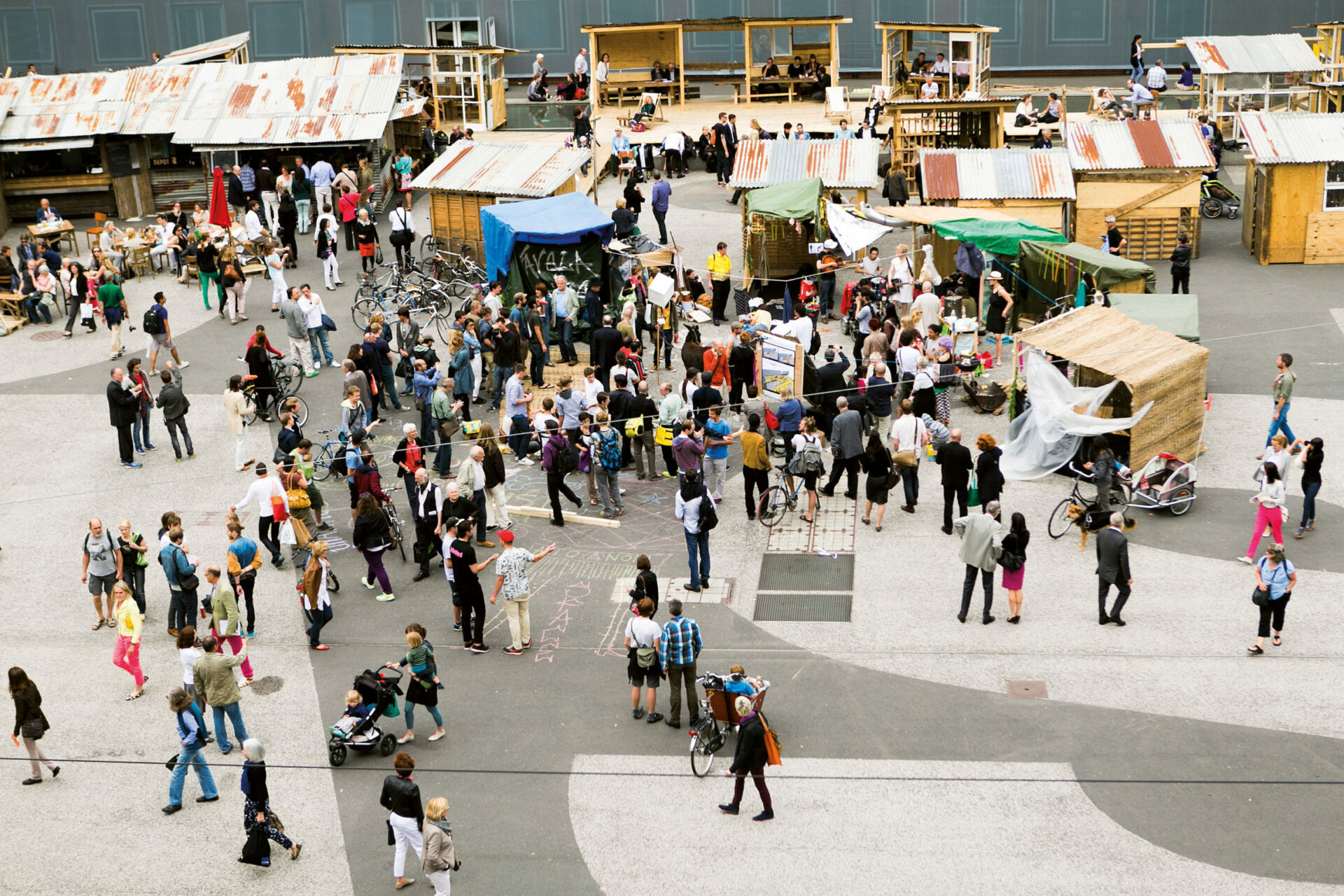
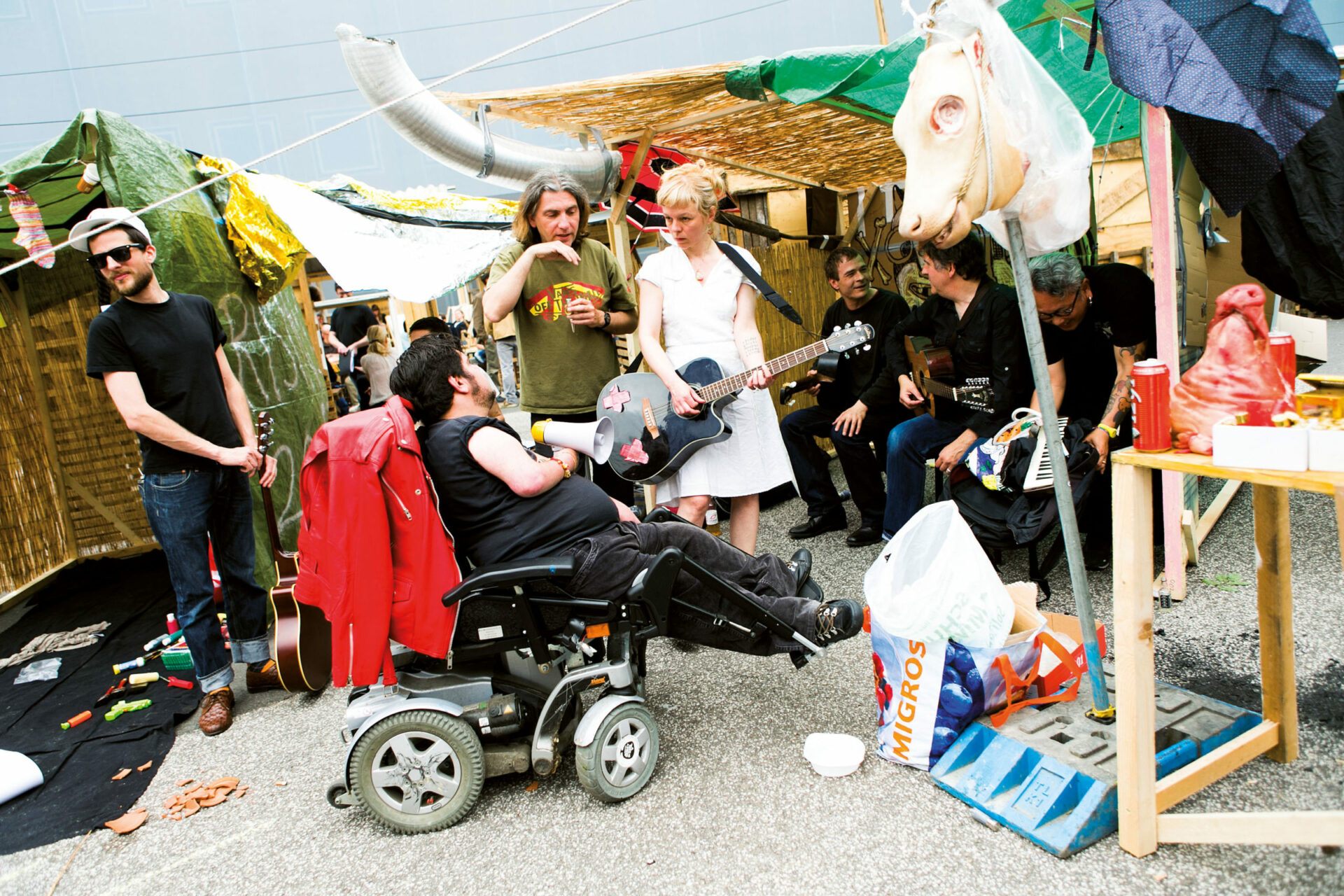
Favela Café, Art Basel, 2013.
Photo : © Stefan Bohrer
This seems to both summarize and support another process, a real-life one this time. Preparing to welcome both the soccer World Cup (2014) and the Olympic Games (2016), Rio de Janeiro has launched new programs to rehabilitate the favelas. On the one hand, infrastructures are being built and habitats are being cleaned up and renovated, but, on the other, inhabitants are being displaced because their lodgings are seen as dangerous and room must be made for new facilities. The improvement of these urban spaces may also increase their real estate value and begin a process of replacing one population with another, one with more financial means. For some, renovation thus becomes eviction.
Under such conditions — and we know that an event as well-covered by the media as Art Basel acts as an echo chamber, amplifying all visible signs — the installation Favela Café could become an exotic attraction, complacent if not complicit, and denounced by protesters. A putative disinterest on the part of an artist who frequently has difficulty reconciling his artistic intransigence with the inevitable concessions required by financial valuation is not a very original problem. Here, however, it is underlined by the juxtaposition of references and connotations that are, in principle, irreconcilable. On the one hand, the used, recycled materials and the word “favela” call to mind the idea of poverty; on the other, the work is invested with the prestige of art and the economic power of its sponsor. Moreover, the word “favela” is not cloaked with the same connotations as are the names of other violent shantytowns: it is also Brazil, samba, festival, and so on. Seen this way, Favela Café can be read as a recreational transposition of poverty for the use of the wealthy, or, in other words, as a form of aestheticizing tourism. The work is thus politically uncomfortable. Its use as a café, in a context of densely circulating capital, conflicts with the image of poverty that its materials seem to reflect, and these mutually exclusive signs are even more violently magnified when their confrontation takes place in public space.
For Kawamata, the process of constructing and constituting communities prevails, and in his work this becomes a kind of subtle analysis, transformation, and subversion of existing topographies. Necessarily, there is complicity between his work and the favelas. Kawamata recognizes this resemblance, but also insists on the differences: his concerns arise from artistic experimentation and make no claim to be a city planning solution. But there is a resonance. When Kawamata creates Field Works, he constructs roughly geometric volumes in the street. His precarious assemblages of cardboard and various other materials found onsite are neither shelters for the homeless nor minimalist sculptures, but a deliberately problematic confrontation of the two references in urban space. Nevertheless, Favela Café works somewhat differently. Its reintegration within an arts context, and within the economic circuit of the art market, is much more visible. And as the economy of art is — precisely — tied to the visible, Favela Café becomes the co-opted sign of a market that is, nowadays, one of the most accomplished forms of truly unregulated financial capitalism. It is this idea that actually underlies Art Basel’s commission: it is not a work destined for sale (it will be donated and become a café associated with Basel’s port, taking on a real social function), but an investment in symbolic capital. Funding from a market institution for a work that is semi-unsellable is a way of drawing attention to the fact that the stream of capital pulled in by Art Basel can also (partially, but spectacularly) be reinjected into artistic, cultural, and social practices that are not profitable. Thanks to patronage, the market is presented as an element supporting the common good — and one recognizes here the classic demonstration of the market economy as a necessary condition for art and democracy.
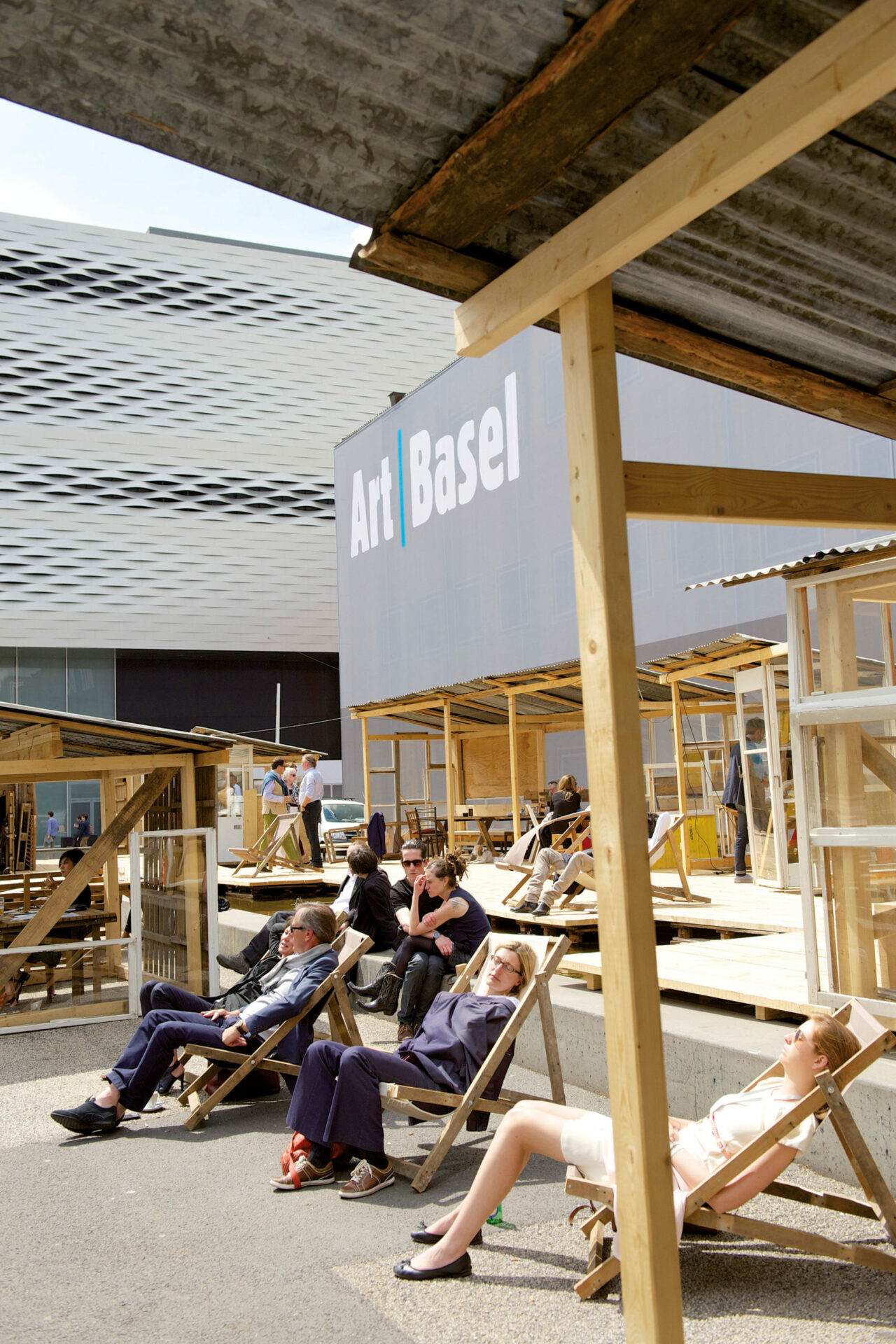
Favela Café, Art Basel, 2013.
Photo : MCH Messe Schweiz (Basel) AG, © Tadashi Kawamata
Favela Café — or, rather, Art Basel via Favela Café — has therefore been reproached for the cynical practice of financially and symbolically valorizing an aesthetic of poor materials, consequently reducing misery to spectacle, with all the attendant implications of simulacrum and denial. The aesthetic of poor construction is now a particularly effective diversion for hiding the very social injustices that are the source of its vocabulary. “Respect favelas,” asserted the demonstrators. Was this meant to suggest that the representation of a favela — necessarily miserable — was morally obscene if it was not sufficiently charged with pathos to leave no ambiguity in terms of moral judgment? In light of the form taken for the occupation of the site, it is unlikely that this is what the demonstrators meant. Having begun with an (authorized) public debate, the demonstration became a party with an (unauthorized) sound track. When the police charged, the hundred or so participants present were dancing, as if the demonstrators had taken the invitation to conviviality implied by Favela Café very seriously — while disconnecting it completely from the figure of expert authority and economic power that Art Basel represents. It is not so much the work that is contested, but the circuit that produced it with such intentions. And these presumed intentions change in response not to uses but to users: by replacing complicit tourists with alternative tourists, or champagne with beer. Presented this way, it seems ridiculous, but one must never forget that such displacement takes place in a regime of signs. From this point of view, it is well and truly an expropriation — which is never insignificant because it tests the legitimacy of economic and artistic institutions founded on property.
This questioning is necessary. The art system has long had the capacity to aestheticize just about anything (and the habit of doing so) – but this aestheticization has also become more and more ambivalent. It acts as valorization or subversion, even recuperation and neutralization, depending on circumstance and political intent. All these configurations exist in the case of Favela Café. However, one of the strengths of Kawamata’s work is its ability to negotiate its insertion into the experience of the site and bring to light tensions and relations of power that are normally invisible. The process of material construction is possible only if it is also a process of social construction in the real world, not merely the art world. For Kawamata, this presupposes deciding that a work is completed and to cede control of it. But to whom? At that moment, a negotiation or struggle begins to determine which body will make use of the work and give it meaning. If the process of constructing a village of huts must — as it does in a real favela — lead to the constitution of a community, the debate becomes political and the excuse of art no longer suffices. When one loses control, consensus becomes fragile, and the politically and economically uncomfortable aspects of art in general (which one prefers not to raise, even — and especially — when affirming an ethical position) enter the spotlight. And investors and experts — at the epicentre of the art world, where the power is and where there is no real place for artists — get nervous. So they assert their (private) property rights and the authoritarian reflexes that go with them, and send the police to turn off the lights. The party’s over.
Translated from the French by Peter Dubé


