
Photo : © Ion Grigorescu, courtesy of Galerija Gregor Podnar, Berlin / Ljubljana
Addressing the particular historical and geopolitical context of central Eastern Europe over the late- and post-socialist period, a short film made by Romanian artist Ion Grigorescu in 1978 was remade nearly thirty years later under different circumstances. The examination of the two works — the first produced while Romania was under the Communist leadership of Nicolae Ceaușescu, the second after Communism — gives rise to numerous considerations that cross the technical and conceptual aspects of re-enactment with Romania’s recent history.
An important figure of the Romanian art scene of the 1970s and 80s, Ion Grigorescu (b. 1945) has, since his beginnings in the late 1960s, subtly reflected in his work some aspects of private and collective life under state socialism, as well as the social and urban changes that characterized Ceaușescu’s regime and its aftermaths. The museographic and curatorial narratives that have recently incorporated his work have mostly highlighted his body experiments on the one hand and, on the other, works pointing to the omnipresence of politics in daily life. This focus shadowed other remarkable aspects of Grigorescu’s multifaceted production rich in religious and literary references related to the development of spirituality and psychic life.
The fall of the Communist system in the Soviet Union and Eastern Europe fostered a large range of readings, of which many adopted the “end of history” teleological perspective. The radical division between “before” and “after” sustained the idea that the experience of life under state socialism was definitely remote, without any possibility of return. Whether such a breach was real or not, it is certain that artists in former Communist states had to face the disintegration of a system that had influenced their work, whether as a positive or negative blueprint. The end of the Cold War introduced a radically distinct regime of exposure and interpretation for cultural production.
How then should we consider, the reiteration or re-enactment of something that cannot return, or at least not under the same circumstances? Does the re-enactment of a gesture, a product, or a situation necessarily require prior knowledge, and if so, what kind of knowledge? Is it the witness’s direct experience, or knowledge mediated by photographs, videos, written memories, testimonials? It is also important to distinguish a re-enactment performed by the same author, as in the case of Grigorescu, and the re-appropriation of an artistic production by a third person or group. In either case, can re-enactment be evaluated through criteria of accuracy and truthfulness?
While these questions formulate possible lines of inquiry, I would nevertheless suggest that the idea of a “right” way to recreate an artistic action is problematic, especially when it contributes to over-heroicizing the figure of the “original” author.1 1 - Concerning the rise of solo performance and its relation to capitalist neoliberal politics, see the last chapter of Bojana Cvejić and Ana Vujanović’s book Public Sphere by Performance (Berlin: b_books, in collaboration with Les Laboratoires d’Aubervilliers, 2013). In other cases, the success of re-enactment appears as a symptom of the homogenizing path imposed by numerous educational art structures. Re-enactments of referential actions drawn from recent art history — especially the neo-avant-gardes of the 1960s and 70s — often occur as an inevitable part of art training, the equivalent of copying great masters in traditional fine arts academies.
Despite these reserves, re-enactment is an interesting method of displacement and re-socialization of past experiences, and also an arena where individual and collective histories can intersect. Any attempt to reflect on these practices in relation to post-Socialist Eastern Europe should take account of the sense of disappearance, loss, and even death which underlie them. I am not arguing here in favour of a compassionate or condescending reading, but rather for a greater acknowledgement and exploration of the cathartic dimension of re-enactment, often expressed through theatrical forms and manifestations of bodies and voices. As the following example seeks to illustrate, re-enactment has a central role in the elaboration of social and individual memory and its use in the present.
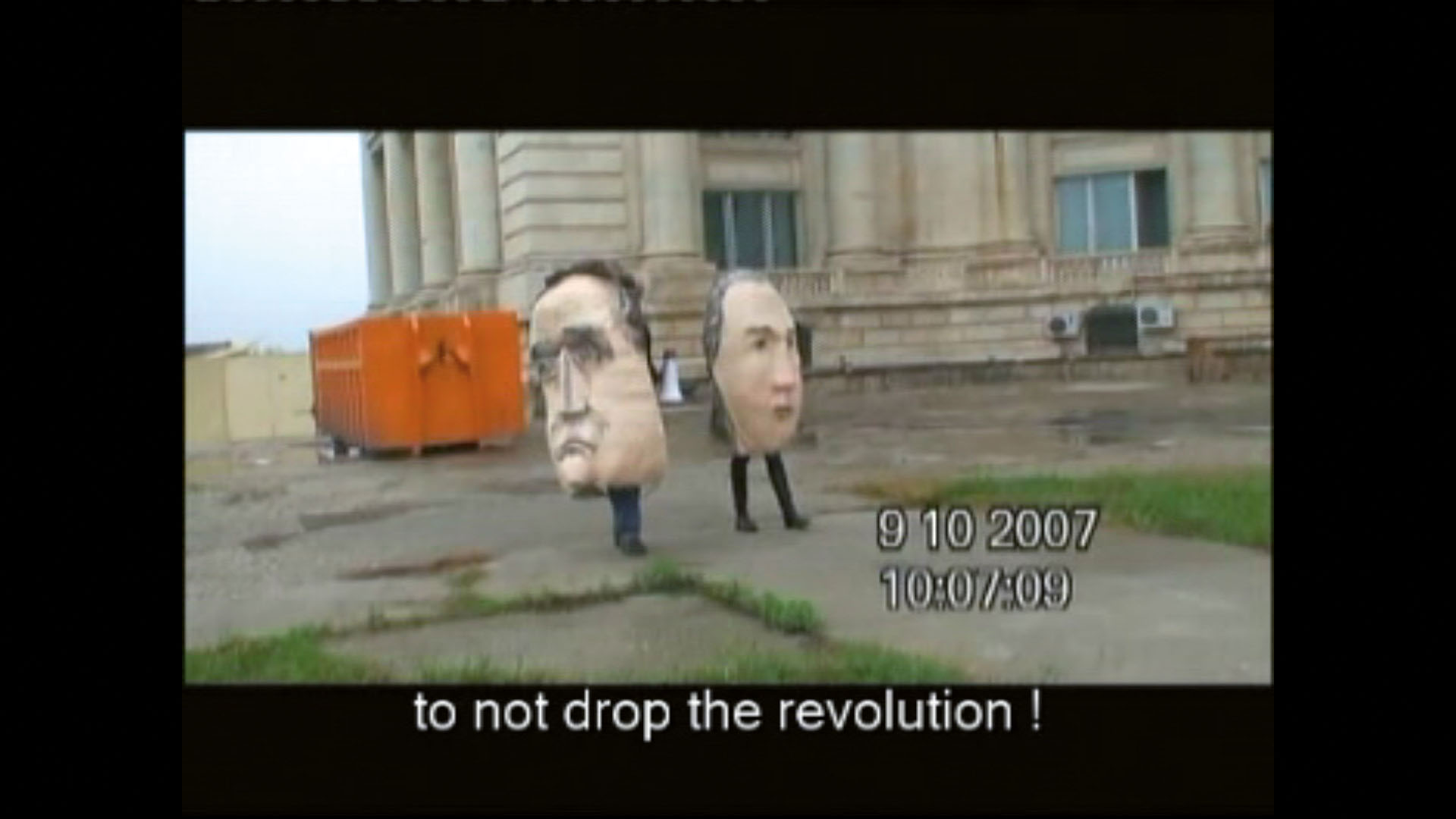
Photo : © Ion Grigorescu, courtesy of Galerija Gregor Podnar, Berlin / Ljubljana
In 1978, Ion Grigorescu realized Dialogue with Ceaușescu, an 8mm film staging a conversation with Ceaușescu, leader of the Romanian Communist Party since 1965 and head of one of the most repressive regimes in the Soviet bloc. The two characters in the film were embodied by the artist himself, thanks to the technical device of superimposition, also used by Grigorescu in other works such as the film Boxing (1977) and the photo series Self Superposed (1977) and Super-position (1979). While Ceaușescu is recognizable from the paper mask on his face, Grigorescu keeps his face uncovered. Both figures stand out against a dark background that highlights their faces and hands, their movements chanting a conversation between them. Their utterances are, however, inaudible; the film is completely deprived of sound, like a pantomime. These characteristics and their aesthetics were presumably dictated by the resources Grigorescu had at his disposal. To resolve the problem of sound, the dialogue is incorporated directly into the image, in the form of a white, compact script that moves upward. The scroll’s speed, as well as its occasional overlap with the faces of the characters, makes it difficult to decipher.
What is the dialogue about? Grigorescu criticizes Ceaușescu’s politics in a way no one in Romania was allowed to — or would even dare — do at that time. The artist does not show any kind of complaisance toward the leader while he denounces the catastrophic consequences of Ceaușescu’s experiments aimed at creating a “new man.” Grigorescu contrasts the dictator’s megalomaniacal will by outlining the dramatic living conditions imposed on Romanian society and the irreparable damage to the psychic conditions and well-being of its people. He doesn’t hesitate to compare Ceaușescu with a “great employer thirsty with speculation in a stock exchange in which [he is] the only investor,” projecting his actions onto the framework of the capitalist machinery.2 2 - Based on the English translation by Dana Chetrinescu Percec of Dialogue with Ceaușescu http://subversive.c3.hu/en/Ion % 20Grigorescu.php.
When Dialogue with Ceaușescu was made at the end of the seventies, Grigorescu’s attitude of accusation and his insistence on pointing to the regime’s obvious failings were nothing but the expression of a great fantasy, which had to be cautiously maintained out of the authorities’ sight. In such an autocratic and authoritarian regime, nobody was allowed to put himself on the same level as the leader, much less criticize his politics. From this perspective, Dialogue with Ceaușescu is a heretical piece, a criminal attack on the cult of Ceaușescu’s personality. Yet, at the same time, the omnipresence of his image in public and private spaces made him familiar to every citizen, as though he could have knocked at any family’s door and sat with them for dinner, debating life and politics.3 3 - See Jan Verwoert, “Life as it is lived. Art, ethics and the politics of sharing all of life’s aspects,” in Ion Grigorescu: In the Body of the Victim 1969 — 2008, ed. Marta Dziewanska (Warsaw: Museum of Modern Art in Warsaw, 2009), 45.
Among Grigorescu’s works, Dialogue with Ceaușescu is probably the most openly critical, for the direct, frontal interpellation it performs. Other productions were less ostentatious in pointing at the invisible hand of the state, like the photographs from the series Electoral Meeting (1975), pointing at the presence of secret agents in a state-organized propaganda meeting. Documenting social and family life, Snagov (1971) revealed the ambiguous limits of privacy, where even family games at a lake where the party members spend their holidays are construed as suspicious activities.
On the one hand, the dialogue between Grigorescu and Ceaușescu epitomizes the frustration facing an immutable system whose leader is deaf to critique and imposes an inexorable economic and social regression on Romanians in the name of a self-made ideology. The abstract concepts and virtues invoked by Ceaușescu — transformation, the Revolution, progress, the forces of production — contrast with Grigorescu’s arguments, relying on concrete examples of the intense privations suffered by the Romanian people. The artist extensively documented the transformation of rural and urban spaces and the growth of poverty in works such as City in Socialism (1974 — 1987), My beloved Bucharest (1977), and Balta Alba (1979), among others. On the other hand, the dialogue fulfils the dream of questioning the leader, holding him accountable for his actions. Regarding this aspect, Grigorescu later observed: “I did what they did at Ceaușescu’s trial: Why did you make people live in cold homes? Why didn’t you give them food? I told him he had destroyed the intelligentsia and he replied that as an artist I did not have a social foundation, I was up the tree, and the people connected with him, not with me.”4 4 - Ion Grigorescu, “A Child of Socialism,” Plural, no. 2 (1999): 72.
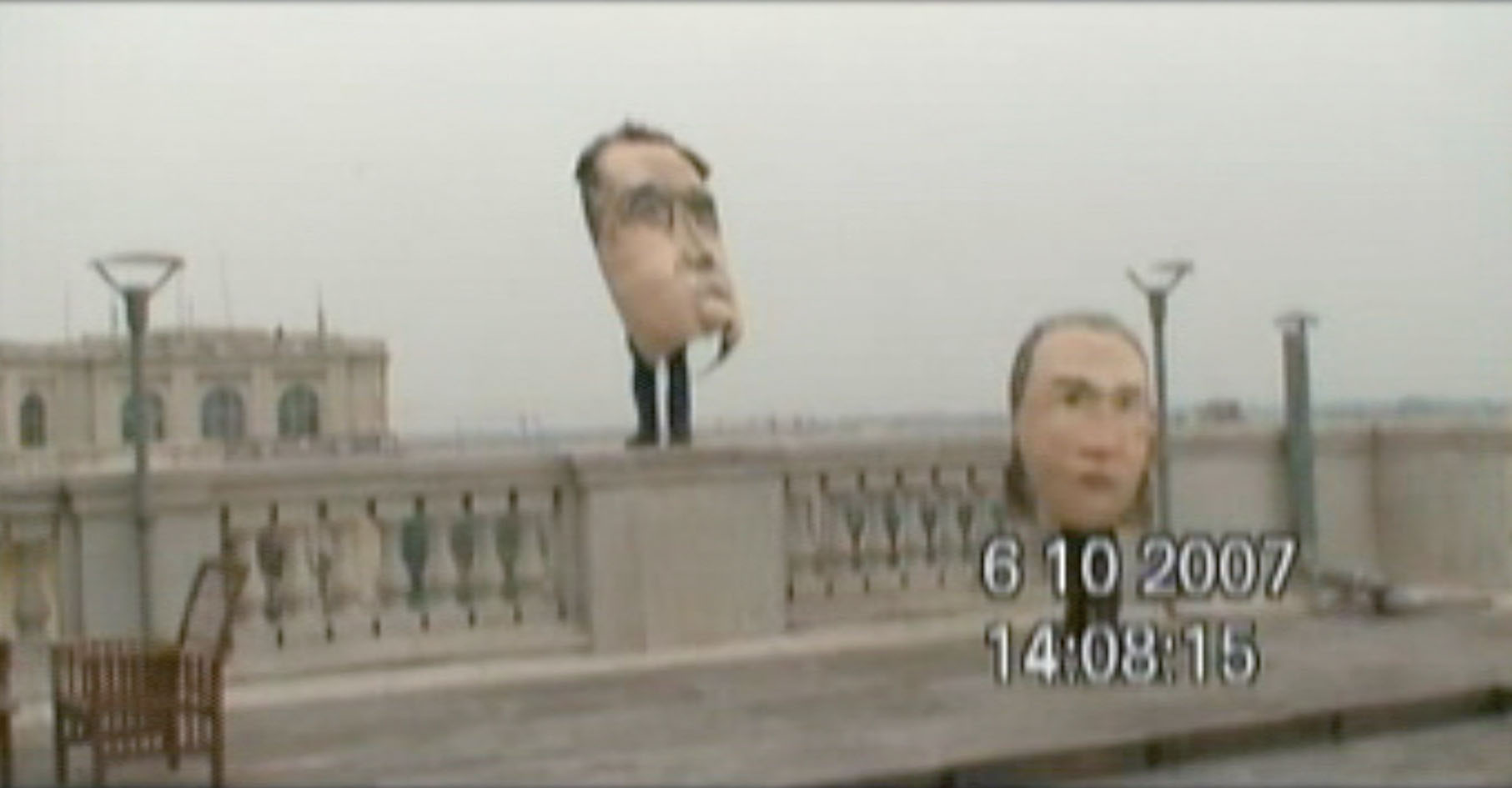
photo : © Ion Grigorescu courtesy of Galerija Gregor Podnar, Berlin / Ljubljana
The verbal contest exposed in Dialogue is unbalanced as it involves two discursive forms that will never meet: doctrinal and abstract on the one hand, and materialist and based on concrete facts on the other. Despite the reality of Grigorescu’s arguments — the catastrophic state of the country and the political and economic actions that led to it — his discourse collides with the dictator’s rhetoric of justification in an endless attempt to deliver the truth to a deaf but speaking machine. We could suggest that Ceaușescu’s deaf rhetoric is performed by Grigorescu as a living — yet mute — body. This articulation of “deaf speech” combined with a living body is particularly significant if we consider it in the light of the dialogue’s re-enactment, as realized in 2007.5 5 - On the use and meaning of voice under Fascist and Communist leaderships, see chapter 5, Mladen Dolar, A Voice and Nothing More (Cambridge, MA: MIT Press, 2006).
As its title specifies, Post-mortem dialogue with Ceaușescu takes place after the dictator’s death, which was concomitant with the fall of the regime in 1989. The protagonists of Post-mortem dialogue with Ceaușescu are, again, Grigorescu and Ceaușescu. This time they are embodied by two actors wearing large paper masks that cover almost their entire bodies. The figures slowly move in an external urban environment, which happens to be the roof, against the background of the colossal House of the People in Bucharest. The architecture appears in the urban landscape as a persistent and obscene record of Ceaușescu’s desire for grandeur and of his innumerable victims.
“I am speaking through art as a man who understood his last judgement,” starts Ceaușecu in the video. His voice resonates from a megaphone. The “last judgement” evoked here might refer to the hasty military trial, after which, on December 25, 1989, he and his wife, Elena, were executed. While watching Post-mortem dialogue with Ceaușescu and hearing the arguments through which Ceaușescu organizes his own defence, it is difficult not to think about the actual trial. The sequence of events that led to the death of the Ceaușescus is probably one of the most iconic scenes of the end of the Cold War. Recorded on video and later broadcast on television, it is still engraved in the collective memory of Romanians, together with the scene of the unexpected collapse of the leader, literally deprived of words and silenced by the crowd in his last public discourse, a few days before.
Whereas the first sentence pronounced by Ceaușescu in Grigorescu’s video seems to express repentance, the discourse that follows instead retroactively legitimizes his actions through two arguments. Firstly, as in the first Dialogue, Ceaușescu insists on his duty to impose “good” on the Romanian people against their will, since they were unable to become revolutionaries by themselves. Secondly, he compares his own leadership with the democratic regime that followed, arguing that the political change did not improve the country’s welfare but, on the contrary, cemented the same dynamics of corruption and oppression, the only difference being that they served capitalist purposes. Both regimes are, in his discourse, equal systems of opportunism and hyper-productivism that benefit a small oligarchy.
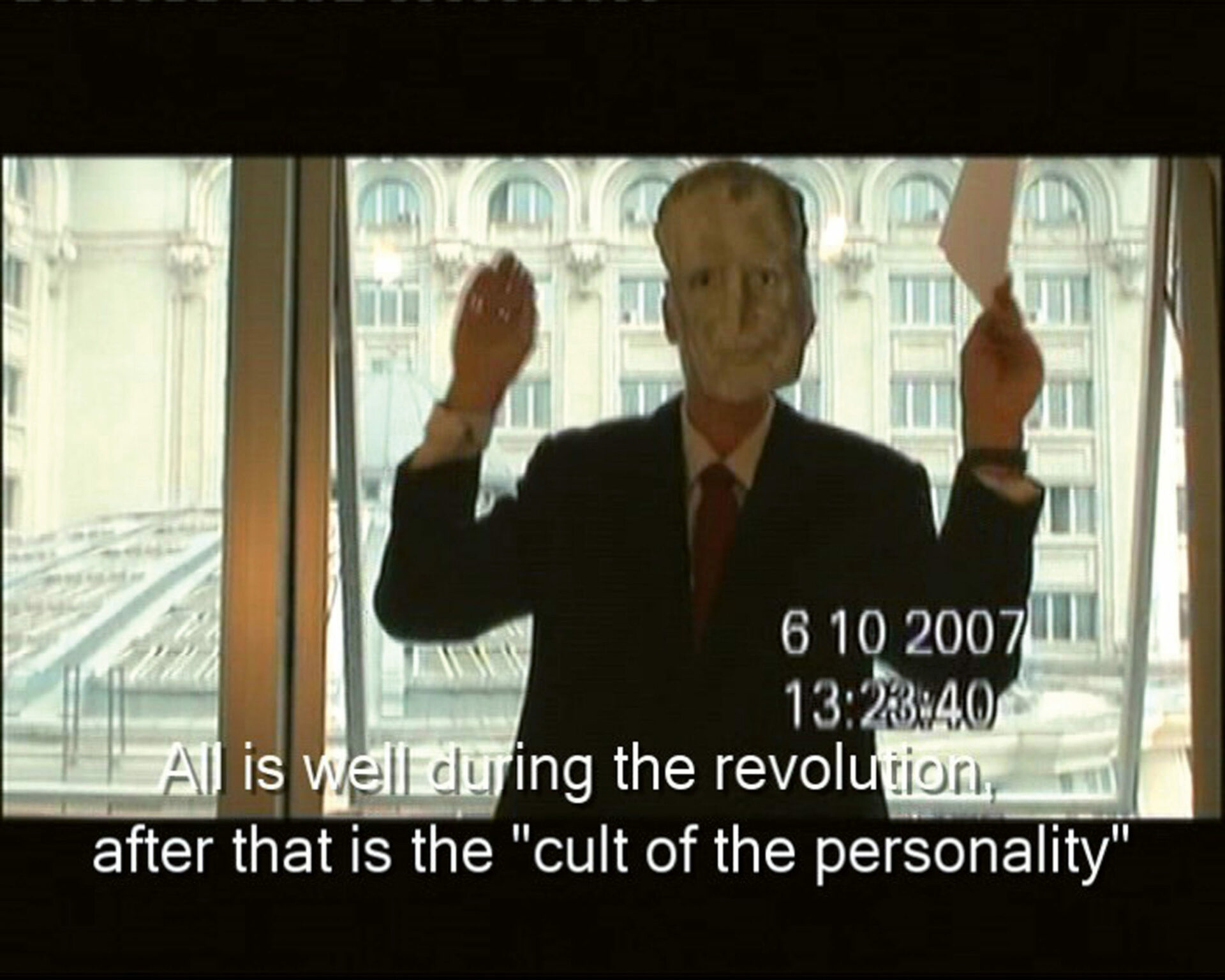
Photo : © Ion Grigorescu, courtesy of Galerija Gregor Podnar, Berlin / Ljubljana
In conclusion, what can be said about the two speeches and their relation to the systemic transformations? In both cases, the artist speaks in place of someone who has or had power, reproducing his discourse. While Grigorescu stands in for himself — as an artist, as a subject of a Communist dictatorship, and then of a democracy — and assumes his own ideas, the dictator inevitably appears as a deaf puppet, repeating his autistic, inconsistent discourse with neither remorse nor apology.
Between the first and the second dialogue, we witness a transformation from a living yet mute dictator into his speaking yet dead body. The symbolic appropriation and use of bodies for political projections has been a recurring practice in Communist and post-Communist periods. It appears urgent to ask what strategies of political legitimization are connected with those specific forms and the processes of mourning, oblivion, veneration, and monumentalization. In a social landscape in the process of reorganization, they are competing devices of historical (re)writing. Using this device and radicalizing it through post-mortem speech, Grigorescu points to the ghosts that still remain. Making the dead speak through another’s body, he exposes the persistence of past experiences and their cyclic reiteration.


