
“I’m an image that moves,” Jean-Luc Verna recently remarked in an interview about his stage performances with the musical group I Apologize1 1 - Interview with Pascal Marius and Pierre Ryngaert, published in the educational issue of the Centre Pompidou’s “Arts de la scène et art contemporain” (2013): http://mediation.centrepompidou.fr/education/ressources/ENS-artsdelascene-arts-contemporain/01-verna.html.. This self-definition, which could apply to many other artists, highlights the current dynamism of creative practices that blend the visual and performing arts, notably dance, which, for want of a better term, are sometimes referred to as “live art.” This term includes the work of artists like Jean-Luc Verna, primarily known for his drawings, who create live performances in exhibition spaces and on stage, or dancers who perform in museums and art schools, borrowing from the visual arts processes such as the lecture or the writing of action protocols. . . One also thinks of Jérôme Bel, whose video of the performance The Show Must Go On (2001) was screened in exhibitions;2 2 - For example, in the exhibition Danser sa vie, held at the Centre Pompidou, from November 23, 2011 to February 23, 2012. Xavier Leroy, who held a retrospective of his danced choreographies at exhibition venues;3 3 - Rétrospective, Fondation Antoni Tapiès, Barcelona, 2012. and particularly, Latifa Laâbissi, a self-described artist-choreographer,4 4 - Lecture at the École des beaux-arts de Nantes, 2009. whose work exemplifies the breaking down of disciplinary barriers. Her choreographies and performances, which lend themselves equally well to the dance stage, exhibition hall, or art milieu event,5 5 - For example, she recently participated in the exhibition Plus ou moins sorcières, at the Maison populaire de Montreuil in 2012, and in the conference Archive vivante. Théâtre, danse, performance, held in October 2012 at the Université Paris Diderot-Paris 7. See http://ufrlac.lac.univ-paris-diderot.fr/CERILAC_WEB/FR/PAGE_Event.awp? P1=16709]. draw on a wide range of elements beyond dance, specifically chosen for their ability to generate discourse and forcefully engage the audience. Laâbissi uses whatever she needs to draw the spectator’s attention to the heart of the issues she is exploring — from the skins of prehistoric creatures to the French flag, to accents parodying the songs of Pierre Perret. After training in the 1980s with Jean-Claude Galotta in Grenoble and at the Merce Cunningham Studio in New York, she soon distanced herself from the movements they represented, finding them too detached from reality. Instead, she focused on practices reflecting the socio-political issues of their time. In her works, racism, prejudice towards the Other’s culture, and the fear of a circulation of people and ideas are addressed in ways that actively promote the migration of all forms of expression. She is inspired by the concept of “lore” as defined by William T. Lhamon Jr.:6 6 - According to William T. Lhamon Jr., “Lore composes the basic gestures of all expressive behavior, from moans to narratives, signs to paintings, steps to dances,” in Raising Cain: Blackface Performance from Jim Crow to Hip Hop (Cambridge, Mass.: Harvard University Press, 2000), 69. As Jacques Rancière wrote in the preface to the French edition of Lhamon’s book, lore is “a matrix of knowledge, accounts and practices that are freely circulated,” in Peaux blanches, Masques noirs (Paris: L’Éclat, 2008), 8 (Own translation). “folklore” without the “folk”; in other words, the various components of minority cultures that circulate from one group to another.
Some of Laâbissi’s recent works are explicitly aligned with a conception of dance that breaks with academic tradition and is open to an exchange with other art forms. The diptych consisting of the choreography Écran somnambule (2009) and the performed lecture La part du rite (2012) are a dual tribute to German Expressionist dancer Mary Wigman (1886 – 1973), who, in a spirit similar to the visual artists of her era, sought to discover movements emanating from the depths of the body. Wigman was friends with painters Emil Nolde and Ludwig Kirchner, whom she invited to her shows and even to her rehearsals, so they could witness every minute detail of her approach. Her choreographies, which allowed the painters to discover just how far the body can be distorted when repressed impulses are allowed to surface, inspired spontaneous paintings. The dancer and artists were driven by the same concerns and participated in the same way in the global movement of Expressionism, which was already breaking down the boundaries among disciplines.
Photos : © Margot Videcoq
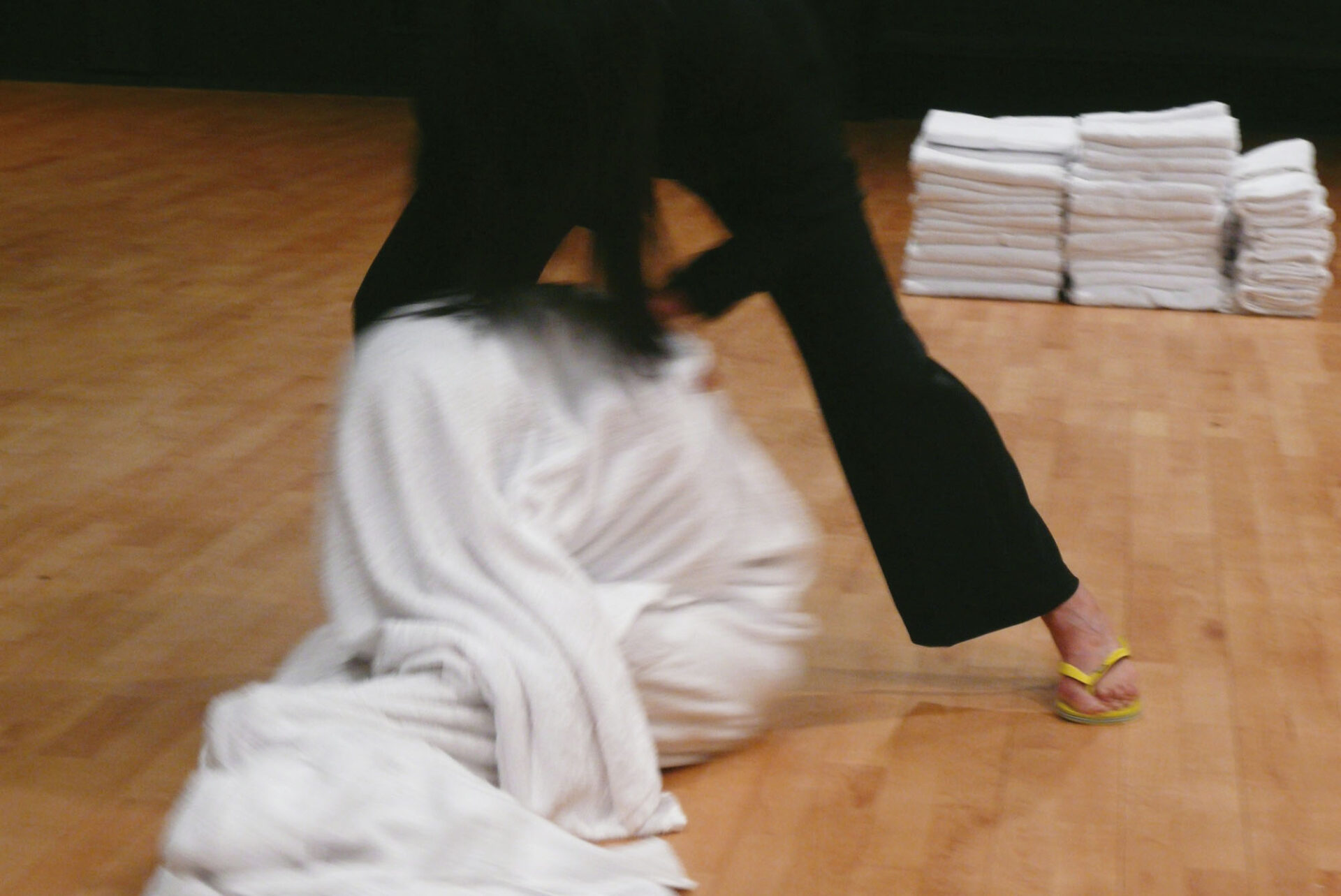
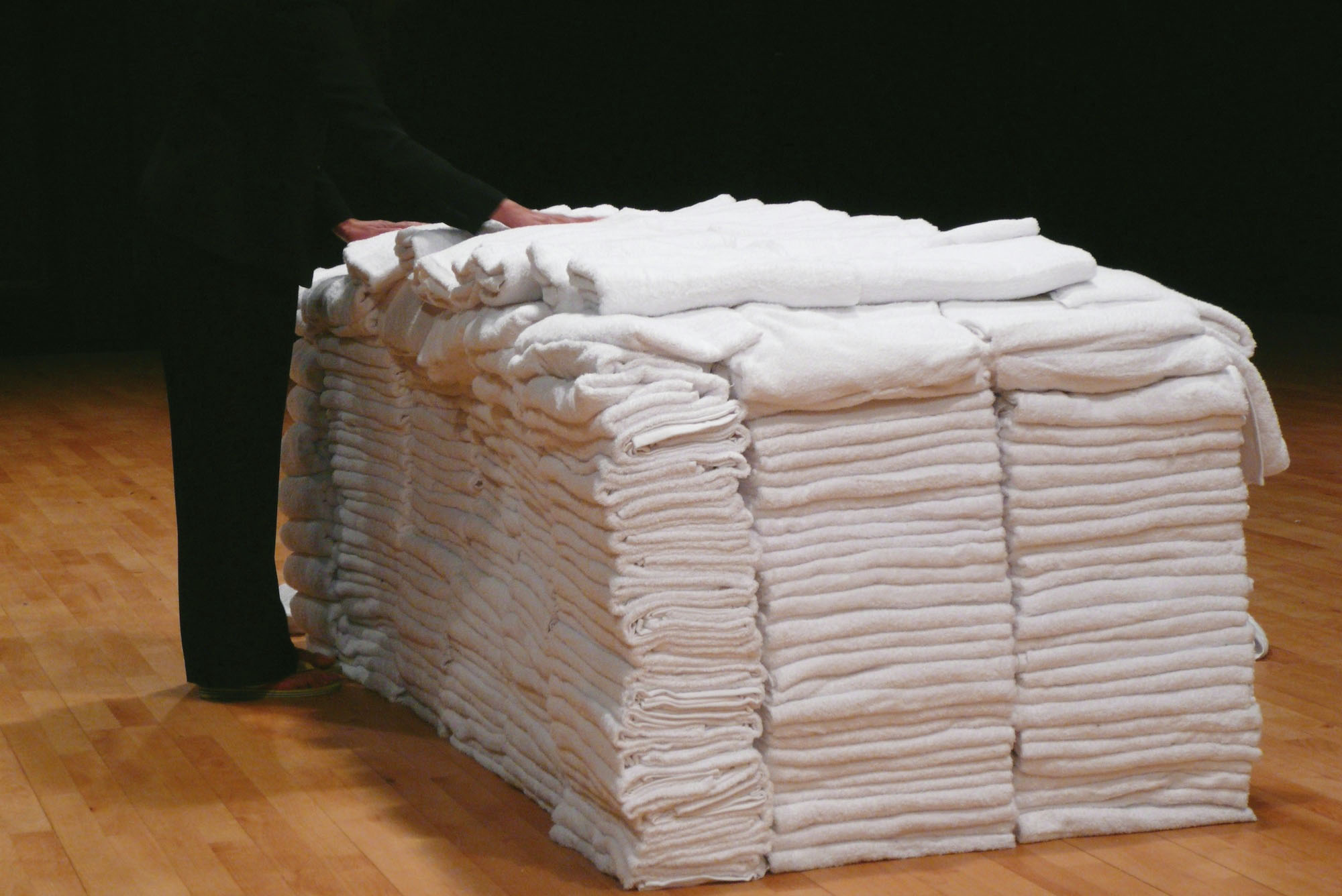
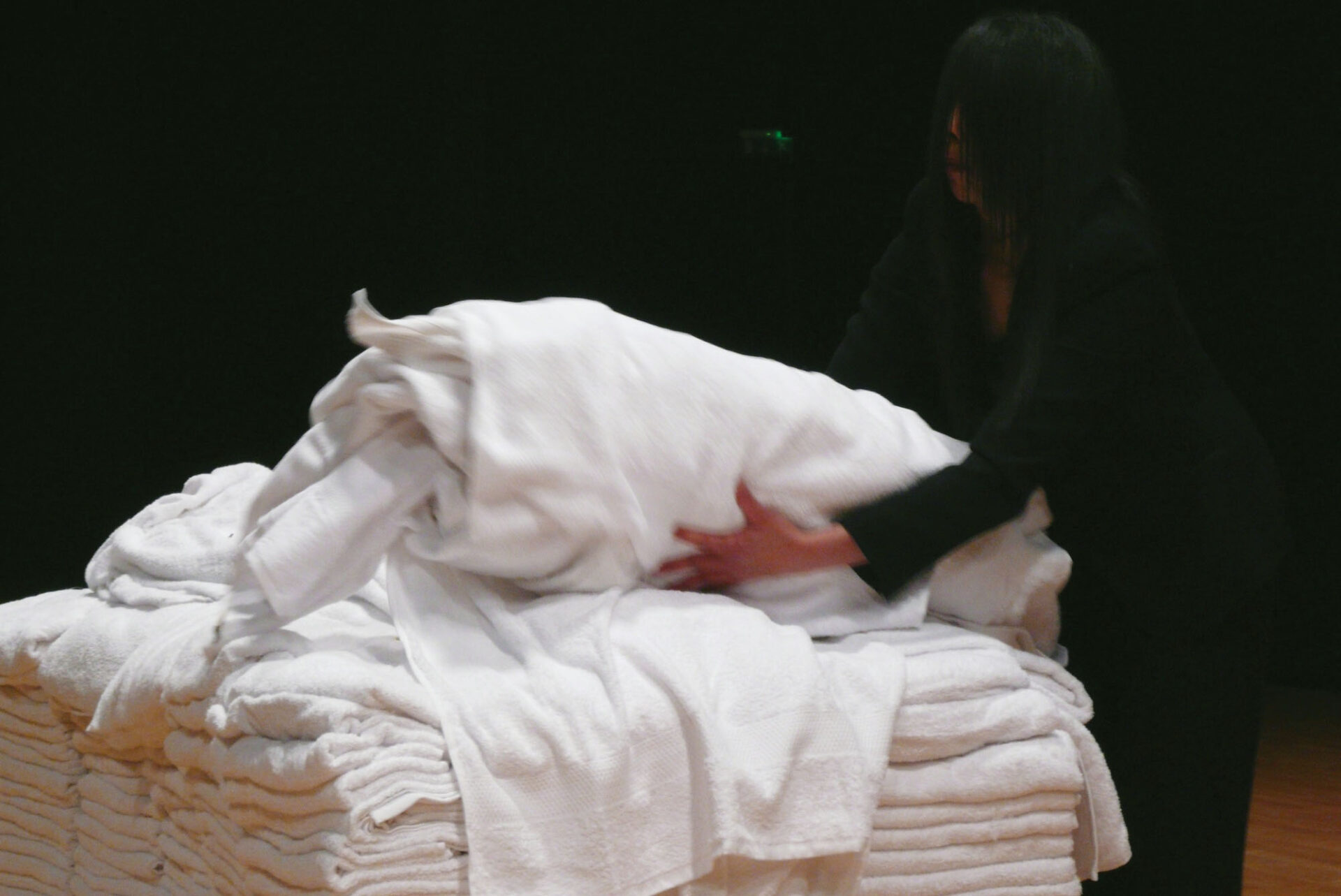
In two different forms, Écran somnambule and La part du rite present a quest that follows in the footsteps of Wigman’s work. The first piece is a reinterpretation (or perhaps even a remake, as we shall see further on) of Witch Dance, “a choreographic oddity”7 7 - Latifa Laâbissi, interview with Anna Colin in “4 Têtes et une oreille”, Le Journal de la Triennale No. 2 (February 2012). in which the German dancer, wearing a Japanese mask with an enigmatic smile, is seated on the ground. Accompanied by percussive sounds, she seems to be performing a Dionysian rite. The first version of this choreography was performed in 1914. A second version, performed in 1926, was preserved in a short film of under two minutes, which served as a starting point for Laâbissi’s work. Performed on stage over a period of thirty-two minutes, her piece is like a slow-motion version of the film in terms of both sound (the soundtrack was extended in a recording studio) and movement. The way she has adapted the original piece to a new context is reminiscent of Douglas Gordon’s 24 Hour Psycho (1993), in which the shower scene in the Hitchcock movie is drawn out over an entire day. In both cases, through the effect of a temporal magnifying glass, the remake underscores the most striking aspects of the original work, suggesting new ways of appreciating it today. La part du rite is a lecture on German dance in the 1920s given by theorist Isabelle Launay, who is wrapped in large white bath towels and looks like a modern-day mummy or ghost. Her bundled-up body is handled by the choreographer who is dressed in black and seems like a strange witch or undertaker involved in a mysterious rite. The lecture, which the woman has difficulty delivering because she is constantly being moved and shaken, seems to come from a grotesque after-life, emanating from a corpse to which it is nonetheless still attached. In recent years, several artists (for example, Éric Duyckaerts) have given talks in which they challenge the autonomy of the word. Laâbissi shows that we are always speaking from an embodied perspective.
Other works are located at the crossroads of dance, performance, and cabaret, offering atypical, seemingly disjointed performances that pose compelling questions. Laâbissi often uses striking accessories or visual references to draw in her audience. For example, in Loredreamsong (2010), a duo created with African-born dancer Sophiatou Kossoko, she wears a white sheet with two holes for eyes, evoking a funny Halloween costume, the violence of the Klu Klux Klan, and a burka. In the following segment, she paints her face black, pointing to the grotesque, stereotypical, and racist nature of blackface makeup, as applied by white American entertainers in the minstrel shows of the nineteenth and early twentieth centuries. Through these references, Loredreamsong critiques prejudices that still exist today, notably in a humorous and hard-hitting segment in which the two choreographers respectively reel off a series of clichés about African and Arab women. Likewise, Self Portrait Camouflage (2006) is a powerful piece, created with artist and stage designer Nadia Lauro,8 8 - Nadia Lauro has also worked extensively with Jennifer Lacey. See Alexandra Baudelot, Jennifer Lacey & Nadia Lauro – Dispositifs chorégraphiques (Dijon: Les Presses du réel, 2007). with whom Laâbissi has been regularly collaborating ever since. In this piece, Laâbissi appears naked, wearing only a Plains Indian headdress. In a talk given at the École des beaux arts de Nantes in 2009,9 9 - http://vimeo.com/5435980 she explained her interest in both the political and aesthetic aspects of the human zoos of the early twentieth century: what they revealed about colonial power and our curious gaze toward the Other. By making this history part of her self-portrait, the artist-choreographer brings these concerns directly into the present. The exoticism of the headdress suggests the fate of minorities in contemporary society, emphasized later on in the performance by an imaginary dialogue spoken with a thick Arabic accent and ending with a parody of the children’s song by Pierre Perret. The familiar cheerful melody of “Les jolies colonies de vacances,” sung with an Arabic accent, becomes “les jolies colonies de la France.”10 10 - A play on the word “colonie,” which can mean “community” or “camp” (“fun summer camps”) or “colony” (“the fun French colonies”) [Translator’s note]. A similar approach is adopted in the choreography Histoire par celui qui la raconte (2008), in which the artist has the dancers wear animal skins with boots or soccer socks, and makes them give speeches in exaggerated accents from their countries of origin. For Laâbissi, these accents are “megaphones,” ways to “bring minority voices into the work.” Thus, entire sections of contemporary society are brought into the art milieu, which is often reserved for the cultural and economic elite.
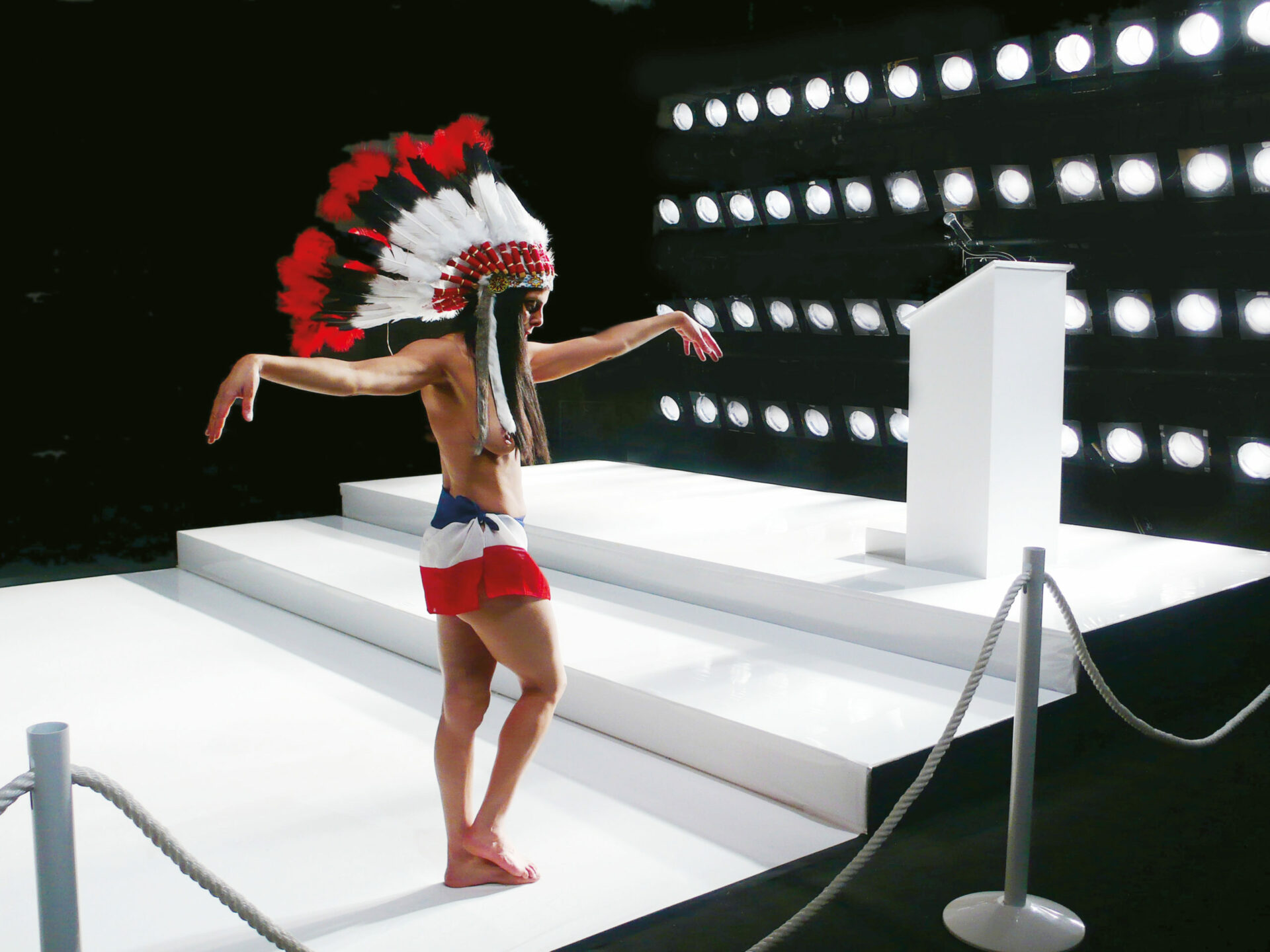
Photo : © Nadia Lauro
Photos : © Sophie Laly
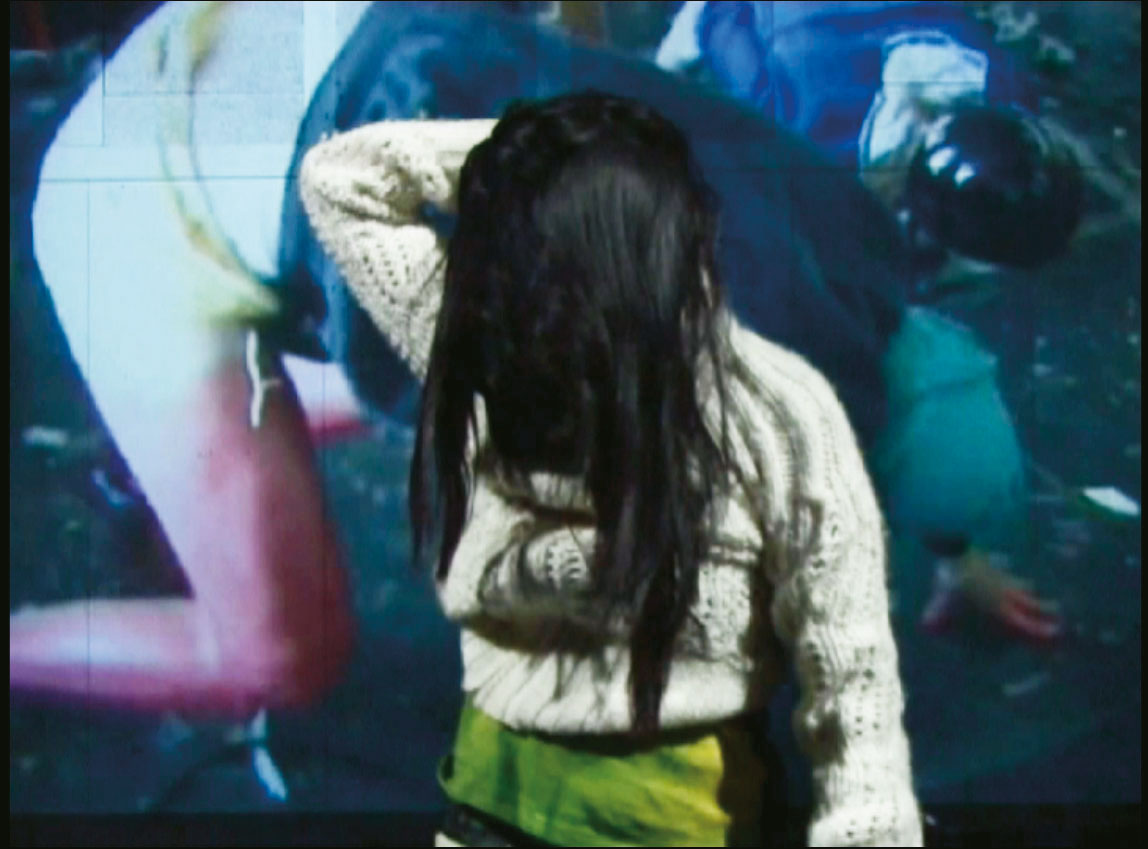
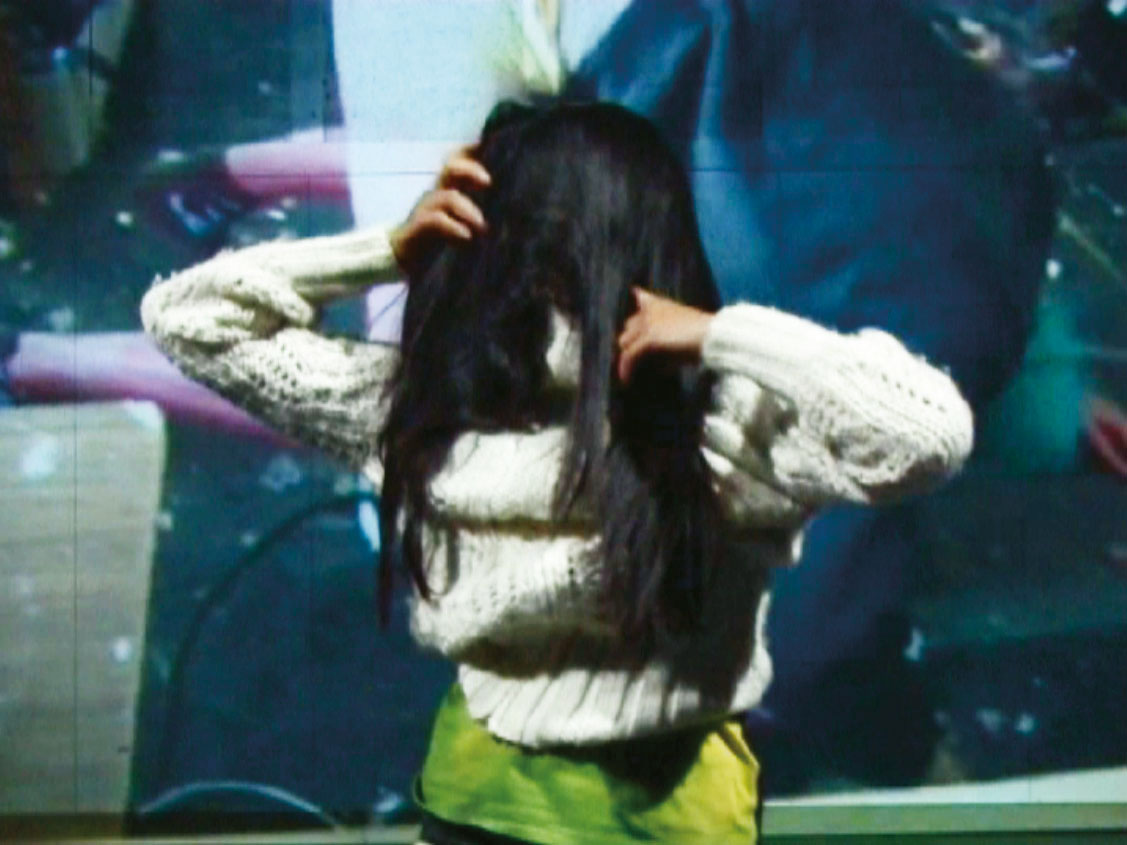
Other works are even further distanced from more usual dance forms and are squarely positioned within the space of contemporary art. Very early on, Laâbissi created works in which choreography was only one element in a much broader performance. Her 2004 work I love like animals speaks to a video by another choreographer, Jennifer Lacey, who collaborated with the highly provocative Viennese art collective Gelatin.11 11 - In 2005, the collective changed its name to Gelitin. The video shows artists in a messy studio, painting their bodies and enacting slow, chaotic movements as they search for voluntarily obscene positions of equilibrium, their heads covered by fabric or hoods that come down over their eyes. With these stop-start images of naked arms and legs in the background, Laâbissi, wearing red mittens and a blonde wig that covers her face, also makes slow gestures, turning around on herself as if embarrassed by her own body. She then lists off all the animals she likes, stopping to make loud imitations of their cries. Her performance is in constant dialogue with the images from Lacey’s work, to the point that both the bodies in the video and that of the dancer seem to be questioning one another. A more recent work, Habiter, consists of a series of explorations completed between 2006 and 2008 in France and Morocco, and makes reference to protocols put in place by artists since the 1970s. Reminiscent of some of Sophie Calle’s projects, Habiter starts with the writing of a small ad placed in newspapers and on posters offering a private artistic performance: “Artist-choreographer seeks person who would like to have a dance project performed in his or her home. The performance is free and will take two hours. For more information, call 06. . .” Once the time and place have been set, Laâbissi goes to the home of the person who may or may not watch the choreography. The exercise involves exploring each new environment. Her movements are attuned to the particularities of her surroundings in a way that is reminiscent of Erwin Wurm’s One Minute Sculptures and, especially, of Bruce Nauman’s explorations of his studio space.
From his Slow Angle Walk (Beckett Walk) and Bouncing in the Corner of 1968 to the Mapping the Studio videos from the early 2000s,12 12 - For more information on these works, see, for example, the entries in the Centre Pompidou-sponsored new media encyclopaedia: www.newmedia-art.org/cgi-bin/show-art.asp? ID=9000000000067788&LG=FRA&DOC=IDEN&na=Nauman&pna=Bruce. Nauman attains a perfect knowledge of his work space, using an approach that is sometimes very close to that of dance. In Bouncing in the Corner, Nauman, his face left out of the frame, sways his body forwards and backwards to fit it into the angle of two walls in his studio. Laâbissi is involved in a similar tactile exploration of intimate spaces in strangers’ homes. She builds on Nauman’s work, adding to it the mastery of her gestures and opening a space in which to get to know the Other. Her experiences are documented in films and photos taken by artist friends Jocelyn Cottencin and Sophie Laly, who have the opportunity to exchange with the home’s inhabitants. Dance is thus used to create a relational aesthetic made all the stronger by the artist’s social engagement.
With her free-form creations, filled with scholarly and popular references, Laâbissi sets an example for artists seeking to break down barriers among the arts and disciplines. But beyond this, does she not also invite us to question the role of art and artists within different yet closely entwined levels of culture?
“Let’s talk about art, says the fool to the idiot”: thus ends Sophiatou Kossoko’s monologue in English at the end of Loredreamsong. Using quasi-Shakespearean language, she points to a certain vanity of art that is considered a world unto itself. . . unless she is praising idiocy as the artist’s ultimate tool of subversion?13 13 - This notion of idiocy is that of Jean-Yves Jouannais, in L’idiotie: Art, vie, politique-méthode (Paris: Beaux-Arts éditions, 2003).
[Translated from the French by Vanessa Nicolai]


