
photo : © 2012 Vanessa Beecroft
Allan Kaprow, who invented the “happening” in 1954, said that this phenomenon was inspired by action painting.1 1 - Allan Kaprow, “In Response,” in Happenings and Other Acts, ed. Mariellen R. Sandford (London and New York: Routledge, 1995), 219-220. CaroleeSchneemann, who is generally associated with Meat Joy (1964), compared her use of animal flesh to painting.2 2 - Carolee Schneemann, More Than Meat Joy, (New Paltz: Documentext, 1979), 62. These two performance artists, along with others who founded the discipline in the 1960s, did not reject the idea of painting — they rather took their inspiration from it. Yet, even today, their works are often considered to be at the opposite extreme of painting. They are seen as part of a performance history that lies on the fringes of the modernist paradigm, and whose origins can be traced back to the theatrical performances of Marinetti and the Zurich Dadaists.3 3 - For a history of performance art, see Roselee Goldberg, Performance Art. From Futurism to the Present (Paris: Thames & Hudson, 2001). They are “immaterial,”4 4 - Performances are only preserved in records, which provide a necessarily partial view and create the idea of immateriality, although the performances themselves are eminently physical and material for those who experience them. transitory, and associated with immanence, in contrast to the transcendence, self-sufficiency, and eternity of paintings,5 5 - Carolyn Korsmeyer, Making Sense of Taste: Food and Philosophy (Ithaca and London: Cornell University Press, 1999), 28. created to be owned and looked at for a long time.
The contrast has not, however, set these two disciplines at opposite poles, as Amelia Jones illustrates through the major influence that Pollock has had on performance art since the 1950s and 1960s.6 6 - Amelia Jones, “The ‘Pollockian Performative’ and the Revision of the Modernist Subject,” in Body Art: Performing the Subject (Minneapolis and London: University of Minnesota Press, 1998), 53-102. A quintessential figure of modernist painting, Pollock paved the way for performance art through his action painting, which saw his body “dancing” on the canvas as he applied the paint. In the words of Régis Michel, “This strange choreography is so familiar to us that we’ve lost all measure of its newness. The dripping dance marks a major departure from the age-old system of Western painting, based on the mastery of gesture, which created the myth of the artist as supreme subject, a true demiurge.”7 7 - Régis Michel, La peinture comme crime ou La part maudite de la réalité (Paris: Réunion des musées nationaux, 2001), 260. (Our translation) In turn, performance artists have drawn on Pollock’s action painting technique, critiquing and expanding its inherent discourse on the heterosexual male body to include the other (women, homosexuals).
In truth, performance art past and present can be influenced by painting in at least two ways, as Vanessa Beecroft’s approach demonstrates. First, she exploits the medium of painting, following Pollock’s ambivalent stance on identification and critique vis-à-vis artistic tradition (modernity, the male figure). Her made-up women embody the painted surface (canvas or paper), with their bodies coated with paint or other similar substances. In one instance, her own body also becomes a painting tool — a brush or spatula with which to apply colour. Second, Beecroft uses painting and its history as the subject of her “motionless” performances, drawing on well-known works and striking themes to create tableaux vivants. These two influences of painting on performance art (those of the medium and the subject) are characteristic of two periods — the first in the 1960s and 1970s, and the second in the 1990s and 2000s — both of which continue to be present today, as reflected in Beecroft’s art. I shall now further explore these influences and how they play a determining role in her work.
photos : © 2012 Vanessa Beecroft
Holding a pose and creating an image, or the painted bodies of Vanessa Beecroft
The tableau vivant was a particularly popular form of entertainment in the eighteenth and nineteenth centuries, in which individuals in costume would hold a pose in order to look like a painting. This bourgeois pastime, chiefly pursued by women, was a way to reappropriate masterpieces of literature and painting in a highly concrete manner by embodying their characters.8 8 - For example, in La Curée (The Kill) and Jane Eyre, Émile Zola and Charlotte Brontë described evenings that included the presentation of tableaux vivants. In the past fifteen years or so, the tableau vivant has been revisited in contemporary art, giving rise to performance and video works in which individuals hold a pose (at least for a time) in order to create pictorial effects — for instance, through the arrangement of elements, the harmony of colours, and the use of light and shadow. In Québec, Claudie Gagnon is a pioneer of the genre, completing her first tableaux vivants in 1995 and many more since, liberally drawing on historical works. Bettina Hoffmann, Adad Hannah, and Daniel Olson are also known for their work with immobile bodies, and emerging artists like Olivia Boudreau, Julie Favreau, and Jacynthe Carrier are picking up the reins with their introspective works. The tableau vivant also serves as inspiration for a number of artists on the international scene: Spencer Tunick, Marina Abramovic, and, of course, Vanessa Beecroft are just three among many who have created performance pieces in which immobility plays a predominant role.
When it comes to the modern recasting of the tableau vivant, Vanessa Beecroft’s contribution is without a doubt the most significant, largely on account of her rapid rise to fame, prolific output and interest, and the consistency of her approach since 1993, not to mention the pivotal role that performance art plays in her work. Using mainly female models, the artist interrogates their passive role — as both model and muse — in the history of painting. She underlines in three ways the manner in which, through the bourgeois pastime of the tableau vivant, the mistresses of the house were able to reappropriate this history by playing the role of both model and artist through their stagings. In fact, and this is a point I will dwell on, Beecroft’s works especially reveal the suggestive beauty of women who are induced to remain passive. A number of these works are inspired by masterpieces of painting; here, they are created by a woman, as shown in vb61 (2007), a work to which I will return in the conclusion of this essay.
Vanessa Beecroft’s performances last several hours, during which the models are not required to stay completely motionless, but must avoid all eye contact and remain detached. They must never speak and must hold their assigned poses as long as possible, after which they can squat, sit or lie down. Neither too fast nor too slow, their movements are controlled and must not be synchronous.9 9 - Marcella Beccaria (with Vanessa Beecroft), “Conversation Piece,” in Vanessa Beecroft Performances 1993-2003 (Milan and London: Skira and Thames & Hudson, 2003), 18-19. In these performances, stillness and silence predominate, creating the effect of a painting: the inaccessible image is close at hand — sensuous, visual, and corporeal yet impenetrable. But the charm of the tableau vivant is momentarily interrupted, with increasing frequency, by the women’s movements and associated sounds, by their accumulation, and the evolution of the composition. Hence, the principal concerns of Beecroft’s performances from a painting perspective: painting as reference point,10 10 - Dave Hickey, Vanessa Beecroft’s Painted Ladies. http://www.vanessabeecroft.com/frameset.html. perfection that tends to deteriorate, order that slides into disorder, and that the idea comes closer to the material as the bodies relax from their poses. Painting and performance art might seem as diametrically opposed as transcendence and immanence, the ideal and the real, but in Beecroft’s work, they are dialogical and inspire much of the fascination and malaise associated with her work. The idea of painting is an essential counterpoint to performance art, which has an impact on the overall interpretation of her approach.
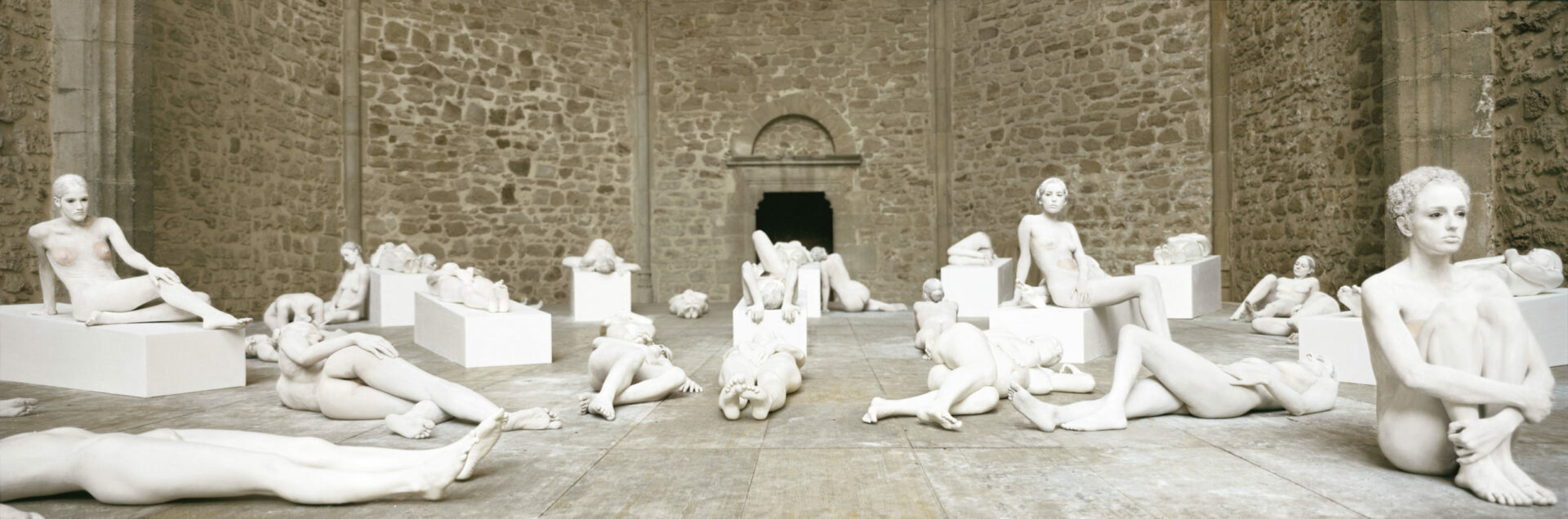
photo : © 2012 Vanessa Beecroft
Some of the artist’s creations evoke paintings by the Old Masters: vb11 (1995) is reminiscent of Holbein’s The Ambassadors (1533); vb25 (1996) echoes Rembrandt’s The Night Watch (1642),11 11 - Marcella Beccaria, op. cit., 19. and vb52 (2003) evokes The Wedding at Cana (1563)by Veronese.12 12 - Giacinto Di Pietrantonio, “The Substance of Art,” in VB65 PAC Milano: Vanessa Beecroft (Milan: PAC Padiglione d’Arte Contemporanea, 2009), 20. Sitting at a table, the women in vb52 are clothed in colours reminiscent of Veronese and eat food the same colour as their clothes. They literally eat and drink the colour that envelops them, giving the impression that they wish to absorb it in order to accentuate or drastically change the shade of their complexion: beige, pink or yellow, or even blue, violet or green. Other works by Vanessa Beecroft point to prominent themes in historical art, such as the Virgin and Child with Saint John the Baptist13 13 - Marcella Beccaria, op. cit. and the Last Supper, or pictorial techniques developed during the Renaissance.14 14 - Giacinto Di Pietrantonio, op. cit., 19. To create chiaroscuro and sfumato effects, her bodies are subtly coated in substances that create a velvety, light-absorbing finish. The resulting effect is particularly impressive in the black bodies, which are the most enigmatic. Other works are inspired by artistic movements such as Symbolism or Abstract Expressionism. The influences of Pop Artand Suprematism are also present throughout her work. The former’s critique of mass consumption of identical objects finds an echo in Beecroft’s numerous, similar-looking models, and the latter’s black squares against white backdrop are evoked by the application of beige, black, or white to the models’ light or dark skin tones.
Beecroft draws inspiration from all of art history, from antiquity to modernity,15 15 - Ibid., 18. and has a particular interest in self-reflexive painting, as evinced by the importance she gives to colour. A number of her performances, including the most recent, are monochromatic, with painted bodies, hair, wigs, and other accessories in black, white, or beige. For example, the women in vb62 (2008) take on the appearance of marble (reminiscent of the sculptures of antiquity), while those in vb66 (2010) appear burnt to a crisp. Some of her pieces feature various shades of beige, grey, or olive green. The striking colour arrangements reflect aesthetic concerns while the women wearing them embody existential crises — and the whole is designed to confront reality with its representation. Other mostly earlier works were created with clothes in complementary (blue and orange) or contrasting colours (red and blue, yellow and black). Beecroft mainly uses accessories for primary and secondary colours. She has never applied body makeup in shades far from flesh tones, which again hearkens back to the paintings of the Masters, each of whom developed his own style without foregoing realistic effect.
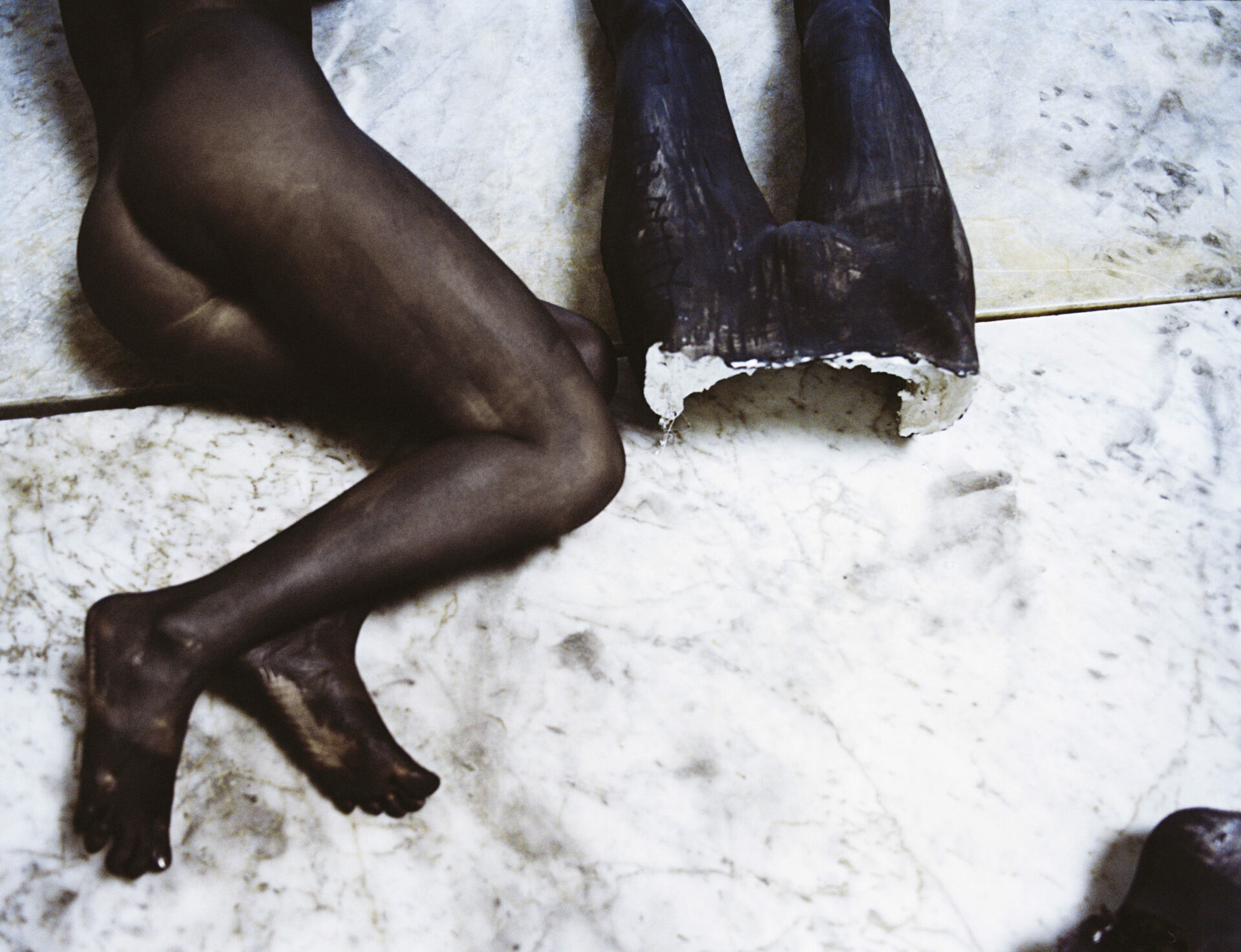
photo : © 2012 Vanessa Beecroft
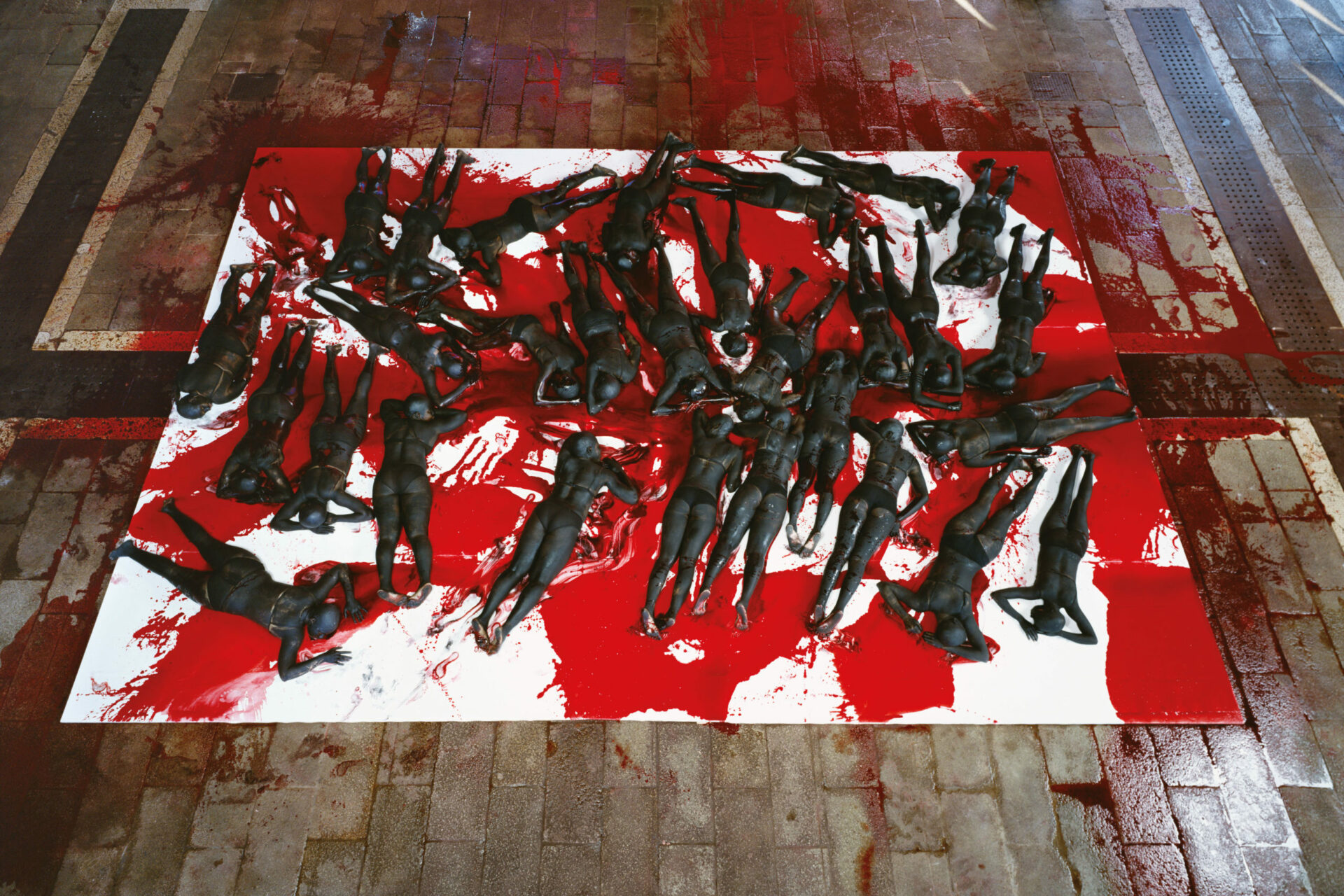
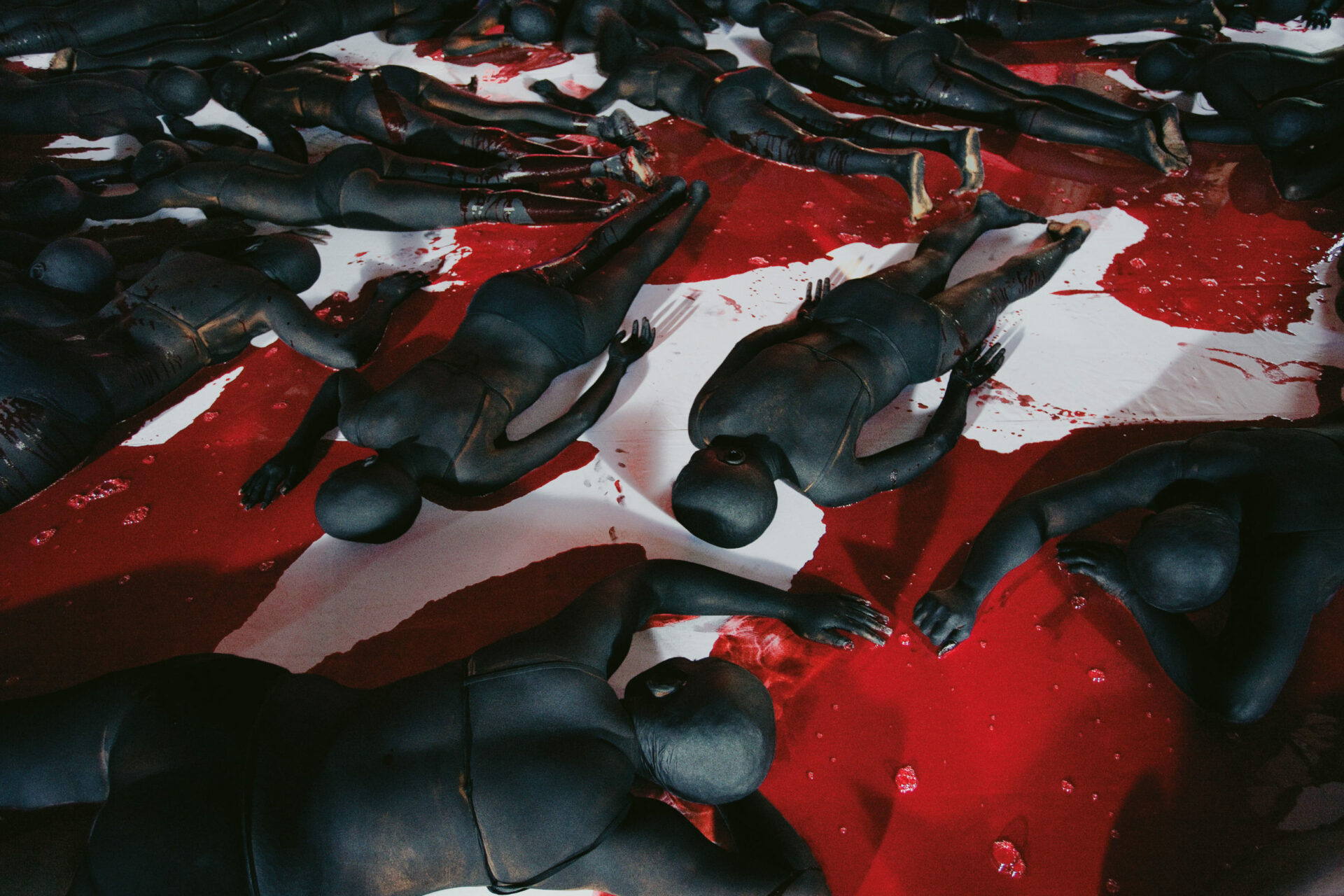
Drip painting was also used on one significant occasion. In a work from 2007 displayed at the Venice Biennale, models painted in black were laid out on a white canvas. Using a bucket and large paintbrush, Beecroft covered them in blood-red paint. This critique of the civil war in Darfur also paid tribute to action painting and the Viennese Actionists.16 16 - Vanessa Beecroft, Vanessa Beecroft vb61 Still Death! Darfur Still Deaf? Venice, PRNewswire. http://www.prnewswire.co.uk/cgi/news/release? id=199996. It was undoubtedly the latter who, during the 1960s and 1970s, most exploited the idea of painting by presciently introducing the tableau vivant into performance art in order to create living, breathing still lifes. Their bodies and those of their models became both the painter’s tool and working surface. By using the tableau vivant and the body as a painted surface (and, in this instance, the body as the painter’s tool), Beecroft makes reference to Viennese Actionism in at least three ways. She revisits the idea of painting by including herself in the piece for the first time. In this way, she declares her allegiance to Pollock, at the same time highlighting issues around the representation of the female subject, issues already evoked by the pastime of the tableau vivant and performances such as Meat Joy, in which the female artist revealed herself to the audience.17 17 - On the performance and body of the female artist, see Amelia Jones, ibid., 349.
Undeniably innovative in their contribution to the re-enactment of the tableau vivant, Beecroft’s works not only recover elements from the history of painting but also from the performances inspired by them. They are located between two media and two histories: the history of painting and that of postmodernism, which critiques and references the former. Beecroft exploits this double ambivalence in a way that allows her works to resist any categorical interpretation. Although often viewed from a specific perspective (generally feminist or autobiographical), they invite a much broader interpretation. It is precisely this ambivalence — the beauty of women and the malaise it arouses — that lends them their enigmatic quality.
[Translated from the French by Vanessa Nicolai]


