
photo : © Collection du Musée des beaux-arts du Canada, Ottawa
An “object,” like an animal, possesses a dual nature: anthropological, when defined as an artifact, and poetic when posited as a metaphor, symbol, or allegory. It appears, then, as the embodiment or image of the “Other,” that which human beings confront in their understanding of the world. For its part, the “animated” qualifier harkens etymologically to anima, whose two meanings of “soul” and “animal” served in Classical philosophy to make distinctions between living beings and to place them in hierarchical order. Thus conceived, the “animated object” can be an instrument of thought for conceptualizing the difference between nature and culture, human and non-human, subject and object. While art history may not have given much attention to the animated object — distinct from the “animated image” 1 1 - David Freedberg, The Power of Images: Studies in the History and Theory of Response (Chicago: University of Chicago Press, 1989).— discourses in anthropology, psychology, literature, and film have taught us to consider the dialectical relationship between subject and animated object as being typically unidirectional: human beings, projecting their fantasies and desires, humanize objects and endow them with a soul. Animism, denoting an inclination to attribute properties of the living to inanimate objects, exemplifies precisely this one-way relationship. Generally dismissed in modern thought,2 2 - Ibid. the concept allows us nonetheless to consider Western literature’s strong influence (through its descriptions and metaphors) on the perception (even the apprehension) of the object’s effectiveness.
Partaking in the renewed interest in the animated object are recent studies in Thing Theory. Contrary to animist thought, this theory emphasizes the primacy of dialogical relationships between the object and the one perceiving it. Moreover, of particular interest in the context of the “material turn” in visual culture is the importance of the everyday object in current artistic production. Thus, I propose we reconsider a recurring object in these practices — namely, the chair — in light of theories on “the thing.”
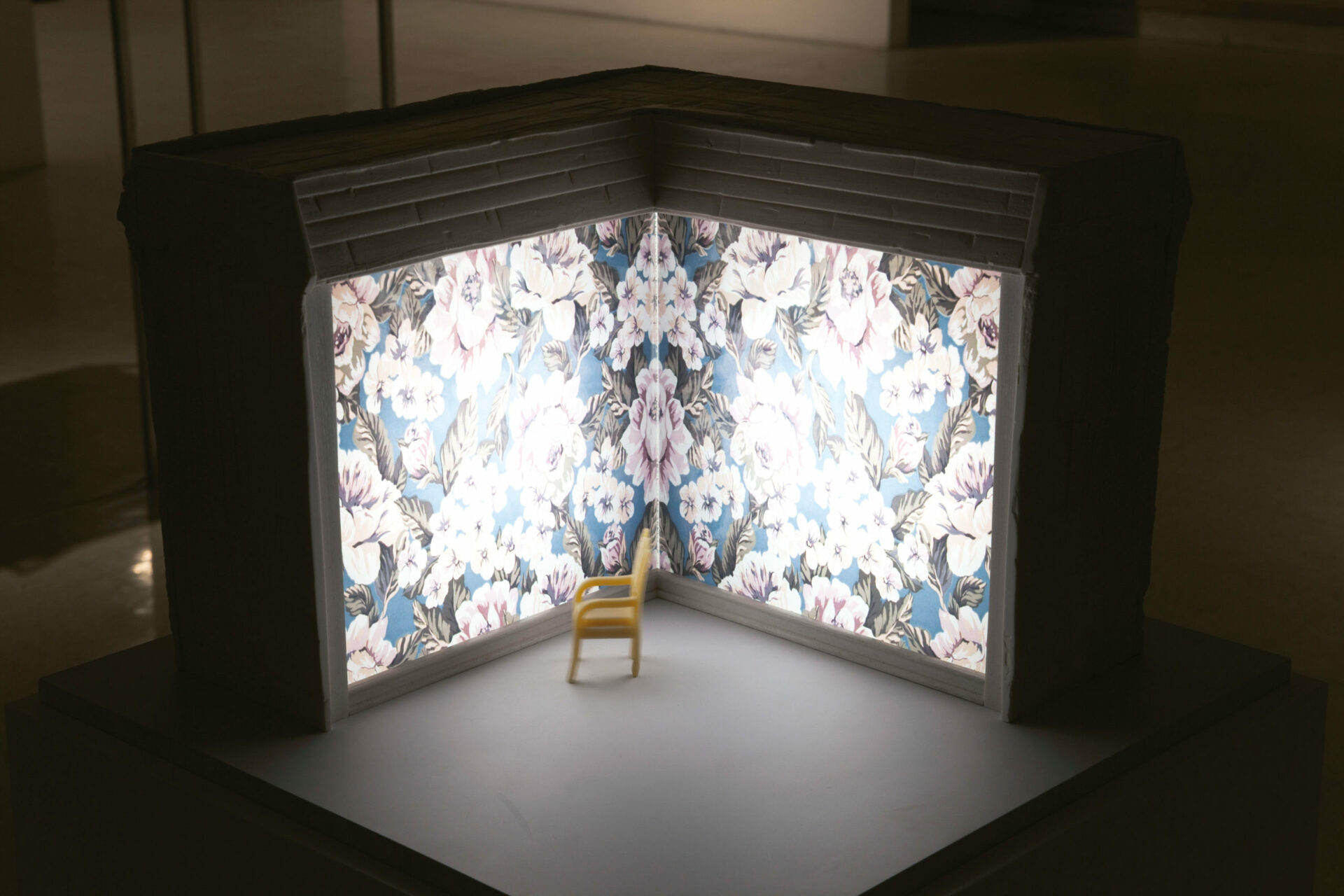
photo : Guy L’Heureux, permission de | courtesy of the artist & Art Mûr, Montréal
Literary and philosophical in origin, these new theories present a poetic conception of the object in lieu of an anthropological concept founded on primitive belief, such as shamanism, animism, and totemism. Joseph Beuys’ Fat Chair (1964) exemplifies the spiritual and mystical considerations characterizing this traditional conception. Seeking to restore the primal union of man with nature, the work’s material composition renders visible the process by which the material itself is put into action. In the work, a formless mass of natural material — animal fat — is placed on a chair; having been refrigerated, this material is first solid then gradually reverts to its original state. By this natural process, Beuys’ work enables us to conceive the animated as the essence of nature, as the performative nature of all living matter.3 3 - Note that Beuys’ oeuvres are part of the development of reflexive thought on magic and the sacred in non-Western societies in anthropology and ethnology from the early twentieth century onwards. The first years of his production coincide, in fact, with the publication of seminal works on such questions as animism and totemism; these include Bronislaw Malinowski’s Magic, Science and Religion and Other Essays (1948), Mircea Eliade’s Le Chamanisme et les techniques archaïques de l’extase (1951, 1968), Alfred Kroeber’s The Nature of Culture (1952), and the works of Claude Lévi-Strauss, including Tristes Topiques (1955), Anthropologie Structurale (1958), La Pensé Sauvage (1962), Le Totémisme Aujourd’hui (1962), and Mythologiques (1964). This vision is akin to animism, which, in ascribing a soul to natural phenomena, attempts to restore nature’s animated condition, however inanimate it may appear to us.4 4 - Sigmund Freud, Totem and Taboo: Some Points of Agreement Between the Mental Lives of Savages and Neurotics [1913], translated by A.A.Brill [1918] (London: Routlege and Kegan Paul Ltd, 1950). The works of Brian Jungen provide another example of this kind of transference. Shapeshifter (2000), which presents a whale skeleton made entirely of plastic patio chairs, prompts us to revisit the boundary between the natural object of the skeleton (or indeed the fossil5 5 - On the connection between totem objects and fossils, see W.J.T. Mitchell’s admirable text, “Romanticism and the Life of Things: Fossils, Totems, and Images,” in Bill Brown, ed., Things (Chicago: University of Chicago Press, 2004), 227-244.) and the cultural object.
Tangential to classifications by which the object is conventionally defined, the question remains as to how one should name the borderline object. In the cases before us, the chair-object affords two distinct moments for interrogating its classification: the first, with its displacement from the home sphere to the artistic, as its use-value is replaced by its artistic value; and the second, when the referent to the chair is lost. With Jungen, this loss is incurred by the production of new imagery that blocks immediate recognition of the chair-object; and in Beuys, by the juxtaposition of two materials, the animal fat and the wooden chair. The unclassifiable object tends to disappear behind the “thing.” In other words, it is at the moment that objects renounce their objectivity, their own nature, that one may perceive the “thing,” which is not a sign, not an art object, but merely that thing that had once been human or had been part of the human being.6 6 - John Plotz, “Can the Sofa Speak? A Look at Thing Theory,” Criticism, Vol. 47, No. 1 (Winter 2005), 113.
The poetic function of furniture-objects can also serve to illustrate the transfer of “object” to “animated thing.” On the one hand, through their function in everyday life and contiguity to human domestic and private space, they embody what Roland Barthes’ referred to as “the world’s human signature.”7 7 - Roland Barthes, “The Plates of the Encyclopedia,” in New Critical Essays, translated by Richard Howard (New York: Farrar, Strauss and Giroux, 1980), 24.Moreover, philosophical discourse attests to many examples of their metaphorical use: one might think of the bed, illustrating the concept of mimesis in Platonic philosophy and expressing the distinction between the sensory world of objects and the intelligible realm of ideas; of the table, with which Marx presented the fetishism and mysterious, ungraspable nature of commodities; of drawers, chests, and cupboards with which Gaston Bachelard argued the difference between image and metaphor; or of the arrangement of traditional household furniture, which Baudrillard considered representative of a given period’s family and social structures.8 8 - Karl Marx, Capital: A Critique of Political Economy, Vol. I [1867], translated by Samuel Moore and Edward Aveling, edited by Frederick Engels [1887] (marxist.org: Marx/Engles Internet Archive, 1995, 1999); Gaston Bachelard, La Poétique de l’espace (Paris: Presses universitaires de France, 1957); Jean Baudrillard, Le Système des objets (Paris, Gallimard, 1968). On the other hand, furniture objects depicted in literature, particularly of the nineteenth century, realize the fantasy of animating and giving voice to objects.9 9 - Examples of this fantasy abound in the fantastical creatures and objects described in the works of Honoré de Balzac, E.T.A. Hoffman, and Edgar Allen Poe, along with the animated objects and caricatures of J.J. Grandville and John Tenniel.
photos : Patrick Mailloux, permission de |
courtesy of the artist & Dare-Dare, Montréal
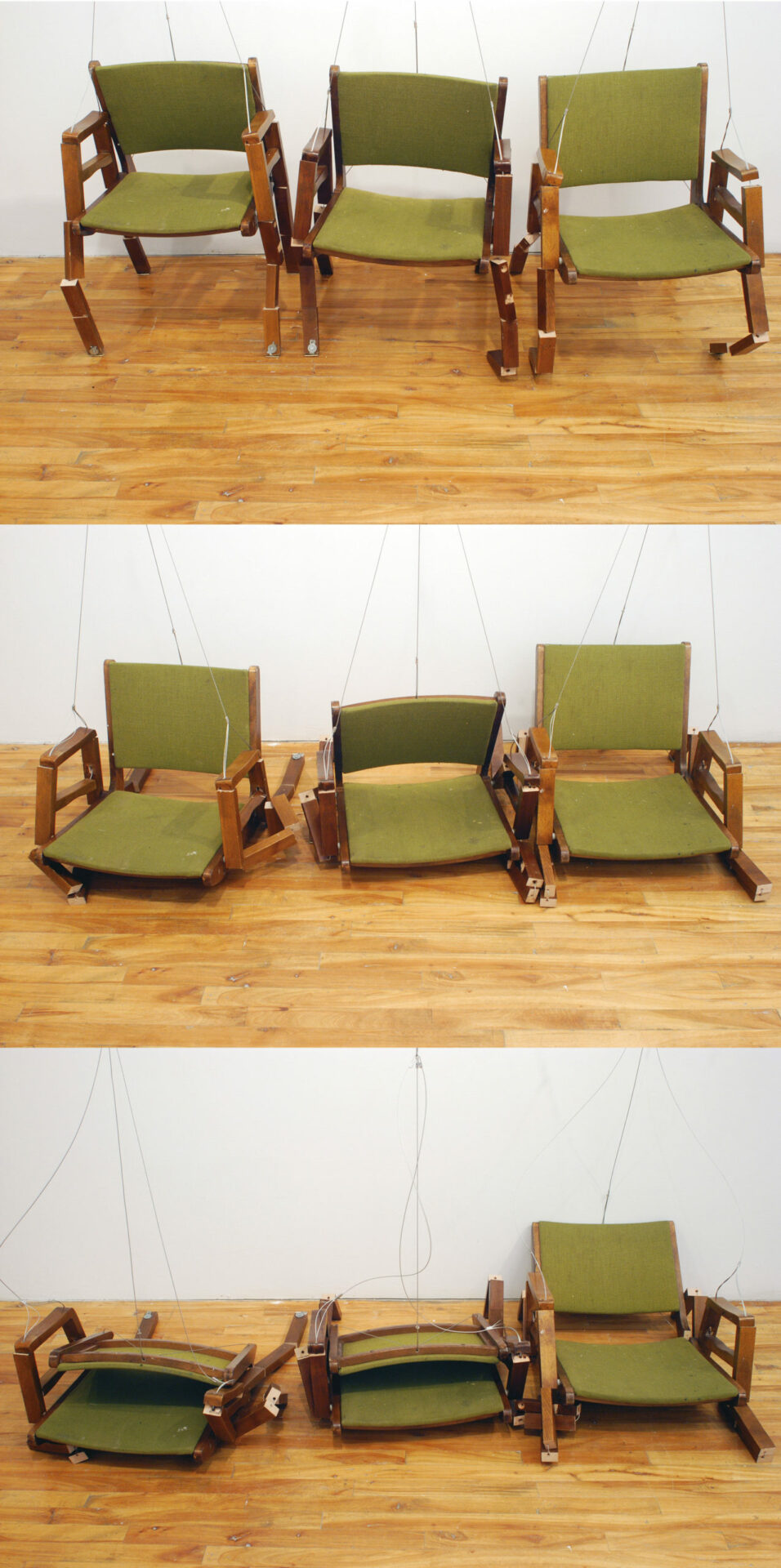
These poetic considerations are made explicit in Adrienne Spier’s Waiting Rooms and Offices (2003). Here, Spier used abandoned, run-down furniture that she took apart — dismembered, so to speak — and then attached to a pulley system that spectators could manipulate to animate the objects. The chairs, whose movement suggests typically human gestures, bring out the latent playfulness of the scene, alluding to the analogy between “living” object and toy, engendered by myths, tales, and fables.10 10 - Baudelaire describes the moment when children, vainly attempting to grasp the essence or “soul” of their toys, shake them, throw them on the ground, dismember them, until, broken to pieces, that marvellous life is extinguished: Baudelaire, “Morale du joujou” [1853], in Curiosités esthétiques. L’art romantique et autres œuvres critiques (Paris: Garnier, 1986), 207. At the Istanbul Biennial in 2003, Doris Salcedo’s Untitled Installation, comprising 1,600 instances of the chair, also revealed the poetic value of the object. Squeezed between two outside walls, Salcedo’s chairs betray the wear and tear of time and the visage of their previous occupants, reminding us that, in Ricœur’s words, “to be born is to attain a durable world … and to die is to withdraw from such a durable world.”11 11 - From Paul Ricœur’s “Préface” to the French translation of Hannah Arendt’s The Human Condition [1958]: Condition de l’homme moderne, translated by Georges Fradier (Paris: Calmann-Lévy, 2005), 22. (Our translation.) That, too, is the “thing,” enriched by the memories of the soul that men have given it, by the desires they have projected upon it, and by time and use. Nonetheless, Spier’s dismantling of furniture and Salcedo’s multiplication of chairs have both withdrawn the object from the everyday continuum and suspended it in a linear temporality, obliging the viewer to navigate between the memory of the object and that which is presented, between the various contexts and discourses that predispose it to interpretation: the relationship between spectator and animated thing thus becomes dialogical, that is, an exchange.
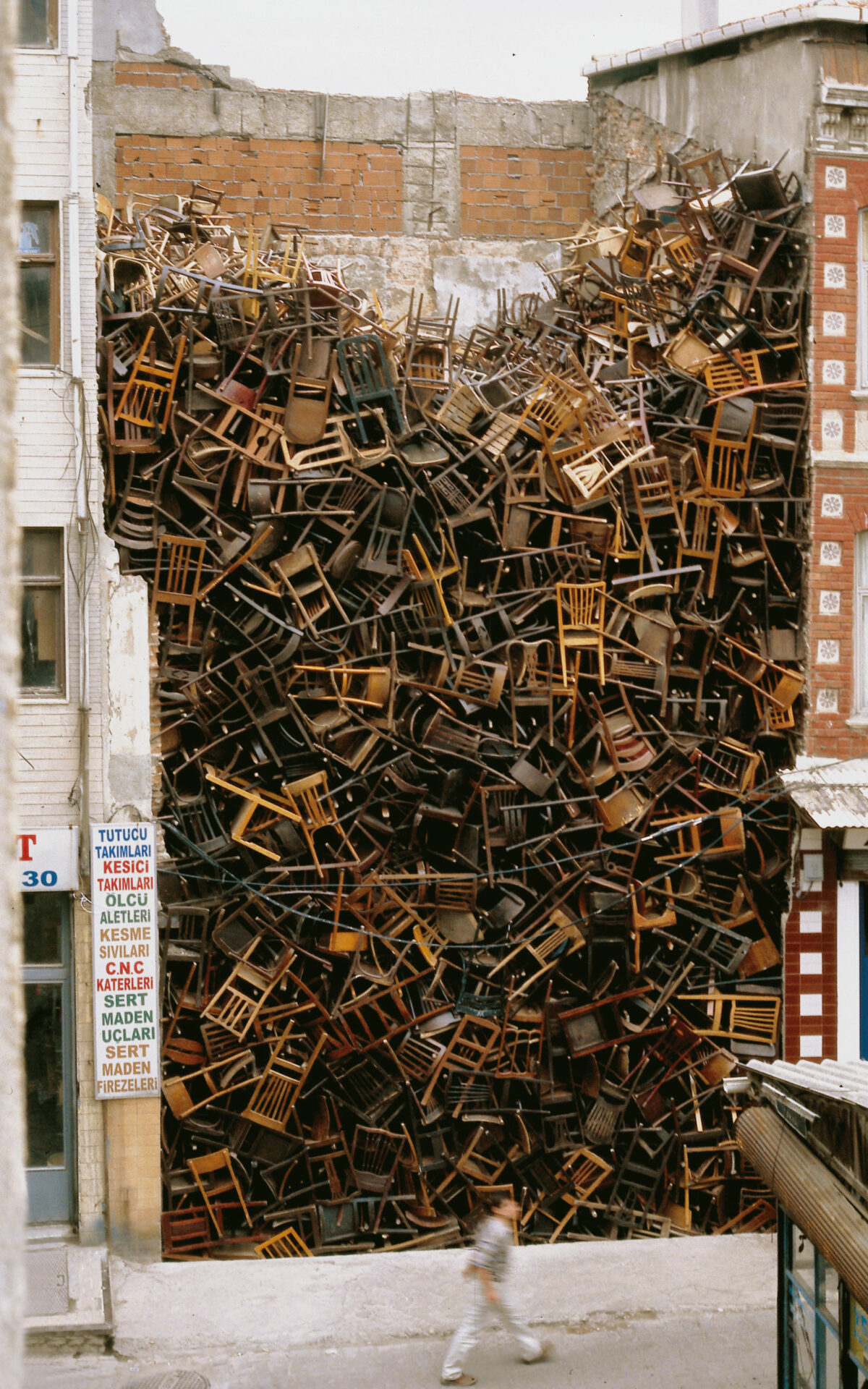
photo : Sergio Clavijo © Doris Salcedo, permission de | courtesy of Alexander and Bonin, New York
& White Cube, Londres
This to and fro between the object and its context, between the object and the stories and descriptive discourses accompanying it, produces a temporal and narrative ambiguity that is exploited in film. Guillaume Lachapelle’s Avancée (2009) plays on cinematic language by presenting a miniature chair, set into motion by means of an electrical apparatus. The miniaturization of the furniture also contributes to the object’s loss of utilitarian value, to the disquieting nature of the animated object, and to perception of the object as a “thing.” The miniaturization prompts us to consider the “secret life of things,”12 12 - Susan Stewart, On Longing: Narratives of the Miniature, the Gigantic, the Souvenir, the Collection (Baltimore: Johns Hopkins University Press, 1984), 54. which endows them with a “life in itself.” From the point of view of a Heideggerian definition of the “thing,” it is the revelation of “being in itself” that initiates the definitive passage from object to thing. The thing comes into being by suspending the usual conditions of the object’s existence, removing it from its ordinary context — or, in poetic terms, by way of its “disenchantment,” which strips away the fantastical narrative to restore it to its essential nature.
As such, the life of the object no longer seems mysteriously imbued with the invisible forces of nature, but by its very quality of “being a thing.” With this, it regains its mystery (and its silence13 13 - On this topic, see Giorgio Agamben, Infancy and History: The Destruction of Experience, translated by Liz Heron (New York: Verso, 1996).), since it can only be rendered by its poetic value. One can see this transformation in the coordination of various objects, materials, and places in the installations of Guillaume La Brie. The title of the exhibition itself is revelatory: “Moitié-moitié, une exposition à 50 % Guillaume La Brie” (2011): it is the very walls of the exhibition venue (Centre Clark) itself that provided the materials for the assembling of furniture-objects. Thus, on display next to a totem-like columnar structure made of two TV furniture units and pieces of drywall is a chair to which is clamped its translucent double. Here, the materiality of the thing and its animated character combine: the other chair obliges us to take notice of the object’s material construction, while the mirror effect and transparency turn it into a ghost, a memory of the object. A similar poetic process was at work in Les envahisseurs de l’espace (2007), an installation that staged an array of furniture-objects that were enclosed, cornered, even crushed by sections of wall to create a veritable “theatre of things” in which the identity of the “invader” — object or spectator — remained an open question.
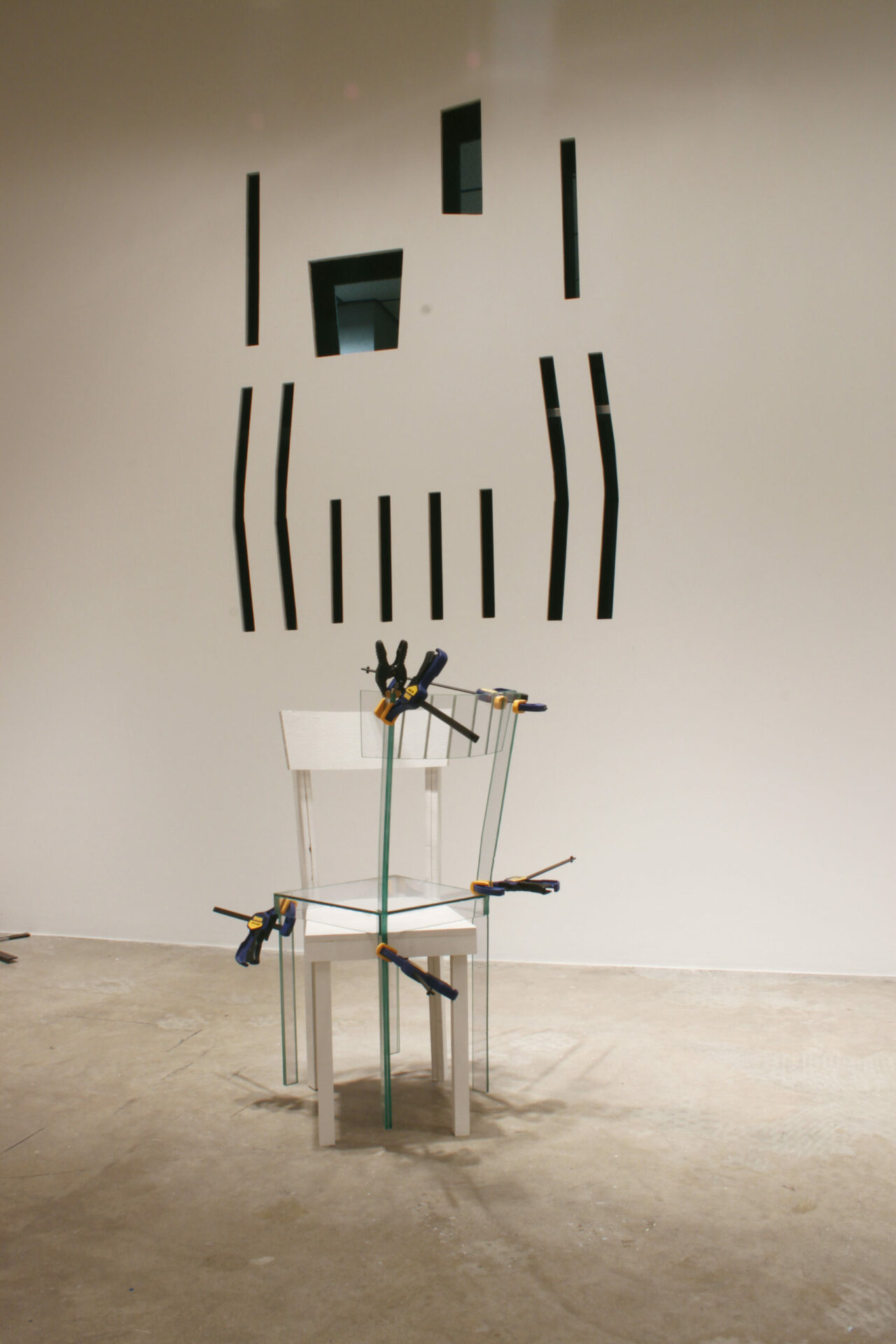
à 50 % Guillaume La Brie, Centre Clark, 2011.
photo : permission de l’artiste | courtesy of the artist
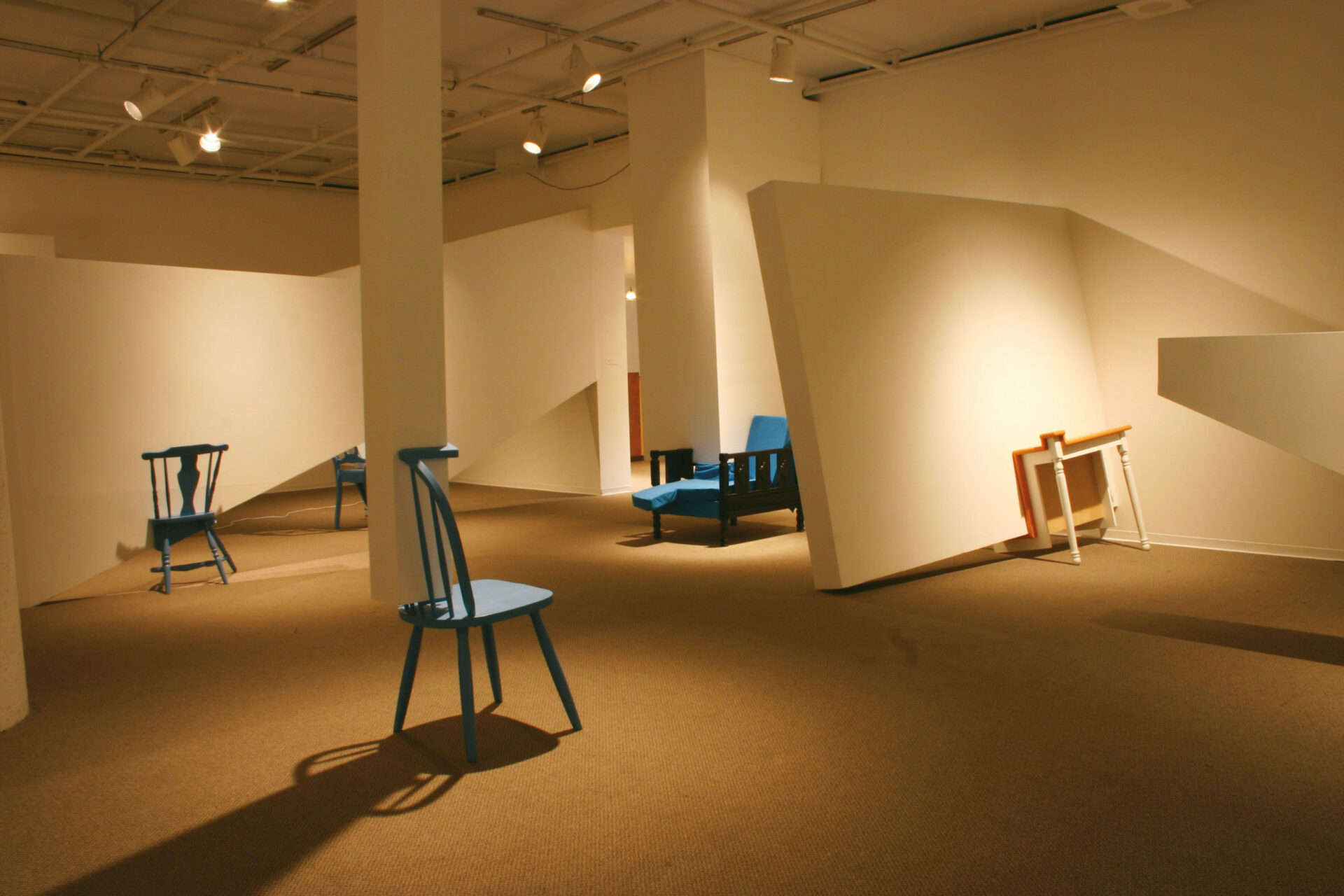
photo : permission de l’artiste | courtesy of the artist
Thus, the animated thing demonstrates the effectiveness of poetic language, as understood by Aristotle, for whom its function, essential to the expression of muthos (translated as fable or story), was to “represent things as in a state of activity,” to show the inanimate as animated.14 14 - Aristotle, Rhetoric, III, 11, 1411b 24-25, translated by W. Rhys Roberts (New York: The Modern Library, 1954). Between the object’s be and be not — not yet, not enough, or too much an object15 15 - Jacques Aumont, “L’objet cinématographique et la chose filmique,” Cinémas : revue d’études cinématographiques/Cinémas: Journal of Film Studies, vol. 14, no 1 (Fall 2003), 197. — the essence of thingness is action. With an ambivalence that signifies its movement, it appears as a fragment of the real that can never be truly grasped or understood: the strangeness of the thing — its “otherness”16 16 - Bill Brown, “Thing Theory,” Things (Chicago: University of Chicago Press, 2004), 12. — makes it into the other that can open up discussion. Yet, the back and forth movement is also representative of the spectator’s reflexive process and interpretations of things. Therefore, the chance encounter of thing and subject, as described by Bill Brown, emphasizes the multiplicity of possible virtual story fragments which the object possesses and imposes: “through our lives, we look through objects (to see what they disclose about history, society, nature, or culture — above all, what they disclose about us), but we only catch a glimpse of things.”17 17 - Ibid., 4. Finally, the artist’s use and transformation of everyday objects through deconstruction, multiplication, and miniaturization separates the object from its objectivity, thus rendering the animated thing visible as the poetic materialization of our rapport with things and, more broadly, with mystery. The Open18 18 - Giorgio Agamben, The Open: Man and Animal, translated from the Italian by Kevin Attell (Stanford: Stanford University Press, Stanford, 2004). may well be the term that best encapsulates this relationship.
[Translated from the French by Ron Ross]


