
© Thomas Hirschhorn / SODRAC (2012)
Photo: Steve Payne
In a recent interview, the contemporary Swiss artist Thomas Hirschhorn posed a challenge for himself, one which his recent works Das Auge (The Eye) (2008, 2011) and Crystal of Resistance (2011) seem to meet with relentless vigour. The challenge was presented in the form of a question, which read: “Am I able to give a form which goes beyond [the] usual facts and criticism of consumption?”1 1 - Abraham Cruzvillegas, “Thomas Hirschhorn,” BOMB 113 (Fall 2010). Though the challenge was directed at Hirschhorn’s past work, it outlines concerns that he continues to revisit. In Western society, the “usual facts” of consumption seem to include only material, as opposed to immaterial, elements. These material elements are further reduced to the inorganic, evidenced in society’s focus on consumer goods, rather than consumer consciousnesses. Consumption is typically considered as the use, exhaustion, and disposal of these basic, often mass-produced goods. The correlated criticism of consumption that arises in conventional discourse subsequently limits its critique to the overconsumption of these goods and the waste that is produced.
Hirschhorn’s criticism extends beyond these conventional perspectives through a focus which widens to include the consumption of both the inorganic and the organic, considering both human and non-human bodies, as well as the hyperconsumption of the immaterial, which includes accounts and stories of human crises. This shift is communicated through the text and materials used in his large, immersive installations. To be clear, although installation is the accepted term for the type of art that Hirschhorn is most well known for, it is one that he is actually opposed to. He prefers to refer to his exhibitions as “displays,” favouring the political and commercial references that this invokes.2 2 - Claire Bishop, Installation Art (London: Tate Publishing, 2005), 123. This political/commercial perspective was clear, though chaotic and haphazardly constructed, throughout Das Auge.
Recently exhibited at Toronto’s Power Plant Contemporary Art Gallery, Das Auge is an immersive, confrontational exhibition that was motivated by the idea of an eye that could see only red.3 3 - Gregory Burke, “Interview with Thomas Hirschhorn,” Power Plant website, March 9, 2011. Political and subversive in nature, the exhibition was filled with disparate everyday objects and protest ephemera combined into odd sculptural forms surrounded by crudely drawn red bricks, and adorned with banners and flags of various nationalities. Though Das Auge was first exhibited at the Vienna Secession in 2008, it directly references current Canadian political turmoil, particularly as it relates to the seal hunt. Hirschhorn was inspired by a photograph that he found of a group of Canadian activists who, to protest the seal hunt, constructed an ad hoc display that featured what appeared to be boxes with white sheets draped over them with toy seals placed on top. Red paint had been splattered on the toys and sheets to represent blood.4 4 - Thomas Hirschhorn, Lecture: “Thomas Hirschhorn on Das Auge (The Eye),” February 24, 2011, http://vimeo.com/22258270? ab. This ad hoc aesthetic is reminiscent of Hirschhorn’s work in general, and his re-creation of this bloodied seal display fit well with his brutally red motif. Here, he is going beyond the traditional criticism of consumption and its narrow focus on only inorganic or inanimate objects. Extending this to living bodies, Hirschhorn is signalling a significant ethical and ideological transition.
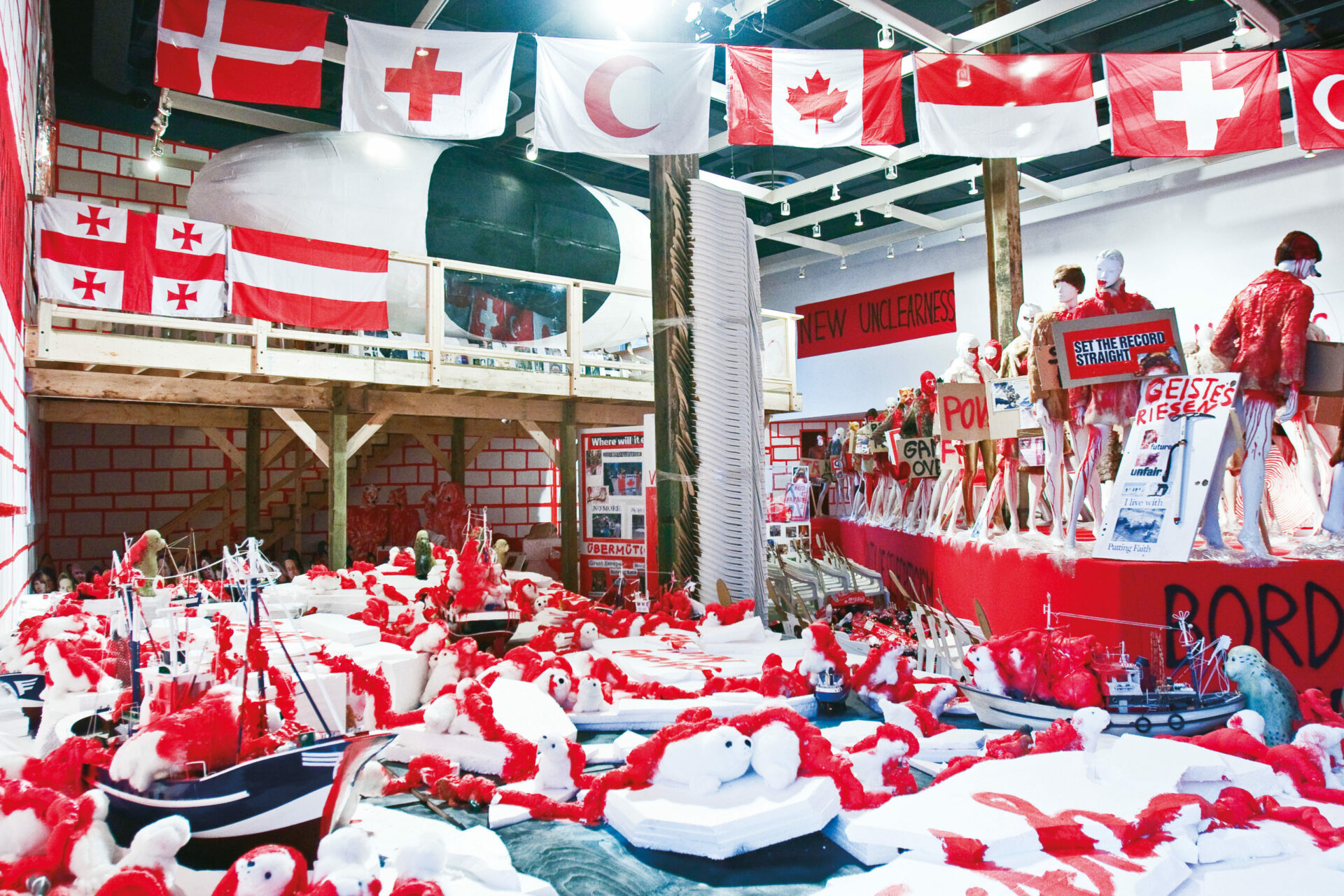
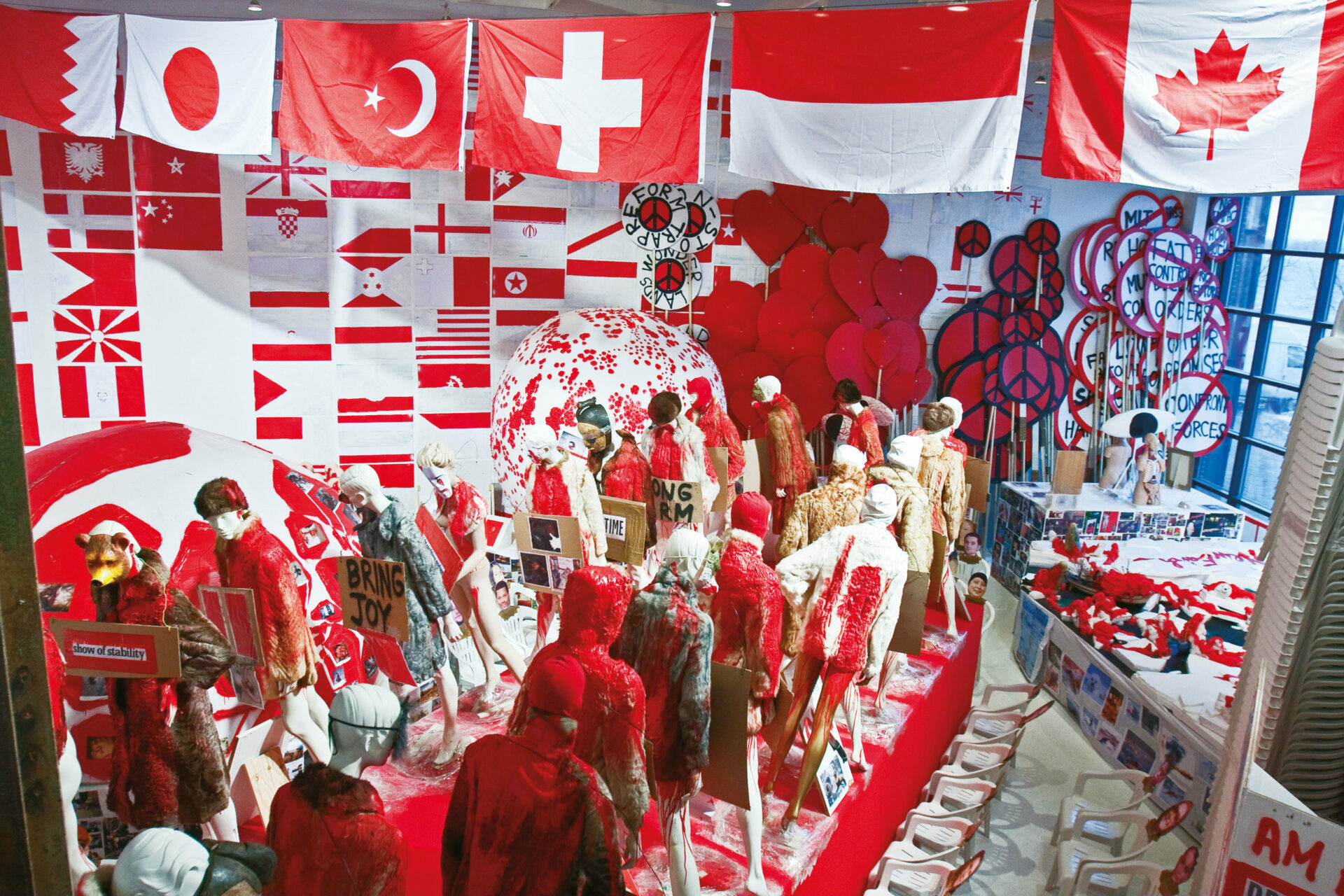
Das Auge (The Eye), 2008, The Power Plant, Toronto, 2011.
© Thomas Hirschhorn / SODRAC (2012)
Photos: Steve Payne
It is not only the animal body that is the subject of his discourse, however, as he has been using mock human bodies through his frequent inclusion of what he refers to as “subjecters.” In Hirschhorn’s discussion of his work the term “subjecters” refers to the mannequins he uses, which are either nailed into, cut up, or, as in Das Auge, dressed in fur coats which have also been sprayed with red paint. He traces the history of mannequins used as visual art material back to the Dadaists and Surrealists, and is inspired by these artists’ subversion of the mock body originally intended for commercial display.5 5 - Ibid. This artificial human body, which exists as a vehicle for commercial goods while being a commercial product itself, offers interesting material for discussing the contemporary body as it exists in a consumer society. It is also interesting to note that, as far as I am aware, he has never exhibited a seated subjecter. Might this perpetually standing up figure be drawn from his interest in resistance?
In dealing with human excess, Hirschhorn’s focus shifts from the individual to the multitude, whereby he expresses a concern for the effects of human disasters. It also signals a terminological shift, in which Hirschhorn no longer refers simply to consumption, but to hyperconsumption.6 6 - Abraham Cruzvillegas, “Thomas Hirschhorn,” BOMB 113 (Fall 2010). This shift towards a consideration of hyperconsumption extends his focus even further beyond the traditional criticism of consumption, including a consideration of the immaterial as well as the material. For both Das Auge and Crystal of Resistance, Hirschhorn has included large numbers of images of survivors and victims of disasters — from natural to military — many of which are low-budget prints and photocopies of images found on the internet. The low production values situate these images more in the realm of the everyday than fine art. Crystal of Resistance, his massive display constructed for the Swiss Pavilion at the Venice Biennale of 2011, had an abundance of banal objects — from televisions to Q-tips — combined and connected with cardboard, packing tape, and other household materials, much of which appeared quite precarious.
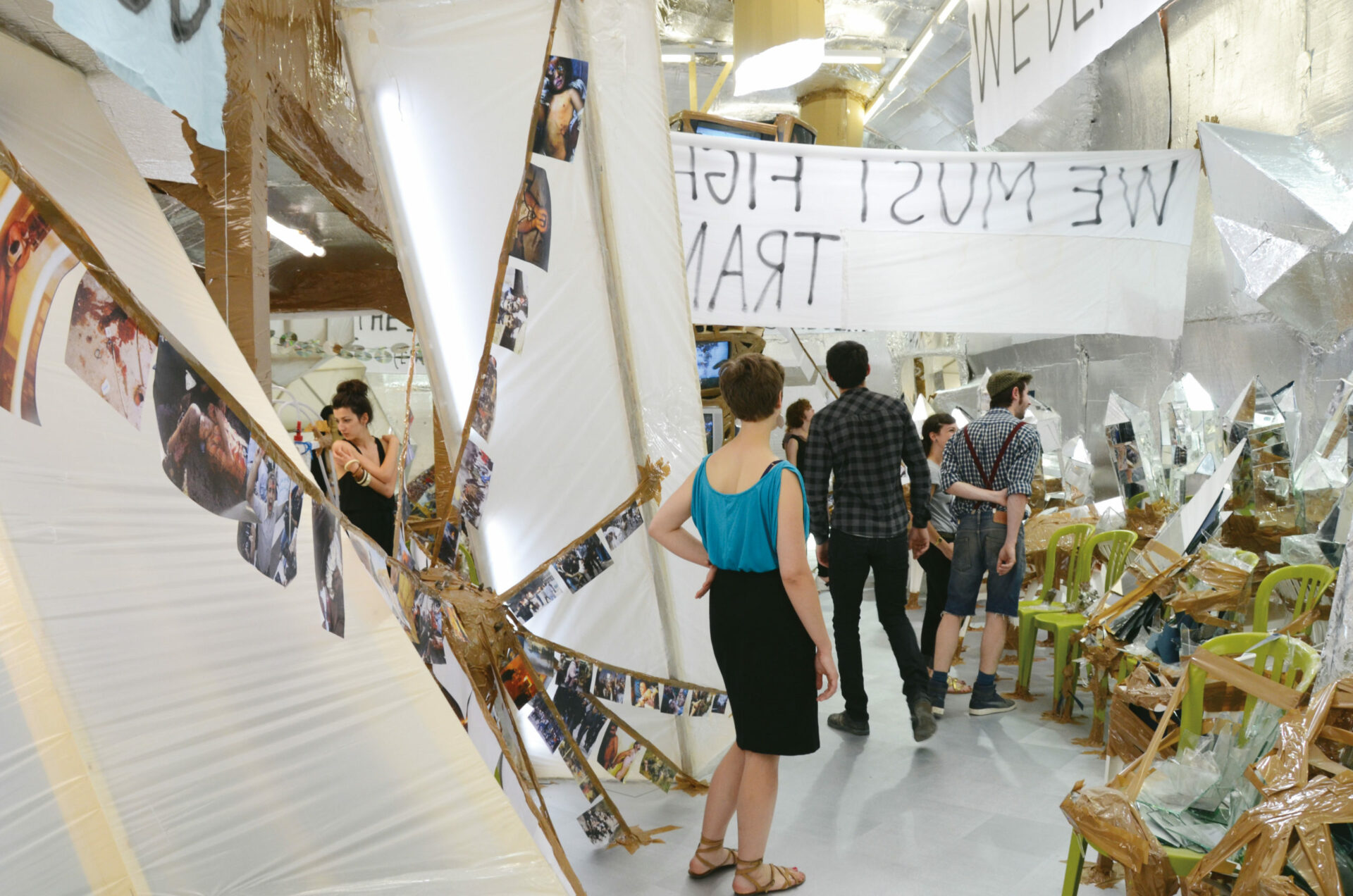
Crystal of Resistance, Biennale de Venise, 2011.
© Thomas Hirschhorn / SODRAC (2012)
Photo : Romain Lopez, courtesy of the artist
This precariousness is a central conceptual concern of Hirschhorn’s,7 7 - “Statement,” Crystal of Resistance website, last accessed January 7, 2012, www.crystalofresistance.com/statement.html and is vital to his interest in both crisis and hyperconsumption. This focus on precariousness and crisis is reminiscent of much current political and socio-economic thought,8 8 - Michael Hardt and Antonio Negri, Empire (Cambridge: Harvard University Press, 2001), see Part 2.1, specifically the section subtitled Modernity as Crisis, 74 – 78. and points towards the asymmetry of international relations that are becoming increasingly influenced by multinational capitalism.9 9 - Fredric Jameson, Representing Capital (London: Verso, 2011), specifically Chapter 7, Political Conclusions, 139 – 151. It is not only the disasters themselves that Hirschhorn addresses, but the hyperconsumption of images and stories focusing on these disasters.10 10 - Abraham Cruzvillegas, “Thomas Hirschhorn,” BOMB 113 (Fall 2010). Though the interpersonal exchange that is requisite in the various news and internet media networks where these images and stories are found is entirely immaterial, it is nonetheless a legitimate and significant form of hyperconsumption.
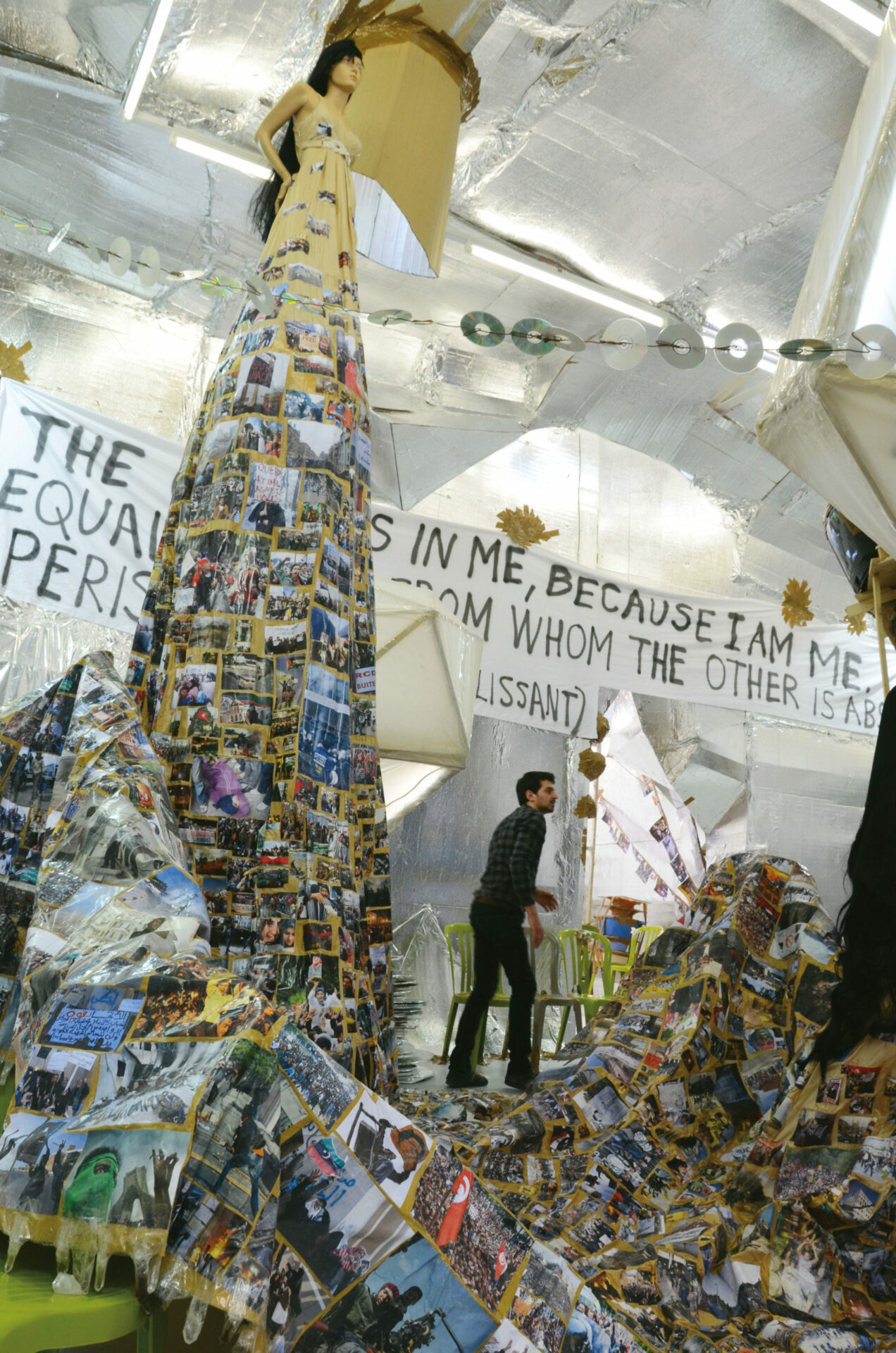
Crystal of Resistance, Biennale de Venise, 2011.
© Thomas Hirschhorn / SODRAC (2012)
Photo : Romain Lopez, courtesy of the artist
Related to his focus on human disasters is his interest in chaos as an approach to structuring his displays, as an indication of the form of hyperconsumption, and as a tool for resistance. Many of his displays appear to be haphazard, with no strict organizing principle beyond the abstract motifs that he has set forth, the motif being red for Das Auge and crystals for Crystal of Resistance. The displays address the themes and content discussed in a seemingly spontaneous and unorganized way. The themes are also often disrupted and broken. Rather than these contradictions taking away from the work, they manage to add to its existence as a paradox, as a work to be not read but explored.
These disruptions and contradictions also reflect society’s hyperconsumption of images and stories of these crises. With the instantaneity and simultaneity of contemporary news and internet communication, these disruptions and contradictions are almost inevitable. News reports and blog posts cannot possibly all be in accord with one another, and the plurality of perspectives is consumed, or rather hyperconsumed, at an unsettling rate.
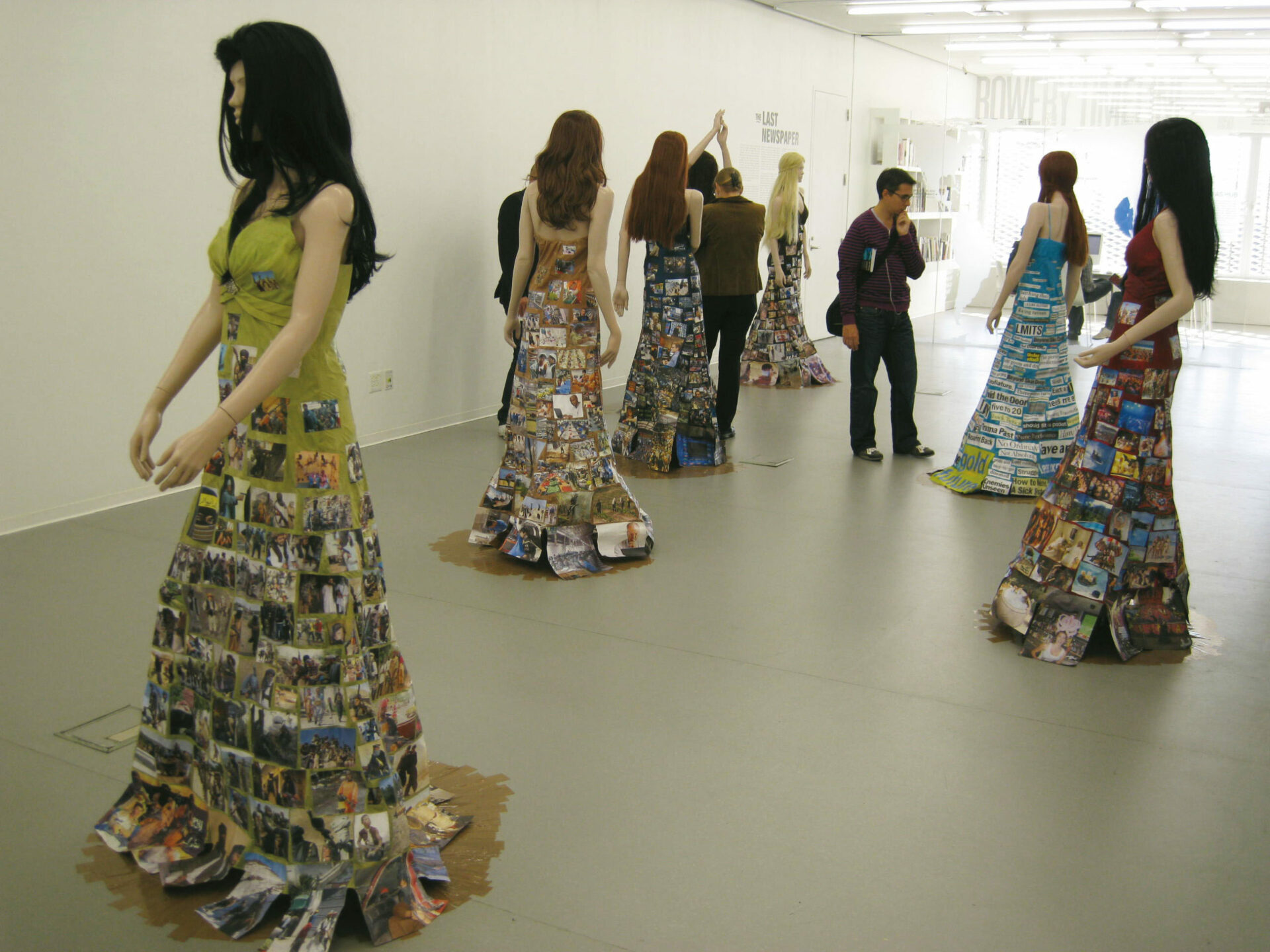
Subjecter, New Museum, New York, 2010.
© Thomas Hirschhorn / SODRAC (2012)
Photo: courtesy of the artist
Hirschhorn also values chaos for its relationship with resistance. He argues that, “chaos is a tool and a weapon to confront the world, which is chaotic, but not in an attempt to make it more calculated, more disciplined…”11 11 - Abraham Cruzvillegas, “Thomas Hirschhorn,” BOMB 113 (Fall 2010). Here, it is chaos not only as a means, but as an end as well; an end that is resistant by way of being chaotic. Chaos as resistance seems to be linked with his use and discussion of the internet, with its rhizomatic, almost chaotic nature. But his interest in the internet appears to extend beyond its bank of images and information to be used for the construction of his displays, beyond its existence as a medium for hyperconsumption. The internet can also be considered a tool for resistance. The internet’s role in recent political protests and revolutions such as the Arab Spring and Occupy movement attests to this. Even in his own practice Hirschhorn uses the internet to offer alternative perspectives and modes of resistance. In conjuction with his Crystal of Resistance exhibition he created a website.12 12 - Website address is www.crystalofresistance.com — note that the website was deleted at the end of January, 2012. The website featured a large number of preliminary sketches for the exhibition, images, and a video of the exhibition itself, as well as text that related to the exhibition, both by himself and other art critics. The site furthers and enriches any experience of the exhibition, while also allowing visitors to enter into the political and conceptual overtones of his work.
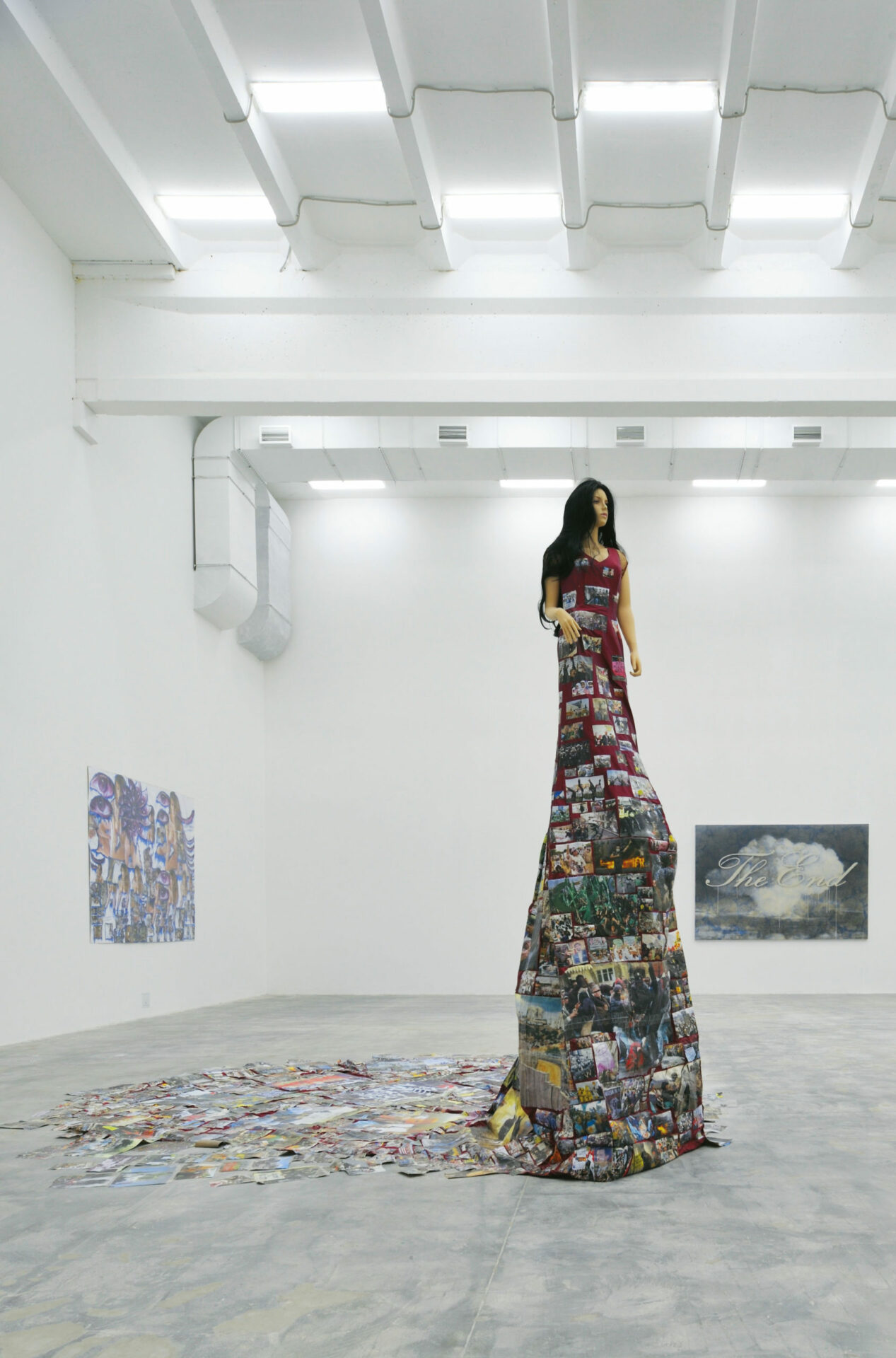
High Subjecter (Protesters) – Peril of abundance, Baibakov Art Projects, Moscou, 2010.
© Thomas Hirschhorn / SODRAC (2012)
Photo: courtesy of the artist
This point of entry is significant in relation to Hirschhorn’s desire to engage not only the art audience, but a “non-exclusive public.”13 13 - Thomas Hirschhorn, Crystal of Resistance flyer, 3. In Art & Multitude, a recently published work by the political philosopher Antonio Negri, the artist is described as the intermediary between “collective action” and “the event of liberation.”14 14 - Antonio Negri, Art & Multitude, trans. Ed Emery (Cambridge: Polity, 2011), 73. It is the alternative perspectives offered by artists that allow them to engage the public in a dialogue concerning modes of resistance and liberation. Hirschhorn seems to agree, as he has stated that this ability to connect and resist is a central, defining feature of the artist. As Hirschhorn writes: “Art — because it is art — is resistance.”15 15 - “Statement,” Crystal of Resistance website, last accessed January 7, 2012, www.crystalofresistance.com/statement.html


