
© Josée Dubeau / SODRAC (2012)
Photo: courtesy of the artist
Time is a compelling and elusive phenomenon, something that is undeniably, consistently present and inescapable, and yet always invisible and indefinite. We know that it passes, that we are lodged within it, but we can only ever see its effects, its contours, and never the thing itself. Time and space — how they might be experienced and made visible, their relationship to different kinds of systems and structures as well as to physical awareness and creative process — can be seen as central to the work of Canadian artist Josée Dubeau.
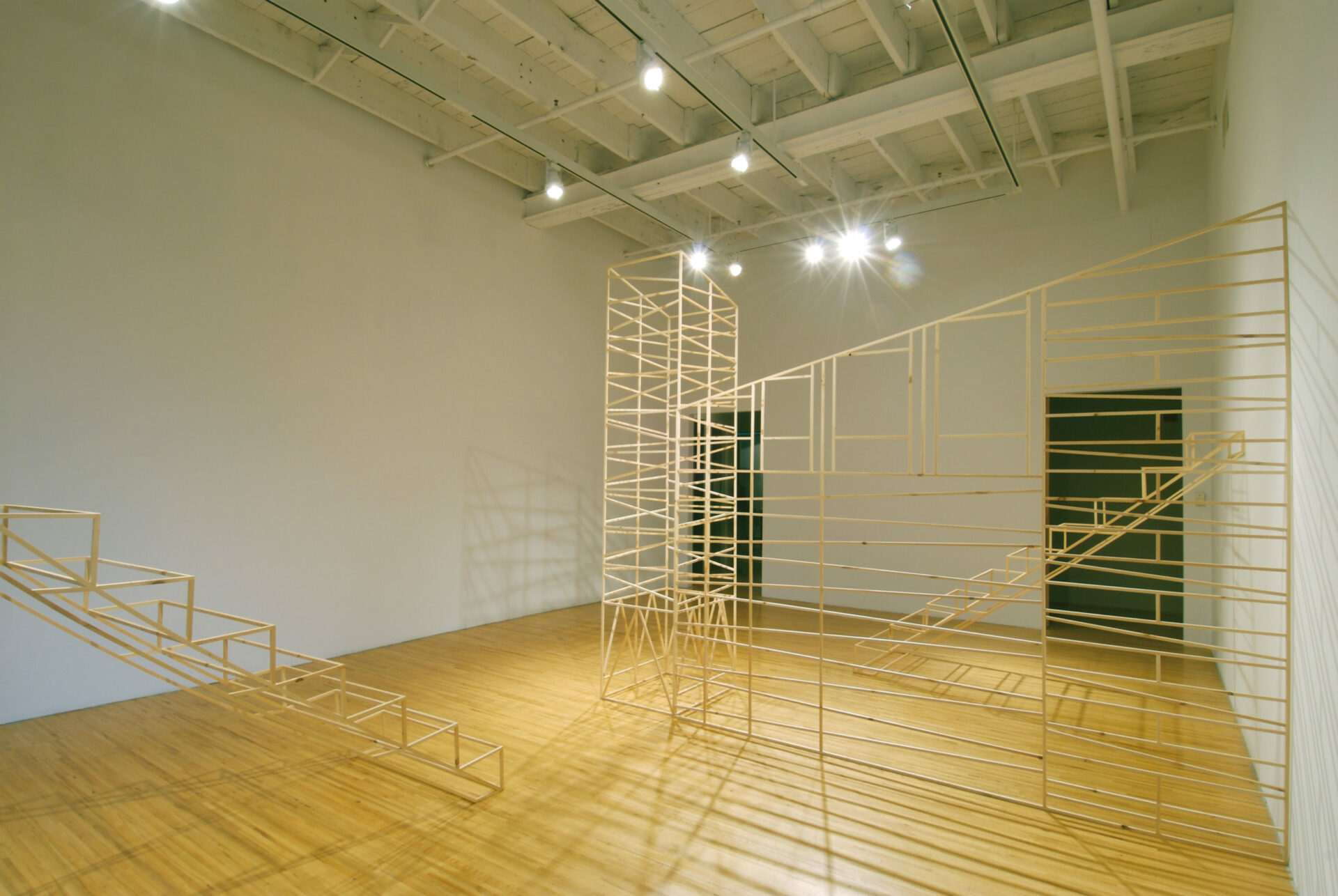
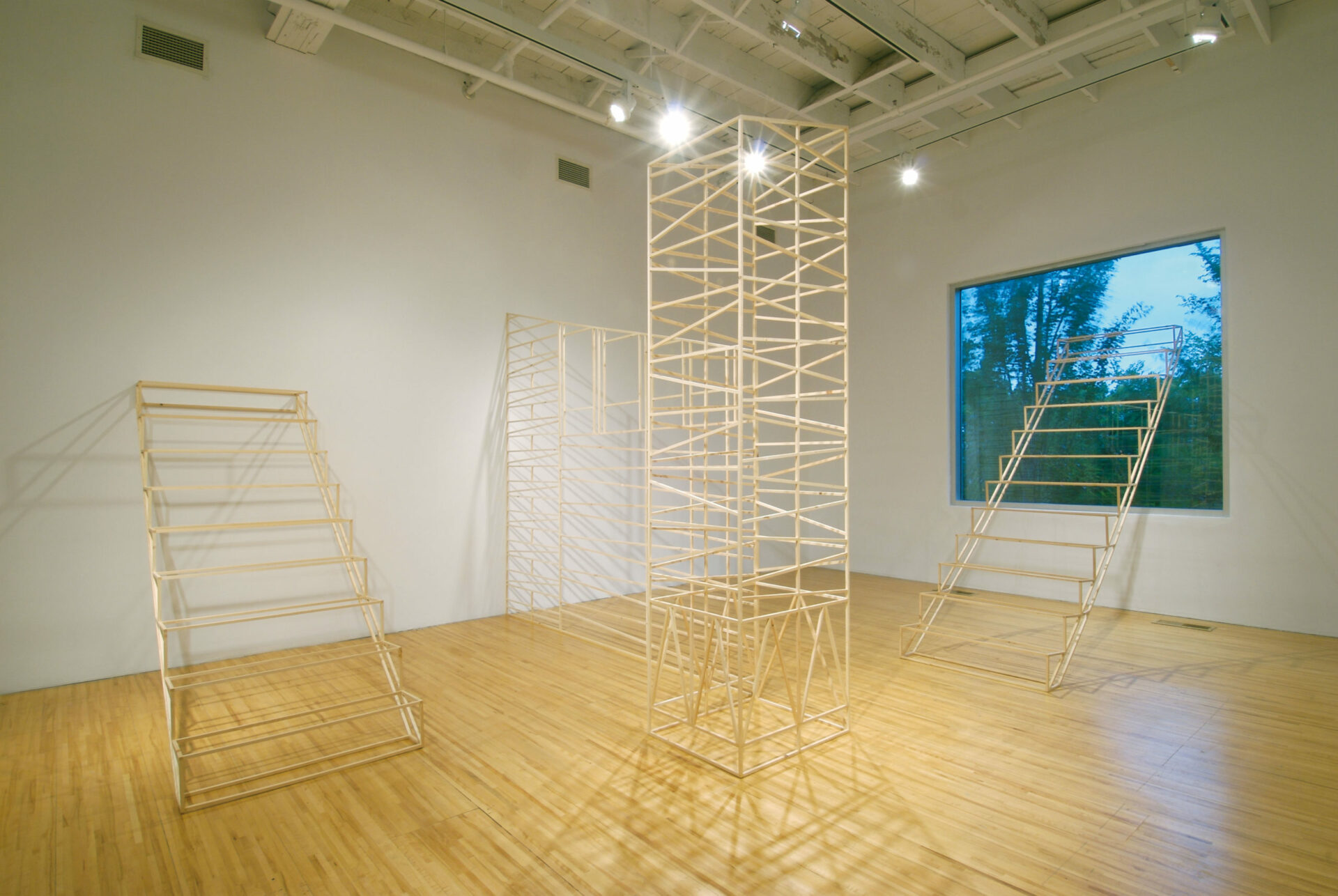
Dubeau’s work often takes the form of large-scale, site-specific installations that raise questions about space and how the human body moves through it, how we experience interiors and exteriors, presences and absences, volumes and voids. In each case a model or schema is adopted to provide rules, units, or systems by which the final structure will be ordered. The artist’s reference points are never arbitrary or entirely self-referential, but rather, recognizable touchstones of the contemporary world ranging from Rorschach blot tests (Dédoublement, 2008) to the generic architecture of public spaces (Espacement, 2004 – 5), and from IKEA home layouts (La Garçonnière, 2006) to Charles and Ray Eames’ model homes (La vie dans un cerf-volant, 2009). Elaborately built from thin pieces of wood (half-inch square pine batons) joined at precise geometric angles, the constructions seem to be both solid and transparent tracings, or diagrams, of themselves: representations of familiar forms and structures then made alien through Dubeau’s use of medium and visual language — empty balconies that one cannot step onto (Pavillon, 2008); patio furniture that would break if used (Suburbia, 2007); walls that are physically impenetrable but through which can be seen the other side. Earlier non-baton-based work similarly relates to the architecture of public space, albeit with more of an interest in social alienation, failed or impeded communication: turnstiles to nowhere (Les Éoliennes, 1997); conference tables with chairs lodged within the centre (Le Procès, 1992); or, with glass panels separating each seating place from the others, like individual yet connected ticket booths (La Table Ronde, 1994).
If these works might be considered interpretations of systems and structures that reveal an insistent desire to explore and problematize the properties and values of space by tracing its human-devised architectures and outlines, it is in a recent series of drawings that Dubeau further extends this interest to “time”: time as abstract and unquantifiable; time as the subject of various systems and structures; and time as a physical, notional, and creative investment, as something that can itself be contained or made manifest in an image.
Calendrier, large scale intervention, Tate Modern, London, 2011.
© Josée Dubeau / SODRAC (2012)
Photos: Grégoire Eberley
During a six-month residency at SPACE studios in London, UK, Dubeau turned to drawing to realize a project that in many ways represents a distillation of the thematic and aesthetic concerns of her wider practice. Based on an extremely specific set of tools — a ruler and a drafting instrument for watercolours designed for precision use by architects — Dubeau established a meticulous and time-consuming approach that would dictate how she would execute the drawings. Some are more particular or rigid in their rules than others, but each — like her previous work — makes reference to visual languages of measurement or quantification: grids, rulers, charts, schematic, diagrams.1 1 - Interview with the artist, July 2011. Unlike the artist’s installations, however, the drawings are pared down to the barest bones possible, stripped of specific referents so they might represent any number of things, a universal or interchangeable armature.
In some works, the ruler has been placed across the longer horizontal of the page twice, creating two parallel lines through its centre (Étude Chronométrique, 2011). Across each line, above or below each increment on the ruler, has been drawn a slight, but sure, vertical stroke varying in length, distance from origin, and often colour. Others consist of lines of different lengths crossing the page up, down, and diagonally, intersecting to make squares and rectangles of various sizes, all forming a large network of connected shapes on an irregular grid that somewhat resembles a set of closed circuits or an elaborate, if circuitous and indeterminate, information flowchart (Calendrier, 2011). Yet another, even more intricate drawing comprises three separate, differently sized and shaped blocks made of interlocking squares, some with lines stretching out on a diagonal into the blank white of the paper below (Charte Organisationnelle, 2011).
Dubeau is reluctant to say the drawings are based directly on any specific pre-existing models, although she mentions influences as varied as the periodic table, diagrams of mushroom growth, and a book that traces the different ways in which time has been kept and visually represented by different ages and societies.2 2 - Ibid. From different angles or points of view, one might also be reminded of musical scores, sound waves, seismic charts, computer systems and networks, communication diagrams, family trees, maps, 3-dimensional models or any number of systems or structures that underpin the many basic modes of contemporary human life.
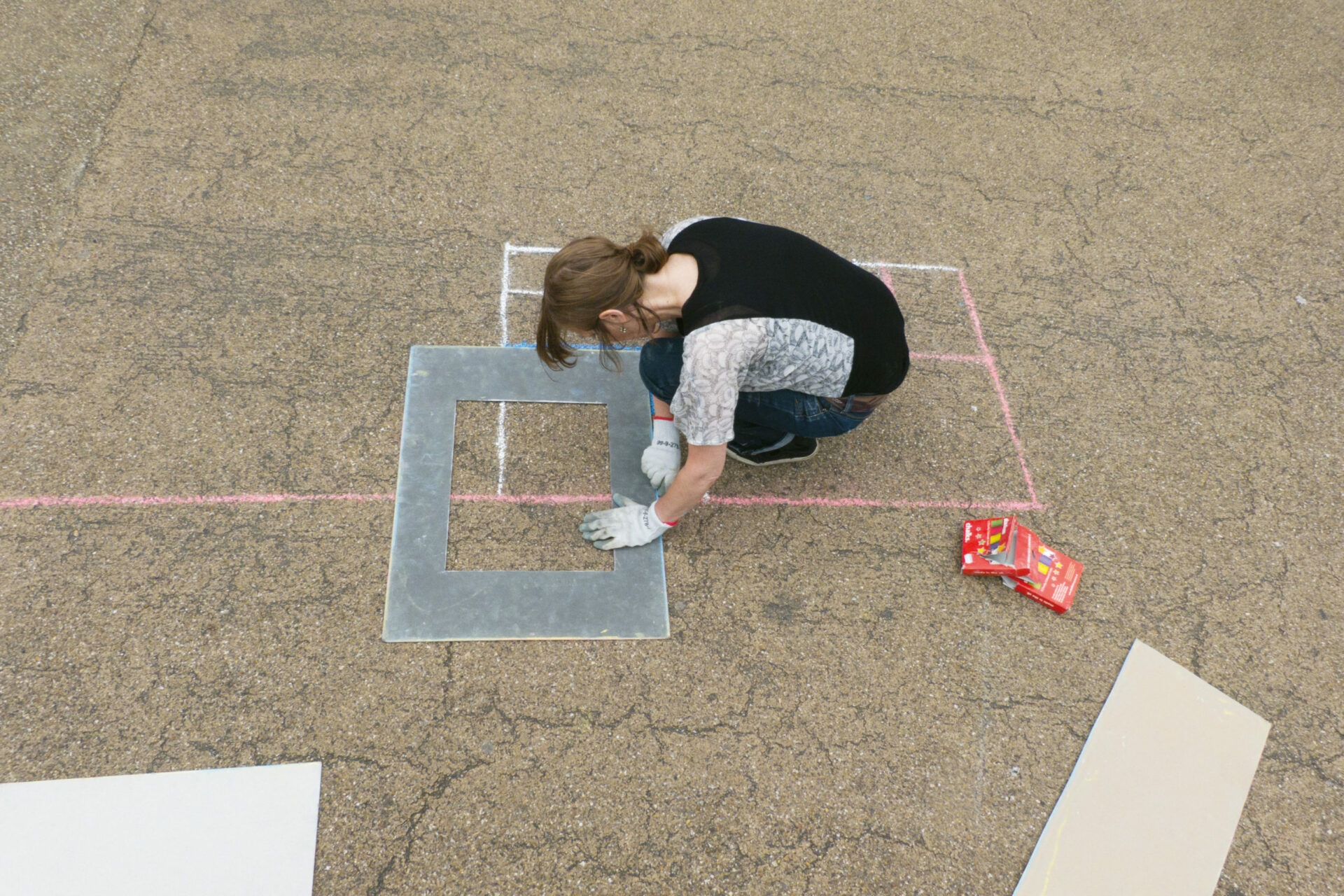
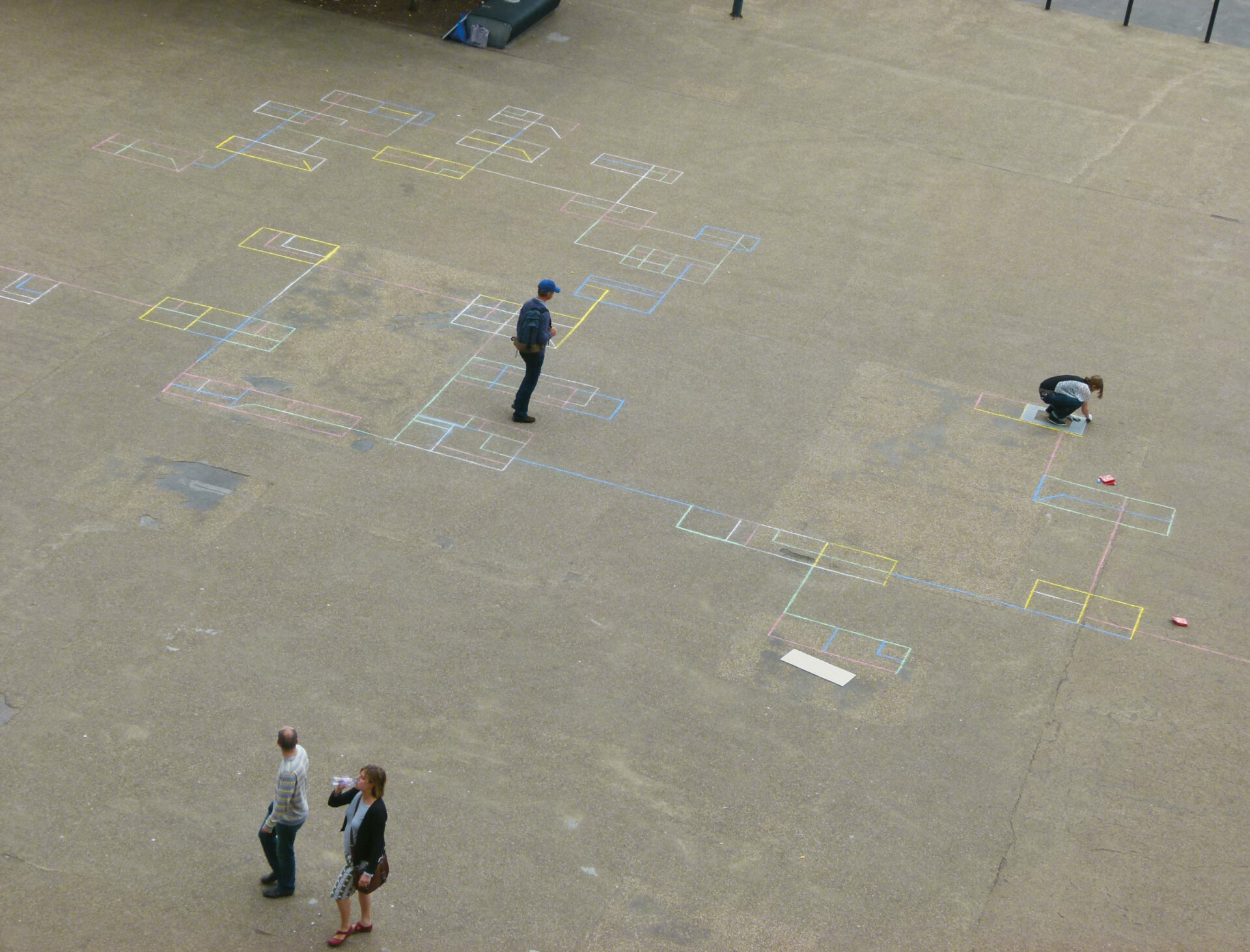
Calendrier, large scale intervention, Tate Modern, London, 2011.
© Josée Dubeau / SODRAC (2012)
Photos: Grégoire Eberley
Indeed, it is this ambiguity that is central to the drawings and perhaps what makes them so compelling. Simultaneously referencing and obfuscating the recognizable and specific, Dubeau’s series of delicate coloured lines, shapes, and forms begin to appear like typologies or topographies, elemental building blocks, palimpsests of all taxonomies from the organic to the inorganic. As such, the manner in which the artist executed them — using a set of specific instruments and self-imposed rules — is also significant. It is not just the form and content that implies the serial and the modular, and therefore repetition and the possibility of the infinite. It is also process which becomes a system under scrutiny: the work gives rise to its own concepts and theories and then, structured according to these, sets itself into motion. It is this element of the self-generative, as Dubeau’s practice defines its own parameters and subjectivity, that seems to indicate the possibility of endlessness, of the interminable, as though the large sheets of paper on which the works exist could continue to unscroll ad infinitum.
Here, in Dubeau’s process, lies the relationship to time and its slippery if unrelenting nature. In the artist’s sculptural work, although the labour involved is evident in the intricacy of detail and construction, it is largely the body of the viewer that is in question, that is, his or her physical experience of navigating the proposed spaces, situations, and architecture. In her drawings, however, it is the artist’s body that is directly implicated, it is in fact part and parcel of the works themselves. Due to the particular qualities of her chosen tools and method, certain elements of the pieces are necessarily predetermined: the time needed for watercolours to dry; the hyper-vigilance required to preserve the outline of each approach; the length of lines or size of shapes dictated by and entirely contingent upon, the artist’s body and gestural ability. Each gesture, each line, is a second, a moment, a record of time meted out, of effort exerted.
Bruce Nauman frequently spoke of his early studio-based video works as attempts to make something abstract palpable, or different manifestations of “the way[s] of filling up a space and taking up time.”3 3 - Bruce Nauman, in conversation with Willoughby Sharp (1970), in California Video: Artists and Histories. ed. Glenn Phillips (Los Angeles: Getty Research Institute, J. Paul Getty Museum, 2008), 185. Demarcating particular spaces within the studio in which various types of actions, routines, or patterns would be carried out, Nauman employed the body and basic elements such as line, rhythm, duration, repetition, as a means of evoking larger notions and properties of time and space. In Dance or Exercise on the Perimeter of a Square (Square Dance) (1967 – 8), for instance, the artist moves methodically around the perimeter of a square marked on his studio floor in tape, each pace stretching half the length of a side and taken according to a barely audible metronome ticking back and forth in the distance. As Nauman traces the physical space of his studio, he also traces an expanded notional space of creative process: that time and movement, duration and endurance, are manifest, alive inside their visual representations. Later works like Stamping in the Studio (1968) and Wall-Floor Positions (1968) are literal and extended depictions of their titles, stretching the relationship of time and process even further, as each is more than an hour in length.
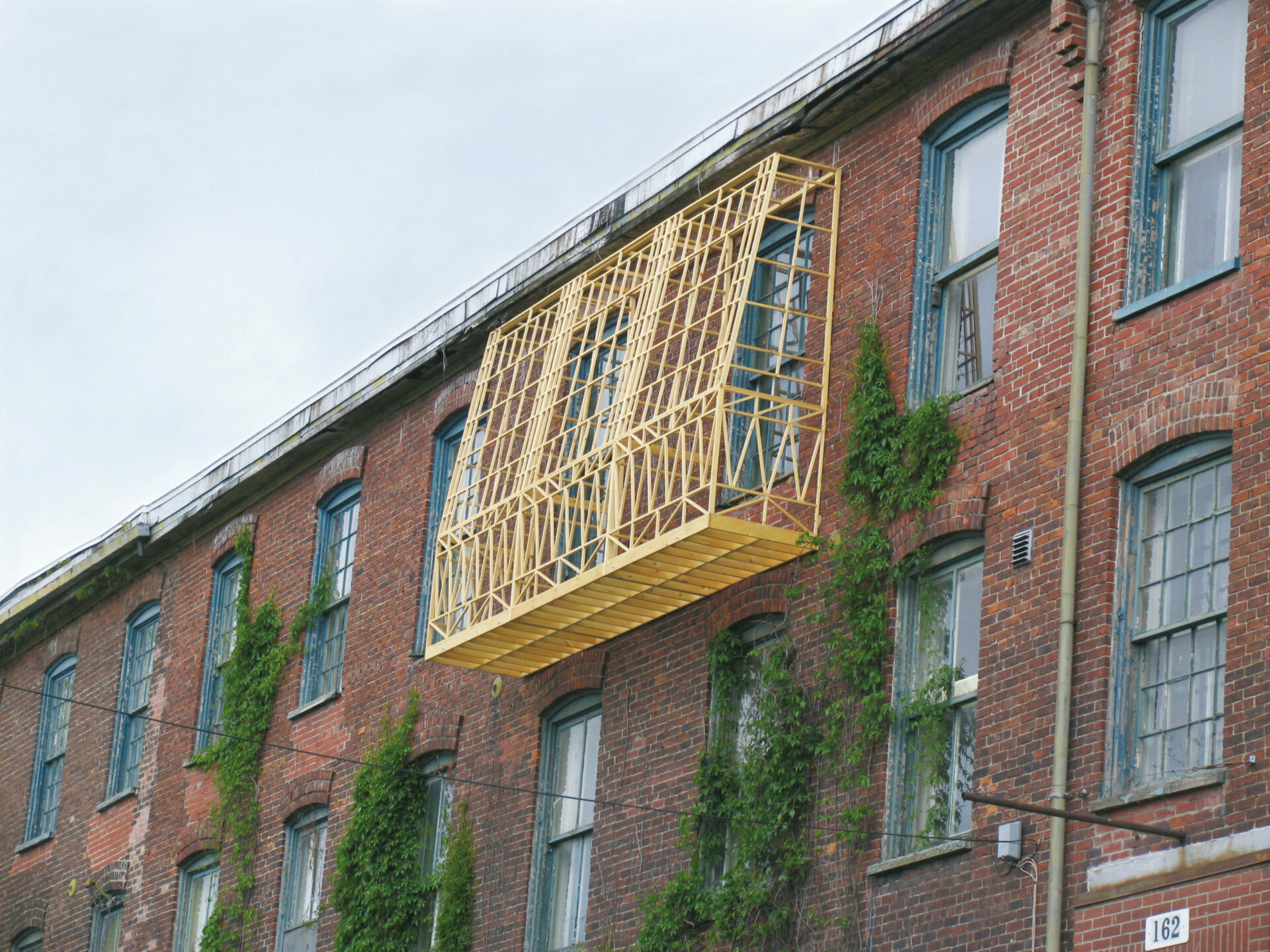
Pavillon, Le 3ième Impérial, Granby, 2008.
© Josée Dubeau / SODRAC (2012)
Photo: Nina Dubois
In a sense, Dubeau’s work is invested in the same endeavor: establishing a practice that problematizes notions of time, both real and abstract, by developing a visual language and artistic process that creates a separate or autonomous sphere of time and being within it that exists on its own, according to its own parameters. The artist’s repeated and repetitive gestures act as tracings, or indexes, of time and space, representations of how creative process might strive to confront, negotiate, and translate each in visual terms; a new means by which to test and reconstitute absolute values and to question their relationship to the body and to systems of representation. As such, the drawings can be seen as time extracted and preserved, measured and frozen, extended and prolonged: they contain duration and a sense of time-consciousness, as well as implicit references to endurance, discipline, the solitary body, and slow, careful rigour. Maurice Merleau-Ponty writes, “it is of the essence of time to be not only actual time, or time which flows, but also time which is aware of itself.”4 4 - Maurice Merleau-Ponty, The Phenomenology of Perception, trans. C. Smith (London: Routledge, 1962), 426. As such, Dubeau’s work can be seen as an instance of time being turned back or inwards, a representation of the “archetype of the relationship of self to self.”5 5 - Ibid.
If there is an element of the tautological here, it is through Dubeau’s use of precise technical tools and ultimate reference to familiar — if abstracted — structural forms that extend the relationship of the drawings to the wider realm of human experience and understanding. Faced with the yawning void of time in one’s empty studio or the infinite possibilities of artistic creation, one might establish rules, an approach by which to harness something vast and only slightly apprehensible. Similarly, in a world of immense physical spaces, bodies of knowledge, and complicated arrays of relationships, we use systems, quantifications, theories, and sets of rules to understand ourselves as beings in both physical and notional relationship to them. We strive to find means by which to anchor ourselves, to make visible and understand the abstract, even if just partially, tangentially. Much of Dubeau’s work highlights this human obsession with ordering, compartmentalizing, and demarcating, as well as its ultimate shortcomings and failures. To ultimately expose, perhaps, that as Wittgenstein wrote of phenomenology, so it might also be with time: “there is no chronology, only chronological problems.”6 6 - Ludwig Wittgenstein, Remarks on Colour, trans. L. L. McAlister and M. Schättle (Oxford: Basil Blackwell, 1977), 53.
Towards the end of her residency in London, Dubeau had the idea to expand her drawings and situate them in the wider environment. Quite literally, she sought an outdoor space and different, bigger tools with which to replicate large-scale versions of what she had been working on in the studio, her intent being to make the grids life-sized, big enough for bodies to walk through in an open space, much as we casually move through many types of grids each day, both consciously and unconsciously. With appropriate reference to the fine arts related context of her project, Dubeau chose the wide expanse of pavement in front of the bankside entrance to Tate Modern.7 7 - Interview with the artist, July 2011. Using large squares of stiff card and thick pieces of coloured chalk, she drew — as in the paper works — series of lines to produce interconnected squares and rectangles joined by single lines that organized all the shapes into a grid-like pattern.
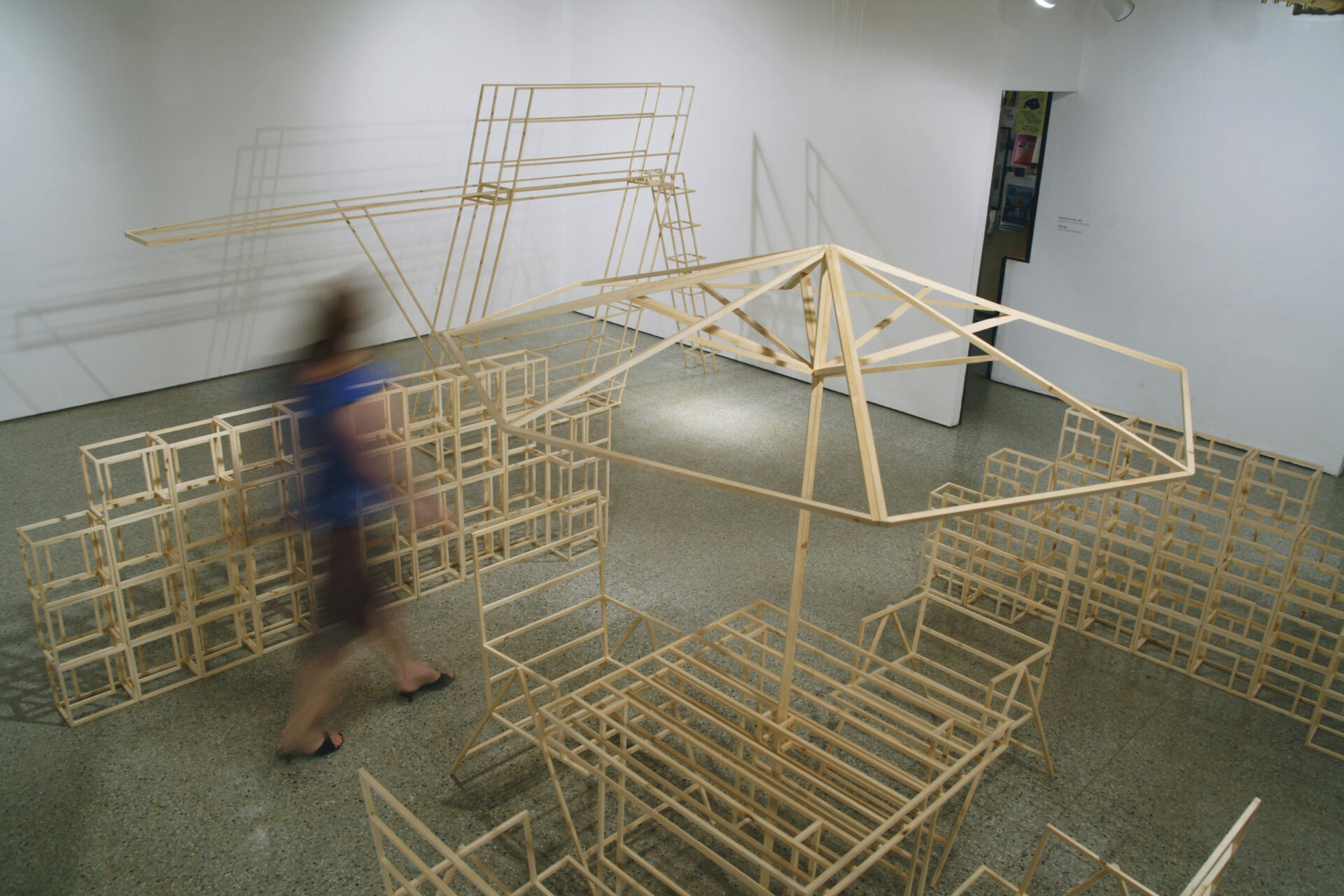
Suburbia, Saw Gallery, Ottawa, 2007.
© Josée Dubeau / SODRAC (2012)
Photo: courtesy of the artist
In an ironic turn, Dubeau’s activity was brought to an abrupt halt as the Tate Modern staff and security guards informed her that she was not allowed to continue, that this particular demarcated space was not intended for this type of public use or demonstration. Tate Modern is a particularly significant location in this instance, as it represents the most powerful, definitive, and officially sanctioned voice of international Modern and Contemporary Art in the United Kingdom. Dubeau’s attempt to execute a piece of work against this backdrop, as well as its ultimate thwarting or failure, perhaps places her directly within and against a number of questions about art institutions. Namely, that they have their own structures of Art and Art History, chronology, and hierarchy, along with social, political, and cultural obligations which include only certain carefully endorsed avenues by which artists and the public alike may access or engage with them.
As Dubeau’s work often suggests, even as we rely on the establishment of systems and structures to order and make sense of the world, both these constructions and we who have devised them, often fail to acknowledge their inability to incorporate a sense of play, freedom, and self-awareness or critical distance. Dubeau’s practice, and this instance or intervention in particular, can be seen as a negotiation of how to incorporate spontaneity and a sense of the inquisitive into an otherwise strictly delineated process and external framework. The outcome at Tate is almost an exercise, a visual or performative schema in itself — an example of the individual, but also the artistic, experience within any of the many structures that shape our day-to-day in ways we are aware of, but often forget to notice or acknowledge as deliberately devised versus naturally occurring. The arbitrary necessity and the necessary arbitrariness of systems and structures as they relate to time and space and our various coordinates and loci reside within them.


