photo : Guy L'Heureux
Is it all that surprising that scale models have likely always been an object of fascination for the human mind? Children’s games confirm the human inclination to make small-scale reproductions of objects whose large dimensions are often difficult to see or apprehend. So familiar is the miniature’s virtual representation of the world, we sometimes forget its fictional nature. The small-scale model is indeed founded on the conventions of verisimilitude, which, while implicitly assimilating the object and its representation, allow one to play on differences of nature and scale, thus enabling effects of simulacra, which postmodern art and thought are particularly fond of.1 1 - Jean Baudrillard, Simulacra and Simulation (Ann Arbour: University of Michigan Press, 1996). On the notion of simulacra in art history, see Michael Camille, “Simulacrum,” in Critical Terms for Art History, Robert S. Nelson and Richard Shiff, eds. (Chicago: University of Chicago Press, 2003), 35-48.
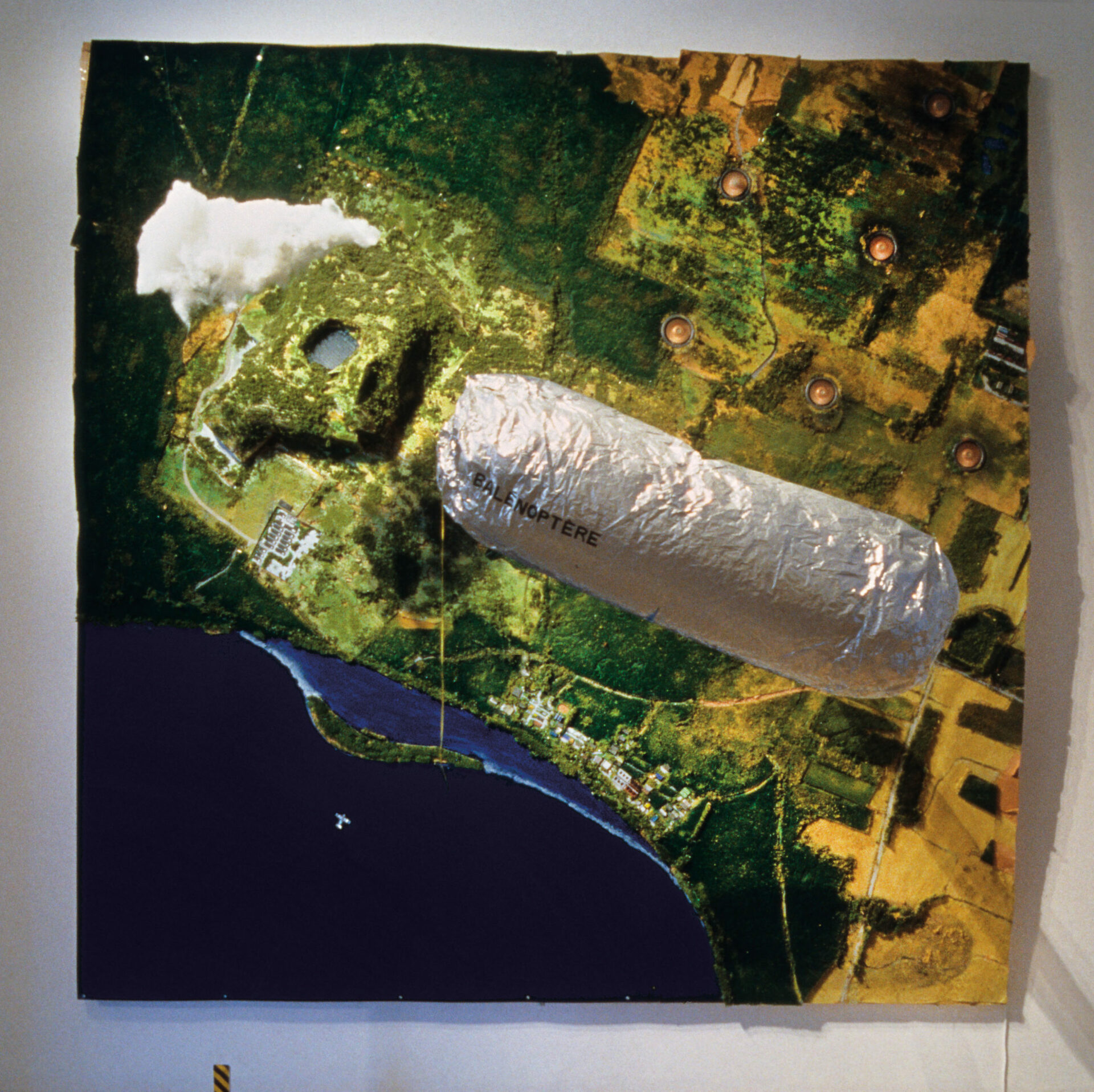
In recent years, many artists — among them, Kim Adams, Oliver Boberg, Christian Carez, Philippe De Gobert, Stéphane Gilot, David Hoffos, Holly King, and Bernard Voïta — have exploited the possibilities afforded by models, sometimes in conjunction with video and photography, with respect to dissimulation and the refraction of the real.2 2 - Camille Morineau, “Images du soupçon: photographie de maquettes,” art press, No. 264 (January 2001): 33-40. In this group, Daniel Corbeil, known for his landscape models, is one whose production, both installational and photographic, has been readily associated with the idea of simulacra.3 3 - John K. Grande, “Daniel Corbeil,” Artforum (October 1998): 131. Driven by thoughts on the rapport between nature and industrial development,4 4 - On this topic, see John K. Grande, Balance: Art and Nature (Montreal: Black Rose Books, 1994). particularly the transformations that urbanization imposes on northern environments, Corbeil’s work has, since the 1990s, explored various facets of simulation in the form of maquettes and scale models.5 5 - On this subject, see Jocelyne Fortin, L’art du canular, booklet accompanying Daniel Corbeil’s exhibition “Machine volante, leurre et réalité,” presented at the Musée régional de Rimouski, from June 19 to September 11, 2005. While it is difficult to take into account Corbeil’s entire production — tied as it is with the scale model paradigm — one can nonetheless highlight some aspects of his work on formal representations of the effects of global warming on the countryside.6 6 - The very title of his recent exhibition at AXENÉO7, “Maquettes et autres dispositifs climatiques” (February 3 to March 7, 2010) underlines the artist’s use of the miniature in the framework of environmental concerns. Environmental concerns, though not the sole focus in the artist’s production, are prevalent throughout his use of and singular engagement with reduced scale models. At a time when computer technologies foster an increasingly abstract and, in some sense, disembodied projection of the model, Corbeil takes the opposite tack. He embraces complexity, detail, and texture, thus providing a sensuously generous experience,7 7 - Gentiane Bélanger, “Faire avec la nature des choses,” ETC, No. 88 (2010): 4 and 10. as replete as the world the model is ostensibly reflecting. Suggestive in its way of both the mechanistic precision of Kim Adams’ installations and the poetic atmosphere of Holly King’s photography, this sensualist approach to modelled landscape emphasizes the materiality of the scale model; it recalls the golden age of film and television models,8 8 - This golden age occurred in the 1960s; see Derek Meddings’ 21st Century Visions (Limpsfield: Dragon’s World, 1993), devoted to Gerry Anderson’s model sets and puppet work, or “supermarionation,” for television. espousing the literalness of representation while transcending it by revealing the simulation. Indeed, through artifices of sculptural and photographic staging, Corbeil’s works are flagrantly obvious about the simulation, leaving spectators in admiration of the construction in its own right. Small renderings lack no breadth of vision: on the contrary, miniatures may encompass things which, by their size, often escape our perception, just as the telescope or microscope can bring the infinitely distant or infinitely small into light. Favouring that most improbable of human experiences — aerial perspective — Corbeil practices a somewhat expressionistic form of model-making. His excruciating attention to detail interrogates the assumptions of the spectator’s perceptions. Since the miniature, in many respects, can seem more real than life, it speaks to our way of apprehending the world, suggesting how constructed and artificial that apprehension is, more indebted to current images than to true personal experience. In other words, the “realist” attributes of Corbeil’s landscapes are not meant to create a seamless illusion. It is all a question of scale; looking closer, one sees that the overall effect is a sham, because not only are the model’s components eminently constructed, they may even be foreign to the environment they point to — whether natural or human. Thus, in Topographie aérienne du Moyen-Nord, site no 30 (2000), a hotchpotch of used objects — electronic circuits, various metallic objects, rugs — come together to form a whole that isn’t merely the sum of its parts, as evinced by the presence of the flying contraptions and the heightened sense of perceptual depth resulting from it. To ensure the illusion is flawed, Corbeil has also incorporated peculiar objects that break the realist convention and steer the apparently ordinary landscape toward other purposes, some in the realm of science-fiction — though we don’t quite know what to make of those strange propellers breaking through the earth’s crust.
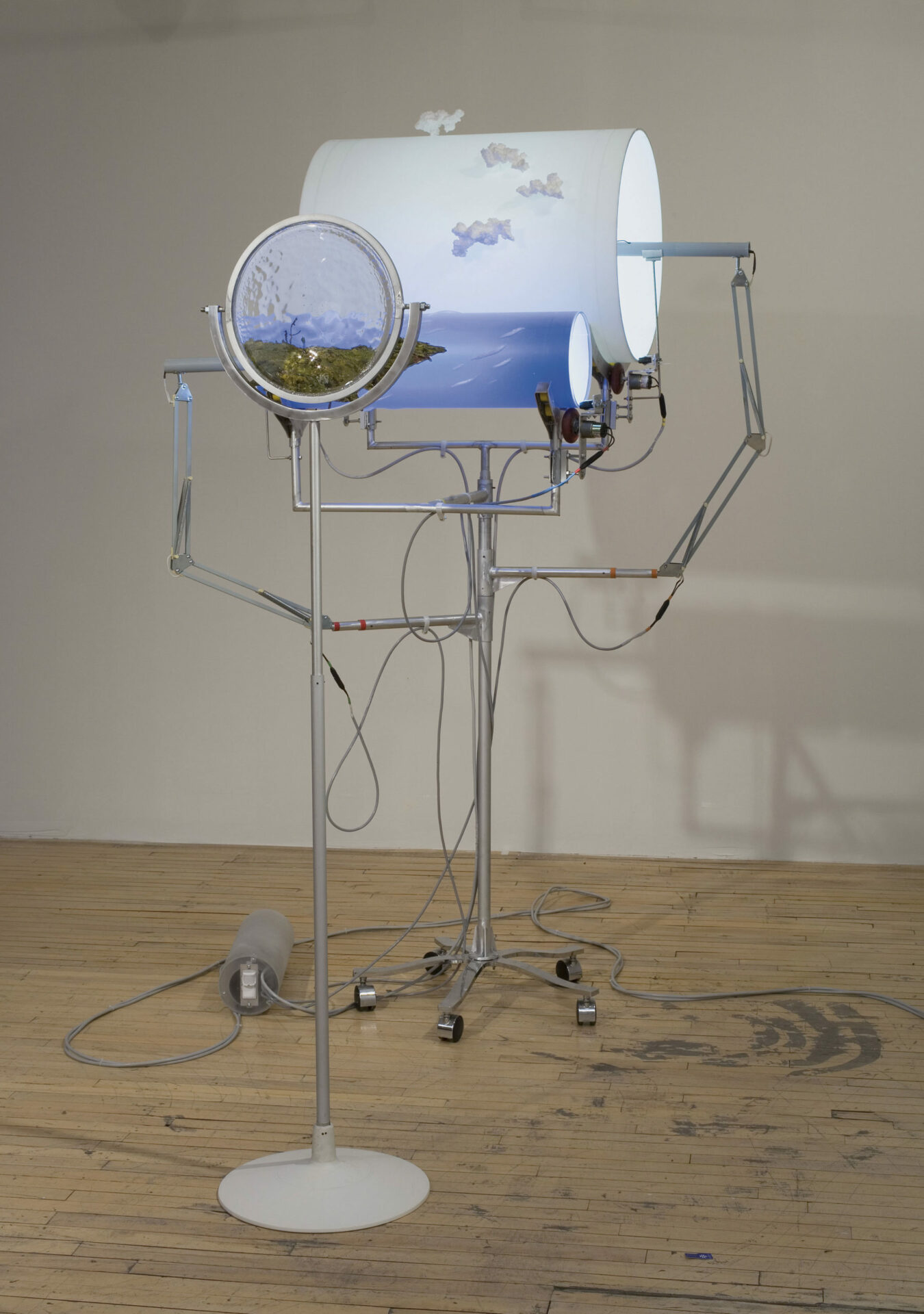
photo : Guy L’Heureux
In more recent works, Corbeil has exposed the simulacra further still, showing the “underpinnings” of the model. The scale model in Dispositif de paysage no 3 (2004), for instance, is presented with its staging apparatus: trestles, painted backdrop, lamps, camera equipment. The work leaves no doubt about the dissimulation, but without sacrificing the sense of lifelikeness resulting from the construction of the trees and mountain countryside. The procedure raises a smile. The device is obvious, but also makes one wonder about the veracity of the demonstration, since the photographic staging influences our interpretation of the scene. If it were masked or out of sight, the apparatus would obviously not have the same importance. Here, the simulation isn’t necessarily indicative of a fake; in the first place, it reminds us of the pitfalls of verisimilitude, while adding a layer of extra meaning.
Increasingly, his creative process accentuates the staging of scale models. In the installation Paysage en roulement (2007), spectators must peer through a lens, at a precise angle, at a fragment of landscape; it is a dynamic context where cylindrical rolls suggest the movement of sea and sky. At first glance, the model seems to occupy a very limited space in contrast to the elaborate apparatus. Closer examination, however, reveals that all this apparatus serves is the model, which appears to be at the centre, at the point of convergence of the installation. Indeed, the technical dimension only exists to serve the landscape, while subjecting it to an eminently artificial and minimal vision that only comes to life through the distortions of the lens. Things are not as simple as they seem.
280 x 280 x 300 cm, 2000.
photo : Daniel Corbeil
Continuing to expose the mechanism behind the staging, Corbeil’s work has recently drawn closer to the modelling used for scientific experimentation. In installations intended to simulate global warming, Corbeil was inspired by labs that use miniaturization procedures, like hydrographic models, to study such phenomena as coastal erosion. With Étuveuse climatique (conceived between 2004 and 2009), he developed a vaguely scientific device for illustrating the results of the greenhouse effect on miniature landscapes.9 9 - Jean-Philippe Beaulieu, “Daniel Corbeil. Paysages sous effet de serre,” Espace Sculpture, No. 70 (2004-2005): 39-40. Here the demiurge model maker assumes scientific garb, thus broadening the installation’s frame of reference and inextricably binding the model to the technical apparatus. The model, explicitly designated as such, is thus given another significance as an element of a larger whole. To insure the experimental value of his models, Corbeil employs malleable materials that are likely to suggest the environmental changes wrought by greenhouse gases. Hardened sugar, beaten egg white, chocolate and marshmallow all become elements of a landscape whose malleability (thawing of the permafrost, mud slides, etc.) is experimented on. Here again, the literal and the figurative commingle in a simulation that is the culmination of the scientific fiction that has fuelled Corbeil’s work from the very beginning.10 10 - John K. Grande, “Daniel Corbeil,” Sculpture, Vol. 23, No. 10 (2004): 74-75.
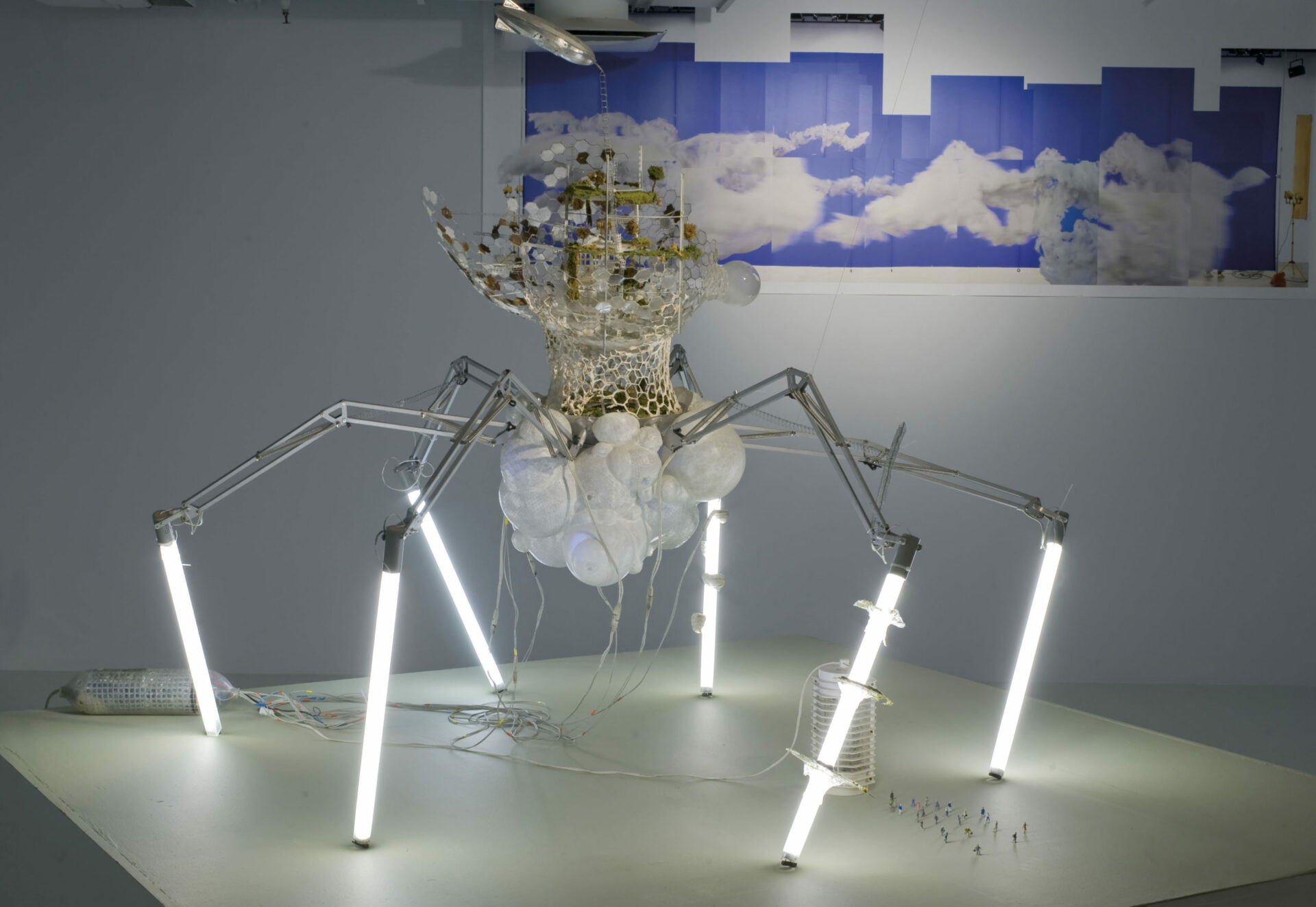
Recently, the artist’s work has engaged in architectural fictions that extend his reflection towards the place of human beings in both present and future ecosystems. Arthropolis, for instance, presented at Galerie des arts visuels de l’Université Laval in 2009, is a model zoomorphic city of the future that must roam the planet in search of dwindling resources: simultaneously a celebration of human technical genius and a sad observation of the darker side of that genius, leading the world to ruin. Reduced to a minimum (plane, grey surfaces of the base, photos of clouds), the landscape expresses a desolation overlaying the city, whose forms and arrangement recall the apparatus that served as framework for prior installations. It is as if the periphery had become the centre in the mise en scène. There is food for thought here about the boons and banes of the very same mechanical technology that allowed the artist to produce his installational simulations.
photos : Ivan Binet
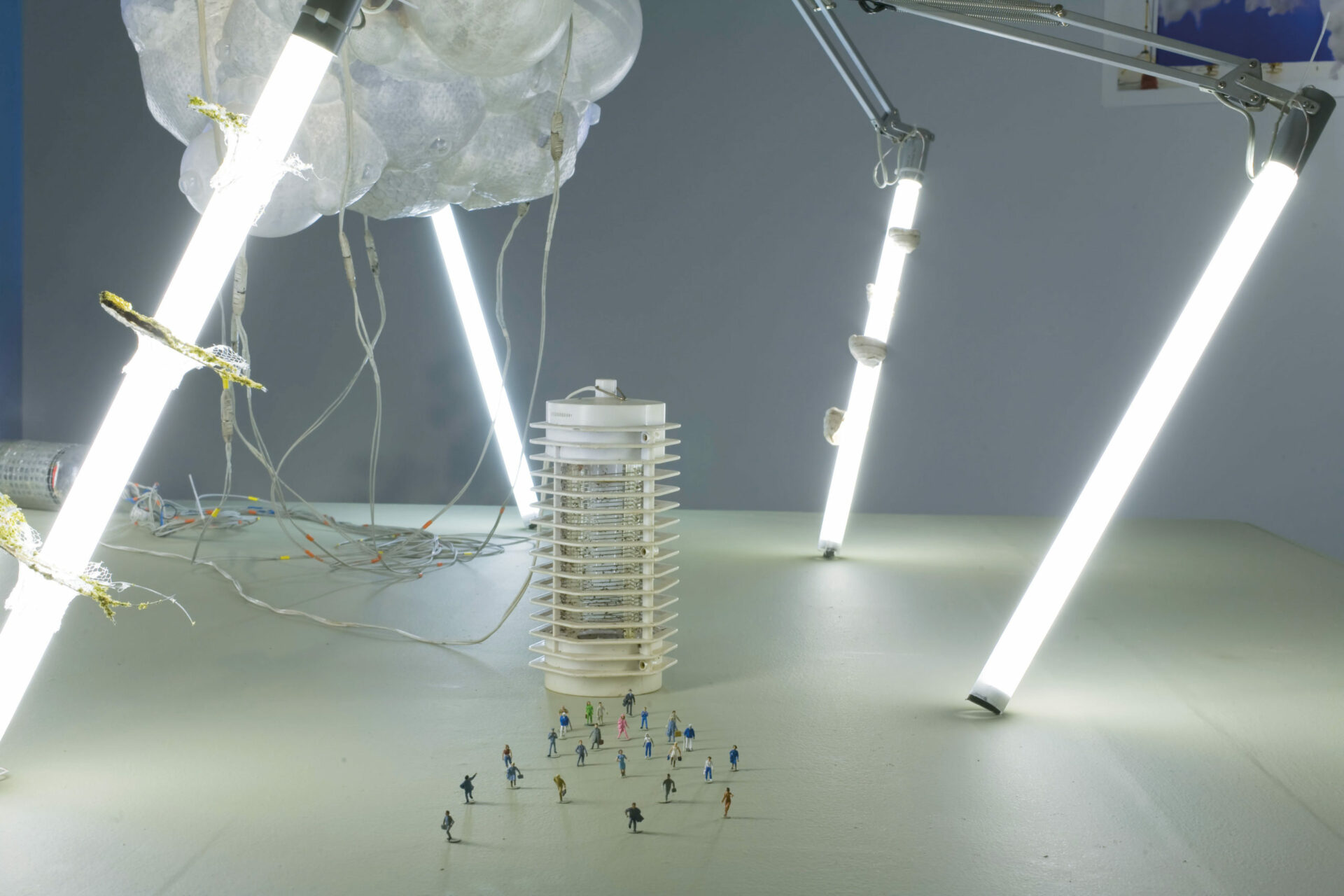
Environmental and ecological discourse abounds in this early twenty-first century; artist Daniel Corbeil’s intent is not simply to reproduce or illustrate such discourse, but to give it concrete form, leaving spectators the task of determining its truth and import. The common thread running through the artist’s production, beyond all the underlying ideas and ideological stances, is the insistence on the materiality of the model, which leads us, not without irony, to our human fascination with the model. Connecting the small with the large, the here with the elsewhere, the scale model gains its full meaning through that which it represents and modulates, allowing the artist — and by extension the spectator — to experience a childlike joy in reinventing the world by reproducing it on a small scale.
[Translated from the French by Ron Ross]