
photo : permission de l'artiste | courtesy of the artist, Schroeder Romero+Shredder & the Brooklyn Rail
In November 2009, the cover of the New York-based journal of art, politics and culture, The Brooklyn Rail, featured How the New Museum Committed Suicide with Banality (2009), a nowinfamous work by American artist William Powhida. It offered a scathing satire of the museum’s growing “cronyism,” and particularly its controversial decision to organize an exhibition of work from its trustee Dakis Joannou’s private collection. Dripping with sarcasm, this detailed pencil drawing is typical of Powhida’s creative practice, which frequently lampoons the contemporary art industry and its excesses, including its cult of celebrity, nepotism, and superficiality. In a recent article about Powhida’s work, Jeffrey Deitch, the well-known New York art dealer just named Director of LA MoCA, attributed these excesses to “the collapse between the avant-garde and mainstream pop culture.”1 1 - Jeffrey Deitch, quoted by Damien Cave, “Tweaking the Big-Money Art World on its Own Turf,” The New York Times, 9 December 2009. This statement, a pantomime of those made by modernists for the last 100 years, is ultimately inseparable from the very confused situation it seeks to describe — a sprawling, vapid scene coloured, in Powhida’s words, “by a deep sense of lack.”2 2 - Ibid.
Throughout the modern period, critical discourse concerning art that blurred the boundaries between high and low culture, art and life, was fraught with eschatology. For modernists, it signalled the end of good art (taste, morality), while for the avant-garde it promised the end of art altogether (sublation3 3 - The word “sublation” is the English translation of “Aufheben,” a contradictory German term used by Hegel that means to both keep and abolish. It thus corresponds to the avant-garde project of ending art by ending its autonomy from everyday life, an elimination whose paradoxical goal is to make life more like art., revolution). The insinuation or outright inclusion of excess decoration, pop culture or kitsch within the framework of high modernism was, and in some ways continues to be, a tried and true strategy for bringing lofty aesthetic categories abruptly down to earth, often revealing deep-seated biases towards race, class, and gender in the process. In this context, kitsch and the decorative function as a kind shadow — a nebulous place containing everything modernism refuses to admit. For Austrian architect Adolf Loos, this shadow was fascist, an aspect he unwittingly revealed by linking ornamentation with moral degeneracy and tattooed murderers.4 4 - Adolf Loos, “Ornament and Crime,” in Bernie Miller and Melony Ward, eds., Crime and Ornament (Toronto: YYZ Books, 2002), 29. For Clement Greenberg, it was an impostor, a plague of “vicarious experience and faked sensations” — the embodiment of “all that is spurious in the life of our times.”5 5 - Clement Greenberg, “Avant-Garde and Kitsch,” Art and Culture: Critical Essays (Boston: Beacon Press, 1961), 10. And for Harold Rosenberg, it was “weak mysticism” — the “easy painting” of artists who squeezed out predictable abstract “masterpieces,” creating what he called “apocalyptic wallpaper.”6 6 - Harold Rosenberg, “The American Action Painters,” The Tradition of the New (New York: Horizon Press, 1959), 34.
Kitsch and its related concepts thus represent what post-structural theorists like to call a double bind. On the one hand, they concern something banal and impure, a kind of cultural excrescence or refuse; and on the other, they are, in the words of Milan Kundera, a glittering “denial of shit,” a fantasy that “excludes everything from its purview which is essentially unacceptable to human existence.”7 7 - Milan Kundera, The Unbearable Lightness of Being: Twentieth Anniversary Edition, trans. Michael Henry Heim (New York: HarperCollins Publishers, 2004), 248. This tension of opposites — a potent mixture of excess and deprivation, desire and anxiety — endows kitsch with an at-times almost inexplicable power of fascination.
Although postmodernism embraced mass culture, commercial art, and the aesthetics of the “Las Vegas Strip,” its theory and criticism eschewed dialectical concepts like kitsch, privileging instead concepts of relatedness, such as pastiche, pluralism, and polysemy. The “end of postmodernism” is perhaps attributable to this denial of opposites, a neurotic splintering that has inspired numerous contemporary artists, art critics, and theorists to revisit dialectical theory, as witnesses the emergence of terms such as altermodern (Nicolas Bourriaud), hypermodern (Gilles Lipovetsky and Sébastien Charles), and supermodern (Marc Augé). Where such theoretical containers are absent or inappropriate, contemporary art is increasingly associated with a set of unsettled adjectives that include the Gothic, baroque, grotesque, and ugly. Although these terms are historically among the hallmarks of kitsch, a substantive consideration of the relevance of the latter in a contemporary context has yet to be undertaken. Such an endeavour would be worthwhile, as it promises to reveal nuances that have been overlooked in the rush to define a new epoch.
It would be foolish to attempt, within the confines of this short essay, to redress the apparent lack of rigorous theoretical attention currently being given to our understanding of kitsch and its role in a dynamic and evolving visual arts context. It is difficult to resist, however, the temptation to throw down some sort of gauntlet. Fortunately, the subject of bling-bling provides just such an opportunity. While on the surface the connection between kitsch and bling-bling seems obvious, upon closer inspection it is more complex. Although the definition of both words links them irrevocably to the double bind mentioned at the beginning of this essay — that of excess and deprivation — there are important differences in their relationship with authenticity, as well as aesthetic and institutional legitimation, to say nothing of their creative modes.
Throughout modernism, discourse concerning kitsch was unquestionably tied to concepts of purity and truth, as well as the crisis of legitimation brought on by the inversion of aesthetic and institutional hierarchies known as avant-gardism. In many ways, this polemic reached its apogee with American pop art, which raised comic books and advertising to the level of fine art, and, by inference, reduced pure painting to wallpaper. Kitsch in this sense represents a deeply paradoxical category, a species of contradiction not unlike grotesquery, in which concepts of high and low, true and false, are reversed and undermined through the creation of hybrid forms.
As with much urban slang, the exact meaning and etymology of the word bling-bling is difficult to pin down. Most definitions link it to various forms of conspicuous consumption, but more specifically ostentatious jewellery, gold teeth, and diamonds. A thoroughly postmodern phenomenon, bling-bling is usually employed in the creation of spectacle for spectacle’s sake — a concretization of gossip or personal myth — and often entails the invention of a grandiose mise-en-scène. It largely disregards questions of authenticity or aesthetic value and concentrates on modes of diversion and self-aggrandizement. Stories with bling-bling themes usually involve the invocation of power through large quantities of diamonds, people getting “dissed” or having fits, and other irregular and excessive behaviour that ultimately boils down to hot air. Polysemous rather than paradoxical, bling-bling is, to put it quite simply, a particular form of bullshit.
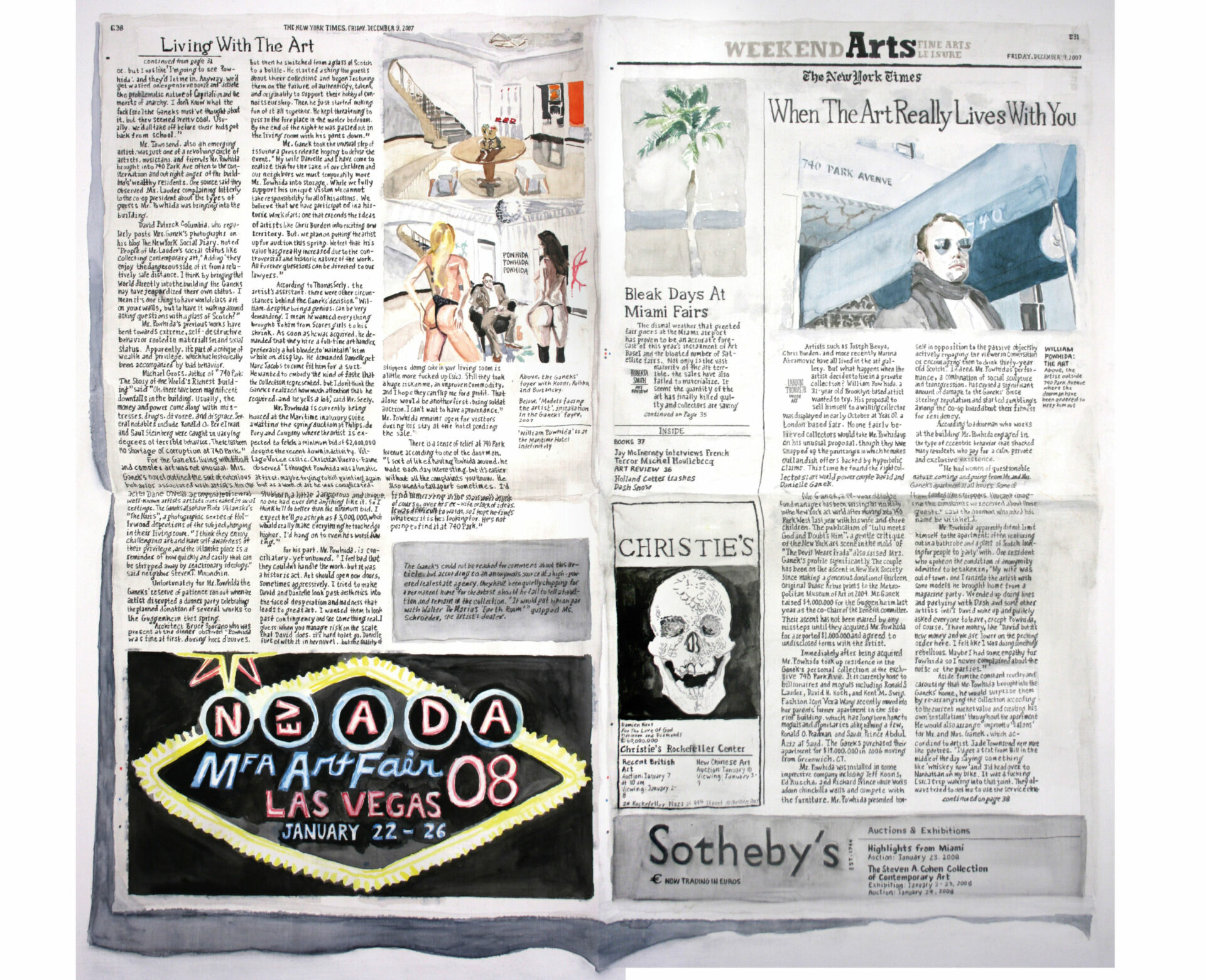
photo : permission de l’artiste | courtesy of the artist
The topic of bullshit is a tricky one, particularly because writing about it is almost always accompanied by the sinking feeling that one is, in fact, creating it. Despite whatever difficulties may lie ahead, investigating both personal and cultural resistances is often worthwhile. Unless one includes Baudrillard’s theory of the simulacrum, serious literature concerning bullshit is scant. In 2005, American philosopher Harry G. Frankfurt published a slim, exceptionally popular book of philosophy dealing specifically with this prevalent, yet under-studied aspect of contemporary Western culture. Originally published as an essay in 1986, On Bullshit spent approximately twenty-seven weeks on the New York Times’ 2005 Best-Seller List. Although it naturally spawned an uninspiring sub-genre of non-fiction dealing with bullshit, to my knowledge nothing serious has been written about this topic since, and certainly not with regards to contemporary art.
Despite its flaws, Frankfurt’s On Bullshit boldly proposes, in the absence of any substantial work on the subject, “to begin the development of a theoretical understanding of bullshit.”8 8 - Harry G. Frankfurt, On Bullshit (New Jersey: Princeton University Press, 2005), 1-2. According to Frankfurt, bullshit constitutes a particularly contemporary kind of deception. While a liar must respect the truth, inasmuch as he or she seeks to undermine it, “a person who undertakes to bullshit his way through has much more freedom,”9 9 - Ibid., 52. since he or she has no concern for what is true or false, and is willing to invent everything, even the context. Bullshit, as such, has a panoramic rather than particular focus.10 10 - Ibid. This having been said, the apparent freedom of bullshitting does not mean it is easy to do, but rather that it involves a “mode of creativity” that is “more expansive and independent, with more spacious opportunities for improvisation, colour, and imaginative play.”11 11 - Ibid., 52-53. Frankfurt even goes so far as to make a rather naïve aesthetic distinction between lying and bullshitting, linking the former to “craft” and latter to “art.”12 12 - Ibid., 53.
Tropes of dishonesty are often associated with avant-garde artists, such as Duchamp and Warhol. The ruse that Duchamp concocted around his notorious urinal is perhaps the most famous. Although Fountain (1917) was calculated to cause a stir, its deception was ultimately in the service of “greater truths” and not excesses. Duchamp placed great emphasis on the difficult, disinterested act of choosing it, as he considered the mass production of readymades something “à craindre” — a sort of “contamination” that could only be excused via the “intervention” of humour.13 13 - Marcel Duchamp, interviewed by Alain Jouffroy, Marcel Duchamp: Rencontres (Paris: Éditions du Centre Georges Pompidou, 1997), 46-49. While Warhol was notoriously less concerned about issues of mass production, he was often just as restrained. He wanted, after all, to eliminate aesthetic choice by becoming a machine, and was aided in this enterprise by methods of deception, such as hiring stand-ins. Unlike the sly, word-playing Duchamp, however, Warhol was a master at hiding in plain sight. “If you want to know all about Andy Warhol, just look at the surface: of my paintings and films and me, and there I am. There’s nothing behind it.”14 14 - Andy Warhol, “Warhol in His Own Words: Unedited Statements (1964-87),” in Kristine Stiles and Peter Selz, eds., Theories and Documents of Contemporary Art: A Sourcebook of Artists’ Writings (Berkley, CA: University of California Press, 1996), 340. In a Warholian framework, pop art may be understood as a kitsch take on the readymade, another version of a lie that tells the truth.
As a manifestation of bullshit, bling-bling is less about paradox, however, and more about mutability. Instead of expressing a conflict it performs a diversion. For a bling-bling take on the readymade, one need only consider the work of artists such as Damien Hirst, Jeff Koons, and Vanessa Beecroft. Hirst gets the prize for the bling-blingiest of twenty-first-century artworks: For the Love of God (2007), a life-size, diamond-encrusted platinum skull that he reportedly sold for £50 million.15 15 - Glen Owen and Polly Dunbar, The Daily Mail (London, UK), 9 September 2007. This project brilliantly demonstrates a bling-bling lack of concern for truth or lies, since it focuses exclusively on affect and the invention of a beguiling situation. This modus operandi is also evident in Hirst’s philosophy of the readymade. In his words, “I’m operating at the top end of the art world … so I can come in and you’re not going to think, ‘It’s a fucking birthday card.’ So I can take a birthday card and re-represent it to you and you’re gonna go, ‘Fucking hell, that’s gotta be important if it’s been put here.’”16 16 - Damien Hirst, quoted by Andrew Osborn, “Entire Hirst exhibition is snapped up by ‘minigarch,’” The Independent (London, UK), 6 December 2006. In his painting Ganek Acquires Powhida (2008), Powhida pushes this insane tautology even further, producing a hilarious satire in which a mega-artist (Powhida’s alter-ego) shocks the art world by turning himself — or rather his persona as bling-bling — into a readymade. According to the painting’s narrative, Powhida wreaks havoc after auctioning himself off to “art-world power couple” David and Danielle Ganek for $1,000,000, becoming thereafter a performative, whiskey-swilling, womanizing, party animal living in their private collection. In the bottom corner of this trompe-l’œil newspaper spread, Powhida cleverly inserts a banal Christie’s ad announcing the auction of For the Love of God at £60 million.
From this cursory, if rather brief analysis, we may perhaps draw the following conclusion: bling-bling, and other categories of bullshit, such as the cynical and vapid, are to the postmodern what kitsch is to the modern — a nebulous space, somewhere to the side of consciousness, containing a twisted version of everything it would rather not admit. As certain branches of psychology know, the existence of such a “shadow” is not an entirely negative phenomenon, because such “sites” necessarily contain a lot of unrealized potential. Indeed, many contemporary artists are attempting to harness this untapped reservoir, what might be called the unique potential of bullshit, through satire and spoof. William Powhida is an excellent example of this. Taking Duchamp’s advice about the insertion of humour rather seriously, he suggests that the solution to the end of post-modernism is not a new take on the modern, but rather the assimilation of one of the latter twentieth century’s most important lessons in art theory: the only way out may be in.


