
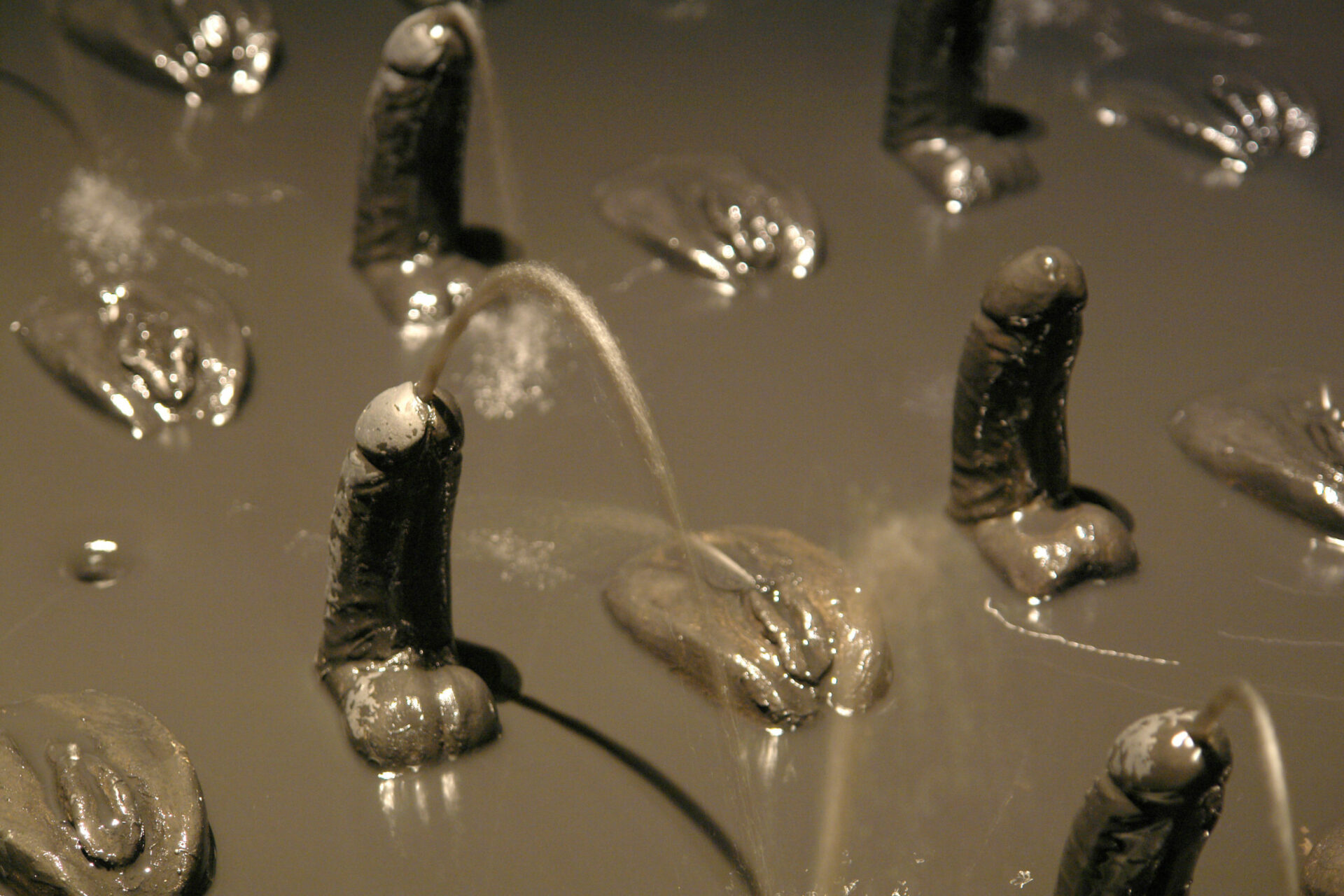
In their Silence on coule installation (2005),1 1 - The title literally means “silence, we’re sinking,” but it also refers to the phrase “silence on tourne” usually uttered by cinema directors on set before the camera starts rolling (it is the English equivalent of “action”). The installation was originally shown in Montreal at the Quartier Éphémère de la Fonderie Darling in the context of a group show entitled Débraye : voitures à controverse (22 July – 22 September 2005). A second version was shown in the exhibition C’est arrivé près de chez vous. L’art actuel à Québec (Musée national des beaux-arts du Québec, 4 December 2008 – 12 April 2009). artist duo Cooke-Sasseville made a brutal comparison between sexuality and the universe of the automobile. In the centre of a room that was entirely painted black, the artists constructed an odd-looking basin atop an elevated platform surrounded by a protective transparent enclosure. Within, the viewer encountered a series of phallus — and vulva-like golden objects that spurted a liquid bearing an uncanny resemblance to oil — that black gold whose exploitation has given rise to all too many conflicts. A series of words referring to the car or its owner were spelled out in golden letters and placed on the adjacent walls; thus, the installation encompassed the reading of such adjectives as: performant (performing), arrogante (arrogant), précieuse (precious), puissante (powerful), ambitieuse (ambitious), vigoureuse (vigorous), etc.
In this work Cooke-Sasseville drew on references stemming from the sphere of the sacred: the installation itself looked much like an altar, and the pervasive use of gold was in keeping with an iconic tradition in which this material symbolizes light and, therefore, divine power. However, in Silence on coule such religious conventions were in the service of a cult of the car. In some sense, the artists sought to parody what has become a widespread cult-like relation to the automobile — i.e., that brand of car fetishism that expresses a manly and macho sexuality, as the cliché goes. Ultimately, the artists ironically addressed issues stemming from popular culture and the world of commodities which, according to Barthes and Baudrillard, also belong to a sign-based economy.
photos : Patrick Altman, Musée national des beaux-arts du Québec
In fact, what is now called “bling-bling” — a relatively new phenomenon that originates in popular culture — also partakes in this same regime of signs whereby one dominates the Other by means of conspicuous consumption and the display of possessions (which implies a form of machismo). For bling-bling denotes a superficial game in which one emphatically exposes one’s shiny and luxurious accessories, if only as a way to stake out a higher social rank and, thereby, to prove — ostentatiously — that one has already “arrived.” As a lifestyle emblematized by the lustre of jewellery, bling-bling has also taken root in the art world, a place where it is hardly uncommon to encounter displays of wealth and luxury, much to the benefit of the art market, which is constantly fuelled by financial speculation. It also bears mentioning, moreover, that the media is particularly fond of details pertaining to the astronomical sale price of much-sought-after artworks. For such media, the only art that counts is sumptuary.
In their latest exhibition, Cooke-Sasseville explicitly address the problem of the commodification of art as well as the process whereby art is marked as bling-bling.2 2 - The exhibition entitled Le petit gâteau d’or (“The Golden Cupcake”) was held at Montreal’s Galerie Art Mûr (6 March – 24 April 2010). In Le petit gâteau d’or, the viewer was welcomed by a long, red carpet along whose path one could admire a series of silkscreen prints depicting a gold bar that was progressively gnawed away, much like a butter cookie. At the end of the carpet, one came face to face with a golden cupcake that was preciously housed in a glass case (apparently bullet-proof). One hundred seventeen grams of eighteen-carat gold were used to make this chic dessert whose decorative topping was comprised of diamonds, emeralds, rhodolite garnets, rubies, topazes, amethysts and sapphires. This work was certainly shiny, but it was far from fake: the precious stones were clearly authentic and spoke of the artists’ intention to “go all the way”; as a result, one could not help but raise an eyebrow.
This installation successfully brings together two worlds, namely, the world of the rich and famous, and the art world, partly because guests were required to wear formal attire during the opening reception, and partly because of the pervasive red carpet. Here, art is no longer regarded as a site of refuge — dreamt up by the avant-gardes — that could seemingly afford one a vantage point outside of capitalism. Much to the contrary, art is understood here as one of capitalism’s avenues of choice; its function is to bring to the fore the fact that paths leading beyond the general economy are scarce, or perhaps even nonexistent. The title given to the silkscreen prints attests to this state of affairs: Valeur refuge (“Refuge Value”) is the value of gold and art when financial markets come tumbling down. Ultimately, Cooke-Sasseville’s small golden cupcake (Le petit gâteau d’or) alludes quite pertinently to a series of recent works by other artists made with highly expensive materials — works whose authors perfectly embody the role of the speculator.
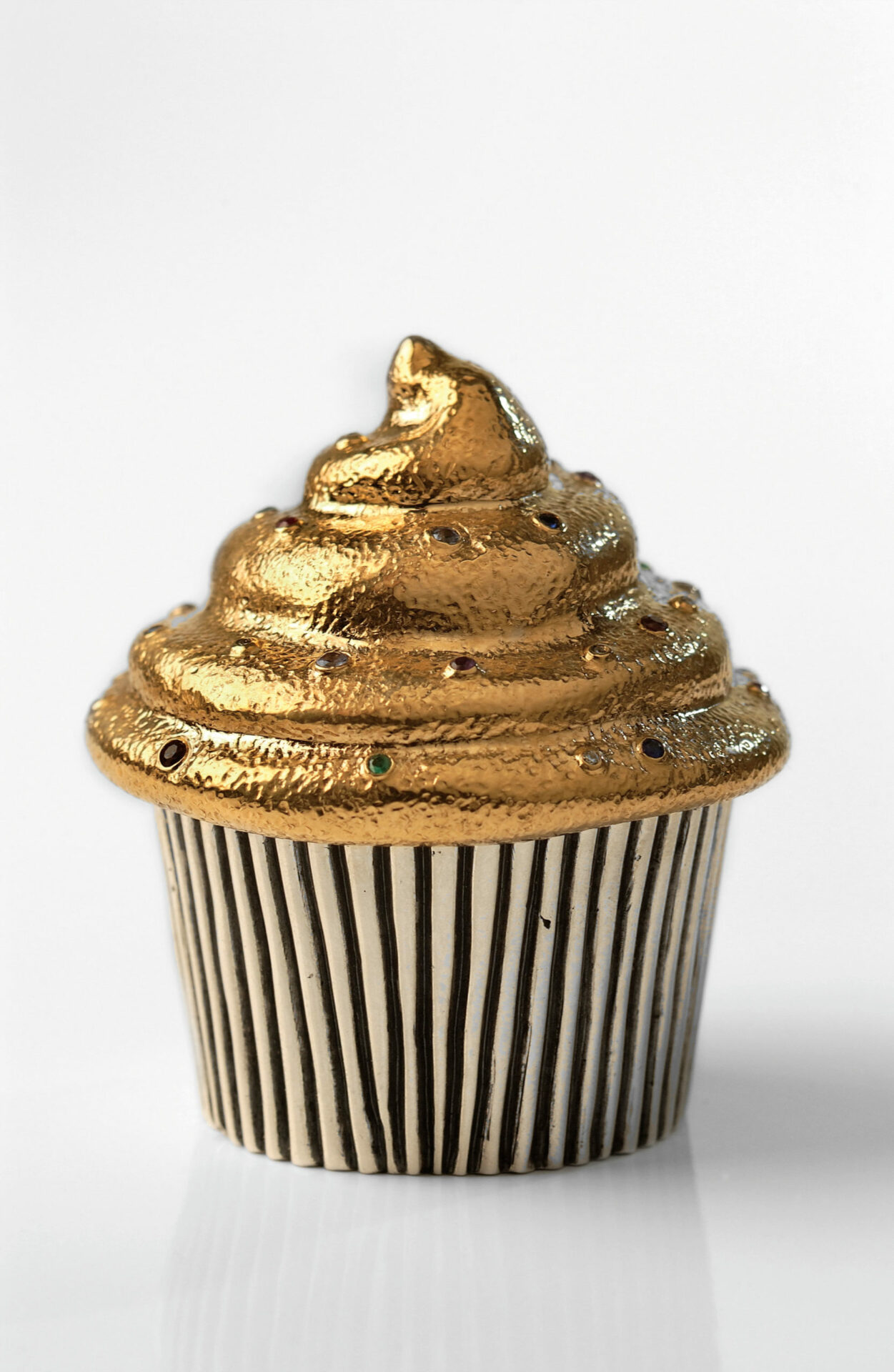
photo : Étienne Boucher
In this light, Cooke-Sasseville’s gesture also dialogues with Piero Manzoni’s Artist’s Shit series (1961). In these canned works, Manzoni demystified the process of artistic creation by comparing it to the digestive process and to the — all too common — human ability to defecate. Importantly, Manzoni asked that each of the ninety cans containing thirty grams of excrement be sold based on the current price of gold; in this way, the artist wished to address the (often) obscure mechanisms that dictate the market value of works of art. Manzoni’s trans-substantiation also parodied the fetishism surrounding the myth of the artist. According to such a myth, the slightest morsel an artist touches is immediately transformed into art — and is thereby subject to speculation.
It is hard not to fathom that Cooke-Sasseville’s project itself alludes to scatology. In fact, one could easily mistake the small cupcake’s topping for the concentric winding of a turd. The exhibition’s spatial narrative also strongly suggests that the gold bar has been ingested, consumed — and defecated. Moreover, the artists seem to claim that the business of cooking up art can encompass all sorts of materials, from the most sumptuous to the most vulgar. All that is required is the transformation of any given materials, and the art market does the rest. In contrast to Manzoni then, whose references to industrialization were effected by means of the standardized repetition of cans, Cooke-Sasseville foreground the uniqueness of their singular cupcake, and thereby allude to the out-of-reach character of luxury goods. As the word cupcake enters the French language and the world of sophisticated desserts, it would seem that cupcakes are now the nec plus ultra of candies.3 3 - According to the artists, their use of the cupcake responds to the Sex and the City movie, in which some of the characters develop a taste for this dessert.
In the final analysis, Cooke-Sasseville’s Le petit gâteau d’or is far from kitsch, but it can certainly be regarded as a critique of the bling-bling phenomenon. In fact, its critical apparatus relies on a postmodern strategy of reversal. This is the reason why this work draws on the logic of bling-bling (the precious materials, the overstated red carpet) as the artists blatantly remain (to the point of caricature) well within the system of art, which in this case means: within the walls of a commercial gallery.
[Translated from the French by Eduardo Ralickas]


