
Photo: © Nicolas Tondreau / Production Recto-Verso 2009
From the very first pages of the album The Seven Crystal Balls1 1 - Hergé, The Seven Crystal Balls (London, UK: Methuen, 1962). by Hergé, Tintin is surprised that captain Haddock needs to put on his monocle in order to recognize him. Not that this old seadog has suddenly become short-sighted, but is does appear that this prosthesis is necessary for him to become (to act as) the lord of the manor. The irony of the situation resides in the contradiction of captain Haddock’s gesture with what one could call his initial program2 2 - The word program is here understood as the “plan of intended proceedings and political projects of an individual or a group,” and as “a series of actions carried out in order to obtain a result.” [Translated from the French definition in Le Nouveau Petit Robert (2001).]: you can not change your status from sailor to lord of a manor by way of a prosthesis, and attempting to do is enough to expose the guilty party to ridicule. Clearly, the role of prosthesis is to carry out the initial program and not to change it out of the blue. Let us also point out that further on, when the captain finds himself in a difficult situation, and rather than calling on the authorities decides to take things into his own hands, he for the first time goes back to using his cap and pipe...
In order to continue with our analysis it is important that we establish a distinction between two types of objects that involve different uses: the tool and the prosthesis. The distinction between tool and prosthesis not only resides in the degree to which the object is integrated into the user’s body, but also into his/her initial program. While the tool is a manufactured object that one takes, and which serves to work matter, to do work, the prosthesis is a device, an apparatus which one wears, which serves to replace a limb, part of an amputated limb, or a seriously deficient or destroyed organ. The tool is an object that is independent of the body, while the prosthesis is an extension of it. Hence most will agree that a hammer is a tool and a wooden leg a prosthesis. What about glasses? That depends on their role: glasses that serve to correct deficient eyesight will be considered a prosthesis, while those that enable one to see further than what is included in a normal human program (binoculars) are taken to be a tool.
This is a fragile distinction, but if it can hold up for the length of this text it may perhaps allow us to consider some artists’ works from a new perspective. What interests us in particular is that the prosthesis becomes a revealing developer3 3 - The original French word “révélateur” carries the double meaning of “revealing” and “developer” in the photographic sense. In order to maintain this nuance the word is translated as “revealing developer.” Translator’s note. — understood in the photographic sense — of an individual or social group’s normal or conventional program, such as it is considered by those who judge the effectiveness or relevance of a given prosthesis. An artificial hand will be judged to be more successful if it physically resembles a natural hand and carries out the same work, even if a hand with nine extensible fingers may perhaps be more efficient in acting on things and carrying out a task. This is so because the prosthesis confirms the wearer in what is conventionally agreed that he or she ought to be.4 4 - This may explain one of our period’s oddities: given the available technologies, it would certainly not be too difficult to imagine a prosthesis with a better performance than the original body part, but we abstain from this because to do so would be to divert the individual from his or her initial program. One can assume that the polemics surrounding interventions that seek to normalize handicapped persons partake in the same problematic. It would also be interesting to study certain ethical positions on the basis of this notion of the program, notably those pertaining to biological innovations such as cloning, or on a different note those related to the wearing of religious symbols in the civil service. From this perspective, the veil, toupee (also knows as a capillary prosthesis) and hair colouring are all part of the same problematic: it is about modifying the body so that its image conforms to a given program.
On what grounds can one establish this relationship between prosthesis and program? How is this question articulated today in the context of interdisciplinary practices that propose to consider some technological prostheses as extensions of the person?
Works by Stelarc and by Orlan have already asked these questions in a very frank manner: the former by declaring the body to be obsolete and calling for its parts to be replaced by sophisticated machines (thus negating the relevance of the initial program), and the latter by idealizing the body itself in a very critical way (in attempting to conform in an extreme manner to the initial program and thereby to reveal its existence and contradictions). Several other artists also work along these lines.5 5 - In February 2009, in Québec City the Mois Multi presented a series on the theme “Prothèses et autres prolongements” (Prostheses and Other Extensions). The questions discussed here are taken from the event’s programming.
The Prosthesis-machine
One of Jean-Pierre Gauthier’s works partially confirms our hypothesis regarding the link between prosthesis and program, because it is by putting this link into play that it derives its impetus. Marqueurs d’incertitude consists of a system of motors, pulleys and cables terminating in pencils that execute large drawings directly on the wall. These drawings are gestural and appear to carry the imprint of a signature, a touch, a style arrived at through training. That the drawings can be created by a machine — created, and not reproduced — is particularly troubling because this function is traditionally one of the specificities of a particular human program: the artist’s.
With her work L’imperméable Diane Landry also confronts us with an ambiguous situation. At the heart of this piece is the artist herself: suspended several metres from the ground, she is attached to a vertical structure with a harness and a horizontal axle, enabling her to turn round on herself, a bit like the blades of a windmill. During this performance she is also completely wrapped in a sort of transparent inflated plastic envelope. In this installation-performance the artist’s body becomes the extension of the machine that supports her, and this is one of the work’s most significant aspects: the abandonment of the artist’s own initiative in favour of an external program, dictated by the mechanical possibilities of the installed apparatus. This submission of the artist’s body to a prosthetic mechanism recalls Lang’s Metropolis or Chaplin’s Modern Times, and brings to mind the often executed duel between human and machine, along with the fear inspired by the representation of the machine’s triumph.
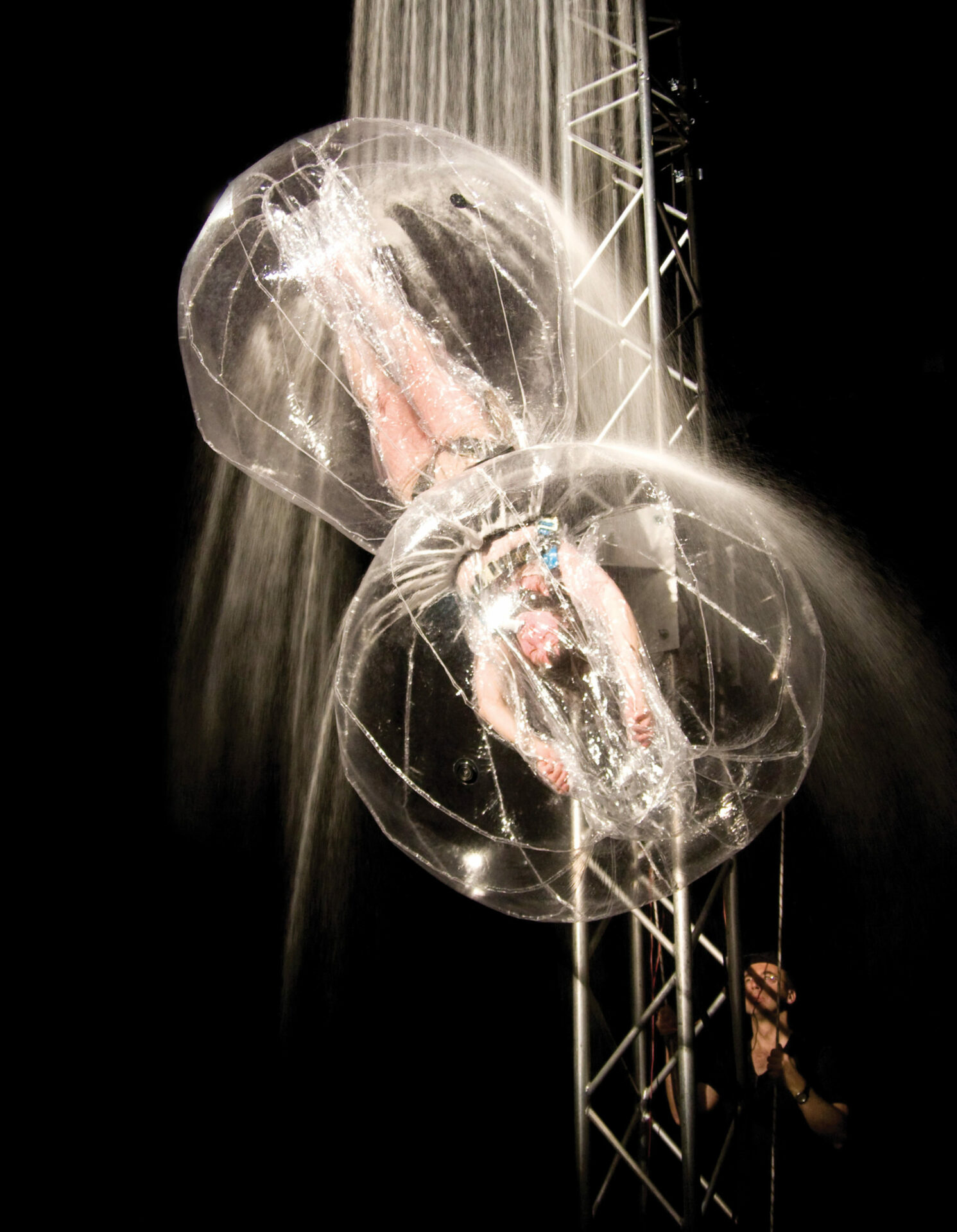
L’imperméable, Mois Multi 10, Québec, 2009.
Photo: © Myriam Lambert / Production Recto-Verso 2009
Sergi Jordà’s Reactable is a musical instrument consisting of a horizontal digital video image on which one can place objects and manipulate them to create sounds. These objects are relatively anonymous — rectangular prisms containing icons — and the video image itself is made up of dynamic lines that represent the relations created between the objects. The particularity of Reactable is the polyvalence of the manipulated objects to compose “in real time”: an object can at once be used to control the speed of successive notes, and then to alter the volume, without changing its material appearance in any way. Nevertheless, there is a certain visualization of the information since the various parameters are displayed (in a more or less obscure way) on the luminescent surface. An important factor: during the performance the image produced by the interface is projected onto a large screen before the audience, and it is there that the performance takes place. There is a sort of omnipotence associated with the manipulation of these objects which at times seem to have the power to transform themselves effortlessly into what we would want them to become, thus creating the ideal tool or instrument. What is striking is the image of this transformation. The abundance of signs surrounding these manipulations — furtive numbers, dynamic connection lines between different objects — increases this appearance of polyvalence, which suggests a variably programmable prosthesis. A particularly revealing factor in relation to our problematic is that the images and sound, arising from an instrument that has no direct material link with them, appear as creations of a mind and hence the extensions of a will, which endows the prosthesis with a mediumistic role — bypassing both medium and media. What makes the instrument interesting therefore does not reside in its capacity to generate new music (the arrangements and created sounds are actually relatively banal) but in the magic put to work to create it. Jordà’s Reactable becomes a prosthesis in the sense that the work makes it possible to create an imaginary program of the human body. The ease with which this ability to act from a distance is accepted as plausible and as an integral part of the initial human program, is deserving of an article all on its own.
The Prosthesis-image, the Image-prosthesis
There are works in which the image is used as a prosthesis, i.e., as an extension of the body and the revealing developer of a program. This is the case of a number of Marcel-lí Antúnez Roca’s works, such as Hipermembrana and Epizoo. One of the most significant elements in these performances is that the prosthesis is never direct, as it is always either revealed by an image, or revealing an image in development.
In Hipermembrana,Roca and Ignacio Galilea propose a Dantean hell made up of projected video images which they manipulate using simple interfaces — switches on the floor which they press with their feet as they move on stage. The floor switches obviously impose a sort of choreography on the two protagonists, but this is not interesting as such. What is more significant is that, counter to our expectation of seeing the two actors — with their power to make images appear — become like demiurges in this infernal world, the opposite occurs: the images are the site of the encounter, and the two characters quickly become enslaved to this video flow. The effect is close to that of Diane Landry’s L’imperméable: it is the machine — in this case a dream machine — that leads the dance, and the prosthesis becomes more powerful than he who wears it. This prosthetic use is particularly fitting in Roca’s work since the performance is a representation of Dante’s inferno: a situation in which the individual’s share of initiative in the carrying out of his program escapes him entirely and irreversibly, as it is replaced by a series of predetermined and unavoidable stages.
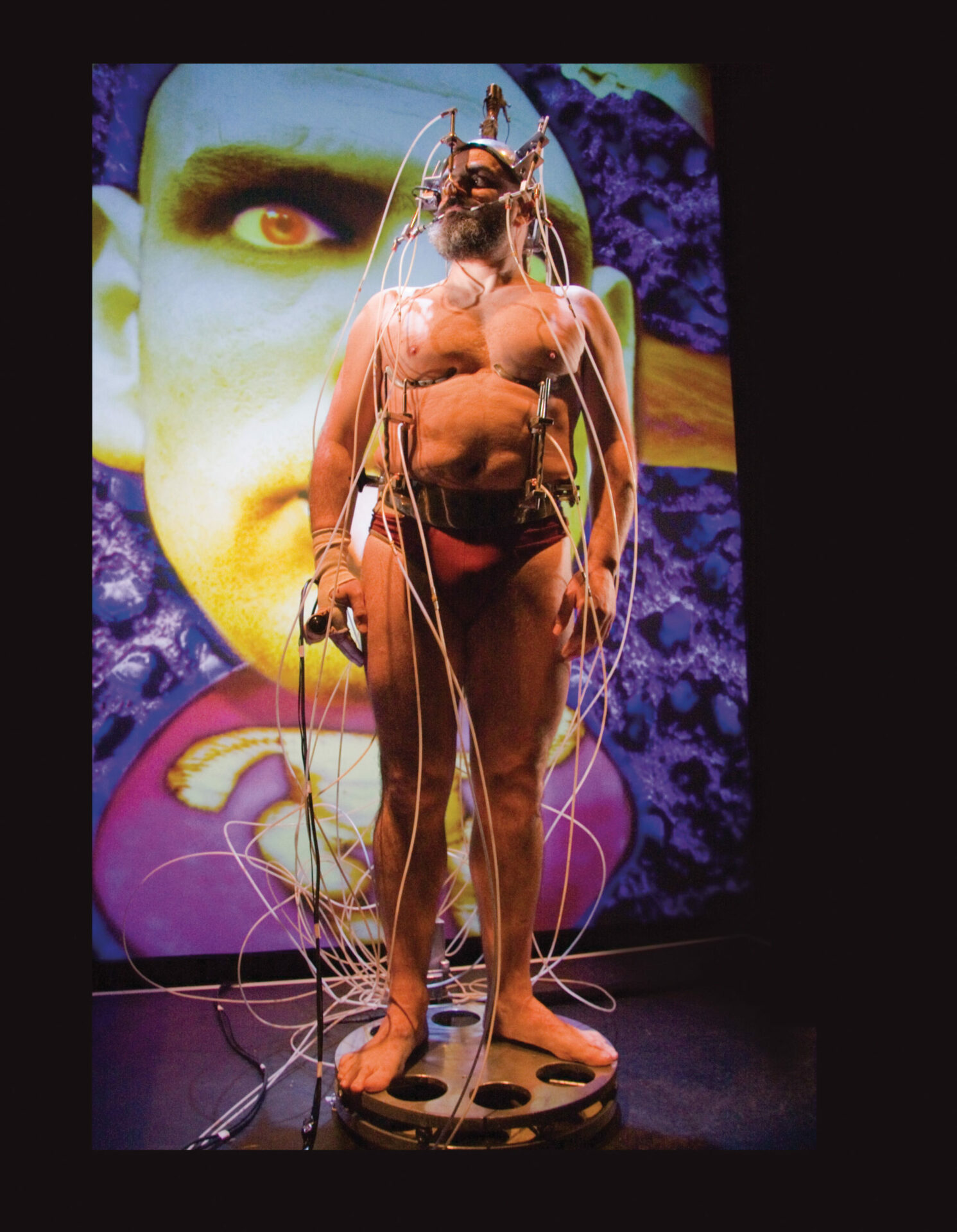
Epizoo, Mois Multi 10, Québec, 2009 © Marcel-lí Antúnez Roca / sodrac 2010.
Photo: © Nicolas Tondreau / Production Recto-Verso 2009
Another work by Marcel-lí Antúnez Roca, Epizoo, aims at an inversion of these roles: whereas in Hipermembrana the artist controlled the apparition of an imaginary infernal world offered up for view before a passive audience, in this work it is the audience that manipulates the artist’s body. The process is as follows: an audience member goes before a computer and clicks on a part representing the artist’s body. This image is visible to all on a big screen. These actions control a series of mechanical prostheses placed directly on the body of the artist, which cause him to undergo all sorts of “little tortures.” This is not an immediate and direct manipulation, since it is produced through a three-part interface. First there is a computer system with its screen, keyboard and mouse, second there are the images produced by the interface, which are the site of the intervention, and finally the prostheses themselves. It must be said straightaway that the mechanical prostheses worn by the artist are not very interesting: the classical image of skin-stretching clamps, a revolving platform to rotate the body, eyelid speculums… the effect is funny for a couple of minutes, at most. The entry interface — keyboard, mouse, screen — is also ordinary. It is in the projected images that the project can be said to truly exist. It is these images that constitute the extension of the viewers’ and the artist’s shared imaginaries. It is there that the encounter takes place. All the more so because the images, which could have been mere technical representations indicating the apparatuses to be activated on the artist’s body, are actually real drawings, pictures, motifs, and symbolic depictions whereby the viewers can imagine the effect that their gestures have on the body of the artist. In this sense, the images become the heart of this prosthetic system: they carry the actions to be performed, the potential stages, and the program.
LoopLoop, a work by Patrick Bergeron shown at the Avatar centre, is presented as an extension of memory. First, it is an extension of the artist’s memory, since the work consists of an assemblage of video images of a trip he took through Asia, and second an extension of the viewers’ memory, because they can follow the trip’s unfolding in this plethora of images which puts this specific memory to the test. What stands out here is the metaphorical correspondence between the form of the projected images and the very process of memory. One witnesses superposed images, images unfurling at various speeds, correspondences between form or content, various image strata, mise en abyme: one could be led to believe that the remembrances passing and colliding before our eyes are ours, and that the visual memory activated here is actually drawn from our own imaginary. In this case it is difficult to determine if this is really a prosthesis. What is the direct link between the work and the viewer? Yet, a program is developed and revealed, which is a capacity to reconstruct images experienced according to a narrative form, with several levels of correspondence, by using images that appear to be disorganized. Must the link be physical for us to speak of prosthesis? Can an image constitute a prosthesis?
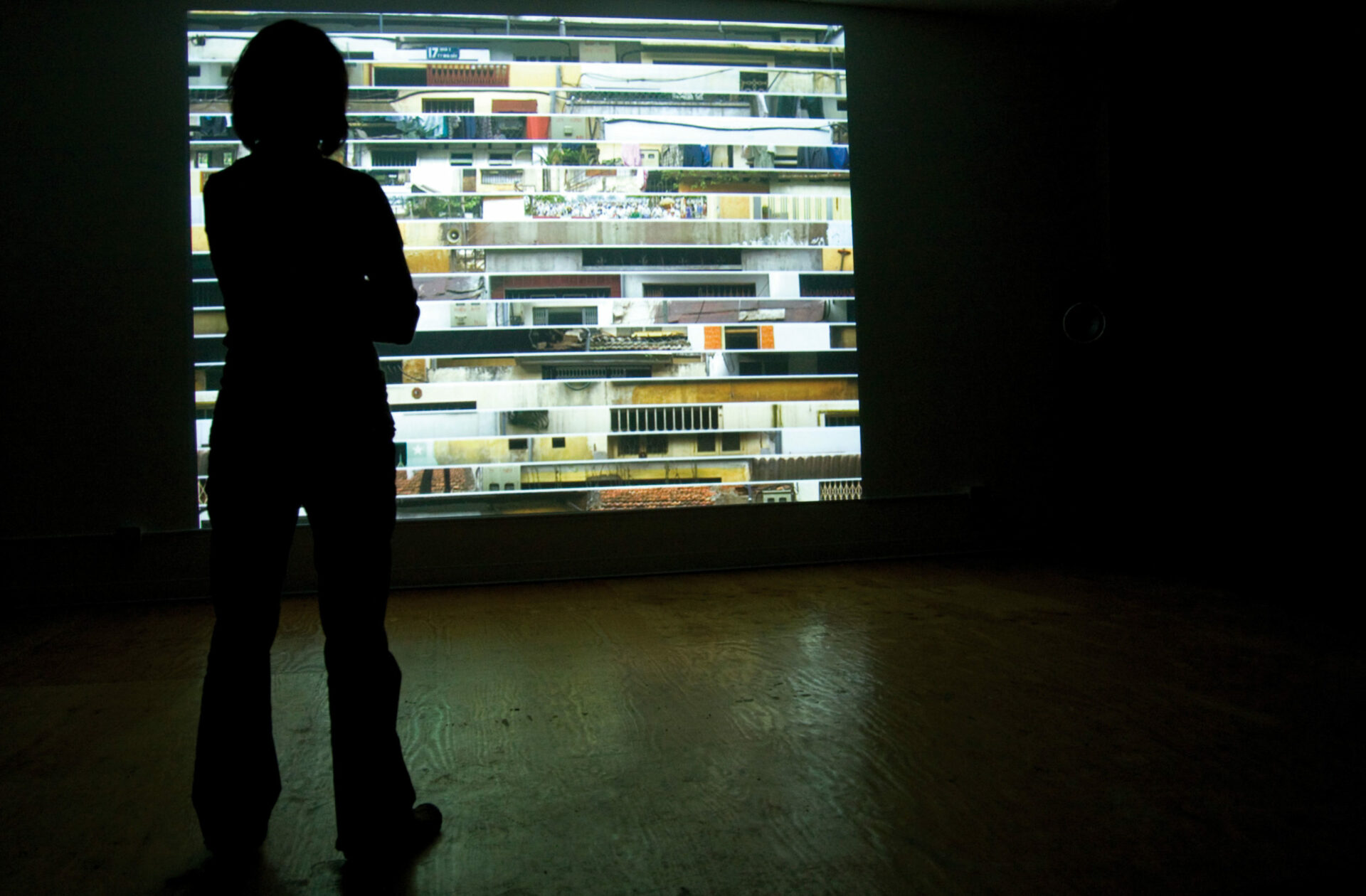
LoopLoop, Mois Multi 10, Québec, 2009.
Photo: © Nicolas Tondreau / Production Recto-Verso 2009
The Prosthesis as Revealing Developer of a Program
Most of the works examined here use prostheses as a proposition to modify or extend the individual’s initial program. There is the person’s submission to the machine in Landry’s performance, the displacement of the body’s limits in Reactable, and in Jean-Pierre Gauthier’s installation the displacing of individual capacities to act on the real, outside the body. The last works analyzed here pose the question of the image as a prosthesis, i.e., as an extension of the person, and particularly of the image as an interface that makes it possible to act on the body of the Other; the image as a gateway to a dream world (Roca), and the image as an extension of the very form of memory outside the body (Bergeron). Actually, it is from within these works that the question of the prosthesis’ dematerialization and its transfer into the image begins to be posed. It is perhaps relevant here to recall that if the pipe and cap are accessories that confirm the conventional role of Hergé’s captain Haddock, it is through a visual prosthesis (a monocle) that he tries to become somebody else.
More broadly speaking, the works presented here make it possible to think the role of the prosthesis as the revealing developer of a cultural construction, which we have termed initial program. For if the system of objects6 6 - See Jean Baudrillard, The System of Objects (London, UK: Verso, 2005). makes it possible to inscribe the individual in the social body (build up as a system of signs), objects — and more particularly prostheses — appear conversely to allow for the inscription of the social system into the individual body through the imposition of a program. Artists’ use of the prosthesis gives them the opportunity to revealingly develop and critique this program by exposing certain of its characteristics and confronting it with other possible ones.
The author wishes to thank Suzanne Leblanc for her collaboration.
Translated from the French by Bernard Schütze


