In September 1920, a few months after the arrest of Sacco and Vanzetti, the anarchist Mario Buda parks a horse-drawn cart loaded with explosives and scrap metal in the middle of the Wall Street financial district, causing a bloody explosion that heralded the spectacularly “successful” and ever-relevant posterity of the car bomb. The car bomb, which was to become the hallmark of terrorist action for acronym-studded rebels, unscrupulous intelligence agencies, and totalitarian regimes all over the world, was the manifest culmination of a half-century of anarchists’ pyrotechnical dreams of blowing up monarchs and plutocrats.7 7 - See Mike Davis, Petite histoire de la voiture piégée, Marc Saint-Upéry (Paris: Zones, 2007). The technique has several advantages: it infiltrates day to day life by disguising one’s intentions in everyday actions; it strikes directly at the heart of the despised system by attacking strategic and symbolic targets; it is simple and cheap to implement; it is sure to have considerable impact, as much by the material damage produced and lives destroyed as by the media exposure it garners, enabling perpetrators to remain anonymous while broadcasting their cause and their determination.
While the comparison may seem in bad taste, given the casualties involved, this brief tactical description of the car bomb may well serve to present a set of artistic practices patterned on mechanisms of terrorist action — without the collateral damage. Gianni Motti’s actions and performances put him in a unique position within the field of political art, and more generally in contemporary art. He made himself known in the mid-1980s, when, in the manner of terrorist groups, he claimed responsibility for disasters that were totally out of his control. When the Challenger space shuttle blew up in 1986, he communicated with the international press to declare his responsibility for the accident. He repeated the stunt a few years later after an earthquake in California, becoming an artistic demiurge successively authoring a dense plume of smoke many hundred cubic meters thick, an earthquake, a fault 74 kilometres long, and millions of dollars in material damage. Sitting quietly at home and following the news, Motti invents an opportunistic form of terrorism while bleeding the notion of authorial signature and legitimacy in art. In a society where everything is an event and all events are bound to some form of copyright or individuality, he becomes the author of the authorless event and, in a Duchampian gesture of unprecedented brashness, transforms it by an act of will into a work of art. His declarations seem to be the ironic counterpoint to Jack Gold’s film The Medusa Touch, where Lino Ventura confronts the paranormal and telepathic powers of a man who can cause airplanes to crash even as he lies in a coma. It may not be a coincidence then that Motti, in 1997, devised a novel strategy for overthrowing a government by organizing a telepathic séance with the intent of causing Colombian president Semper to resign and had it covered by the main opposition newspaper El Espectador.
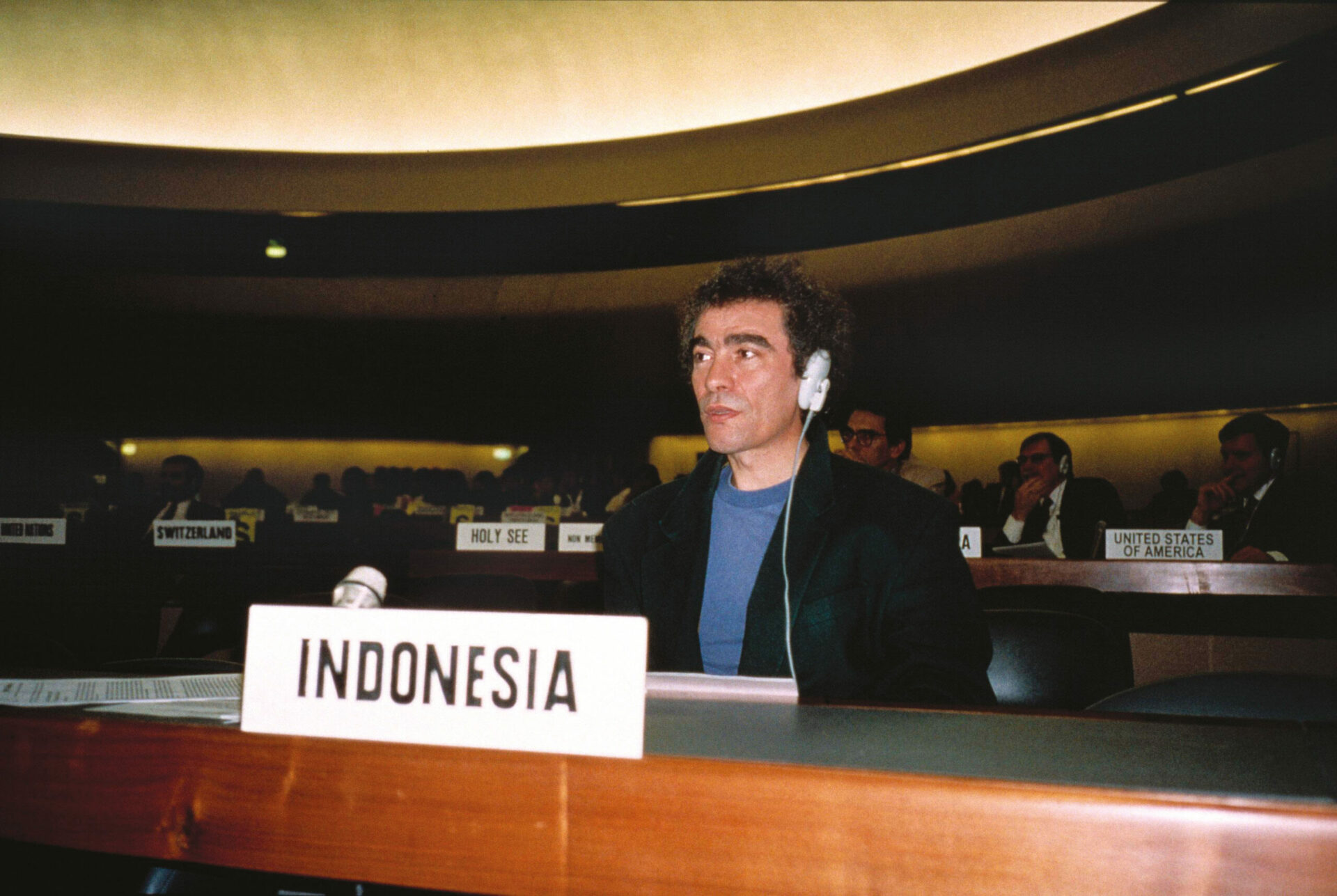
photo : permission | courtesy Galerie Nicola von Senger, Zürich
Like Buda’s wagon placed in the middle of Wall Street, the inner sanctum of American capitalism, Motti unabashedly infiltrates the very heart of the most prestigious international institutions. In 1997, for the 53rd session of the UN Commission on Human Rights in Geneva, he took the place of the absent Indonesian delegate and proceeded to speak on behalf of ethnic minorities, win several representatives to his cause, and walk out of the assembly with them as a sign of protest. In 1995, he surreptitiously donned the Neuchâtel soccer team’s jersey and, in the eye of all the cameras and of the spectators in the stadium, walked onto the field to join team members for their warm-ups before returning to bench. Adopting methods usually reserved for espionage or police investigations, he intrudes inconspicuously upon restricted zones so as to exploit them and cause a disturbance. He revels in the idea of being where he shouldn’t, in putting a strain on the channels of nomination, legitimacy, and selection, to reveal their persistent absurdity, to interrogate social, political, economic, or religious dogma, or simply to highlight mythological aspects of reality.
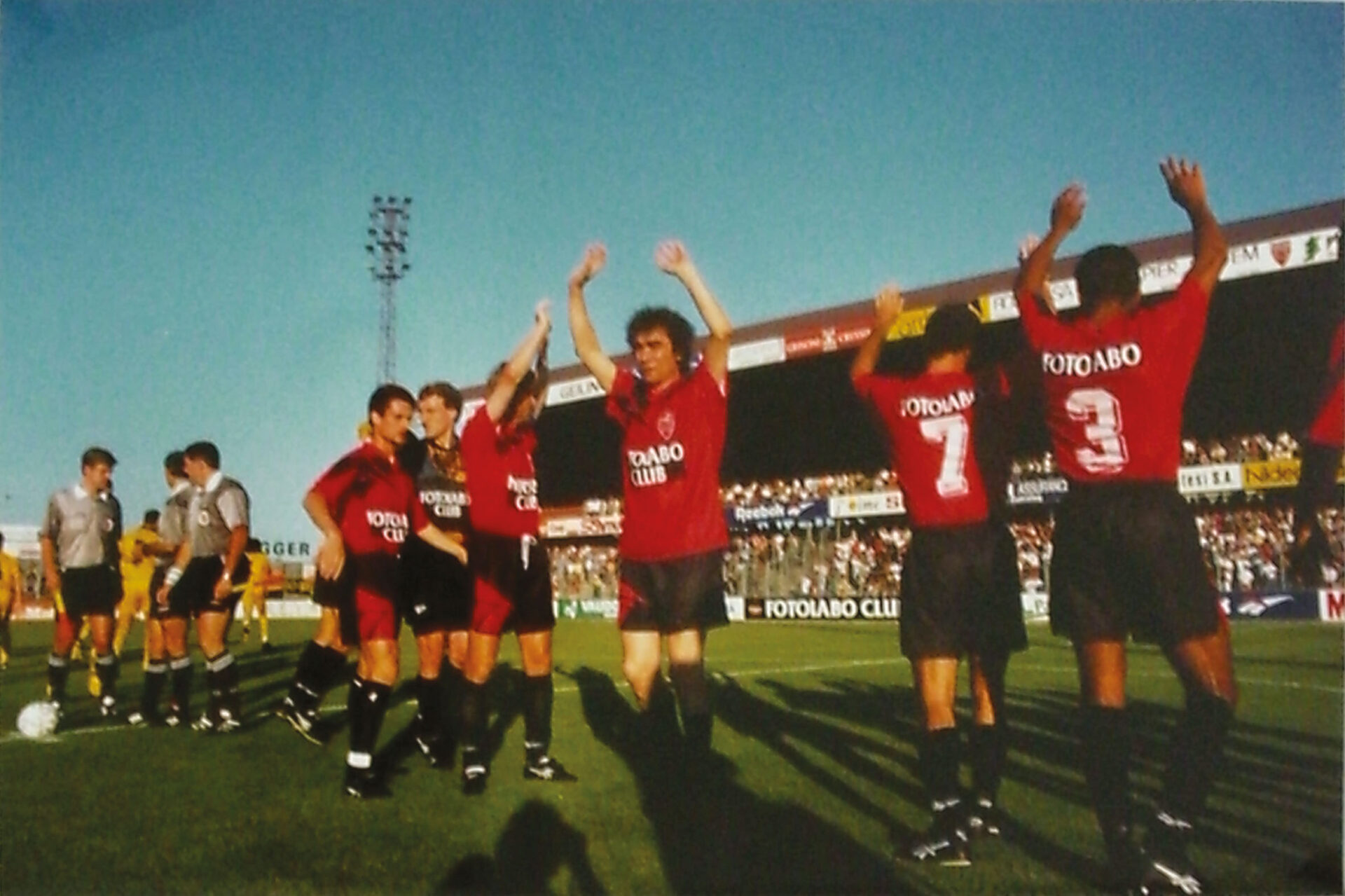
photo : permission | courtesy Bugada & Cargnel, Paris
Ambiguous, ironic, sometimes outright disturbing — as when he plays go-between for Raël, former B-rate pop star and ambassador of extraterrestrials on Earth8 8 - In 1999, Motti gave the Raëlians, whose movement had just been banned in France, some exposure by inviting a group of them to the opening of the exhibition “Expender 01.” He then had the followers lie naked in a pattern to form the message I ♠ GM, to show extraterrestrials the bond connecting Raël with the artist. — , Motti’s work pushes its own logic so far and carries out its pretence so assiduously that the underlying intentions can be hard to decipher. In “Cette vieille chose, l’art…,” Roland Barthes writes of Pop Art: “the philosophical meaning of this work is that modern things have no other meaning than the social code by which they are manifest — such that, essentially, they are no longer ever ‘produced’ (naturally), but immediately ‘reproduced’: reproduction is the essence of modernity.”9 9 - Roland Barthes, “Cette vieille chose, l’art…,” L’obvie et l’obtus (Paris: Seuil, 1992), 188. Here, it is no longer the images, but the gestures, codes, and systems of power that the artist reproduces. His work would seem to dwell on producing a double of reality, on tracing it out to highlight its fault-lines. Such a stance recalls the contradictory argument of the anarchist banker described by Fernando Pessoa: aware of not being able to escape the “social fictions”10 10 - Fernando Pessoa, Le Banquier anarchiste (Paris: Christian Bourgois Éditeur, 2000), 20. that make up reality and the power relationships that emerge from even the best-intentioned, he sought to be his own liberator, not through bombs, but by becoming a master of the sinews of war in bourgeois society — money — , much like a pirate at the helm of the royal fleet. Motti plays on the excess of spectacle, striving to show that “in the truly inverted world, truth is a moment in falsehood.”11 11 - Guy Debord, La Société du spectacle (Paris: Gallimard, 1992), 6. Thus he possesses the power of revealing the hidden mystery of reality, though by aping it he goes beyond mimesis to enter the process of becoming. What Gilles Deleuze has to say about Melville’s work is enlightening here: “Ahab doesn’t imitate the whale, he becomes Moby Dick, he enters that zone of familiarity where he can no longer be distinguished from Moby Dick.”12 12 - Gilles Deleuze, “Bartleby ou la formule,” in Hermann Melville, Bartleby (Paris: Flammarion, 1989), 185. Motti fuses with reality, without which, all the critical and ironic import of his work is lost.
It is still hard to put a name on Motti’s work: artwork, action, happening? While they seem to reactualize a history of performance represented by such artists as Chris Burden, his interventions take place outside the framework of art and its audience. At first glance, he plays out the commonplace union of art and life dear to avant-garde modernists, from Bauhaus to Fluxus, although, as we’ve seen, his work is heavily redolent of simulacra that contradict the possibility of such an equivalence. He also eschews the fetish of the trace, the collation of elements documenting the performance. Motti produces no artworks, no images. There are no objects, photographs, videos to circulate on the art market, which distinguishes him from many socially involved artists who are trapped in the contradictions of the critical and the commercial. Of course, the artist isn’t above reproach; images circulate, exhibitions devoted to him are held in prestigious art institutions. By acting within the heart of the system, he doesn’t have to produce documents, because his interventions and declarations are ineluctably picked up by the media, which produces the required images and documentation, in the process becoming the communicating artist’s precious and all-powerful collabo-rators or assistants. Like a car bomb attack, his interventions rely as much on the facts as on the effect. As for his exhibitions, they always take a strange turn. At the CEC in Geneva, for the opening performance, he hijacked a busload of Japanese tourists and brought them to the opening of his exhibition. For his retrospective at the Migros Museum für Gegenwartskunst in 2004, in a space transformed into a corridor devoid of artworks, he had a group of mediators tell visitors about his art productions. Thus, art is no longer seen but heard, no longer made up of images but of writings, of corridor noises that travel back and forth. In 2009, during an economic recession and the Madoff scandal, at La Ferme du Buisson and the Synagogue de Delme, he conceives a “crisis exhibition” made up solely of dollar bills, whose sum is the budget of the exhibition. While revealing the financial mechanisms that underlie artistic creation he is also producing an ephemeral installation whose investment is null, since in the end the art centre keeps all the money that had literally been exhibited.

photo : permission | courtesy Galerie Nicola von Senger, Zürich
His distant rapport with the work would seem to be akin to Melville’s scribe Bartleby, who ceaselessly goes over the phrase, “I would prefer not to,” while becoming increasingly detached from any desire for or possibility of acting. On the contrary, though, Motti persists in imagining an economy of means to disrupt the legitimacy of prevailing authority and the in-grown reflexes of the art world. His, then, is a contradictory rapport with a system he turns to ridicule but of which he becomes dependent by the very fact of his intention of turning it to ridicule.
[Translated from the French by Ron Ross]