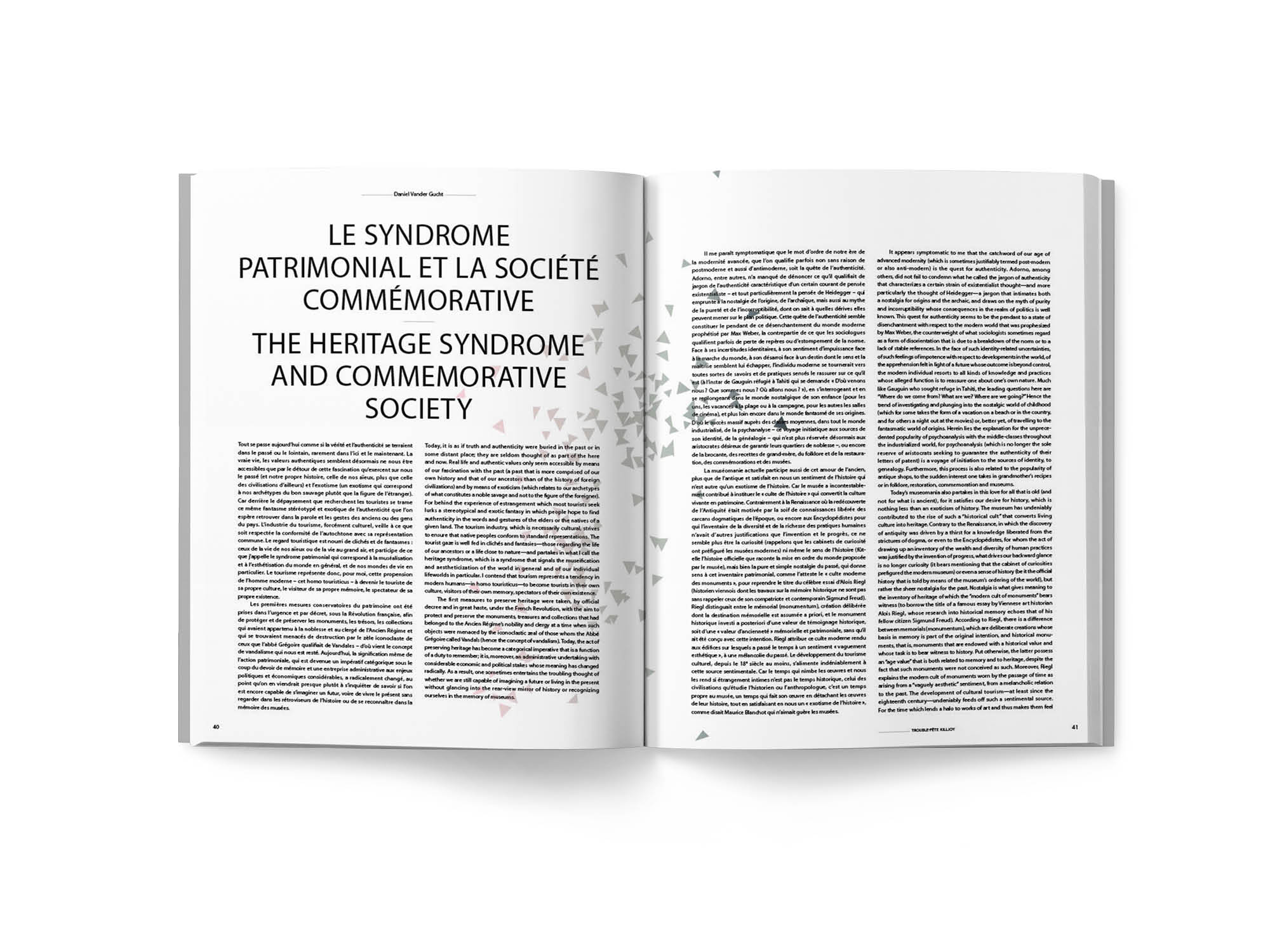
Today, it is as if truth and authenticity were buried in the past or in some distant place; they are seldom thought of as part of the here and now. Real life and authentic values only seem accessible by means of our fascination with the past (a past that is more comprised of our own history and that of our ancestors than of the history of foreign civilizations) and by means of exoticism (which relates to our archetypes of what constitutes a noble savage and not to the figure of the foreigner). For behind the experience of estrangement which most tourists seek lurks a stereotypical and exotic fantasy in which people hope to find authenticity in the words and gestures of the elders or the natives of a given land. The tourism industry, which is necessarily cultural, strives to ensure that native peoples conform to standard representations. The tourist gaze is well fed in clichés and fantasies—those regarding the life of our ancestors or a life close to nature—and partakes in what I call the heritage syndrome, which is a syndrome that signals the museification and aestheticization of the world in general and of our individual lifeworlds in particular. I contend that tourism represents a tendency in modern humans—in homo touristicus—to become tourists in their own culture, visitors of their own memory, spectators of their own existence.
The first measures to preserve heritage were taken, by official decree and in great haste, under the French Revolution, with the aim to protect and preserve the monuments, treasures and collections that had belonged to the Ancien Régime’s nobility and clergy at a time when such objects were menaced by the iconoclastic zeal of those whom the Abbé Grégoire called Vandals (hence the concept of vandalism). Today, the act of preserving heritage has become a categorical imperative that is a function of a duty to remember; it is, moreover, an administrative undertaking with considerable economic and political stakes whose meaning has changed radically. As a result, one sometimes entertains the troubling thought of whether we are still capable of imagining a future or living in the present without glancing into the rear-view mirror of history or recognizing ourselves in the memory of museums.
It appears symptomatic to me that the catchword of our age of advanced modernity (which is sometimes justifiably termed post-modern or also anti-modern) is the quest for authenticity. Adorno, among others, did not fail to condemn what he called the jargon of authenticity that characterizes a certain strain of existentialist thought—and more particularly the thought of Heidegger—a jargon that intimates both a nostalgia for origins and the archaic, and draws on the myth of purity and incorruptibility whose consequences in the realm of politics is well known. This quest for authenticity seems to be the pendant to a state of disenchantment with respect to the modern world that was prophesized by Max Weber, the counterweight of what sociologists sometimes regard as a form of disorientation that is due to a breakdown of the norm or to a lack of stable references. In the face of such identity-related uncertainties, of such feelings of impotence with respect to developments in the world, of the apprehension felt in light of a future whose outcome is beyond control, the modern individual resorts to all kinds of knowledge and practices whose alleged function is to reassure one about one’s own nature. Much like Gauguin who sought refuge in Tahiti, the leading questions here are “Where do we come from? What are we? Where are we going?” Hence the trend of investigating and plunging into the nostalgic world of childhood (which for some takes the form of a vacation on a beach or in the country, and for others a night out at the movies) or, better yet, of travelling to the fantasmatic world of origins. Herein lies the explanation for the unprecedented popularity of psychoanalysis with the middle-classes throughout the industrialized world, for psychoanalysis (which is no longer the sole reserve of aristocrats seeking to guarantee the authenticity of their letters of patent) is a voyage of initiation to the sources of identity, to genealogy. Furthermore, this process is also related to the popularity of antique shops, to the sudden interest one takes in grandmother’s recipes or in folklore, restoration, commemoration and museums.
Today’s museomania also partakes in this love for all that is old (and not for what is ancient), for it satisfies our desire for history, which is nothing less than an exoticism of history. The museum has undeniably contributed to the rise of such a “historical cult” that converts living culture into heritage. Contrary to the Renaissance, in which the discovery of antiquity was driven by a thirst for a knowledge liberated from the strictures of dogma, or even to the Encyclopédistes, for whom the act of drawing up an inventory of the wealth and diversity of human practices was justified by the invention of progress, what drives our backward glance is no longer curiosity (it bears mentioning that the cabinet of curiosities prefigured the modern museum) or even a sense of history (be it the official history that is told by means of the museum’s ordering of the world), but rather the sheer nostalgia for the past. Nostalgia is what gives meaning to the inventory of heritage of which the “modern cult of monuments” bears witness (to borrow the title of a famous essay by Viennese art historian Alois Riegl, whose research into historical memory echoes that of his fellow citizen Sigmund Freud). According to Riegl, there is a difference between memorials (monumentum), which are deliberate creations whose basis in memory is part of the original intention, and historical monuments, that is, monuments that are endowed with a historical value and whose task is to bear witness to history. Put otherwise, the latter possess an “age value” that is both related to memory and to heritage, despite the fact that such monuments were not conceived as such. Moreover, Riegl explains the modern cult of monuments worn by the passage of time as arising from a “vaguely aesthetic” sentiment, from a melancholic relation to the past. The development of cultural tourism—at least since the eighteenth century—undeniably feeds off such a sentimental source. For the time which lends a halo to works of art and thus makes them feel strangely intimate is not historical time (the time of civilizations that is studied by historians or anthropologists); rather, it is a time that subsists in museums, a time that does its magic by dislocating works from their history, while satisfying our “historical exoticism,” to put it in the terms of Maurice Blanchot, who clearly disliked museums.
In is in this light that one must understand the debate that opposes, on the one hand, those who commend the restoration of monuments and works of art spoiled by the passage of time in view of restoring them to their initial state and re-establishing the original effect such works procured on the contemporary public, and, on the other hand, those who venerate the process whereby works of art, patina included, are ennobled such that they echo the manner in which they are anchored in the collective memory of successive generations. For instance, consider those statues, temples and churches that were originally painted. Or those busts sculpted out of chocolate by artist Dieter Roth, which are now being devoured by worms as the artist perhaps intended, but whose ineluctable destruction is regarded as an unacceptable and invaluable loss by their owner and in light of future generations. What is at stake here is the ephemeral nature of all works of art, which saves us from being crushed by the sheer number of masterpieces in existence. In the final analysis, what is vital—and thus eternal—is art itself, or rather the inalienable faculty of creating such masterpieces. But that is obviously not the point of view of collectors or museum curators.
Undoubtedly, the nineteenth century’s great dream was to leave behind traces that would equal those from antiquity; hence the fashion for public monuments, triumphal arches, obelisks, funerary monuments, public buildings and, of course, museums, for a museum is as much a public monument as a public collection. The very glory of the Nation depended on such efforts, and public buildings were erected as much to embody such glory as to edify the people, who were called upon to partake in the construction of a world that was on the road towards progress. The twentieth century was no less prolific in perpetuating this tradition of edifying and erecting monuments, but it was nonetheless haunted by the fear of being unable to remember. There is almost a kind of panic in this obsession to draw up inventories and to archive, which compels us compulsively to collect singular and collective histories, be they shared or personal. It is as if we were running the risk of irretrievably losing the very memory of the world and the possibility of writing its history. This obsession is all the more incomprehensible given the fact that our age is without contest the most abundant in documents, archives and first-hand accounts in the form of sound recordings or films. Of course, such an overabundance of documents perhaps saturates our quest for meaning, much like the constant flow of information tends to annul the actual content of the news. What remains meaningful when everything is meaningful? How can we continue to build cities if everything has to be preserved? How can we move forward if the present constantly eludes us and if the key to our existence seems to lie in the realm of heritage?
The heritage syndrome seems to hinge on the fact that we are haunted by the fear of forgetting history, a history which we do not cease to recall, to commemorate and to celebrate. According to a Jewish proverb, one can only transmit two things to one’s children: roots and wings. Perhaps the wings of modernity compel its children to seek out their roots. The quest for cultural identity, which is mediated by the quest for one’s roots, is as much a type of personal therapy as it is a remedy against what sociologists call anomia in reference to Durkheim. To have elders recount the story of their lives, to find one’s roots, to cultivate sites of memory, such are the diverse manners in which the late twentieth century’s heritage tropism manifests itself, in the wake of the unpredictable mass success of various sorts of museums, such as ecomuseums, museums of Man and futuroscopes. Yet although the museum claims to help us to better see and remember, does it not ultimately dispense us from looking and making use of our memory as cultural tourists, as it reduces us to the function of merely recognizing the world as opposed to knowing it, of storing images as opposed to actively engaging with reality? Is it not a museified world that is unknowingly put at the disposal of homo touristicus, in order to satisfy our thirst for all kinds of exoticism?
Despite the fact that the present reveals itself and constructs itself without the past, we nonetheless find solace in the fable of heritage, that is, in a past to which we impute a truth value and which we strive to preserve as if our ultimate illusions depended on it. We console ourselves by consuming the world and its cultures in a touristic mode, collecting exotic clichés or playing the role of natives or peasants during the short duration of our vacations; moreover, when we are back home we dress, decorate and eat according to our ideas of what is “ethnic” or “indigenous.” Our contemporary sensibility, which is wholly aesthetic, is characterized by a nostalgia for an exotic or fantasmatic kind of history, which is the temporal pendant to two contemporary trends, namely the need to resort to tourism as a means of estrangement and the obsession to locate identity through genealogy. For tourists are more voyeurs than voyagers, even if they sometimes dream that they are adventurous. Such tourists aspire to recognize the “typical” in clichés, as they are driven by the postcards and picture books of their childhood. Tourists seek the reproduction and repetition of a certain exotic emotion by means of their quest for a “staged authenticity.” Such tourists, which we all embody, travel in order to recognize sites seen in magazines and catalogues, on television or at the movies, much in the same way as we go to museums to make sure that the originals actually resemble their reproductions.
The departure from what is ordinary, common or banal does not, however, necessarily translate into an experience of the extraordinary, the picturesque or the exotic, despite the sales-pitch of tour-guide companies. In their efforts to keep us occupied, entertained and relieved of ourselves, the society of the spectacle and the tourism industry nearly obliterate the very possibility of being a flâneur, a dilettante or an amateur (the latter being another form of tourism to be rehabilitated), as well as our precious capacity to be bored. Ultimately, such are the principles of dreaming, imagining and creating.
Translated from the French by Eduardo Ralickas


