
photo : Guy L’Heureux
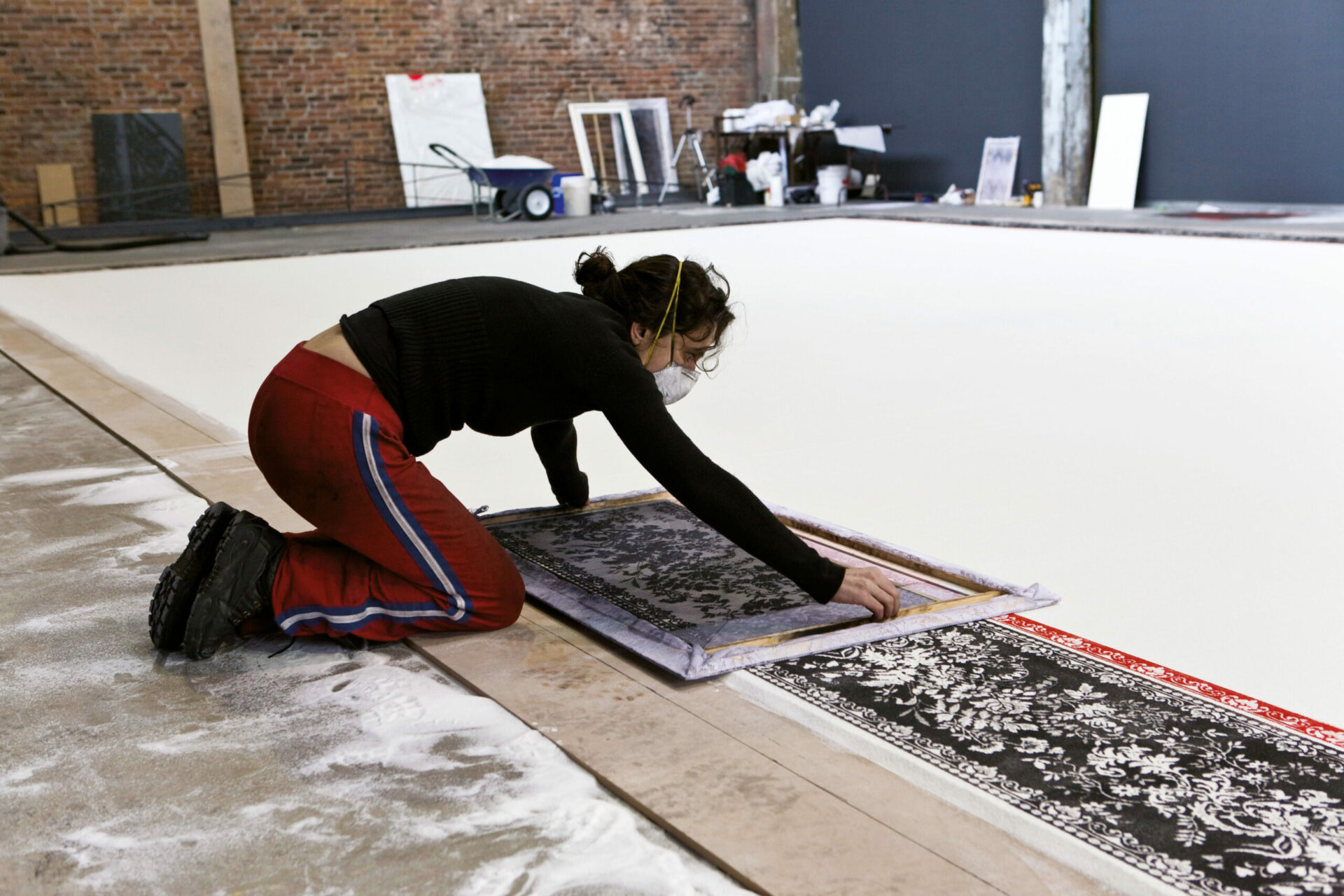
“Caution: Extremely fragile. Please do not touch.” This printed warning is the only explicit barrier guarding Aude Moreau’s Tapis de sucre 31 1 - Darling Foundry, Tapis de sucre 3 (20 March to 1 June 2008).. The concept of the work, which the artist has already applied to more intimate spaces,2 2 - Tapis de sucre 1, Triangle Artists’ Workshop, Dumbo, New York, Brooklyn, 2002 and Tapis de sucre 2, Orange 2006, Saint-Hyacinthe contemporary art event. is in this case extended to the great hall of the Darling Foundry. At first sight, the contrast could not be more pronounced between the imposing rawness of an architectural container designed for heavy industry and the subtle delicacy of a contemporary artistic content, which insinuates itself into the empty shell of an outmoded model of economic exploitation. However, is this opposition so certain? Here sugar is dumped in industrial quantities (two and a half tons, to be precise), in a shocking sample of its over-consumption in a society that is accustomed to a sweetness enabling it to maintain harshness at bay, beginning with the conditions of its production. It is in the sugar industry that working conditions closest to slavery have been perpetuated, confining a distant agricultural proletariat to an existence more precarious than that of an artwork made of sugar: such is the price of the snug security of Western comfort. In a manner similar to the Sugar Children series by Brazilian artist Vic Muniz, Aude Moreau’s Tapis de sucre ties the bitter rigidity of the iron law of wages to the sweetness of life in the consumer society it underpins.
The Tapis de sucre also questions the place of a refined culture—as of refined sugar—within this raw economic logic. The carpet seems precious because its stencilled fringes reproduce a decorative lace motif, applied repetitively with great care to convey the impression of handmade work. This craftsman-like work, which imitates the industrial process, invites comparison with the thankless labour that preceded it elsewhere to produce its raw material, evoked in the sugar plantation scenes painted in dark filigree on the exhibit walls. The artwork commands respect by simultaneously underscoring the dignity and indignity of work, drawing on the ambiguous connections between artistic creation and industrial production.
Following the thread of this web of contradictions can take us far, namely to the “sacred” origin of all culture according to the anthropological thesis posited by critic René Girard in Violence and the Sacred. According to Girard, the peace and plenty that any social order claims to ensure first arises out of the general fray of rival desires competing for a common object. As a social pact, the sacred union around the victors results from a unanimous confusion between this founding violence and its “barbaric” victims, allowing “civilization” to be purged of the former along with the latter.
It is the sacrifice of the scapegoat, still to be seen in the margins of Tapis de sucre 3, driven into the industrial shadow of a shining artistic surface. The sugar itself is the revealing precipitate of desire in its pure infantile form, invisibly saturating everything we consume so as to maintain a dependency whose nature and implications remain hidden from us until we see it massively poured onto a factory floor. In seemingly inviting consumption, all the while maintaining the prohibition against it, this obscene waste only serves to further emphasize the sacred dimension of the sugar. In this way, the desire which the artwork cleverly thwarts is maintained, since to give in to it would profane the “pure” object that sustains such desire, possibly triggering an escalation of vandalism worthy of the primitive horde. The ephemeral survival of Tapis de sucre hangs by a thread tautly stretched between conflicting impulses, in the precarious balance of a tour de force relying on an archaic fulcrum to defy—even as it invokes it— the command to give in to all temptations on which the economy runs.
This sacred space is nonetheless given over to desire to the point of suspending it in a more gaping openness to any and all contingencies. As a dazzling white skin, of a grain so delicate that the most timid caress would suffice to lacerate it, the Tapis de sucre resembles the finely raked sand of a Zen garden upon which we dare not trample, but where irregular rocks emerge here and there, in an indecipherable arrangement. Likewise, in its very materiality, the artwork acquires in the surrounding space the character of a desert erratically punctuated by protuberances and crevices, which underscore its otherwise immaculate emptiness: craters of rubble fallen from the ceiling; gashes and contusions inflicted by the fleeting touch of careless visitors; the cruel, brownish scars of rainwater leaks; and the light, parallel tracks of discreet wildlife. These traces, beyond human control, become part of the surface of the sacred enclosure set apart from the latter, to make room for and give rise to the Void of which everything that spontaneously arises in the artwork partakes, bearing witness to the Void’s sovereign power in the vulnerability of its very self-emptying. The Tapis de sucre furthermore does without security guards to enforce the respectful distance imposed by the museum as an institution; this highly fragile work can fend for itself precisely by putting itself at the mercy of all comers, as though by virtue of the Tao’s acting-without-acting
(wei wu wei).
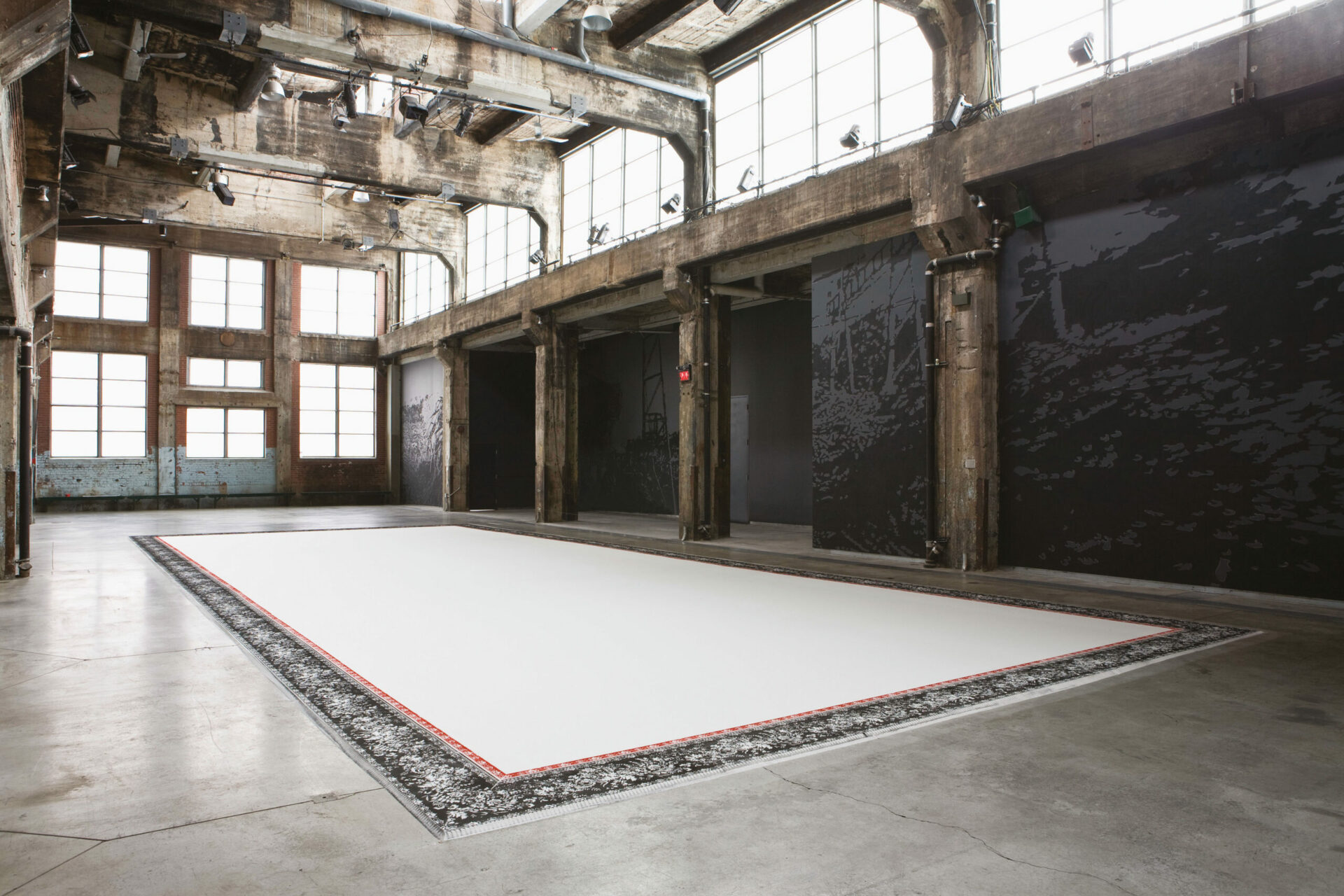

photo : Guy L’Heureux
The Void nevertheless reclaimed its rights over its ephemeral foil during the public dismantling of the installation, titled VACUUM and filmed as a performance. It was only a matter of letting sanitation professionals do their job: vacuuming up the poured sugar, then transferring it to a tank truck parked outside so as to recycle it as food for a pharmaceutical laboratory’s microorganisms. After a few weeks’ detour through art into the cultural sphere, the sugar provided for free by Lantic thus re-entered the economic circuit. The industrial system finally exercised its annihilating power over the vulnerable softness of the Tapis de sucre, which had covered its iron logic with a revealing coating. Overtaken by a strange unease, one might have shuddered to watch this white skin being slowly flayed until all that was left was a bare gray floor. The fragility of the environment given over to economic exploitation might come to mind upon seeing this snow-white carpet being inexorably eroded by the vacuum cleaner.
Besides, until the very last moment, one could hardly believe that the majestic Tapis de sucre would actually disappear, slowly dwindling to oblivion before our eyes; it was as though it had been invisibly rolled up rather than irretrievably abolished, each fragment containing the dimensions and the structure of the whole, much as in a hologram. Due to the sacred aspect of this sugar mandala, its transfer into the vacuum called for a ceremonial dismantling comparable to that of sand paintings in Tibetan or Hopi rituals, whose surfaces are grooved by a straight slash to break their microcosmic charm prior to restoring them to the Void. In this happening, the technical procedure of the profanation of an artwork reduced to its own dust ended up being ceremonially sacralized as an integral part of the work’s creative concept in the very process of its destruction, evoking the sacrifice of fragile human and natural resources by the technological system that harnesses them as such. In surrendering to the world-system as a willing victim, the fragile and ephemeral artwork identifies itself with what is weak and precarious to the point of allowing raw power to erase it, as though the only way not to give in to its sway were to uncover it, letting it run on empty. For only the Void has the final word, however faint its voice might seem, as it echoes through such an art of the fragile.
[Translated from the French by Vivian Ralickas]


