
Photo: John Ellsberry, courtesy of Creative Capitalism
What is it about the idea of a “public” that appears so central to certain forms of creative production? It would seem that relegating a public (or many publics) to a place alongside an art-making apparatus (a group, a collective, an object, a concept) without first defining what or who constitutes that public is somewhat misleading, and signals a kind of groundlessness. Such a concern pervades recent writing on art and architecture.1 1 - See for example Brian Massumi’s forthcoming Architectures of the Unforeseen (MIT Press) and work by Bruce Mau and Rem Koolhaas. Yet somehow grounding a definition in either geographic proximity or demographic specificity (or even in terms of collective sensibilities and judgment) continually falls short of satisfactory. In his recent book, Publics and Counterpublics, Michael Warner sets out to theorize the ways in which “counterpublics” are formed by the marking of difference in relation to a larger public, especially through a self-awareness of difference or subordination by such groups (counterpublics) themselves. Still, Warner begins with a decidedly (and deceptively) simple question: what is a public?2 2 - Michael Warner, Publics and Counterpublics (New York: Zone Books, 2005).
In 2004-05, a small group of artists, musicians, and designers in Baltimore, Maryland, formed a creative collective—Creative Capitalism—with the aim of producing and disseminating art and music. Working in Baltimore’s fertile musical environment, the collective has since released several albums by Ponytail, Low Moda, History at Our Disposal, The Tall Grass and Noble Lake. The collective stands as more than a glorified record label, however, as the artists involved focus on modes of creative production that rely not solely on either the gallery system or music industry for exposure and distribution. More importantly, the specificity of what or who is included in the collective is completely shaped stylistically and aesthetically by a wide (socially and geographically) network of friends and friends of friends. For instance, Jon Brumit, a some-time contributor to the collective, invited Creative Capitalism to be involved in the art/concept/guerrilla “Neighborhood Public Radio” broadcast project at the 2008 Whitney Biennial. While actions or works carry an individual signature, as a methodology they become folded into situations of mutual creativity; the idea is to provide the conditions for a creative public, wherein this public can be constantly invented and reinvented along lines it sets out for itself, at points that are initially undetermined. Creative Capitalism attempts to occupy a space somewhere between an event and a technology.
The first project undertaken by the collective was a 192-page book/CD entitled Friends and Friends of Friends (2005), composed of art contributed through a call-out to artists and musicians in Baltimore, their friends, and their friends’ friends, which eventually included contributors from New York, Texas, California, France, England, Scotland, Singapore and elsewhere. The curatorial experiment allowed the network to move out from the centre, and to touch on unexpected nodes; for example, after asking why so many packages were arriving around the time of submission, co-founder Peter Quinn’s postal carrier took it upon himself to submit his own work: detailed Afro-centric paintings of semi-erotic female-animal hybrids with future-world backgrounds. Chance “friendships” between artists established the project’s experimental curatorial method—but at the same time, the process erased evidence of the centre from which the network began in the final product. The concept driving the volume was co-operation, but a kind of co-operation that does not necessarily require a directing authority. There is a strong theoretical point (though one that falls short of being over-determined) linking these forms of co-operation to the types Marx describes, where a large number of activities (production) can be carried out over an extended space, thereby resulting in an equivalence of production.3 3 - Karl Marx, Capital: A Critique of Political Economy, Vol. 3 (New York: Penguin Classics, 1993). Here, however, the result is not so much Marxist as it is Deleuzian: the apparatus under-girding production is nothing more (and nothing less) than a threshold, one ballasted by the network itself.4 4 - Gilles Deleuze and Félix Guattari. A Thousand Plateaus, trans. Brian Massumi (Minneapolis, MN: University of Minnesota Press, 1987). (It is worth noting that the otherwise “proletarian” reading of the collective can easily be eschewed by the fact that one of the bands produced, Low Moda, was featured in the most recent runway show by Yves Saint-Laurent in Paris.)
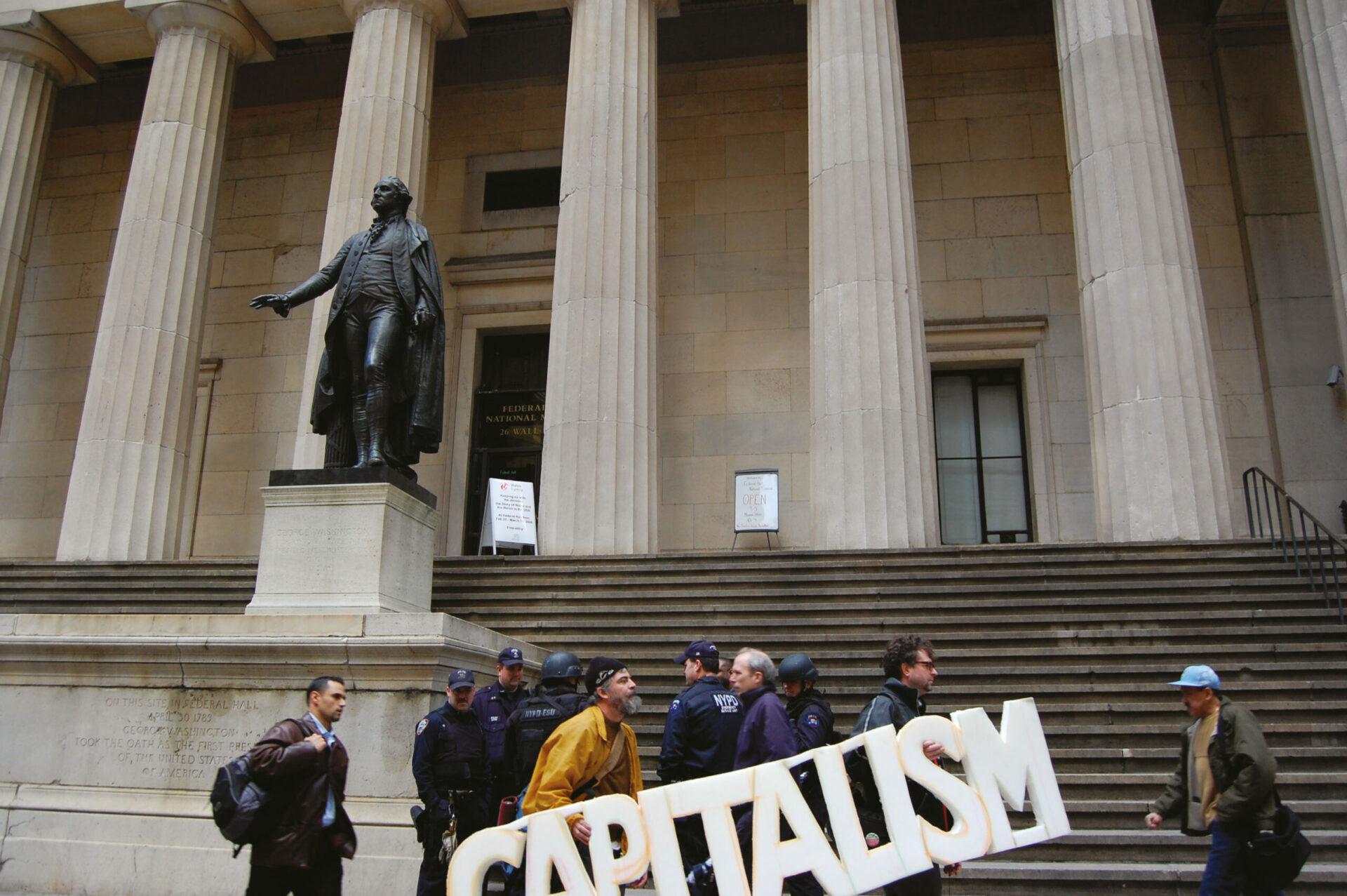
Creative Capitalism Carries Capitalism from Wall Street to the Whitney Biennial, 2007.
Photo: John Ellsberry, courtesy of Creative Capitalism
The second project, Notebook (2006), used the same curatorial method as Friends, but focused on random notations, sketches, and notebook entries on paper, reproduced in a black and white book, and it included a DVD of short videos. The publication and launch of Notebook clarified the nomadic, “spectator-less” ethos of the group. The books themselves were printed with plain cardboard covers and rubber-stamps forged with the title, the publisher, and the ISBN number were used to mark the books. In the gallery, long tables were installed and workstations were designated to carry out the assemblage. Contact-microphones were attached to the tables and a basic PA system was positioned in front of the tables. Then, as contributors, members, and an interested public filtered through the door, all were put to “work” in the performance of the book’s production. Passed from station to station, the covers were hand-stamped with the necessary information; the microphones amplified the industrial rhythm of the performance, with a member of the collective joining in on viola for “melody.” Anyone in the gallery could stamp, uniquely marking the finished products that were then put on sale during the show. All of these actions were necessary in bringing forth the “product”: therein lies the paradox of an audience-less performance—the performance of an audience that is liquidated in the assemblage of the object itself.
Audience-less performance illustrates the deeply transformed concept of “the public” that drives the work of Creative Capitalism. The standard presumption that art or performance must “reach the audience” is largely absent because the initiatives of the collective do not presume a public that is already there, passively awaiting identification or activation. Creative Capitalism is not a model for reaching “the people”; it is a structure of becoming that, through creative expression (art as detonator), seeks to constantly reinvent itself through an impossible engagement with a public that consists of people who are missing.
This is not to say that Creative Capitalism has no concern with “being popular.” In fact, the collective openly seeks to circulate the works it generates as widely as possible. It may not presume a public, but the collective certainly invokes an engagement that brings real people together to produce and/or experience particular forms of creative expression. Entering into the shifting space of the collective, participants become fabulists, visionary mythmakers with the power (fleeting, contingent) to pluralize engagements typically understood to be singular.5 5 - Fabulation is a concept developed by Henri Bergson in Chapter 2 of The Two Sources of Morality and Religion (South Bend, IN: University of Notre Dame Press, 1977). Creative Capitalism’s paradoxical desire to be popular is rooted not in “finding” audiences or markets but rather in strategies of overflowing itself, inventing and reinventing publics and the collective itself as it flows.6 6 - Gilles Deleuze, “Whitman,” Essays Critical and Clinical (Minneapolis, MN: University of Minnesota Press, 1977). See also Daniel W. Smith’s introduction to the same volume, “‘A Life of Pure Immanence’: Deleuze’s ‘Critique et Clinique’ Project.”
In an age when headless networks and asymmetrical organization structures evoke images and unending rhetoric regarding terrorist cells, foreign and domestic threats to particular visions of democracy, etc., Creative Capitalism can be read as a crank provocation. What is “capital” in this context? The group plays on the habits of thought and action connected to “capitalism,” while never quite defining its relation to the term, other than each member containing all the capacities of “capital” to be wilfully bartered for a larger creative gain. While the mysticism of capitalism is explicitly mocked by the group (giant papier-mâché heads serve as the group’s “corporate heads,” a silent board of directors), the structures of a capitalist enterprise remain firmly in place. The group does not aspire to inflict a condescending “people’s art” on the world and, for all of its aspirations to be “popular,” Creative Capitalism does not seek out “the people” to educate, convert, or speak for. Returning to and modifying Michael Warner’s question, in this context, “what are the limits of a public?”—here, a definition would have to incorporate circumstance as much as circumvention. In a sense, it is difficult to describe something so disperse, so simultaneously theorized and under-theorized, so wilfully and passively inclusive. It feels appropriate to end with a question from the collective’s manifesto: “What is your function?”


