
Photo: courtesy of Dan Graham
A prominent and unconventional figure in contemporary art since the 1960s, Dan Graham has obsessively designed for the past thirty years architectural and urban models, notably “pavilions”—human-sized architectural-sculptural structures characterized by clean lines and mirror surfaces. In line with his theoretical writings as well as the performances and installations he produced at the beginning of his career, his mirror and glass pavilions, generally intended for public spaces, raise issues of self-perception and perception in one’s own surroundings.
Following modernist architecture’s use of glass as found in major Western cities, Graham plays with transparent and mirror materials to confuse observer and observed, public and private space, inside and outside. Between art, architecture and design, these architectural-sculptural works, by their presence in public spaces, question the very functionality and sociability of the artwork. As a guest of the City of Paris, which launched a comprehensive program of urban and landscape development to mark the inauguration of its first tramway route around the capital, Graham created two structures: From Boullée to Eternity andMannerism/Rococo. The first one found a permanent location at the Porte-de-Versailles metro station, while the second was shown at the Marian Goodman Gallery in Paris last February. Making reference to two opposing architectural styles (neoclassicism and baroque), both projects reflect the complex approach of a provocative artist. Dan Graham’s work, playing with contradictions in an effort to systematically transgress established codes, draws its forms from minimalism while asserting itself as social art. In so doing and against elitism, it attempts to confuse and disrupt streets, gardens and museums.
Violaine Boutet de Monvel & Jonathan Regier: From Boullée to Eternity, that’s the title of your pavilion at the Porte de Versailles tramway station in Paris. This February, another of your pavilions will be shown in Paris, at Marian Goodman Gallery. The title of that work is Mannerism/Rococo. There’s an obvious link between your work and neoclassicism—thus Boullée. It’s in the lines; they’re very clean, very uncluttered. I have a harder time seeing a reference to rococo in your pavilions. Is it that you use reflective material? That you distort the viewers and the landscape? This is definitely the case in Mannerism/Rococo. And this practice might be construed as a sort of mannerism.
Dan Graham: They were both proposals for the tramway, but the one I’m showing at Marian Goodman Gallery, which I think is a much nicer piece, was designed for an area near a sports arena, where there’s a glass building with two-way mirrors. But the space was very narrow. Ami Barach thought it might be too dangerous to set the piece there, that people might destroy it. So we preferred the plan for Porte de Versailles. It’s an open area and maybe the police can look after it. And actually neither one was a new idea. I had them in my notebooks, but I thought they fit the situation. I like the one in Marian Goodman Gallery because it’s narrow. It’s very perverse, very mannerist in a certain way.
Dan Graham
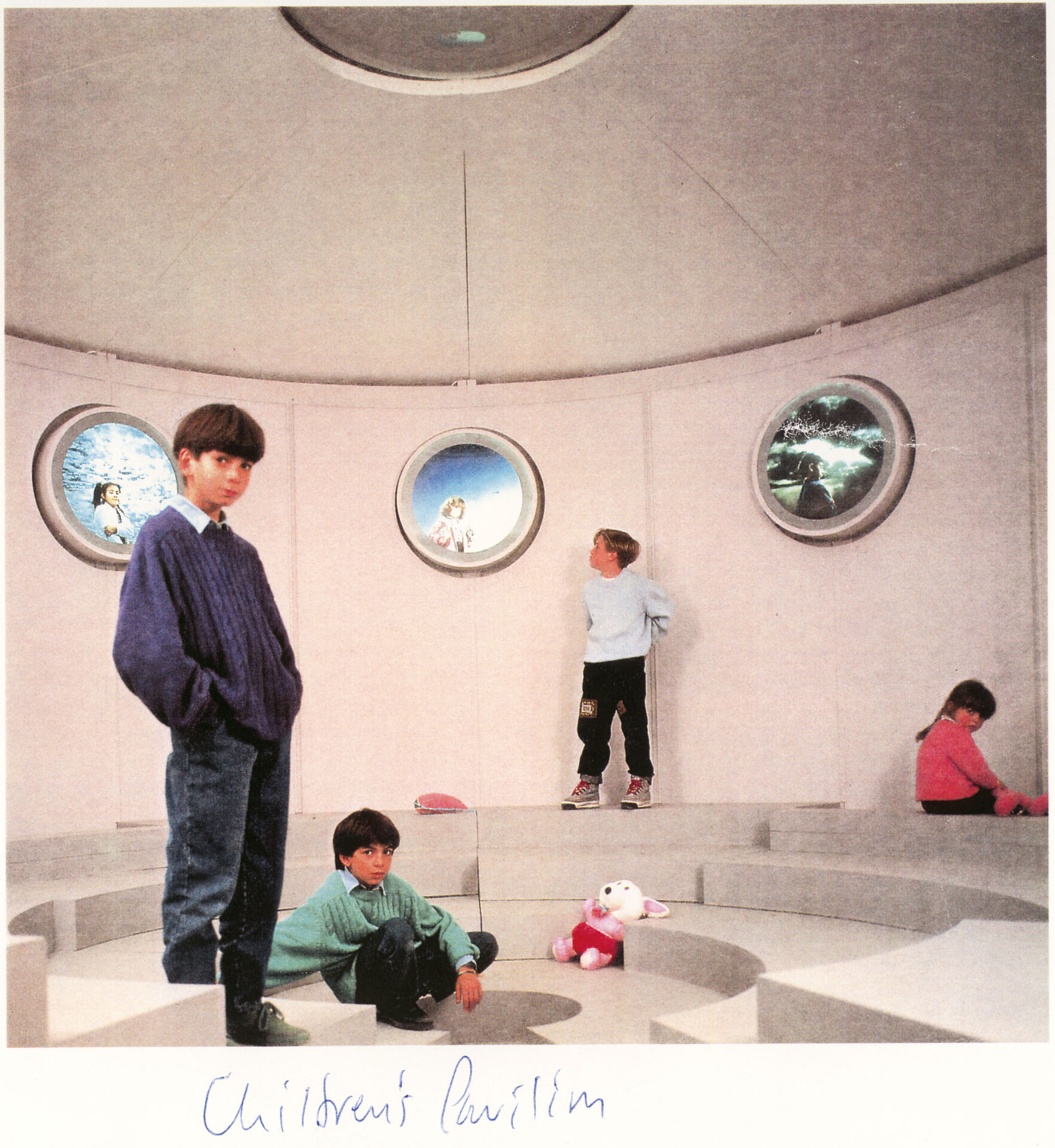
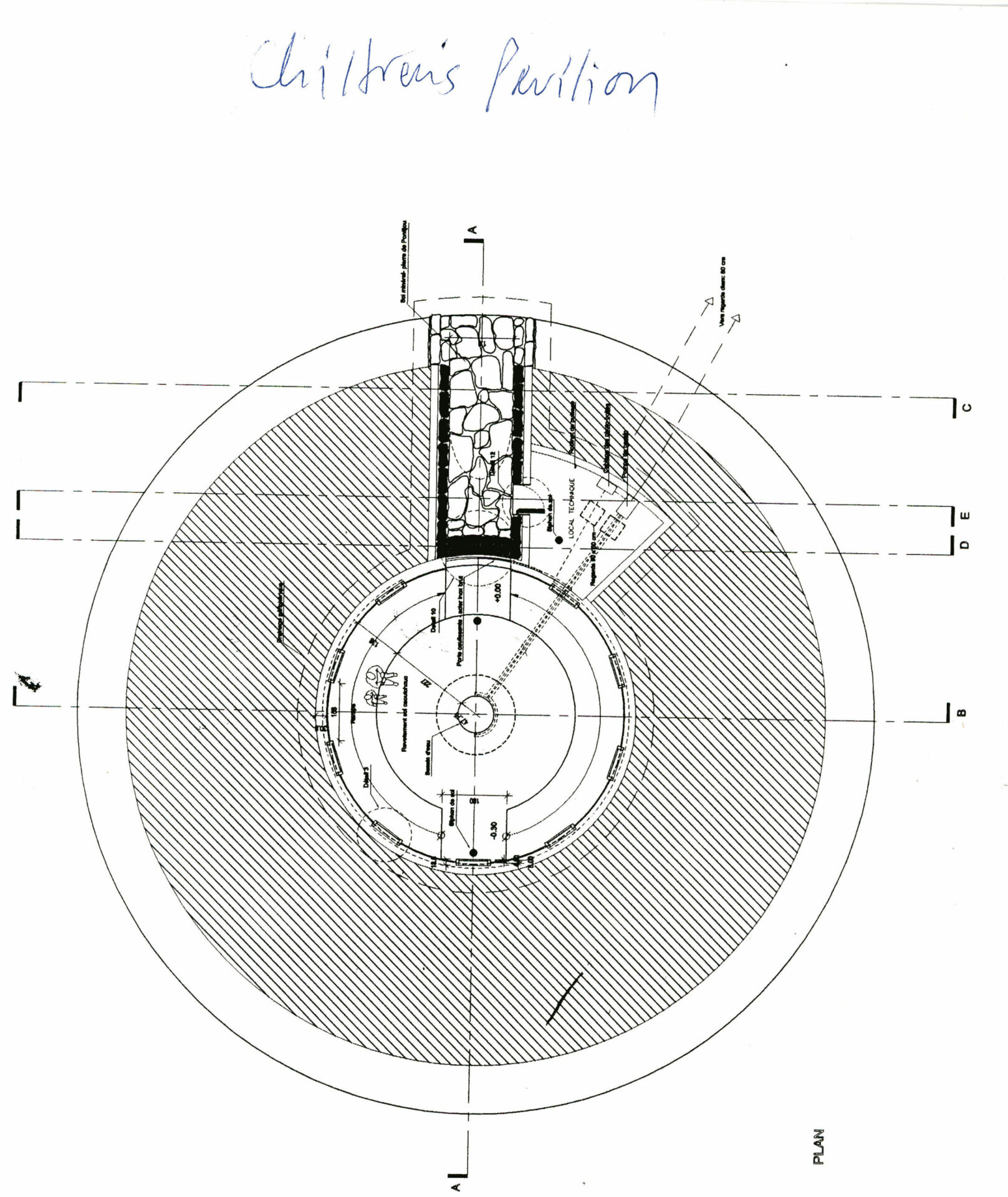
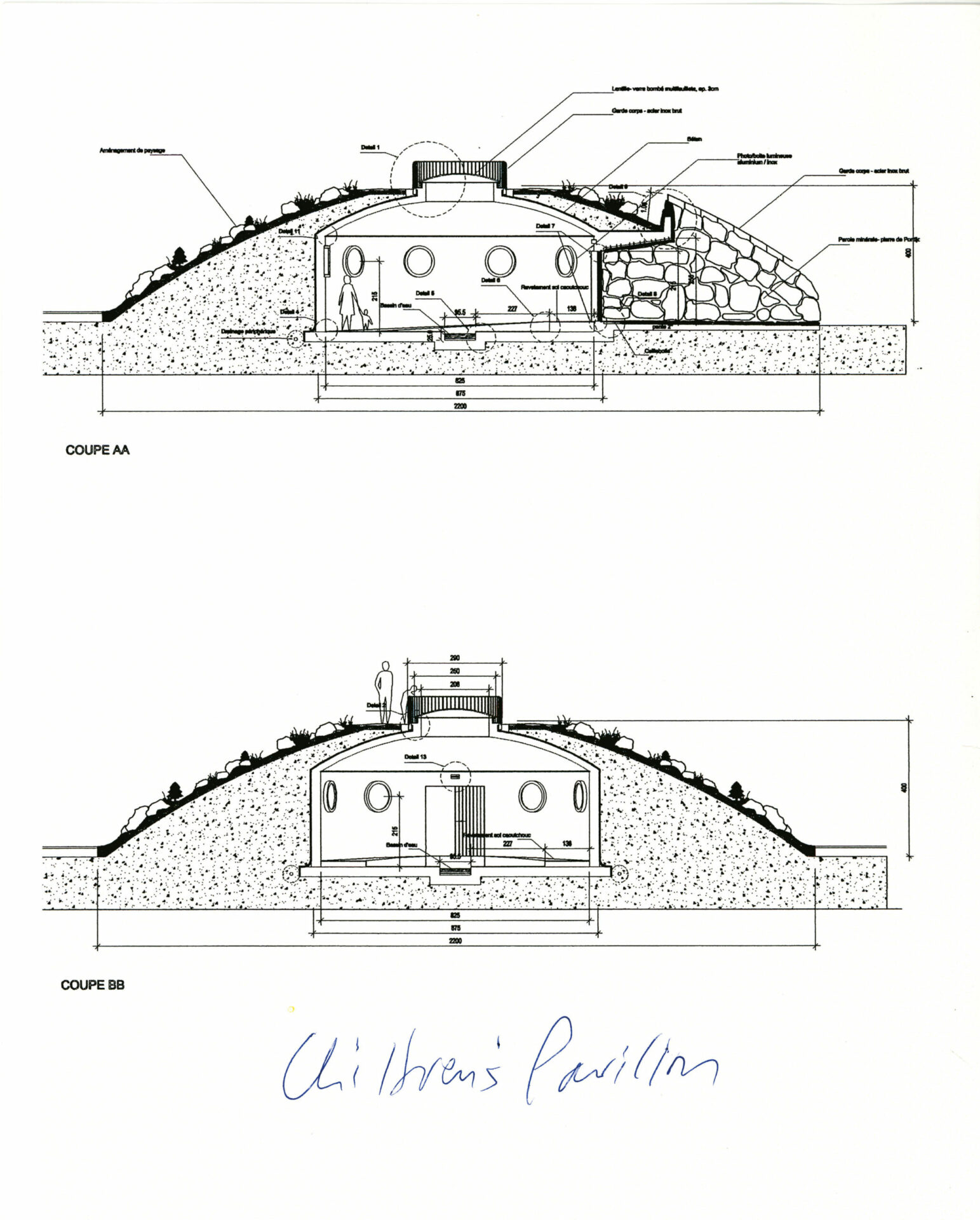
Children’s Pavilion, 1988.
Photos: courtesy of Dan Graham
VBM & JR: And the neoclassical background?
DG: The neoclassical background I’m relating to is the 1980s, when all the architecture was neoclassical. It was kind of fascist like the 1930s. Minimal art began with these geometrical forms, and what I’m trying to do is undermine minimal art. Minimal art was objective, whereas I want to be intersubjective.
And also I got very involved with the baroque, rather than rococo. Because with the baroque, when you move, the image moves, so it’s all about moving rather than fixating yourself. And of course there’s a contrast with Renaissance perspective, there’s a time delay, there’s the motion of the spectator in time. And also my work is outdoors. The clouds and the sky keep changing, and you get more reflective surfaces than transparent surfaces. I also like the idea—I think I picked up on this because children like it—that when the surface is anamorphically enlarged, boys can see themselves as supermen, whereas on the other side, women who are overweight can see themselves as thin. Actually, my Children’s Pavilion was originally going to be done in Parc de la Villette. A children’s mountain was there—so you can become king of the mountain. I referenced the Children’s Pavilion to that site. I wanted to have the interior look like Lascaux. The water basin is like a grotto, so the reference is also to Boullée. It’s like an observatory.
VBM & JR: What can the children see?
DG: They see themselves. It’s a concave two-way mirror and they can see themselves as giants against the real sky. On the same note, rococo comes from my interest in the Amalienburg Pavilion in Munich, and also the best rococo church is St. Nicholas in Prague… and it’s on a hill. I once did a piece called Pergola Conservatory, which was kind of a walkway. The top is a curved two-way mirror glass ceiling. The pergola grows around it. But actually, when you look up in the sky, instead of seeing angels in the sky, you see yourself. You see the real sky instead of heaven. And it’s a modern material that I’m using, something that’s used in houses for patios, for sundecks. So I combine modern suburban and urban references with traditional garden architecture or church rococo. Also, unlike neoclassicism my work still uses baroque developments, because as you move, the image moves. So in a certain sense I’m undermining what seems to be a reference for my work.
VBM & JR: Where did you realize the Children’s Pavilion?
DG: It was never done. It was going to be done in the city of Blois for the year 2000. Jack Lang wanted it. But then Jack Lang went to Paris to campaign, and the project went into the city bureaucracy and they killed it. I can show you some plans… this is the top… and then inside is a convex fish-eye lens, also a two-way mirror so the parents can look up. They see the real sky and their gaze meets the gaze of the children on the top. The water basin also shows reflections, and you can hear the water, so it is like a grotto. And actually Jeff Wall’s tondi go much lower, so children can look down and see the parents, very small, looking up, and they can see the tondi—the roundels—which express a fantasy about different children of different nations. But the sky is shifting… it becomes more transparent than reflective every moment. So that comes in part from thePergola Conservatory. But with the Children’s Pavilion, I wanted to do something that was subterranean, ecological and also mythical. And it’s a fantasy. I never thought it would be done. It’s now credited mostly to Jeff Wall, but Jeff had little to do with it.
VBM & JR: The reflections are so important to your work. It makes me wonder where the boundaries are. Where does a work end? Where does the city begin?
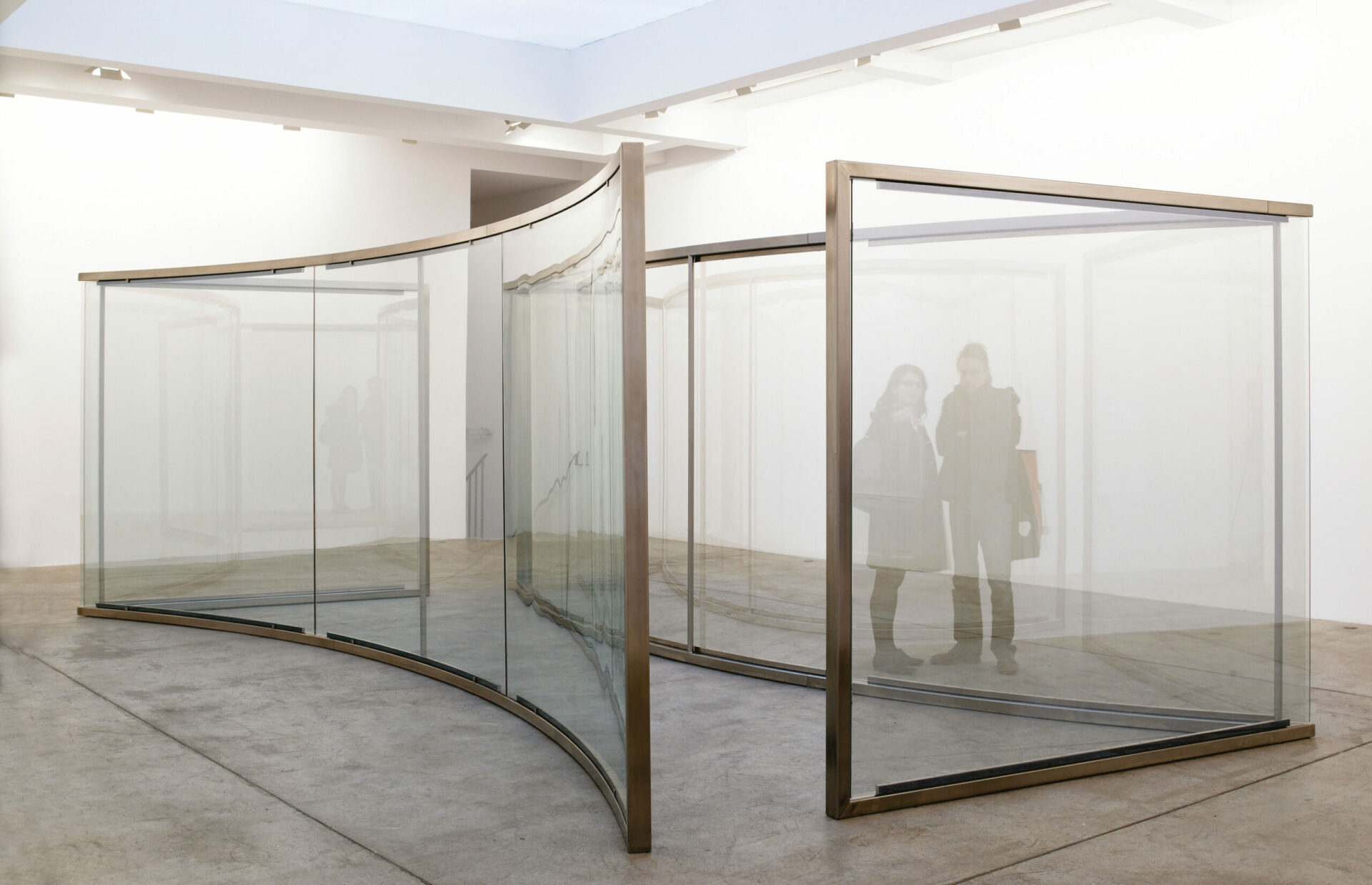
Mannerism/Rococo, 2007.
Photo: courtesy of Dan Graham & Galerie Marian Goodman, Paris
DG: When I was fourteen, I read Jean-Paul Sartre’s Being and Nothingness, and Lacan takes everything from Sartre. Sartre talks about the small child having a sense of himself as an ego when he sees other people, or of seeing himself as he sees other people. So it is about the meeting of the two gazes. It is about intersubjectivity. And Lacan took everything from that.
I think art really comes from childhood memories. I wanted to contradict minimal art, to become very involved in people seeing themselves perceiving, seeing themselves perceiving at the same time as they are perceived by other people, and to have this done with a reference to nature. There’s that ecological side.
VBM & JR: What about the functional aspect of your pavilions? What kind of research do you do on an urban or cultural space before you install a pavilion there?
DG: Originally, I had a gallery that showed early minimal artists like Sol Lewitt. Sol Lewitt and Dan Flavin worked at the Museum of Modern Art as guards during the time there was a very big show calledThe Great Experiment, about Russian constructivism. And all minimalist art that I know comes from Russian constructivism. We always hated Duchamp. Russian constructivism is somewhat functional. With my own work, I’ve done many things that are partly functional. For example, the DIA Foundation piece was actually designed to be a performance space. I wanted to make the DIA into an outdoor concert space. I know Thurston Moore of Sonic Youth wanted to perform, and Laurie Anderson, an ex-girlfriend of mine. They didn’t allow it. I also wanted the DIA to be both a 1970s alternative space and a 1980s corporate atrium—with a performance space, with a videotheque. And there is a very good piece that hasn’t been done called Fish Pond/Swimming Pool. You would have fish on one side, people on the other, and a café underneath it. So I really like things that are quasi-functional. Cinema, of course, is like that. I think the reason I like things that are partly functional as well as aesthetic is because they can gather a lot of people. And my work is very much about public space.
VBM & JR: So the first functional aspect of your work would be to make people gather?
DG: Yes.
VBM & JR: In the piece for the tramway station, do you have seats? Is it supposed to be a waiting area?
DG: Well, I wanted it to be a waiting area but they didn’t allow it.
VBM & JR: Why?
DG: They didn’t want it to be covered. They didn’t want a ceiling. The reason is they’re afraid people will go on top of the ceiling.
Actually, what was really interesting is when I was working with the FRACs in Brittany in the 1980s. All of these spaces were overlays of different historical gardens. I wrote an article about the garden as museum, museum as garden, because I think the first museums were Renaissance gardens. In fact, it was anti-Buren, because Buren is ahistorical. He doesn’t show the museum as always shifting, shifting through historical moments, through time. I really did a lot of research on garden architectures. I don’t know Paris that well, but Ami Barak said that in Porte de Versailles there’s a building by Buckminster Fuller, so I took that into consideration. For me the city plan is the first thing to think about because I think art is not about the white cube, but about the city plan. I also like the surfaces of the city. I use two-way mirror glass because of glass buildings in the 1970s, late 1970s. They did this in America for one reason. It was a time of ecology in America, and corporations were being shown to ruin the environment. So they started using two-way mirrors because it cuts down on air conditioning costs. The sun is reflected off the outside. It also sets up a surveillance situation.
VBM & JR: It’s a form of power.
DG: Yes, because people on the inside can look outside without being seen. But actually the corporation looks like the sky. I think corporations are melting themselves into the environment. I want to reflect that. I am very involved with the surfaces of the city. Certainly, cinema is related to the city—the city is a trap for your gaze. I’m using a lot of perforated stainless steel for material, and I’ve decided that a big influence on me is Seurat. Seurat is pretty amazing. He puts his dots on the frame. And his work is about blue-collar people and entertainments, which is what my work is about.
VBM & JR: In your work the spectators can see themselves, can play with the distortions, can move around. It’s very entertaining.
DG: It’s also about the spectators seeing themselves as spectators. I’m very interested in that. It’s about the family group, and my work also has a lot to do with families. There was art tourism in the 1980s. The family could get in a car and go camping on Saturday, and on Sunday they could see art. This was influential for me, this family-focused art tourism. I dislike Buren’s idea, that the museum is the establishment. It’s also very ahistorical.
VBM & JR: I’d like to ask you about the video documentation of your pavilions. In these videos we hear you comment on your work, we see spectators experiencing the work. Do you consider these videos pieces of art in themselves?
DG: No, I use them for lectures. Actually, when I have big exhibitions I use models and videos. The videos show time moving through the work, and they show people in that situation. I think these still photos you get in magazines show nothing.
VBM & JR: I went to a recent lecture you gave. You were showing a video, and you would make comments on the comments in the video. I liked it a lot. It was an endless comment, a developing comment. We don’t get to hear that type of dialogue very much.
DG: The thing is, when I do lectures it comes out of teaching. In teaching you have to use humour. That’s maybe my Jewishness becoming important. There’s a lot of comedy in that tradition. Also, I saw a lot of television. And on late-night television you have important people on, say, Jay Leno, and they’re always chatting. I like to imitate that.
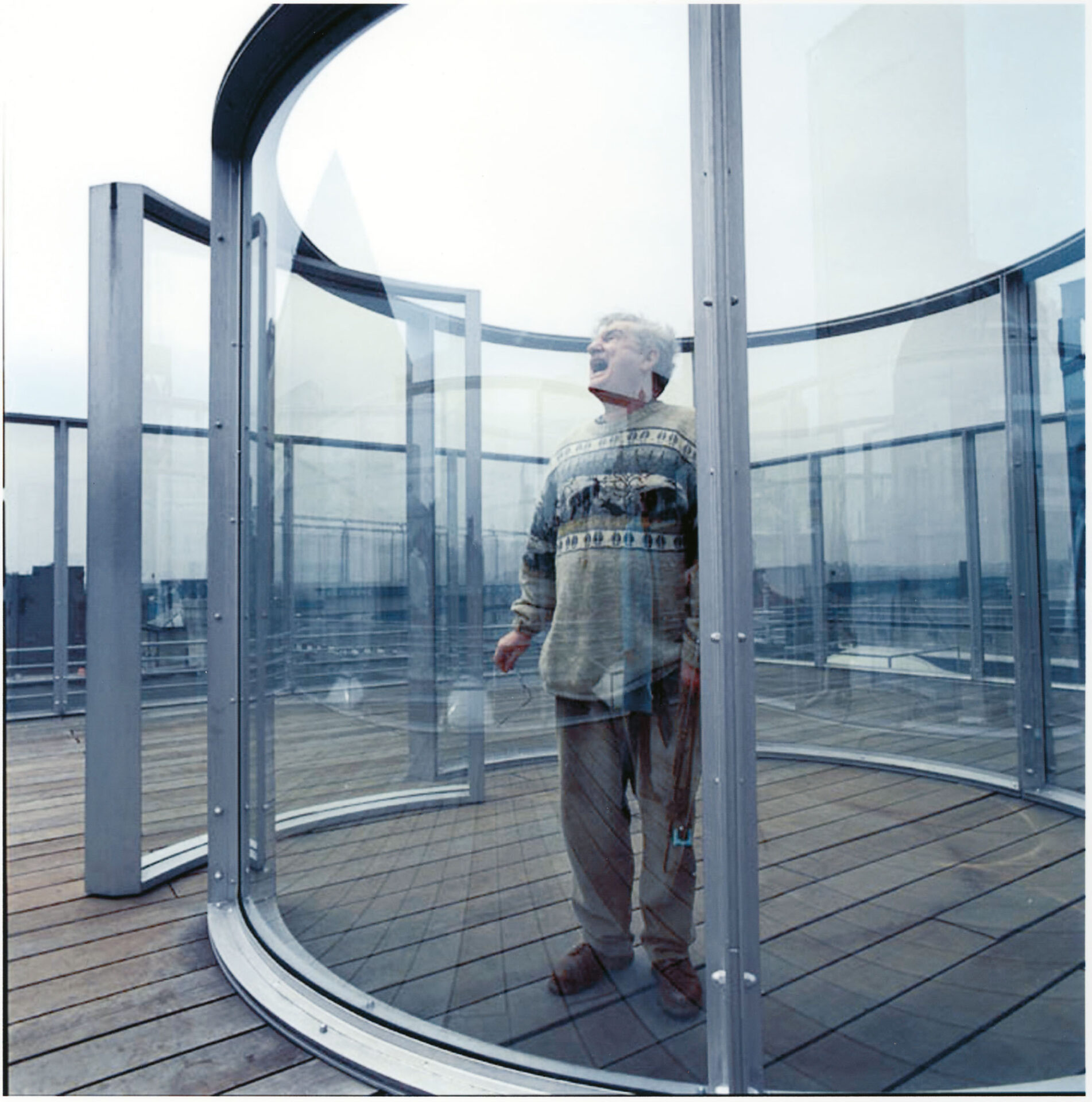
Two-Way Mirror Cylinder Inside Cube and Video Salon : Rooftop Urban Park, 1991.
Photo: courtesy of Dan Graham
VBM & JR: Your two-way mirrors pop into my head when I consider that endless dialogue. I think of the artist regarding his own work, and regarding himself as an artist set against the backdrop of the city. Is there an anthropological process at play?
DG: It’s all about time. Unlike minimal art, my work has a lot to do with processes in time. I was very influenced by people like Steve Reich, who took from Terry Riley the idea of the time delay. But there was also drug time, that “being so much in your own brain.” I started with phenomenology but got very involved with 1960s drug time. I’m also very influenced by Benjamin’s idea of the “just past.” You have all these artists of the 1960s and 1970s who deny the art of the 1980s and 1990s. But in my DIA piece, I was trying to do a 1980s corporate atrium and a 1970s alternative space, a penthouse roof and slum roof. I really want to reconstitute what just happened—that’s Walter Benjamin’s idea. This is a way to really show history. Now everything is neo-1960s, neo-1970s.
VBM & JR: Is there a sociological element to your work?
DG: No, I hate sociology. I’m interested in the anthropological. When I was thirteen, I read books by Margaret Meade. That made me a feminist, and also made me very interested in anthropology. Then, when I was a little older, I read the works of Lévi-Strauss. I think the interest is in the family structure. And early Bourdieu was doing anthropology. He was very interested in the family structure. There’s a conflict I have between structuralism, which I started with, and real-time, passing time. I recently read a wonderful book about traditional French gardens. This book says there’s a conflict between neo-classical and baroque garden design. The neoclassical was Cartesian. It was the formal design of the garden, whereas the water in the garden, that was baroque. It was amorphous. It was Pascalian. I think in a way I set up a conflict in my own work between minimalism and the subverting of minimalism. I like the idea of putting something on a boundary, so it’s not one thing or another.
VBM & JR: And what about Rock My Religion. You’ve really got a flow to your commentary. Sometimes when you’re reading a text, it’s like you don’t have time to finish it—so you won’t. You’ll just cut off at the middle of a sentence. I really like that. It really involves you in the flow of the video. Or sometimes you’ll change your train of thought. It really gets the spectator involved.
DG: I think that I was influenced by Godard in the beginning. His films are like magazine articles. AndRock My Religion—we did that without money. It was totally amateur, but I was a rock writer. I thought it would be more interesting to do something as a film or video. Also, I’d done many feminist pieces, but I realized that we need a female hero, a heroine, so I found Patti Smith. As I mentioned, the DIA, they didn’t allow me to have music there. I also wanted to have cartoons, etc. They wouldn’t allow it. All my pieces have this problem. I go a little to far in making my work populist, as opposed to the elitism of most museums. They’ve taken the screens down at the Waterloo Sunset at the Hayward Gallery. I wanted to have videos at DIA because I wanted people to remember what had happened during the 1970s. It was about historical memory. In fact, I wanted it to be non‑elitist… but unfortunately it’s become an elitist space.


