Notice: Function _load_textdomain_just_in_time was called incorrectly. Translation loading for the woocommerce-shipping-per-product domain was triggered too early. This is usually an indicator for some code in the plugin or theme running too early. Translations should be loaded at the init action or later. Please see Debugging in WordPress for more information. (This message was added in version 6.7.0.) in /var/www/staging.esse.ca/htdocs/wp-includes/functions.php on line 6131

Notice: Function _load_textdomain_just_in_time was called incorrectly. Translation loading for the complianz-gdpr domain was triggered too early. This is usually an indicator for some code in the plugin or theme running too early. Translations should be loaded at the init action or later. Please see Debugging in WordPress for more information. (This message was added in version 6.7.0.) in /var/www/staging.esse.ca/htdocs/wp-includes/functions.php on line 6131
Knowledge and Not-Knowledge Production in the Art School – Staging – Esse

Knowledge and Not-Knowledge Production in the Art School

Justin Langlois
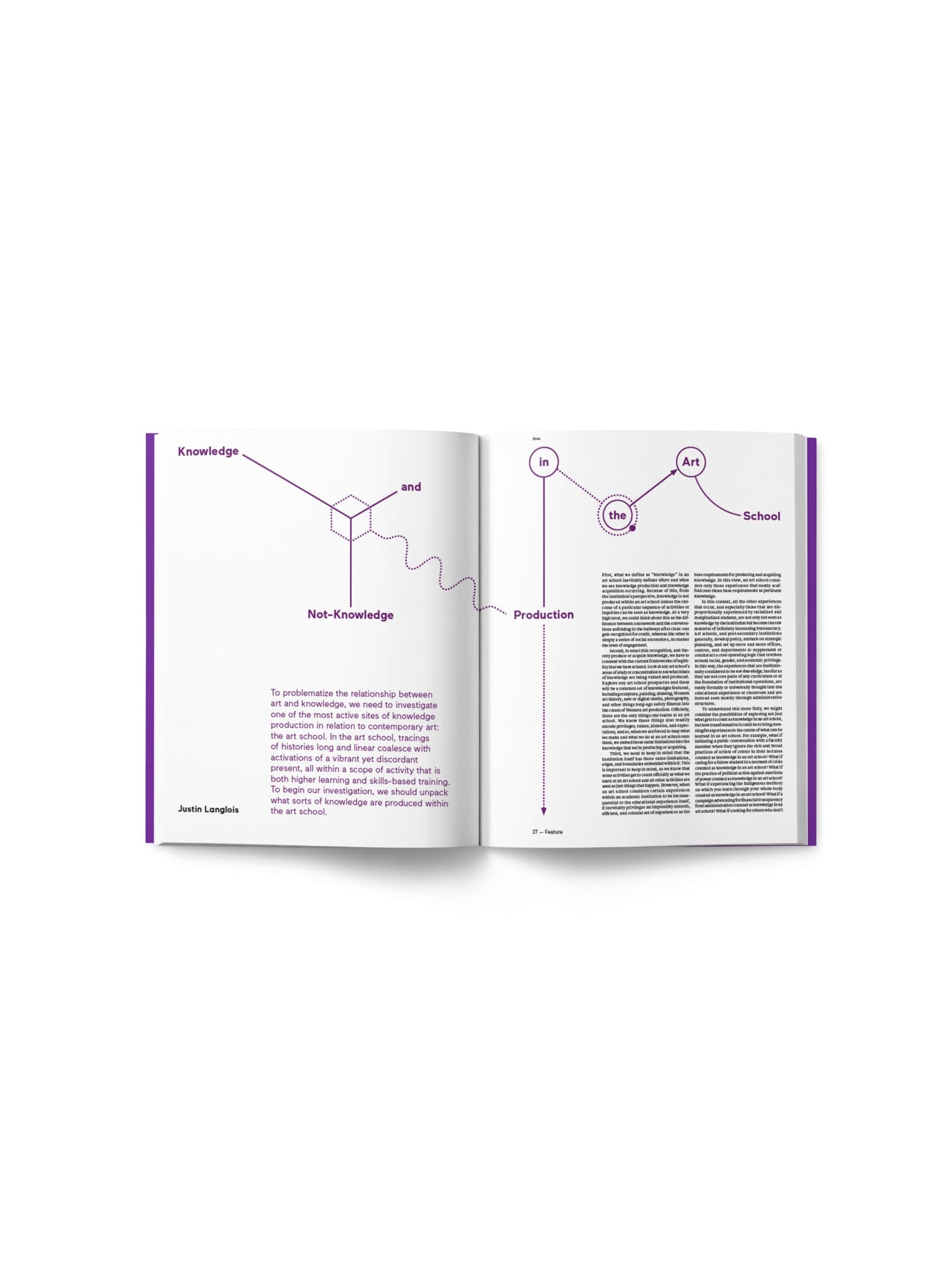
To problematize the relationship between art and knowledge, we need to investigate one of the most active sites of knowledge production in relation to contemporary art: the art school. In the art school, tracings of histories long and linear coalesce with activations of a vibrant yet discordant present, all within a scope of activity that is both higher learning and skills-based training. To begin our investigation, we should unpack what sorts of knowledge are produced within the art school.

First, what we define as “knowledge” in an art school inevitably defines where and when we see knowledge production and knowledge acquisition occurring. Because of this, from the institution’s perspective, knowledge is not produced within an art school unless the outcome of a particular sequence of activities or inquiries can be seen as knowledge. At a very high level, we could think about this as the difference between coursework and the conversations unfolding in the hallways after class: one gets recognized for credit, whereas the other is simply a series of social encounters, no matter the level of engagement.

This content is available with a Digital or Premium subscription only. Subscribe to read the full text and access all our Features, Off-Features, Portfolios, and Columns!

Subscribe (starting at $20)

Already have a Digital or Premium subscription?

Log in

Don’t want to subscribe? Additional content is available with an Esse account. It’s free and no purchase will ever be required. Create an account or log in:

My Account

This article also appears in the issue 98 - Knowledge
Discover

Suggested Reading