
Photo: Marc Domage, courtesy of La maison rouge, Paris
Antoine de Galbert’s foundation, La maison rouge, has launched a series of exhibitions highlighting lesser-known city art scenes. The exhibitions show not only how a territory, environment, or location can inspire artists but also how the identity of such spaces is in turn transformed through the vehicle of art.
For the first exhibition in the cycle, we have artist and director of the Musée International des Arts Modestes in Sète, Hervé di Rosa, to thank for convincing Antoine de Galbert of the merit of Winnipeg’s artistic production.1 1 - The exhibition will also be presented at the MIAM in Sète and at Plug In ICA in Winnipeg (2011-2012). There seems to be renewed interest in shows based on particular art scenes, as evinced by the recent showcasing of work by Arab and Indian nations. But the strength of My Winnipeg2 2 - My Winnipeg, presented at La maison rouge in Paris, June 23 to September 25, 2011. probably lies in how it managed to bring attention to the local scene without conjuring a fixed or self-referential identity, while avoiding a hegemonic representation of the discourse on contemporary art. Focusing on a city rather than on a nation also shows that the construction of artistic identity is principally channelled through the appropriation of shared territory or spatiality. Another interesting aspect of the exhibition is its programming: the presentation of the city also serves as an inspiration to travellers. Conceived as a tourist guide, the catalogue is intriguing in itself: artist presentations intermingle with information on climate, geography, and history.
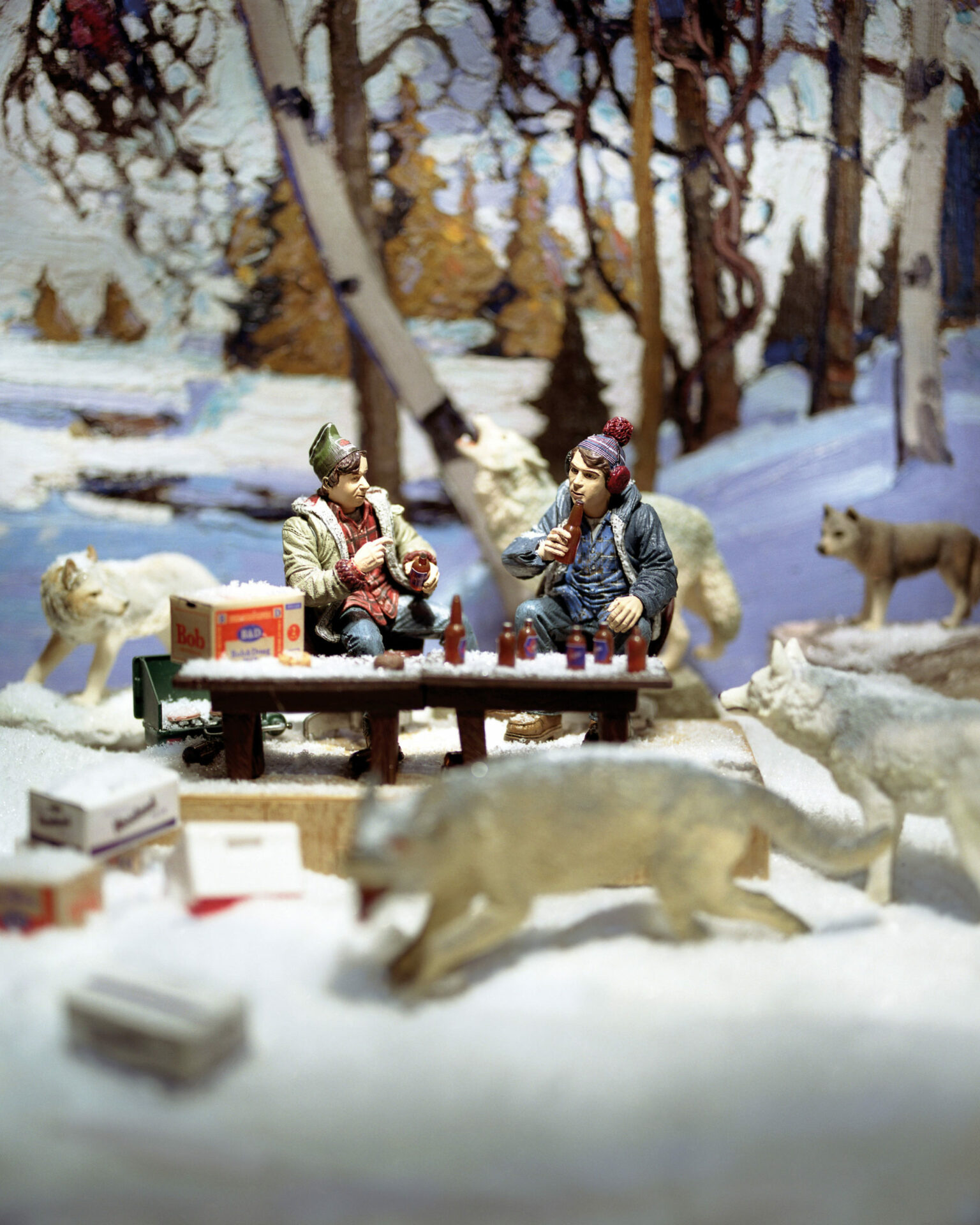
Early Snow with Bob and Doug, 2005.
Photo: © Diana Thorneycroft, courtesy of Art Mûr, Montréal & Galerie Françoise Paviot, Paris
The first section of the exhibition, Rien ne vaut son chez-soi (There’s No Place Like Home), which curator Sigrid Dahle conceived around a divan — part psychoanalyst’s office, part archive — proposes a topography of Winnipeg’s imaginative world. Documents, photographs, postcards, films, posters, along with fictional works portray the territory’s hostile reality. While for many Europeans, Winnipeg may only conjure the wonderful world of Winnie the Pooh3 3 - The city isn’t the bear’s birthplace, but of his owner, who took him across the Atlantic to become a Canadian curiosity in the London Zoo, which inspired A.A.Milne’s storybook character and later Disney adaptations. or the birthplace of Harlequin publishing, the reality seems rather less beguiling. This city of 700,000 inhabitants — whose Cree name signifies “where the muddy waters meet” — was the theatre of lasting struggles: frequent floods leading to massive evacuations, extremely harsh winters, plagues of mosquitoes, potholes in all the streets (Winnipeg may be the only city in the world that has a phone app to locate them). Add to that a traumatic social history, courtesy of its colonial past, its isolation, the hardships undergone by the nations that have come and gone, the sectarian conflicts, and class struggle.4 4 - My Winnipeg, guide de la scène artistique (Lyon: Fage Éditions, 2011). This section of the exhibition also has a predilection for ghosts and spiritualism. At the dawn of the twentieth century, physician Thomas Glendenning Hamilton specialized in séances, during which he produced a large number of spiritualist photographs. Winnipeg then is a haunted city, the outcome, in Dahle’s words, of a “gothic unconscious,” a dark unease tinged with depressive sadness.
The second part of the exhibition, entitled Red River, lacs gelés et paysages intérieurs (Red River, Frozen Lakes and Inner Landscapes), placing more emphasis on great open spaces, only confirms the first assessment. Featuring Guy Maddin’s black and white film My Winnipeg, whose leitmotif urges Winnipeggers to wake up and flee, Maddin’s personal memories intermingle with rather rancorous local anecdotes, in a style reminiscent of 1930s cinema. One gets used to sadness, Maddin says, but even when you manage to leave, the city’s image follows you: You can leave, but you can never check out.5 5 - AA Bronson, We are the Revolution, 2010, cited by Robert Enright in “Winnipeg: l’art du confort par temps froid, My Winnipeg, guide de la scène artistique, op. cit., 61. Indeed, Maddin believes that he is fulfilling a life-saving mission by discouraging people from going to Winnipeg.
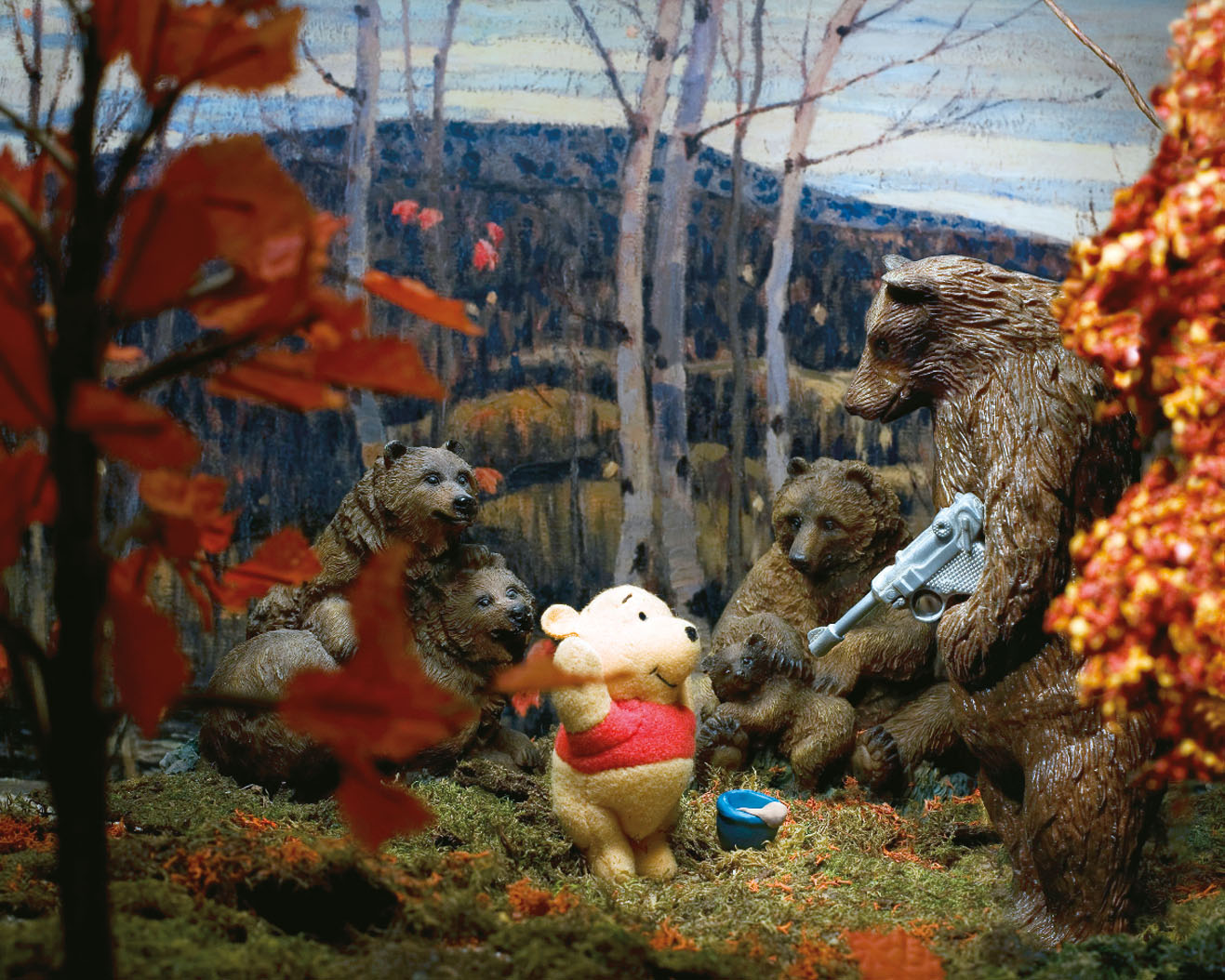
Group of Seven Awkward Moments (Maples and Birches with Winnie and the Pooh), 2008.
Photo: © Diana Thorneycroft, courtesy of Art Mûr, Montréal & Galerie Françoise Paviot, Paris
In this section, there are also dioramas by Marcel Dzama, Kent Monkman, and Diana Thorneycroft, evoking improbable scenes related to Winnipeg culture. Monkman’s diorama, The Collapsing of Time and Space in an Ever-expanding Universe, for instance, presents a plush 19th-century living room whose disarray suggests the presence of a depressive mind. Nature has begun to take over the parlour; a beaver is gnawing at the foot of a desk; crows are croaking. At the back of the room, a long-haired character in a nightgown whom we only see from behind is sitting in an armchair facing the window. Moving around the space, we become aware that he is a Native American transvestite shedding black tears. What he’s contemplating through the window is a classical tableau portraying him riding bareback among free-roaming bison. This improbable character, Native transvestite Miss Chief Eagle Testickle, is the alter ego of the part-Cree artist, a character whom he stages in his performances, films, and photographs. This modern vision of the “two-spirited” berdache — a body housing both a male and female spirit, as traditionally described by First Nations societies — symbolizes the normalizing violence of cultural confrontation during the European colonization, when these nuanced souls were labelled perverts and sodomites.
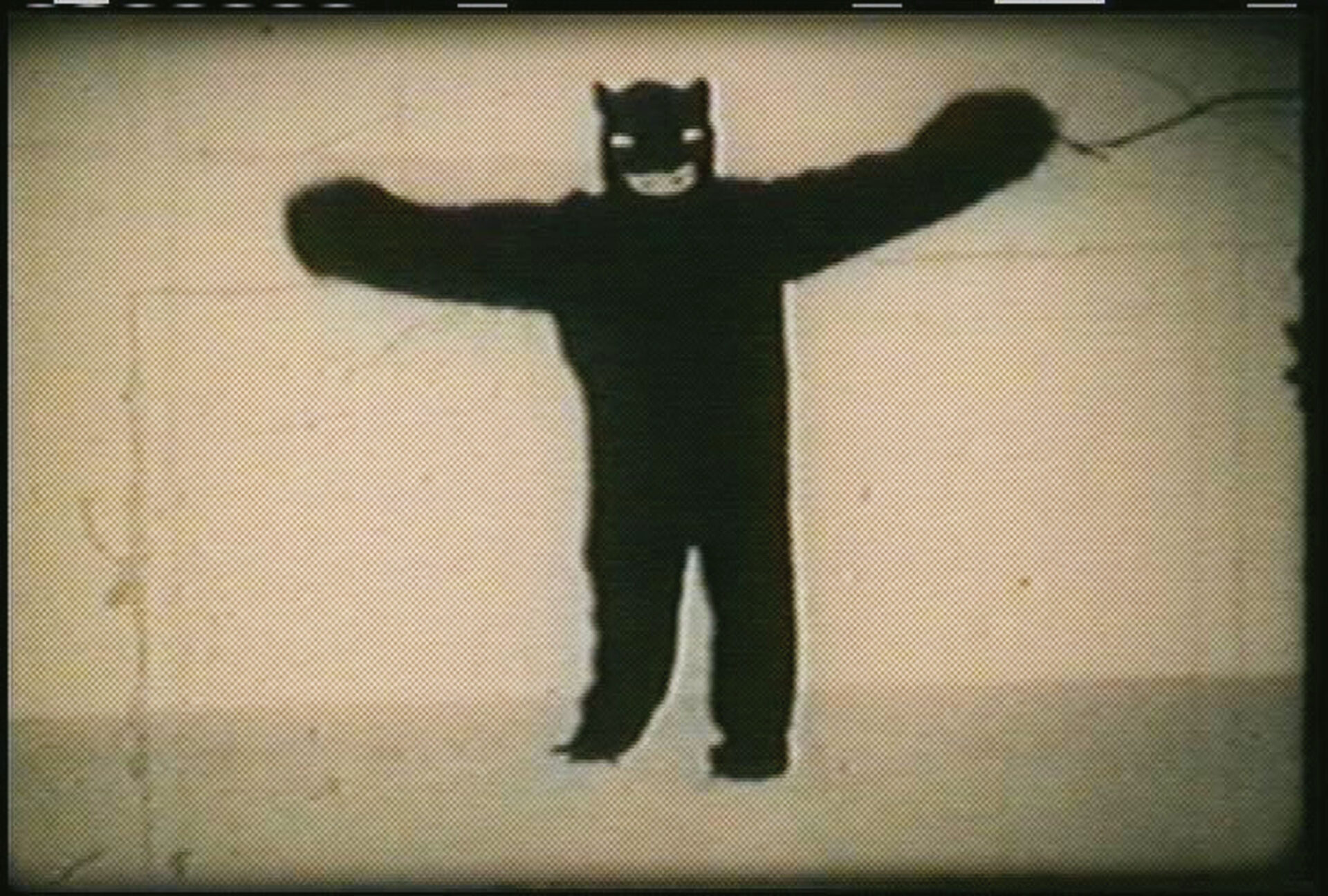
The Lotus Eaters, 2005-2007.
Photos: courtesy of David Zwirner, New York
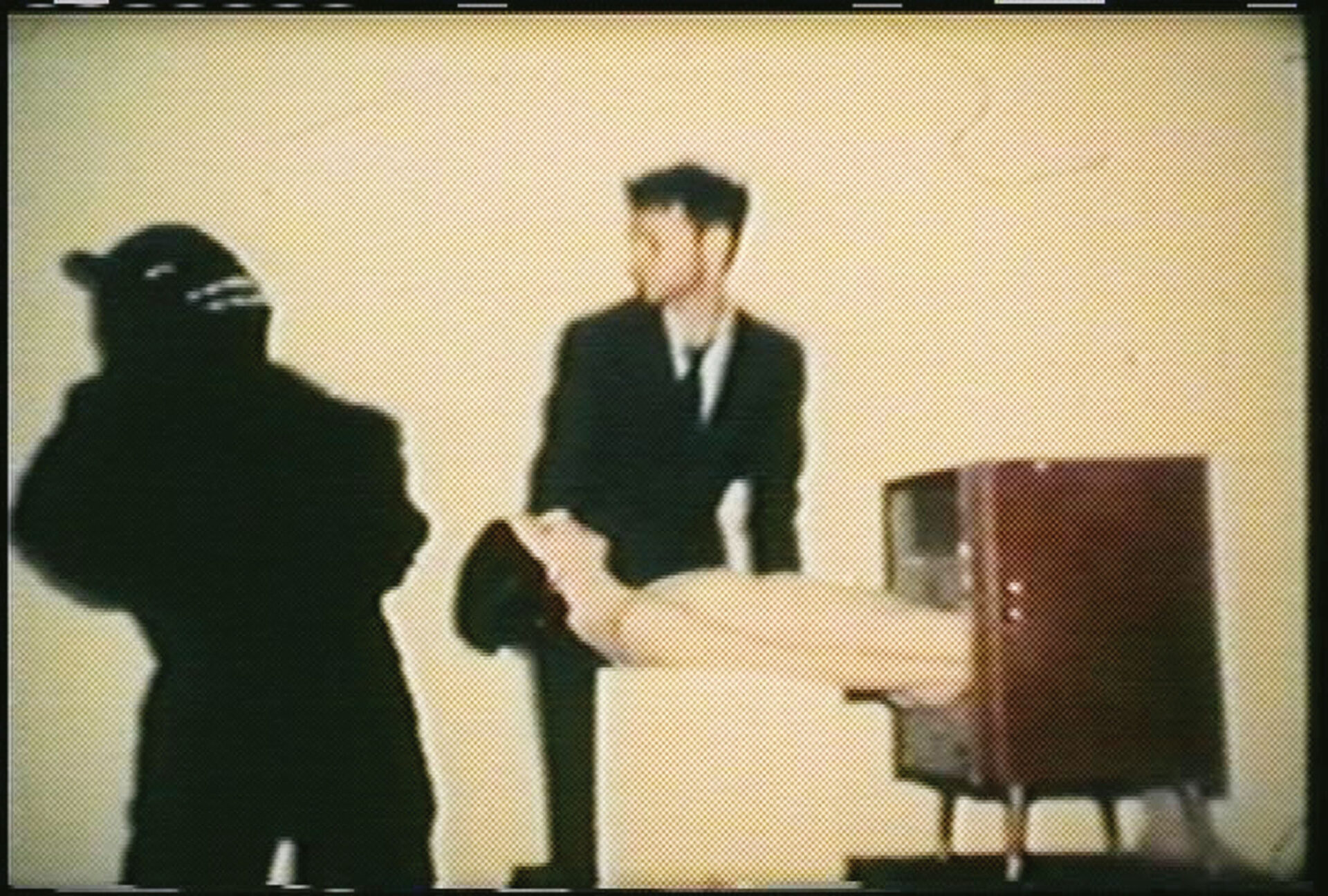
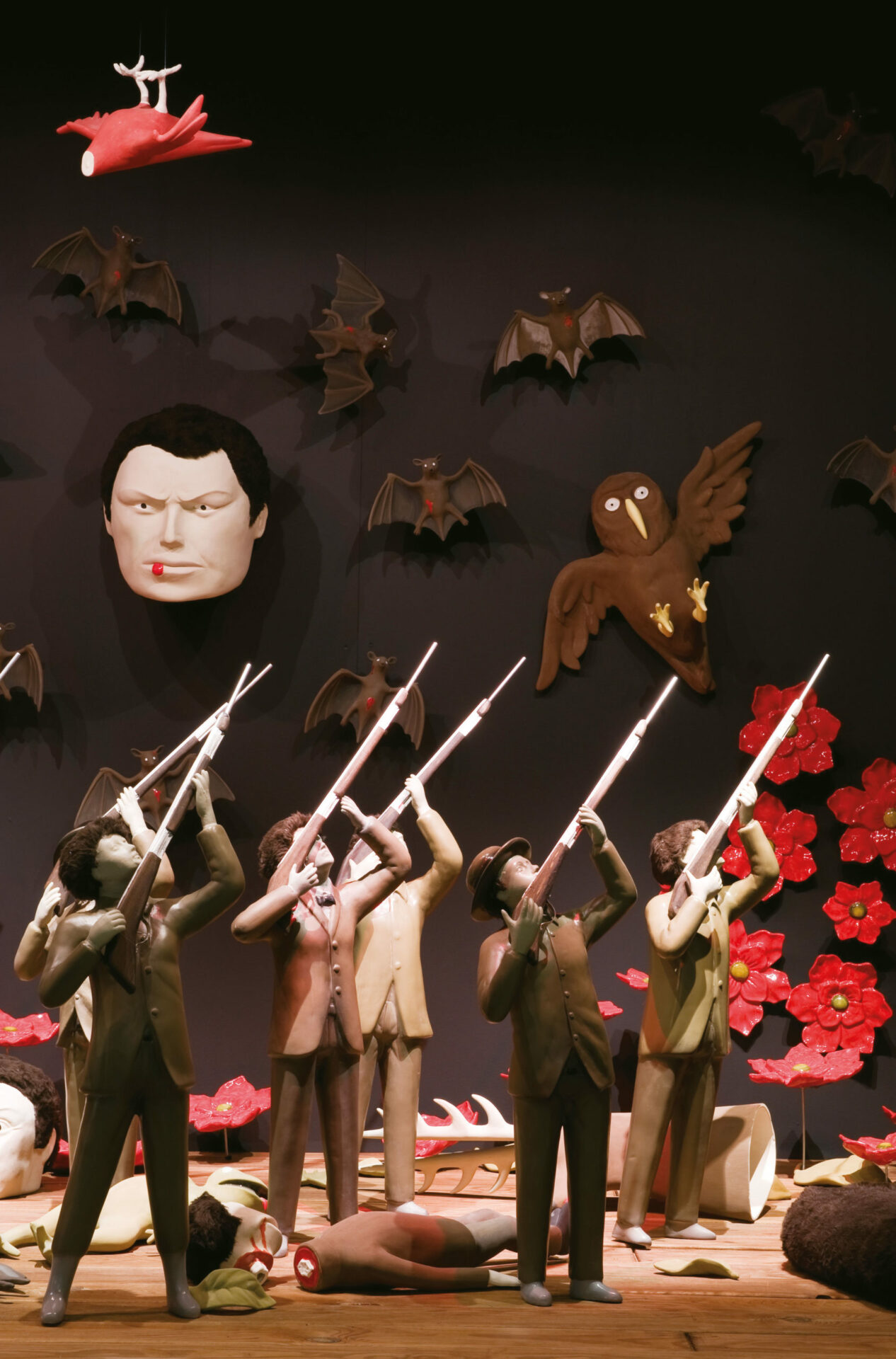
On the Banks of the Red River (detail), diorama, 2008.
Photo: Marc Domage, courtesy of David Zwirner, New York
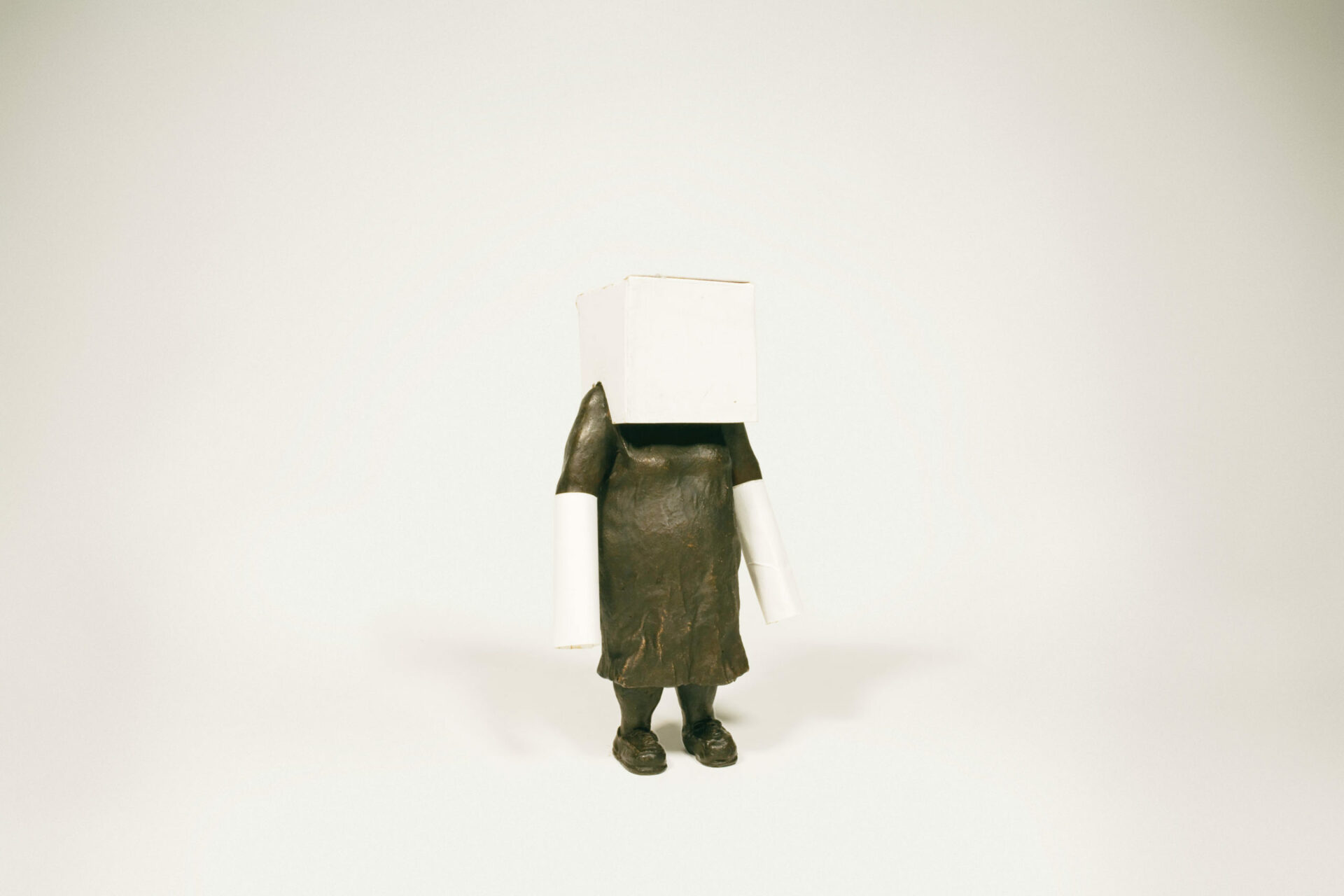
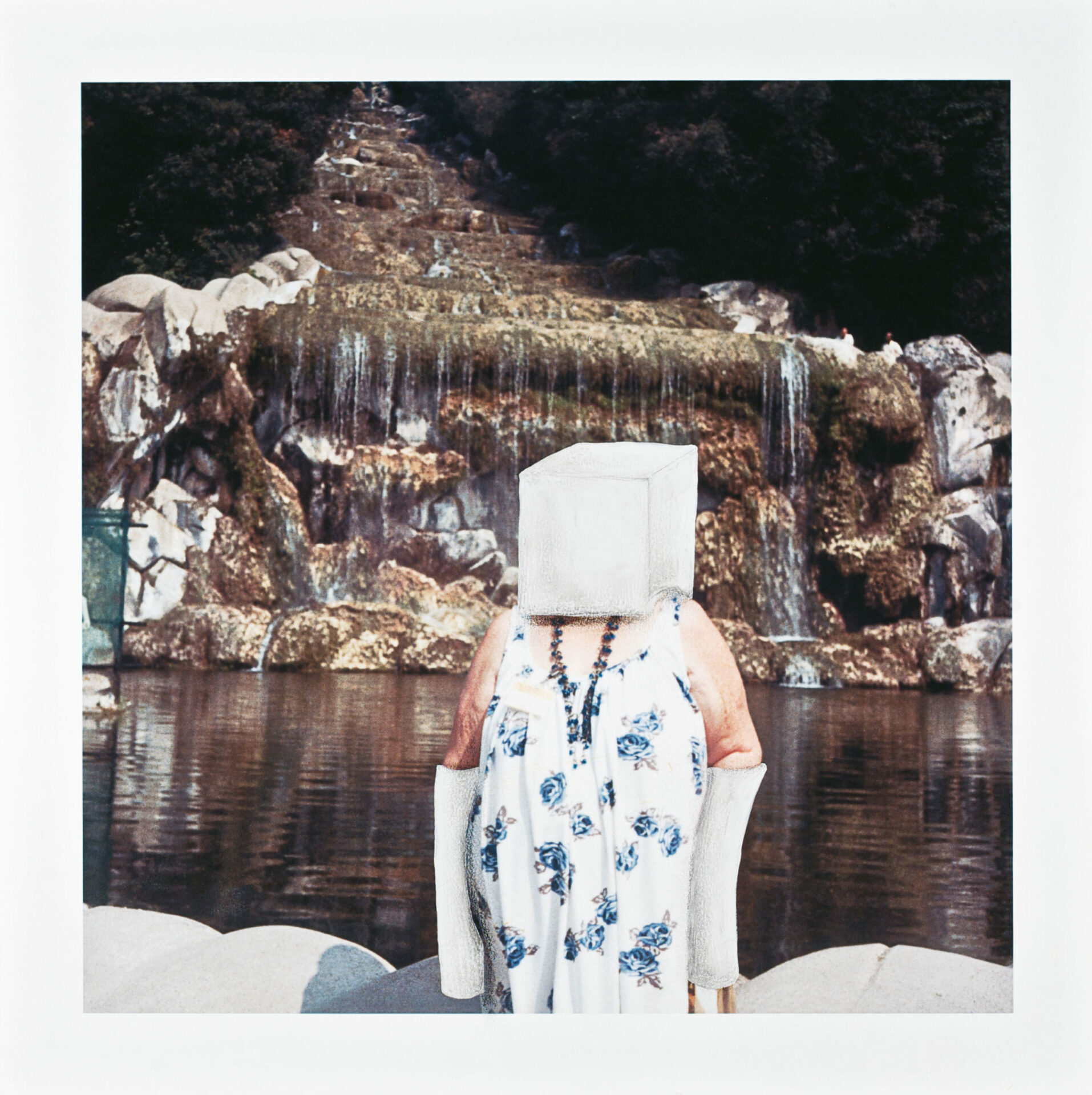
A significant amount of space is given to Sarah Anne Johnson’s project House on Fire, which dramatizes another traumatic personal experience, here associated with the experiments the CIA conducted on the artist’s grandmother in the fifties and sixties when she was being treated for post-partum depression at the Allan Memorial Institute in Montréal. Conducted secretly at the clinic, without consulting the patients’ families, the trials aimed to study the effects of certain drugs on brainwashing, mind control, and behaviour modification. Press clippings, family photos heavily overlaid with decorative motifs, bronze sculptures, and a scale-model house all help exorcise this agonizing period, representing the phobias and hallucinations her grandmother experienced following the experiments: her head in a block of ice, limbs engulfed in plant-like tendrils. . . The rooms of the house are no less hallucinatory, with the topsy-turvy furniture swamped in drifts of snow or vegetation.
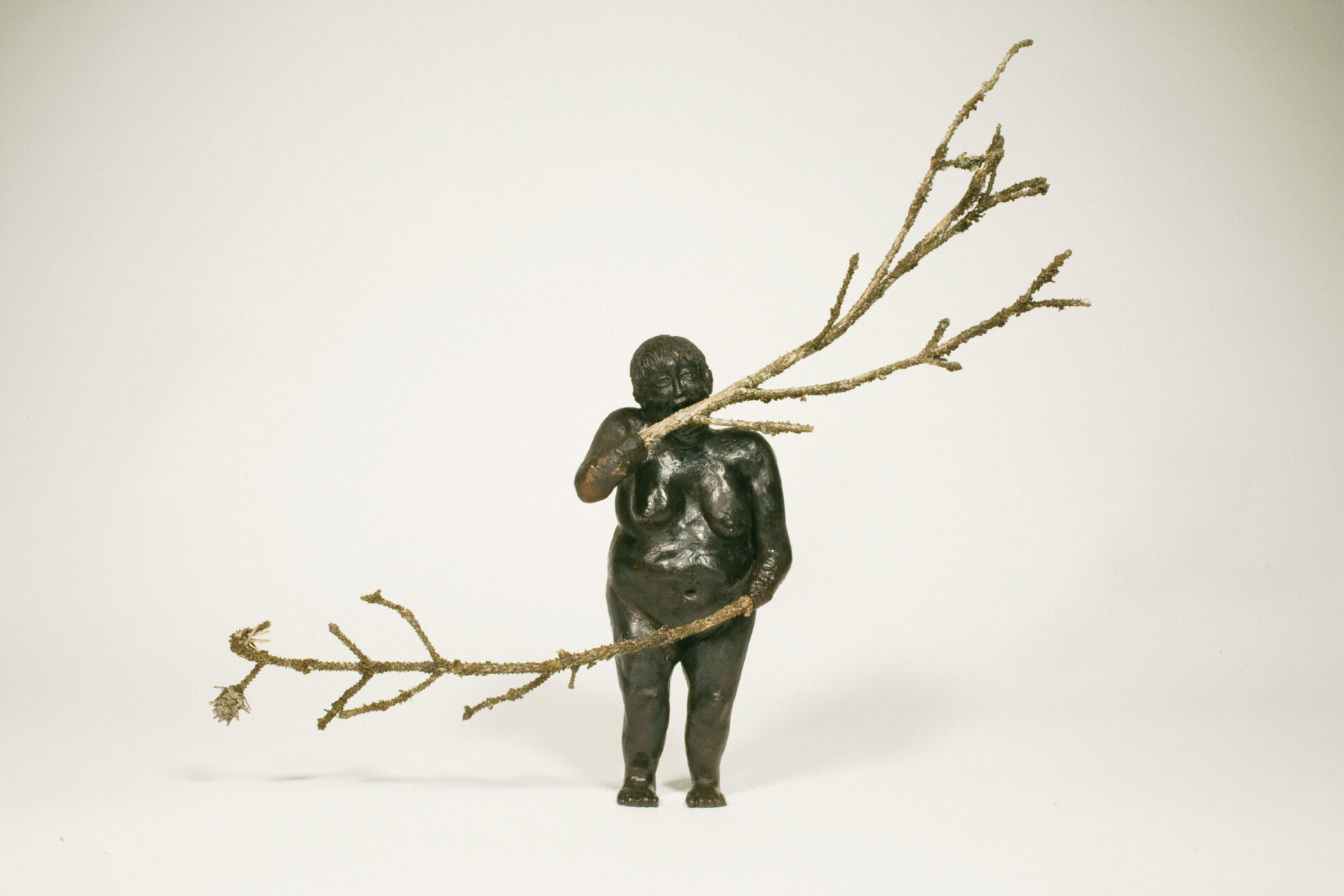
Family Tree, 2008; Black Out, 2008.
Photos: © Sarah Anne Johnson, courtesy of Stephen Bulger Gallery, Toronto
Trauma also seems to crystallize in the monomaniacal project Ice Fishing in Gimli. For eight years, Rob Kovitz built up an encyclopaedic account of ice fishing in Gimli, tirelessly compiling every scrap of information that could be related through a play of free association. The outcome: eight volumes, totalling 4,450 pages of text and images, testimony to a truly alarming obsession.
The exhibition also reserves an important place for collective work in Winnipeg art production. One wall, for instance, is dedicated to Paul Butler’s Collage Parties, a travelling workshop he’s been organizing since 1997, which betrays the influence of the Winnipeg School of Art’s penchant for surrealism. Artists regularly gather around materials provided by Butler — magazines, glue, beer — to produce collages. Here they’re part of the Keyhole Project, for which Guy Maddin asked Butler to set up collage sessions that would help generate a future feature-length movie.
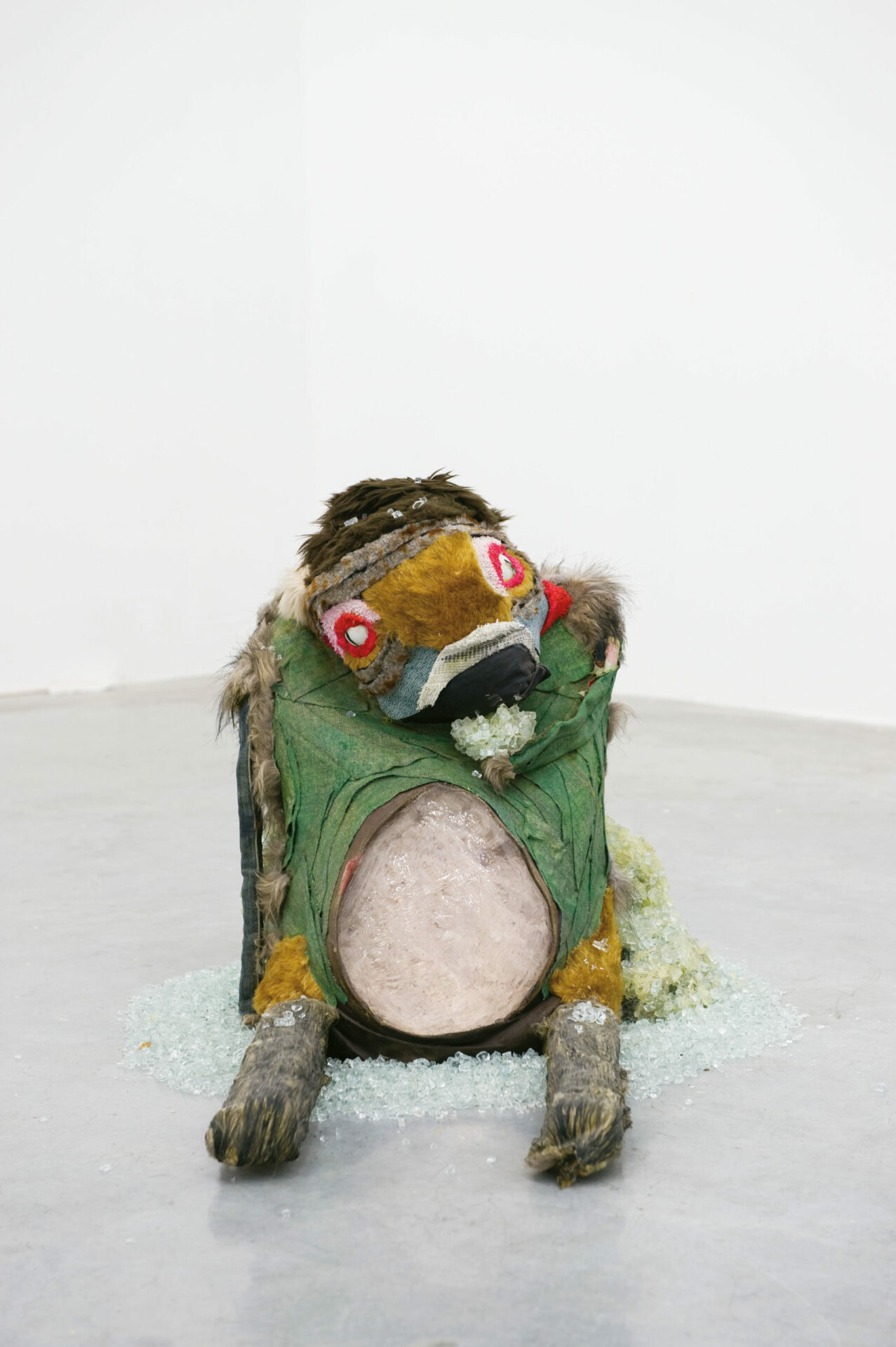
Propelled Through Life by a Staggering Lack of Dignity, 2007.
Photo: Marc Domage, courtesy of La maison rouge, Paris
The collective dimension is also represented by the Royal Art Lodge, a group active in the 1990s and early 2000s whose members6 6 - Mainly Michael Dumontier, Marcel Dzama, Neil Farber, Drue Langlois, Jon Pylypchuk, and Adrian Williams. — all Winnipeg art students — would gather for drawing sessions. Most of the works shown were produced during such encounters. Characterized by the use of graphic techniques on small-scale formats (ink and watercolours on yellow sheets dated with an ink stamp or by hand), they seem to emerge, as Hervé di Rosa puts it, from an “alternate past.”7 7 - Hervé di Rosa, “Pourquoi Winnipeg?”, My Winnipeg, op. cit., 8. Jon Pylypchuk, now living in Los Angeles, presents paintings and sculptures produced from recycled objects, resembling both outsider art and local crafts but with a vindictive strain in their message. Characters in a volcanic decor attempt to reach another character bearing an American flag and a kind of phylactery on which one can read: “Welcome to America fuck faces.”
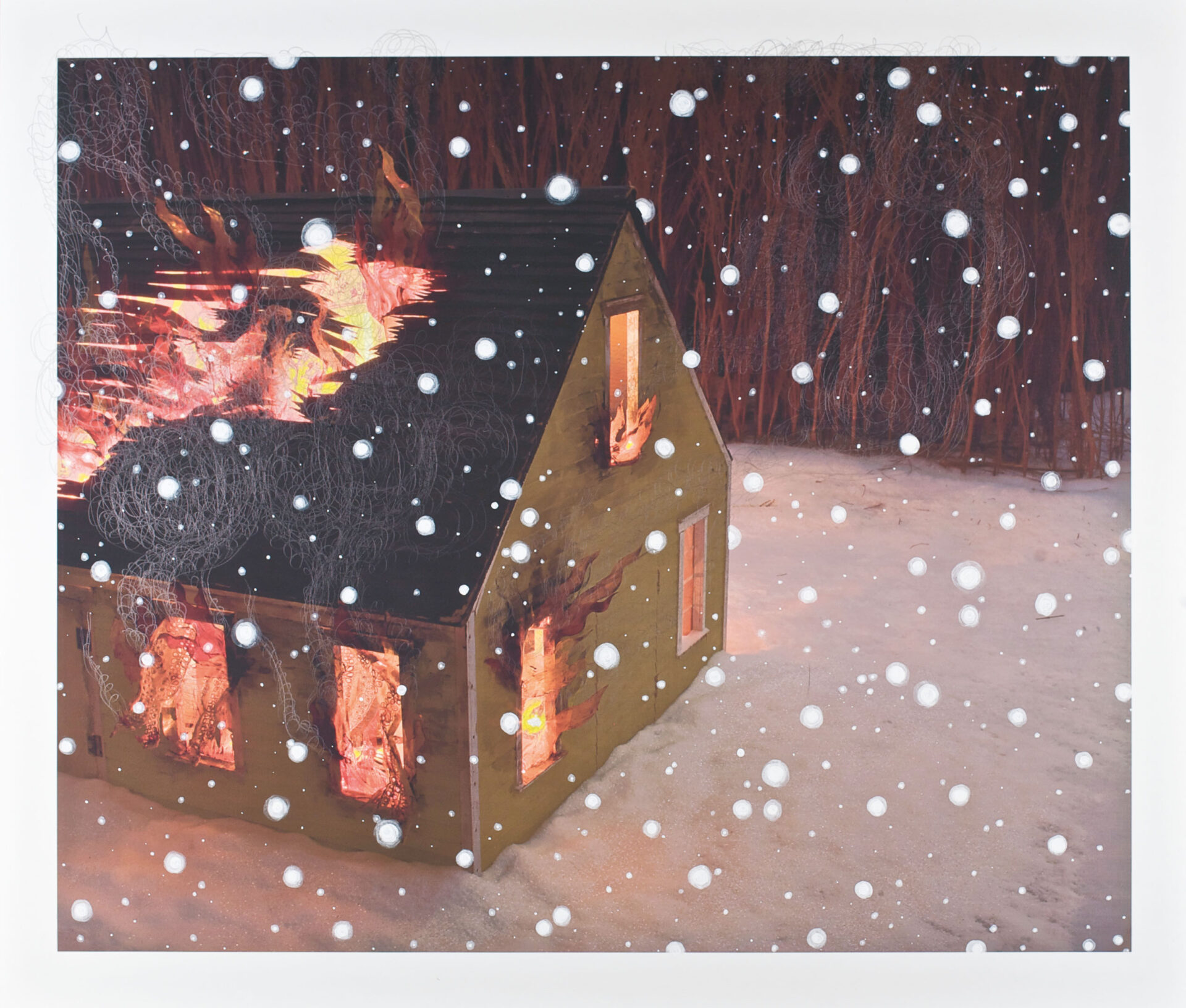
House on Fire, 2008; White Out, 2008.
Photos: © Sarah Anne Johnson, courtesy of Stephen Bulger Gallery, Toronto
The exhibition concludes with the representation of a sultry, libidinous Winnipeg. Noam Gonick’s Winter Kept Us Warm reminds us that Winnipeg is also a locus of lesbian activism and radical feminism. The section includes a filmed performance of Totentanz by Sharon Alward, produced in 1990 at Plug In. Having poured gallons of blood and sperm on the ground, the artist attempts to clean it up with ridiculously inadequate means: tireless work evoking the role of health providers during the AIDS epidemics. The performance sparked local controversy when the city Mayor subsequently refused to enter the gallery.
Winnipeg’s relative isolation, the absence of rivalry among its artists, and the recognition of shared local influences (like those of the WAG’s Inuit art collection in the first productions of the Royal Art Lodge) contribute to the existence of a true art scene. Marcel Dzama likens this sense of belonging to identifications one might have with a mythological site. Despite its melancholy image — The Times (London) dubbed the city World Capital of Sadness for four years running — Winnipeg remains a nexus of stimulating art.


