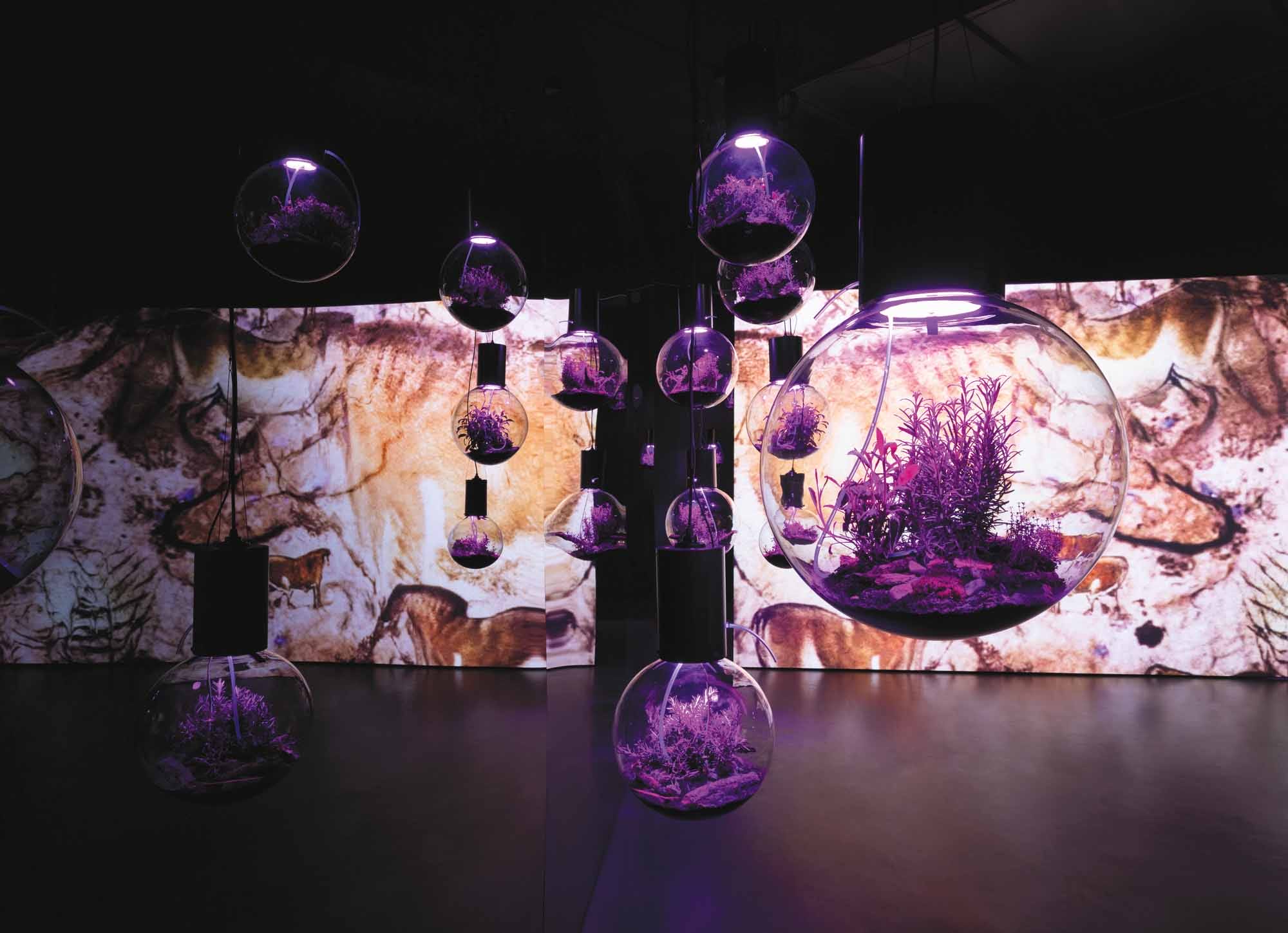
photo : permission de l’artiste | courtesy of the artist & Yancey Richardson Gallery
Despite an increasingly complex understanding of their relationship, modern and postmodern art may still be said to share in an exploration of the limits of representation. Although each is motivated by a wide and ever-changing range of aesthetic, social, political and cultural concerns, both embrace negative presentations—images of failure, rupture, fragility, transience, and decay—in a way that bridges many of their differences. French post-structural philosopher Jean-François Lyotard once referred to this as an aesthetics of “the missing contents,”1 1 - Jean-François Lyotard, The Postmodern Condition: A Report on Knowledge, trans. Geoff Bennington and Brian Massumi (Minneapolis: University of Minnesota Press, 1984), 81. famously distinguishing between the modern and postmodern according to the manner in which each approached the idea of the unpresentable, rather than on the basis of a binary opposition or linear timeline. For Lyotard, as for many post-structuralists, the postmodern was not only an inextricable part of the modern, it was its “nascent state,”2 2 - Lyotard, 79. and images of inadequacy were common to both.
Perhaps no other philosophical category is better suited to theorizing aesthetic inadequacy than the sublime. Not surprisingly, the advent of postmodernism proper is concatenate with a renewed interest in this concept, and particularly as it was articulated by Immanuel Kant in the Critique of Judgement (1790). Unlike previous works on the subject, Kant’s Analytic of the Sublime contended that the sublime did not occur in nature or in “any sensuous form,” but instead “concerned the ideas of reason.”3 3 - Immanuel Kant, The Critique of Judgement, trans. James Creed Meredith (Oxford: Clarendon Press, 1969), 92. It was therefore an elusive event, a feeling that occurred only within the spectator. In contrast to the beautiful, which produces a pleasing and harmonious balance of faculties, the Kantian sublime results from a mental rift, a cleaving of the mind in which reason thinks the almost unthinkable—infinity, death, limitlessness, disaster—and imagination fails to provide it with a commensurate image.
This content is available with a Digital or Premium subscription only. Subscribe to read the full text and access all our Features, Off-Features, Portfolios, and Columns!
Already have a Digital or Premium subscription?
Don’t want to subscribe? Additional content is available with an Esse account. It’s free and no purchase will ever be required. Create an account or log in: