
photo : permission de l’artiste | courtesy of the artist & Yancey Richardson Gallery
Despite an increasingly complex understanding of their relationship, modern and postmodern art may still be said to share in an exploration of the limits of representation. Although each is motivated by a wide and ever-changing range of aesthetic, social, political and cultural concerns, both embrace negative presentations—images of failure, rupture, fragility, transience, and decay—in a way that bridges many of their differences. French post-structural philosopher Jean-François Lyotard once referred to this as an aesthetics of “the missing contents,”1 1 - Jean-François Lyotard, The Postmodern Condition: A Report on Knowledge, trans. Geoff Bennington and Brian Massumi (Minneapolis: University of Minnesota Press, 1984), 81. famously distinguishing between the modern and postmodern according to the manner in which each approached the idea of the unpresentable, rather than on the basis of a binary opposition or linear timeline. For Lyotard, as for many post-structuralists, the postmodern was not only an inextricable part of the modern, it was its “nascent state,”2 2 - Lyotard, 79. and images of inadequacy were common to both.
Perhaps no other philosophical category is better suited to theorizing aesthetic inadequacy than the sublime. Not surprisingly, the advent of postmodernism proper is concatenate with a renewed interest in this concept, and particularly as it was articulated by Immanuel Kant in the Critique of Judgement (1790). Unlike previous works on the subject, Kant’s Analytic of the Sublime contended that the sublime did not occur in nature or in “any sensuous form,” but instead “concerned the ideas of reason.”3 3 - Immanuel Kant, The Critique of Judgement, trans. James Creed Meredith (Oxford: Clarendon Press, 1969), 92. It was therefore an elusive event, a feeling that occurred only within the spectator. In contrast to the beautiful, which produces a pleasing and harmonious balance of faculties, the Kantian sublime results from a mental rift, a cleaving of the mind in which reason thinks the almost unthinkable—infinity, death, limitlessness, disaster—and imagination fails to provide it with a commensurate image.
Forced to “the limits of what it can present,” imagination does “violence to itself in order to present what it can no longer present.”4 4 - Jean-François Lyotard, Lessons on the Analytic of the Sublime, trans. Elizabeth Rottenberg (Stanford: Stanford University Press, 1994), 55. The sublime, as such, is literally the unimaginable, and it can only be visualized negatively as a failure to present the unpresentable. Ironically, it is through this very frailty—this “sinking into insignificance before the Ideas of reason”5 5 - Kant, 105.—that imagination unexpectedly acquires the wherewithal to “come back to itself.”6 6 - Jacques Derrida, The Truth in Painting, trans. Geoff Bennington and Ian McLeod (Chicago: The University of Chicago Press, 1987), 142. One of the many paradoxes inherent to the sublime is its ability to imbue states of fragility and failure with a sudden and unforeseen strength, a reversal of fortune in which reason appears like an imbalanced tyrant, and fractured imagination like a heroic survivor.
photos : permission de l’artiste | courtesy of the artist & Yancey Richardson Gallery
Inasmuch as large portions of contemporary existence continue to escape adequate representation, particularly within the dominant modes of cultural expression, artists remain committed to exploring the limits of the presentable, whether it is according to modern, postmodern, or some other yet-to-be-defined set of aesthetic principles. In recent years, a number of strategies have come to the fore, in many cases elaborating previous approaches and subjects, a significant number of which may be associated with proto-modern periods such as the Renaissance and Baroque. Although both these eras were riven with paradox and contradiction, the former is the stranger, more disjointed of the two, a crucible in which the volatile elements of industrialism, capitalism, colonialism, and modernity fomented. Fragility, the vanity of human existence, and end of all things were common tropes within the Renaissance’s intricate web of “revolutions,” and not surprisingly historians continue to debate the proper definition and validity of this historical period.
Within the relatively vast sphere of Renaissance art, an entire genre of painting was tellingly devoted to presenting material pleasure as a fragile, vain pursuit in comparison with the sublime and eternal “glory of God.” Employing a complex lexicon of negative symbols—skulls, rotting fruit, time-pieces, bubbles, flies, flowers, slain animals—vanitas still lifes (from the Latin word for vanity) were intended to pique the conscience of Renaissance entrepreneurs made wealthy by industrialization, agricultural advancement, and expanded trade routes. The contents of these paintings—lush and painstakingly rendered man-made or natural objects laced with a hint of purification—were supposed to evoke in the viewer sublime Ideas of death, morality and the hereafter. Ironically, vanitas still lifes quickly became desirable objects in themselves, sought after by wealthy collectors with an avarice that contradicted the painting’s original moral message.
Vanitas still life employed a negative form of presentation easily associated with the Kantian sublime. According to Kant, although the Ideas of reason “cannot be contained in any sensuous form,” they could be “excited or called to mind by that very inadequacy itself.”7 7 - Kant, 92. As such, a still life depicting the tender flesh of a peach slowly rotting beneath the shadow of an insect “inadequately presents the infinite in the finite,”8 8 - Derrida, 131. or in other words, it shows us what we “permanently thrust aside in order to live” morally.9 9 - “Abjection, on the other hand, is immoral, sinister, scheming, and shady.” Julia Kristeva, Powers of Horror: An Essay on Abjection, trans. Leon S. Roudiez (New York: Columbia University Press, 1982), 4.
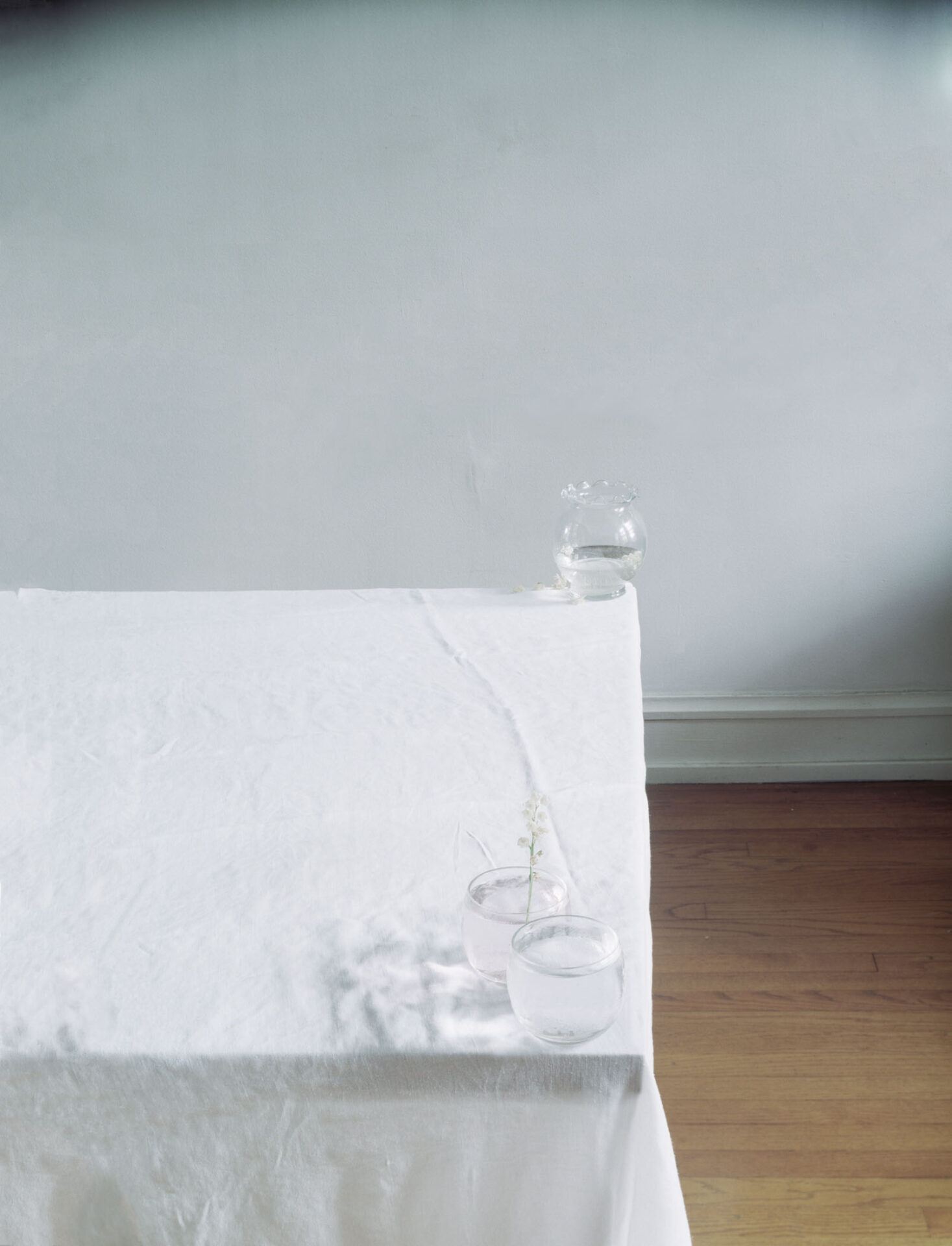
photo : permission de l’artiste | courtesy of the artist & Yancey Richardson Gallery
Contemporary artists working in the genre take this subtle form of abjection to greater lengths, replacing delicate Renaissance symbols of emptiness and futility with aestheticized images of consumer waste, garbage, or partially consumed processed food. Where once a meticulously painted scull symbolized death and the dangers of material indulgence, plastic packages and refuse now stand in for new ideas of hell and human weakness, including the global social inequality brought on by capitalism, the environmental destruction of the planet, and the wars and displacement resulting from both. While the aesthetic strategy remains one of inadequacy—“inadequation presented in its own yawning gap”10 10 - Derrida, 132.—there is a noteworthy shift from a narrative of exquisite self-sacrifice to one of wanton self-destruction.
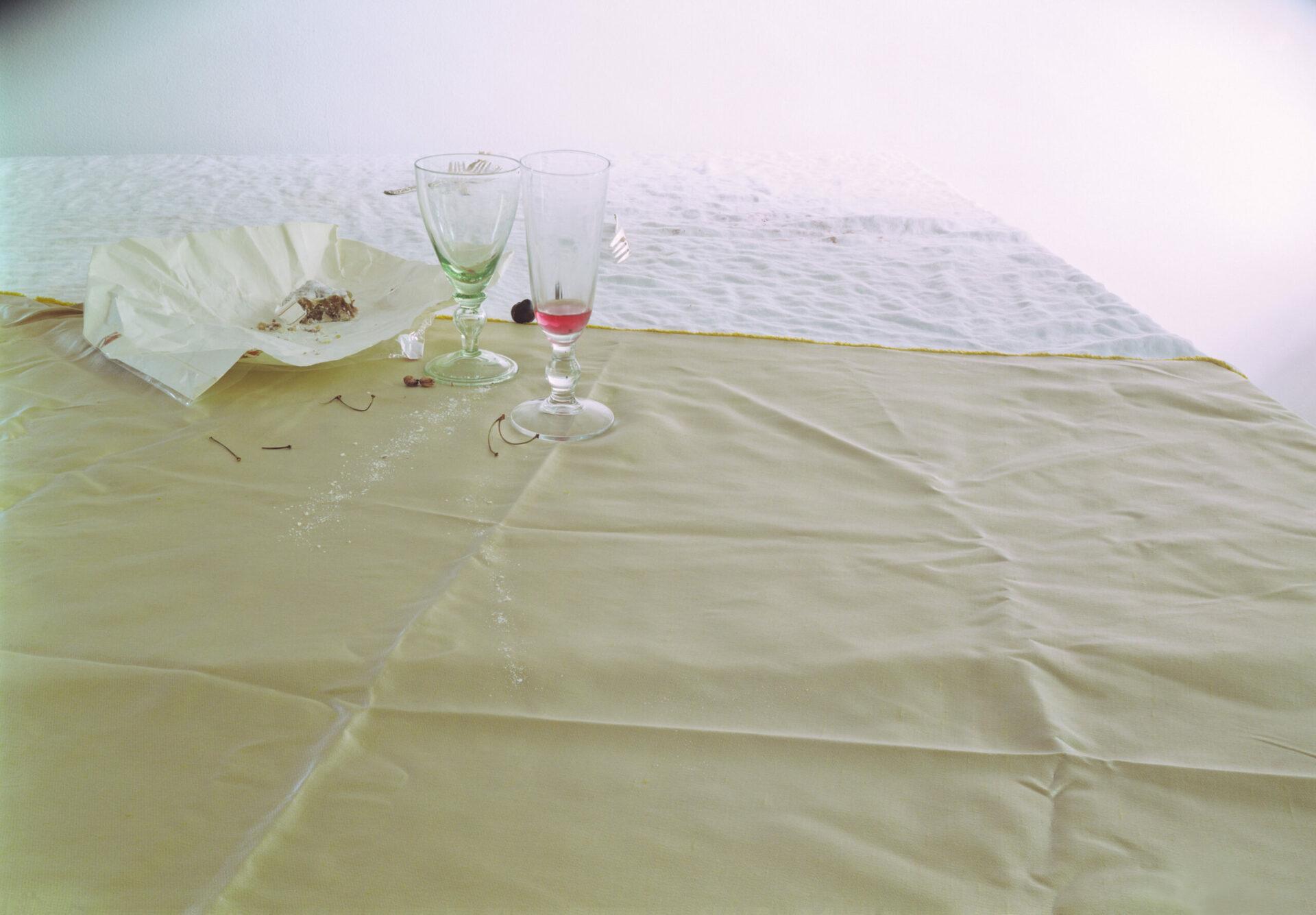
It is possible to distinguish at least two different methods of invoking vanitas still life in a contemporary context: one that quotes, at times almost directly, from the historical canon of these paintings; and another that takes a more pop art, ready-made approach. Laura Letinsky’s series of photographic still lifes falls within the former category. Depicting the haunting remnants of meals scattered across pale, minimalist tabletops, her images’ spare, elegant aesthetic recalls the intimacy of a Chardin painting. The subtle inclusion of mass-produced items—a half-eaten red lollypop, a crushed pop can, an empty carton—shifts the work from poetic to critical, however, conjuring the desultory effects of consumerism, both social and ecological, as well as the failure of grand narratives such as progress. In a related vein, Montreal photographer Louis Joncas creates visually lush still lifes from his own garbage, evoking a similar sense of human fragility and weakness. Neatly arranged on the pristine white background of commercial product photography, his Detritus series presents a changing array of refuse linked to common addictions—sex, drugs, nicotine, junk food—diversions that many use to assuage or silence their fears of failure and death. Unlike traditional vanitas still lifes, however, the work of both artists focuses on the moment after consumption, thus fostering a profound sense of ambivalence and even meaninglessness. In these photographs one sees that material desire has not been resisted, but it has also not been entirely fulfilled.
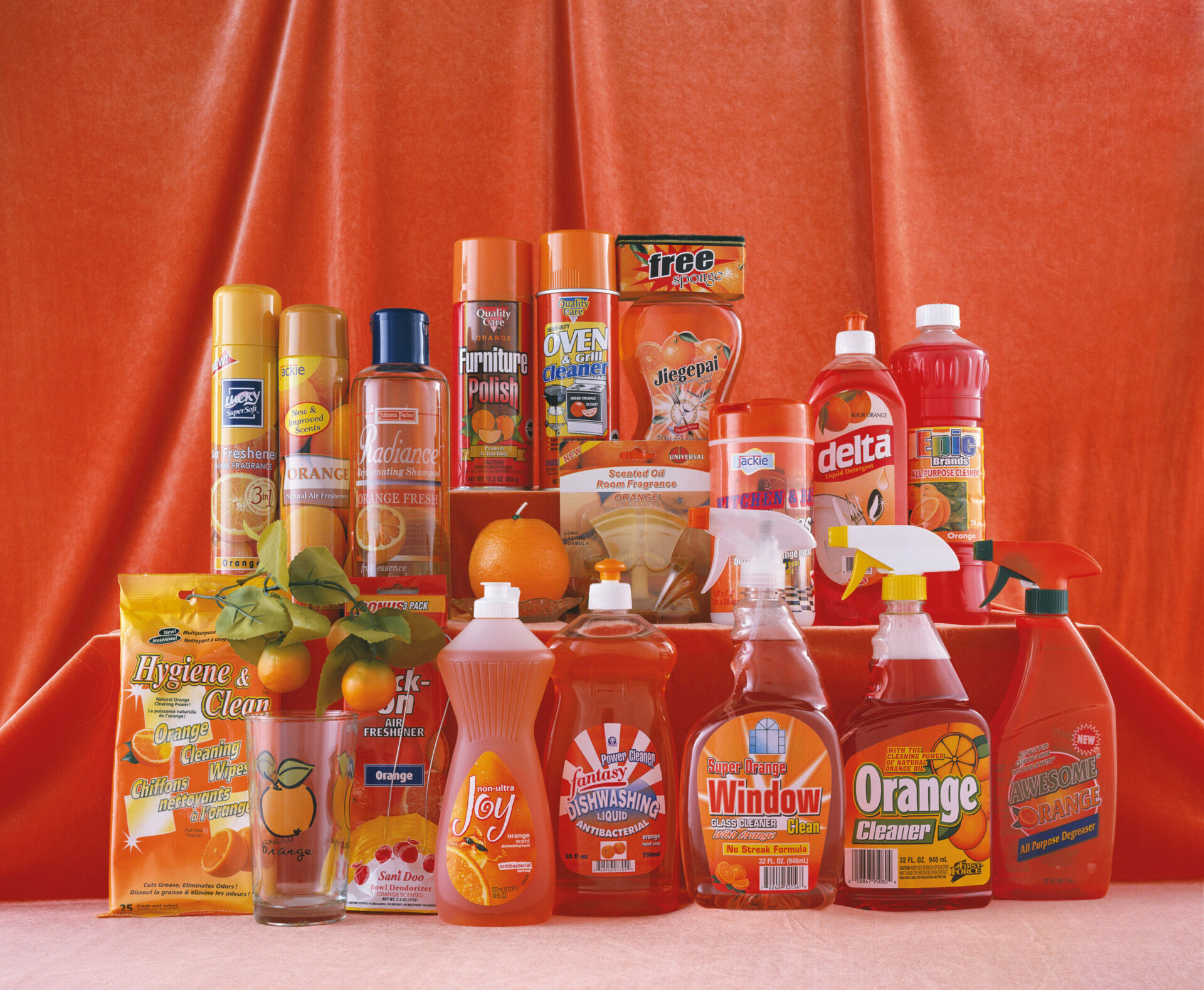
photo : permission de l’artiste | courtesy of the artist
Working more in the spirit of Andy Warhol or Claus Oldenburg, Toronto photographer Colwyn Griffith exemplifies the second contemporary approach to vanitas still life. Photographing products culled from a sea of consumer knock-offs available in Dollar Stores all over North America, Griffith plays upon and confuses the conventions of commercial photography and still life. Podium (2006), a work devoted to an array of consumer products whose brand-names superlatives (Top Notch, Premier, Spice Supreme, etc.) invoke the myth of modern value, ironically reduces modern grand narratives to cheap rhetoric. Also constructed from groups of Dollar-Store products, Apple (2006) and Orange (2006) depict a consumer vision of the natural world in which an endless array of products serves to eulogize an environment destroyed by consumerism. While Renaissance vanitas still life used the delicate frailty of the natural world to symbolize mortality, the plastic versions in Griffith’s photographs are disposable but do not decay. Instead of reminding a greedy populace of the inevitability of death, these images offer a new, more disturbing form of vanity. In the words of Jean Baudrillard, “If objects no longer grow old when you touch them, you must be dead.”11 11 - Jean Baudrillard, The Illusion of the End, trans. Chris Turner (Stanford, CA: Stanford University Press, 1994), 101.
Although many contemporary artists are dealing with similar ideas and socio-political issues in their work, like the artists above they also remain engaged in an aesthetic practice. In many ways, this floating between art and politics encapsulates the current atmosphere of contemporary art. In its worst manifestations, art theory appears to have reached the end of a great banquet of ideas, and, like an addict, has begun flailing nervously for just one more course. The side effect is a kind of stuttering: post-post-modern, neo-modern, double aftermath, first past the post…the list of possible names for the last supper goes on. And yet, we are still surrounded by the aesthetics of inadequacy. Indeed, this may be its most important moment. Perhaps all that is required at this point is simply a conscious experience of this insufficiency, this failure of imagination. Although the distance between contemporary art and Renaissance still life is vast, their lessons remain largely the same: without taking a moment to quietly realize the limits of material existence reason quickly turns to madness and imagination becomes its slave.


