Kent Monkman
mistikôsiwak (Wooden Boat People)
December 19, 2019–April 9, 2020

Photo: Anna-Marie Kellen, courtesy of the artist
December 19, 2019–April 9, 2020



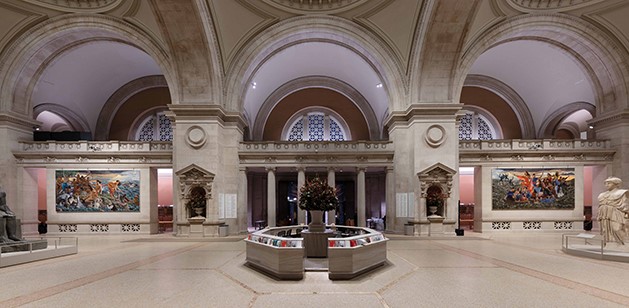
Installation view, mistikôsiwak (Wooden Boat People), The Metropolitan Museum of Art, New York, 2019.
Photo: Anna-Marie Kellen, courtesy of the artist
When it comes to Western painting, size matters a great deal. And that’s not just because large canvases can be ostentatious signs of opulence. Since the Renaissance, the size of a painting has dictated the nature of its subject. History, mythology, and religion—important humanist subjects—commanded the largest canvases. Smaller ones were routinely reserved for scenes of a commercial nature like landscapes, portraits of animals, and still-life compositions. More than a simple economic convention, the relationship between subject and canvas size, along with the hierarchy of genres it solidified, functioned as a visual code. At a glance, the size of a painting told the viewer if it had something important to say. By the nineteenth century, this convention was so commonplace for those who regularly visited art museums that the wrong combination of subject and size could be enough to stir up a colossal scandal. Unconventional works of art were either seen as a deliberate insult to the public, or as an irreverent disrespect to the academician and the connoisseur.
It was the scale of Gustave Courbet’s A Burial at Ornans, which offended more than its subject: the funeral of a working-class “nobody.” Measuring 11’ x 22’, the painting promised history, but it delivered everyday life at its ugliest (as the commentators of the time saw it). Times have moved on, and over the past two hundred years, art audiences have been offended by much more than the size of a canvas, although these classical conventions still condition our reception of art today.
You must log in to read this text! It’s free and no purchase will ever be required. Create an account or log in:
Please note that Editorials, Digital Residencies, Videos, and Archives are always free to access.
Want more? Some content is available with a Digital or Premium subscription only (Features, Off-Features, Portfolios, Columns).