
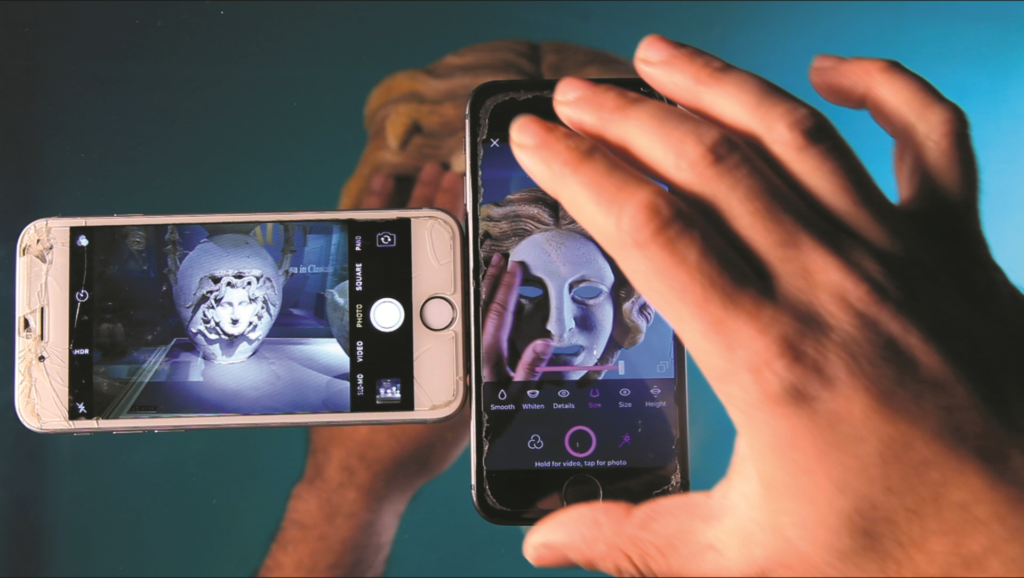
Medusa, video still, 2020.
Photo : courtesy of the artist & Mophradat, Brussels
This fall, a neat row of six cracked televisions suspended precisely one metre apart welcomed MOCA Toronto’s visitors as they entered the museum’s lobby. This video installation titled Medusa (2020), by the Ramallah-based architect and visual artist Yazan Khalili, was commissioned by the Consortium Commissions—an initiative supported by Mophradat (Brussels) and various partnering institutions, including MOCA Toronto, Hammer Museum in Los Angeles, CCA in Glasgow, and KW in Berlin.
Yazan Khalili is known for his extensive research into facial recognition technologies and for drawing parallels with Indigenous and classical masks. In Greek mythology, Medusa is the female figure with venomous snakes in lieu of hair, whose gaze turns humans to stone. Khalili was reminded of the goddess as he photographed a collection of Greek masks and the facial recognition feature of his iPhone identified the stone carvings as human faces — symbolically reversing Medusa’s harrowing curse. This spurred a two-fold investigation into our growing reliance on artificial intelligence (AI) and the equivocal description of what exactly constitutes a face.
You must log in to read this text! It’s free and no purchase will ever be required. Create an account or log in:
Please note that Editorials, Digital Residencies, Videos, and Archives are always free to access.
Want more? Some content is available with a Digital or Premium subscription only (Features, Off-Features, Portfolios, Columns).