
Photo : permission de l’artiste | courtesy of the artist
Darren Harvey-Regan’s new photographic suite, Metalepsis, presents a precise, yet open-ended group of small photographic images. Pared-down, formalist, geometric, very nearly black and white images depicting arrangements of surface textures (are they rocks? concrete? polystyrene?) in a nondescript, shallow space; two identical “bracket” images at either end of the series — meant to highlight the latter’s circularity — each consisting of a double image of a single orange appearing side by side on a plain background. On the left, both the orange and the background are the same uniform shade of orange; on the right, the entire image is black and white. In the centre of the series, there is just one more instance of saturated colour, in the form of an image of a sharply pointed stone squashing an orange in what appears to be a vaguely studio-like setting. Interspersed with these images are two paradoxical images of prayer: to the right of the central, squashed orange, what appears to be a black and white photograph of a kitschy postcard of Jesus, hands clasped, looking to the heavens; to its left, another praying figure (the young prophet Samuel) whose image has been cut into shards. Just three triangular chunks of the figure’s image have been placed against a rich black background.
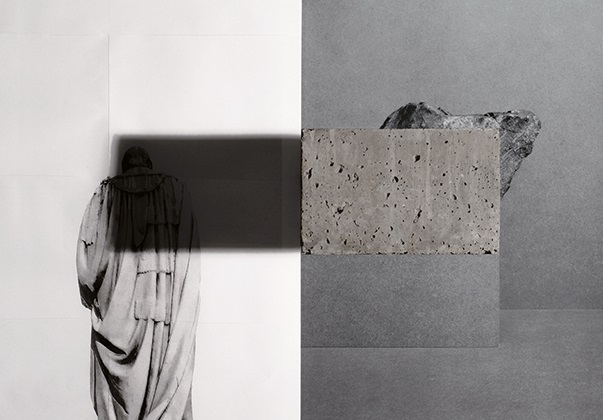
Metalepsis, détail | detail fig. 9, 2014.
Photo : permission de l’artiste | courtesy of the artist
This suite stages a dense thought process: threads and strains of almost-arguments seem to circle endlessly around an absence of a central “content.” This affective absence, however, at the heart of the work, feels highly specific, full of the feeling of emergent thought; it embodies the same sort of future-facing, but as of yet still silent fullness of a pensive face that is just about to speak. The suite proceeds meticulously through additions, negations, obfuscations, juxtapositions, and inflections of one image with another. Yet within this plurality of processes emerges an oft-reiterated concern. Without, I hope, placing too centralizing a claim on this concern (I would still rather say that the heart of this work can’t be said, and even more than this, that this sense — and concept — of the unspeakable is itself central to the logical/affective structure of the work), I want to argue that this suite performs a double procedure, according to which the mysteries of transcendence are staged as both a trope and a mode of enquiry. This enquiry proceeds largely though a methodical and multi-faceted examination of the historical conditions through which conceptions of abstraction have been linked to — or severed from — conceptions of transcendence.
This content is available with a Digital or Premium subscription only. Subscribe to read the full text and access all our Features, Off-Features, Portfolios, and Columns!
Already have a Digital or Premium subscription?
Don’t want to subscribe? Additional content is available with an Esse account. It’s free and no purchase will ever be required. Create an account or log in:


