
Bookworms, Arprim, centre d’essai en art imprimé, Montréal, 2012.
Photo : Caroline Cloutier, permission de | courtesy of the artist & Arprim, Montréal
Against a backdrop of fleurs-de-lis, a pile of books reveals the titles of politicians’ biographies, historical accounts, patriotic discourses, and other analyses of Quebec society: Cité libre, L’Énigme Charest, Le Goût du Québec: l’après-référendum 1995, L’Exécution de Pierre Laporte, Nègres blancs d’Amérique, René Lévesque: Oui, and others. This is how volumes charged with meaning appear in Étienne Tremblay-Tardif’s video series Minutes du patrimoine (2012 – 13): stacked like bricks, like the storeys of a building. Tightly framed, projected on the far wall of the gallery,1 1 - The work was presented in the solo exhibition Bookworms at ARPRIM, from November 2 to December 8, 2012. they take on a solid, monumental aspect — at least until the artist’s worn heavy-duty work boots enter the frame a few moments later. The larger-than-life artist places his giant feet firmly on the books, which shift under his weight. He picks up an electric drill, points the tool’s tip into the top of the pile, and turns it on, boring directly into the historical matter. Slowly, stories and accounts from the so-called collective memory are reduced to shreds, with “the typeset pulp churned out again as shavings.”2 2 - Étienne Tremblay-Tardif, quoted in “Étienne Tremblay-Tardif: Bookworms,” ARPRIM, www.arprim.org/programmation/2012-2013/229-etienne-tremblay-tardif-bookworms.html (our translation). Having drilled through the tomes from top to bottom, the artist exits the frame, leaving behind him the vestiges and ruins of his destructive gesture.
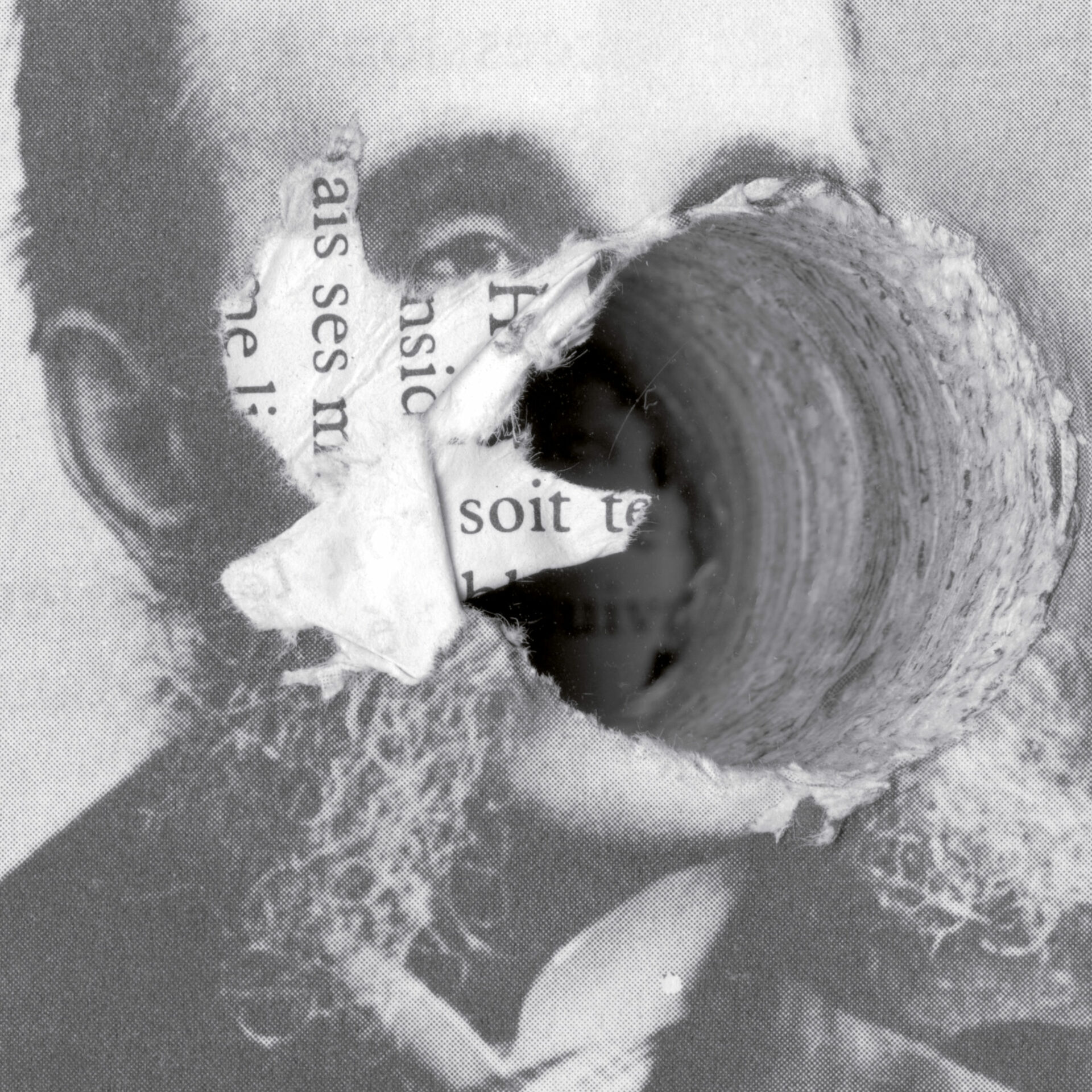
Bookworms / Portraits commémoratifs (1867-1929) : Félix-Gabriel Marchand
(1832-1900), 2012.
Photo : permission de l’artiste | courtesy of the artist
Yet the project doesn’t conclude here. The artist returns to contemplate what he can create with the remnants of his work. In one of the hole-riddled books,3 3 - A used copy of P.-A. Linteau, R. Durocher, and J.-C. Robert, Histoire du Québec contemporain: de la Confédération à la crise (1867-1929), vol. 1 (Montreal: Boréal Express, 1979). he discovers the faces of important historical figures ravaged by the rotations of the drill. These he digitizes, enlarges, and reprints to present them as a gallery of mutilated portraits titled Bookworms (2012).4 4 - This title was also given to the exhibition presented at ARPRIM in 2012. This series of works exemplifies Tremblay-Tardif’s approach: to bore deep into Quebec’s collective history to find material for new constructions. In the course of his research, he accumulates documentary material, which he selects as much for its content as for its form. His references, which illustrate his specific interest in the socio-political and cultural context of Quebec — its history and political debates — are drawn from newspapers, historical publications, and art history books old and new. Printed matter plays a dominant role in his work, as both a subject for reflection and a process of creation. Using printing techniques, he reproduces the accumulated material, mixing up references by cutting them out, copying them, and superimposing them to bring them back into circulation. His approach could be described as that of an archival artist, characterized, according to Hal Foster, by a will to “turn ‘excavation sites’ into ‘construction sites.’”5 5 - Hal Foster, “An Archival Impulse,” October 110 (fall 2004): 22. It is in this manner that the artist stages his research in construction-site installations.
This content is available with a Digital or Premium subscription only. Subscribe to read the full text and access all our Features, Off-Features, Portfolios, and Columns!
Already have a Digital or Premium subscription?
Don’t want to subscribe? Additional content is available with an Esse account. It’s free and no purchase will ever be required. Create an account or log in:


