
Indignation is hatred towards one who has done evil to another.
Spinoza1 1  - The Chief Works of Benedict de Spinoza, Trans. R.H.M. Elwes, Vol. 2 De Intellectus Emendatione — Ethica. (Select Letters). Revised edition. London: George Bell and Sons, 1901, http://oll.libertyfund.org/? option=com_staticxt&staticfile=show.php % 3Ftitle=1711&chapter=199398&layout=html&Itemid=27 (accessed November 1, 2012).

Those who, like me, are familiar with the current social and political climate in Russia, were shocked to learn, in an article published in the The Voice of Russia on May 23, 2012, that Vladimir Putin’s government condemned the violence inflicted by the Quebec government on its citizens. Referring to the police crackdown on protests held last May in Montreal in opposition to Bill 78, and in Chicago during the NATO Summit, Konstantin Dolgov, the Russian Foreign Ministry’s Special Representative for Human Rights,criticized the “disproportionate use of force by riot control agents despite the fact that the protests were peaceful in character.”2 2  - “Russia concerned about protestors’ rights violations in US, Canada,” The Voice of Russia, May 22, 2012, http://english.ruvr.ru/2012_05_22/75532138/ (accessed August 20, 2012). Cynicism?
Like their counterparts in Quebec and the United States, Russian youth have been trying to make their voices heard in recent months. In a context where freedom of the press is severely restricted,3 3 - See “Comment le Kremlin étouffe la presse russe,” Le Figaro.fr, October 10, 2006, http://www.lefigaro.fr/international/20061027.FIG000000156_comment_le_kremlin_etouffe_la_presse_russe.html (accessed August 20, 2012). the public sphere becomes a prime forum for political action, and symbolic activity the safest language. However, the stakes and risks are far higher in Russia, where there is virtually no culture of protest and repression is harsh. Charged in March 2012 of “hooliganism motivated by religious hatred” and of inciting violence and organizing an unauthorized protest, three members of the feminist punk band Pussy Riot found themselves facing seven years in prison. An international movement in solidarity with the artists rapidly emerged: Amnesty International condemned the arrests, protests were held across the globe, and countless artists expressed their support. The decision of the criminal court was handed down on August 17. After close to five months of temporary detention, Maria Alyokhina, Nadezhda Tolokonnikova, and Yekaterina Samutsevich were sentenced to two years in a prison camp.4 4 - On October 10, 2012, following an appeal, Yekaterina Samutsevich was released on probation by the Moscow court. The sentences handed down to the other two Pussy Riot members were upheld.
Pussy Riot
Inspired by feminist performance art, the Viennese Actionists and the riot grrrl movement, Pussy Riot formed in September 2011 to protest Vladimir Putin’s announcement of his intention to run in the presidential elections of March 2012.5 5 - Putin had held the presidency for two terms, from December 1999 to May 2008. Since he was not legally entitled to seek a third consecutive term, he appointed his Prime Minister, Dmitry Medvedev, as his successor, taking over the latter’s position. Putin’s announcement in September 2011 of his intention to run again for president (with Medvedev as Prime Minister) caused a general outcry. The group has since become an irksome symbol of Russian resistance. Pussy Riot’s guerrilla performances, generally involving three to eight women, are given without notice (i.e., illegally) and mainly in busy, highly symbolic public places: the Moscow Metro, a prison rooftop, Red Square. There are no limits on the number of artists in the group, so if one singer is imprisoned, another can take her place. Before the March arrests, nobody knew their names or had seen their faces, since each member went on stage wearing a brightly coloured knitted balaclava.
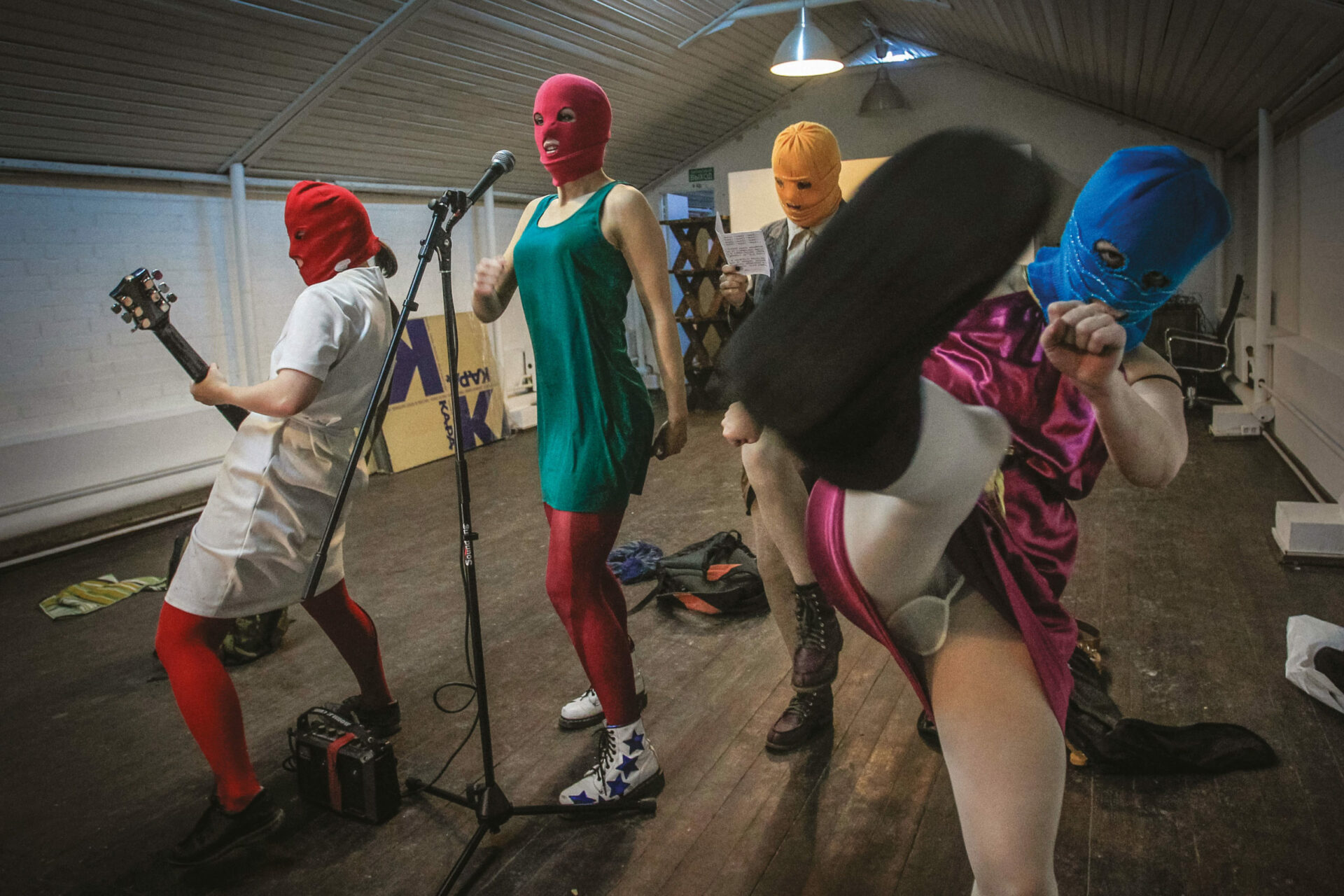
Studio practice.
Photo: Sergey Ponomarev
On February 21, 2012, a few days before the March 4 election, Pussy Riot staged its boldest protest yet: a dozen members, armed with guitars and microphones, burst into the Cathedral of Christ the Saviour in Moscow, the seat of the Russian Orthodox Patriarchate. In a striking performance of prayers and songs, delivered in a fiercely ironic tone, they urged the Virgin Mary to stop Vladimir Putin from running for president.6 6 - Clips of this performance can be viewed on YouTube: www.youtube.com/watch? v=Yr0jNui5Qw8 (accessed August 20, 2012). Less than two weeks later, on March 3, two women who admitted to being members of the group were arrested under Article 213 of Russia’s criminal code. A third member was arrested on March 16.
The Russian community is divided over Pussy Riot’s actions, deemed blasphemous but at the same time admirable for denouncing the collusion between Church and State. While some see the repression of such artistic protests as the duty of a responsible government seeking to maintain law and order, others see it as an expression of extreme malevolence, a refusal to engage in dialogue with indignant youth who are asserting their right to express their opinion and denounce the social and economic injustices in their lives. This is the stance adopted by the Pussy Riot members themselves. In a statement made during her trial, Nadezhda Tolokonnikova explained: “What was behind our performance at the Cathedral of Christ the Saviour and the subsequent trial? Nothing other than the autocratic political system. Pussy Riot’s performances can either be called dissident art or political action that engages art forms. Either way, our performances are a kind of civic activity amidst the repressions of a corporate political system that directs its power against basic human rights and civil and political liberties.”7 7 - “Pussy Riot Closing Statements,” N+1, August 13, 2012, http://nplusonemag.com/pussy-riot-closing-statements (accessed August 20, 2012). Similar cases of citizen outrage, revolt, and repression have been erupting throughout the world in this early 21st century: in Egypt, Iran, Greece, France, England, and Quebec… the list is long. As philosopher Philippe Saltel suggests, given the magnitude of the phenomenon, “there is a need — an urgent need — for a philosophical enquiry into the motives of malevolence, when current opinion generally tends to point to malevolence as a motive.”8 8 - Philippe Saltel, Les philosophes et la haine. Paris: Ellipses, 2001, 7 (Own translation).
Hatred
For Saltel, this malevolence is hatred — a cool and crystallized rage focused on an object that has become emblematic of an overwhelming affect. It is the hatred shown by an authoritarian government towards a defiant and rowdy youth, which it attempts to suppress through gag orders (in the media), imprisonment, and even a denial of the existence of an organized opposition — all in the name of love for Russia and respect for the rule of law. As the Director of Amnesty International France asserts, “The goal of the [Pussy Riot] trial is to stifle all criticism and opposition to Putin’s regime. They are the victims of a system, and the case is symptomatic of many other things that are going on… in Russia today.”9 9 - “Pussy riot: deux ans de camp pénitentiaire pour leur « prière » anti-Poutine,”Associated Press, Le Devoir, August 17, 2012, http://www.ledevoir.com/international/actualites-internationales/357066/les-pussy-riot-reconnues-coupables (accessed August 20, 2012) (Own translation).
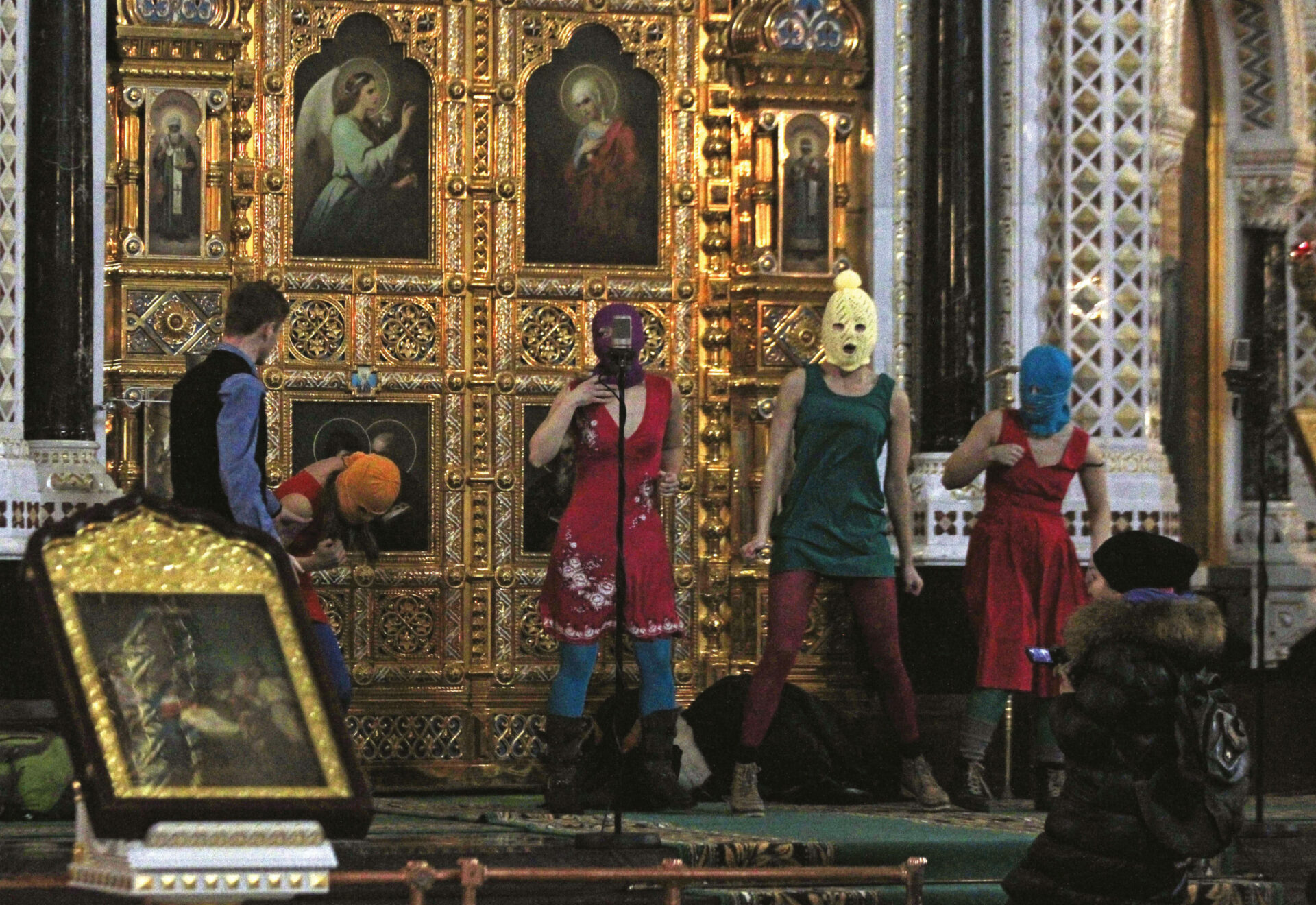
Cathedral of Christ the Saviour in Moscow, February 21, 2012.
Photo: Sergey Ponomarev
In Saltel’s view, such hatred results in a subject’s desire to eliminate the object of his or her “aversion.” The goal is to remove the latter from one’s view or life: “To hate someone (or a group) is to let them know that the complex web of their existence and their creative authority are worthless. It is obviously through lying and denying them their humanity — by directly attacking their honour — that the goal of creating the greatest suffering possible can be achieved. We hope the other will hate us in turn, not only to justify our own hatred a posteriori but also to prove that we have successfully hurt our target.”10 10 - Saltel, 53 (Own translation). In cases of hatred, “the subject considers the object to be bad by nature, positing a utopian world that is in some sense cleansed of this embodiment of evil.”11 11 - Ibid., 27 (Own translation). For Putin, this utopia is perhaps a prosperous and peaceful Russia. It is possibly also a world in which a government can rule in a cynical, opportunistic, and arrogant manner, with no input or opposition from its citizenry.
From Hatred to Indignation
However, Pussy Riot’s members are more than just scapegoats for hatred; they play with it, feed into it and on it. As Saltel suggests, hatred is communicated and shared. Pussy Riot’s hatred is markedly different from that of leaders faced with a constant irritant. It is the hatred of a generation that has grown up in precarious circumstances, in a State it considers to be corrupt and repressive, where the extreme wealth of the oligarchs stands in contrast to the kind of poverty that should not exist in an industrialized, resource-rich country. “This hatred, this fight against a recognized enemy within its own limits, is no longer an obstinate hatred, but rather deserves to be called just indignation.”12 12 - Ibid., 66. In other words, a “just hatred.” As Émile Zola stated, victims of major injustice must be driven by indignant hatred: “Hatred is holy. It is the indignation of strong and powerful souls, the militant disdain of those who are angered by mediocrity and foolishness.”13 13 - Émile Zola, Mes haines. Causeries littéraires et artistiques [1866]. (Geneva: Slatkine Reprints, 1979), 1 (Own translation).
If the government manages, at least in part, to muzzle the object of its hatred through media control, repression, and imprisonment, Pussy Riot’s members have to find more creative ways to show their defiance and indignation, in order to ultimately destroy the object of their disdain. Even when it can be considered just, “hatred is an emotion that is as much tied to a sense of loathing as it is to an act of destruction.”14 14 - Jacques Hassoun, L’obscur objet de la haine. (Paris: Aubier, 1997), 15 (Own translation).
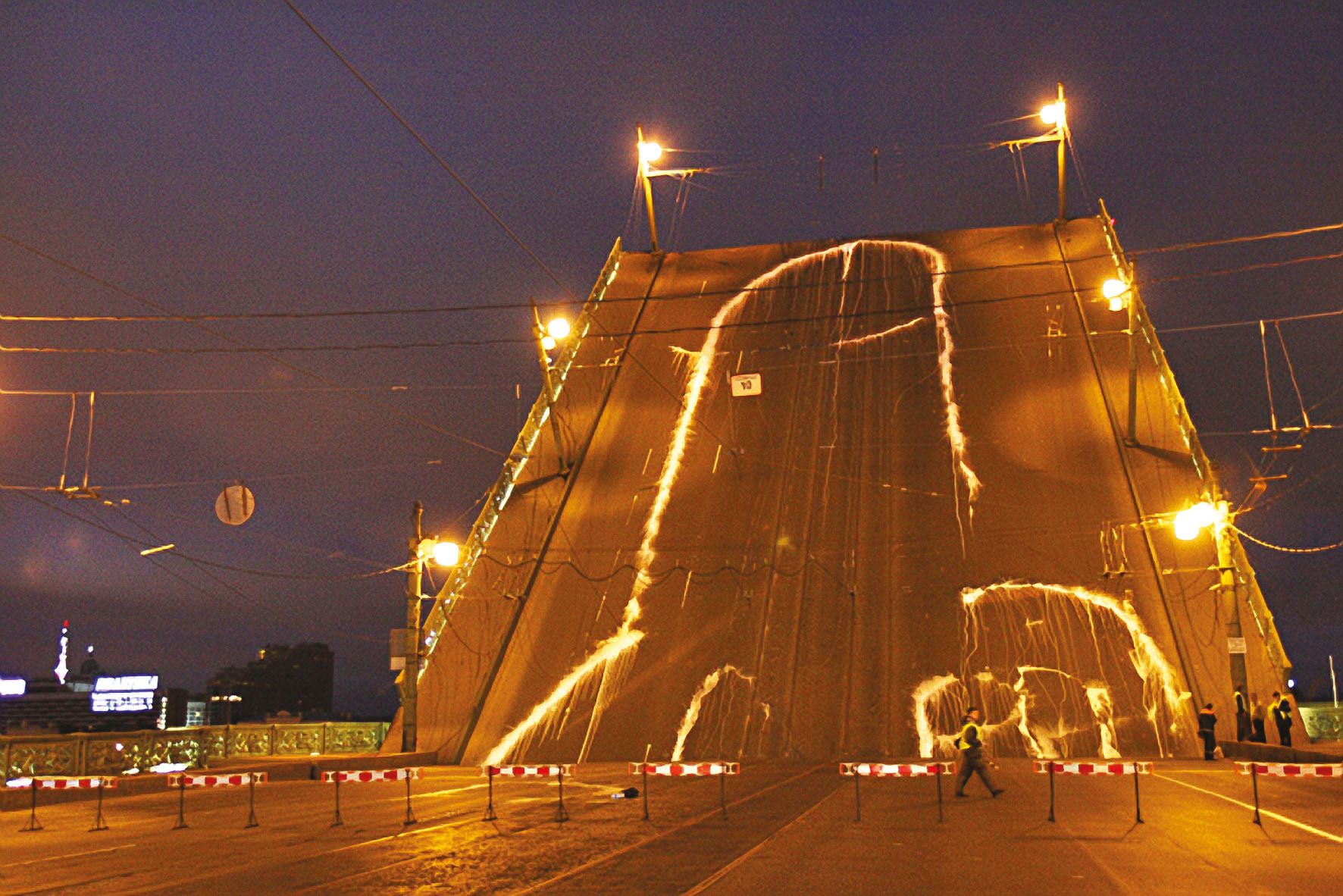
Phallus (painted) on the Liteyniy Bridge, St. Petersburg, June 15, 2010.
So, what are the members of Pussy Riot doing to achieve their goal? While ignored by the Russian media, they appropriate public places in which to unleash their protest arsenal. They appeal directly to the public and circulate images, words, and videos through social media. Like the Actionists, they take the intellectual and physical risk of using their own bodies to create art and convey their indignation. The power of the body, at once rebellious and vulnerable, to communicate a message through performance is undeniable. Pussy Riot performers belt out lyrics that are more than vitriolic; they are profoundly satirical. They use mocking humour to question symbols of power and oppressive institutions, exposing their inherent weaknesses and contradictions, turning them into objects of scorn and ridicule, and undermining their authority. It is, of course, a purely symbolic destruction, but it has the potential to get people thinking about a different kind of utopia than that sanctioned by leaders and state-controlled media.
Pussy Riot’s members are not the only Russian artists to use anonymity, occupation of public space, satirical humour, and symbolic destruction as protest strategies. The group CAT (Contemporary Art Terrorism), formed in 2003 in Novosibirsk, uses the Internet to organize flash-mob protests parodying official protests from the Communist era. Participants are regularly harassed, arrested, fined, and forced to sign statements to the effect that placards bearing the messages “Tanya, don’t cry!”, “Ah!” and “Grrr!” are not a direct attack against the Russian regime. There was also the memorable exploit staged by the collective Voina (War), founded in 2007. In the early morning of June 15, 2010, the group painted an enormous phallus on the Liteyniy Bridge, a drawbridge across the Neva in St. Petersburg. Each time a ship passed in the hours that followed, spectators were treated to the sight of an erection, close to 65 metres tall, rising in front of the headquarters of Russia’s secret police, the FSB (formerly the KGB)15 15 - A clip of this performance piece can be viewed on YouTube: http://www.youtube.com/watch? v=MYajNxa_UrU (accessed August 20, 2012).. Although the artists were arrested, the Ministry of Culture and the National Centre for Contemporary Art awarded them an innovation prize in the visual arts category. These few examples of artistic protest aside, it is clear that the recent two-year sentences imposed on Pussy Riot members are a sign that the Putin regime is hardening its stance, confirming its refusal to tolerate any form of protest, artistic or other.
Translated from the French by Vanessa Nicolai


