
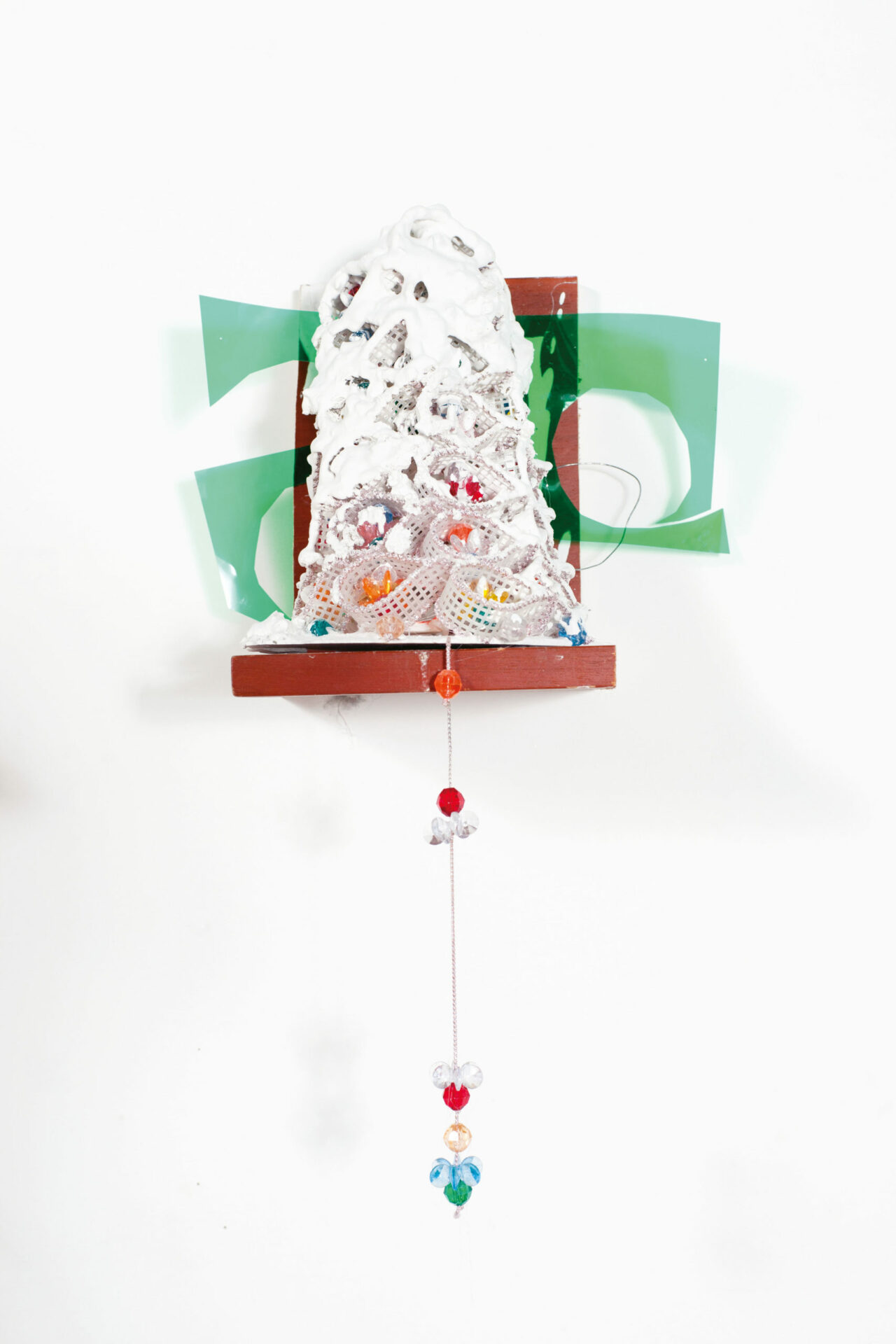
A long, broken, burbling line of stuff stretches around the walls of a vast space. Serge Murphy’s exhibition The Shape of Days — a collection of bas-relief assemblages placed closely side by side — reaches around the Jean-Noël Desmarais Pavillion in Montréal’s Musée des beaux-arts. At first glance, the work seems like an odd decorative flourish in an oddly empty room. Walking around its perimeter, we move past an overwhelming array of altered everyday objects. Broken into individual units, the burbling line swarms around small shelf-like components, halfway lines jutting out from the wall. A gestural vocabulary spreads out from each shelf in all directions. Elements rest, stack, and protrude above; strings, wires, drawings, bags, and bits of plastic dangle below. Ties, tea, cardboard, colanders, flower pots, pieces of styrofoam, spools of thread; cut, glued, pinned, bent, splattered, speared, clasped, drenched, painted.
In the short text Verb List (1967-1968), Richard Serra succinctly catalogued sculptural potentials with a series of action words: “TO ROLL, TO CREASE, TO FOLD, TO STORE. . . .”1 1 - Reprinted in Artists, Critics, Context: Readings in and Around American Art Since 1945, (ed.) Paul F. Fabozzi (Upper Saddle River: Prentice Hall, 2002): 234–35. Murphy’s work shares both Serra’s gestural penchant and the Verb List’s obvious concern for how gestural potential becomes enshrouded in language. The odd assemblages on display incite us to imagine the actions by which they were produced. Yet they also become a syntax, a grammar for containing those traces of movement: shelf-sentences of heterogeneous actions, qualities, and subjects, many linked with “and. . . and. . . and. . . .” Murphy’s concerns with action and language echo, reconfigure, and reconsider modern sculptural legacies. From Kurt Schwitters’s assemblages to David Smith’s early totems, twentieth-century sculpture often fabricated flows of material into succinct gestural units. Many of these works echoed a structuralist belief in the universality of both language and the human body as interpretive keys.
Anthropomorphism, of course, remains an important force in recent sculpture, even if theoretical accounts of it have changed. Indeed, Murphy writes that, “sculpting is looking for shapes that resemble us.”2 2 - Serge Murphy, quoted in the wall text at the Musée des beaux-arts. Yet the myriad recognizable, cheap commodities he uses complicate this drive toward resemblance, introducing prosthesis and possession into the equation. Referring to the reach of hands, the objects extend the body’s capacity, for instance, its propensity for holding things augmented by bags and bowls. In their usefulness these objects also act as economic lures, enticements toward the practices of ownership: seeking, selecting, and buying. Awash with things, these works require a “noun list” as well as a verb list. The objects of which they are made extend, but also resist, identification with the sculptor’s action — because in a sense, they have their own. They raise the question: to whom, exactly, do the actions on Serra’s verb list belong — the materials or the sculptor? Who, or what, produces them — the sculptor’s will or the latent potential of the materials emerging through encounter with a hand or two? The answer is complex; Serra’s list, I think, slightly favours the sense in which the sculptor actively imposes form onto a passive material. Murphy’s noun-objects, on the other hand, sustain the murky uncertainty of this encounter, asserting themselves as self-possessed possessions, with their own singularity and potential (much like us).
photos : Pascal Grandmaison, permission de l’artiste |
courtesy of the artist
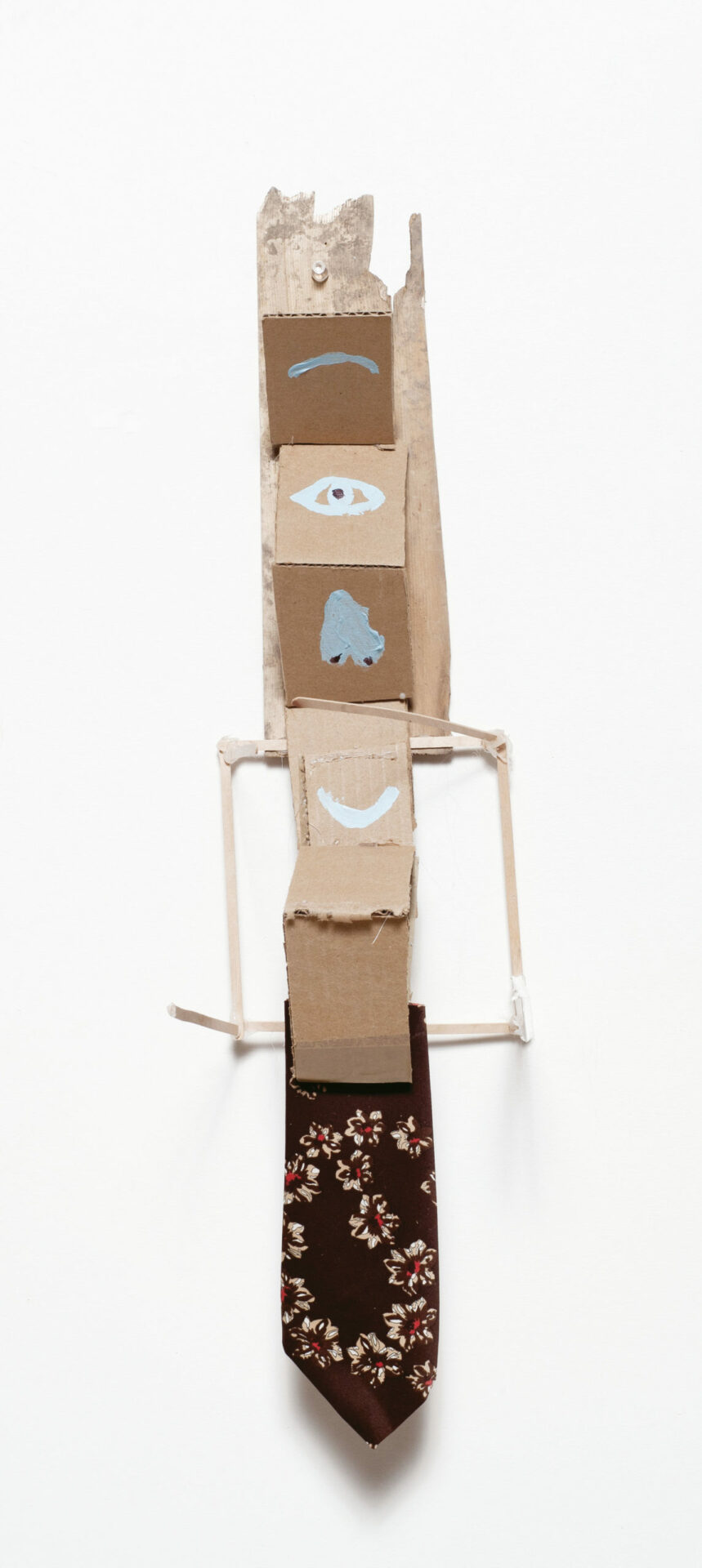
By and large, Murphy’s raw materials are commodities, whose production only minimally involved human hands: factory labourers attending to machines in smooth, streamlined production regimes. Murphy’s own productions are not nearly so streamlined; like Thomas Hirschhorn and many other like-minded contemporary artists, his works harbour no pretension of being “well made.” These artists actively denounce the importance attached to high-quality manufacture — a tradition nearly as old as mass production itself. As early as 1854, British art critic John Ruskin argued that, “the demand for perfection is always a sign of a misunderstanding of the ends of art.”3 3 - John Ruskin, On the Nature of Gothic Architecture: True Functions of the Workman in Art (London: Smith, Elder & Co., 1854), 13. Ruskin saw around him a culture obsessed with finery and polish, and lamented the loss of free, imperfect craftsmanship in which manufacture served as a vehicle for thought. It was inhumane, he believed, for factory workers to slavishly follow others’ designs; glass bead manufacturers, for instance, did not “have the smallest occasion for the use of any single human faculty: and every young lady, therefore, who buys glass beads is engaged in the slave-trade.”4 4 - Ibid., 11. Ruskin conveys streamlined design’s bad conscience in a way that is, of course, deeply felt in our own time.
If the messiness of The Shape of Days is rhetorically staged as the artist’s messiness (a sculptural messiness added to the once-clean, commodified object) then these works ask us to rethink the conceptions of skill on which notions of the “well made” are based. For Murphy’s “skilled” labour presents itself as slapdash compared to the sleek finitude of the commodity. This is the point: Murphy cuts through, or cuts off, the finished quality of slavishly-made everyday objects and renders them enigmatic — even as he demystifies skilled production by using processes (twisting wire, cutting plastic bags) that, presumably, just about anyone could do. “Un-designing” manufactured objects, his sculptural activities dismantle utility, carefully plucking use value from the equation. Lobbing paint on a spool of thread removes its potential to be unwound and sewn (to unwind and sew?); cutting out chunks from a plastic bag removes its ability to hold anything. Subtracting use value, Murphy retrofits these objects with analogical propensities, staging a return of thought to manufacture. Yet this staging also issues a refrain, a repeated myth of art’s purposive purposelessness. Modern art has asserted itself, again and again, as counter to rationalized, industrialized production. The point is not a “point” at all; it points to the need to sustain the staging.
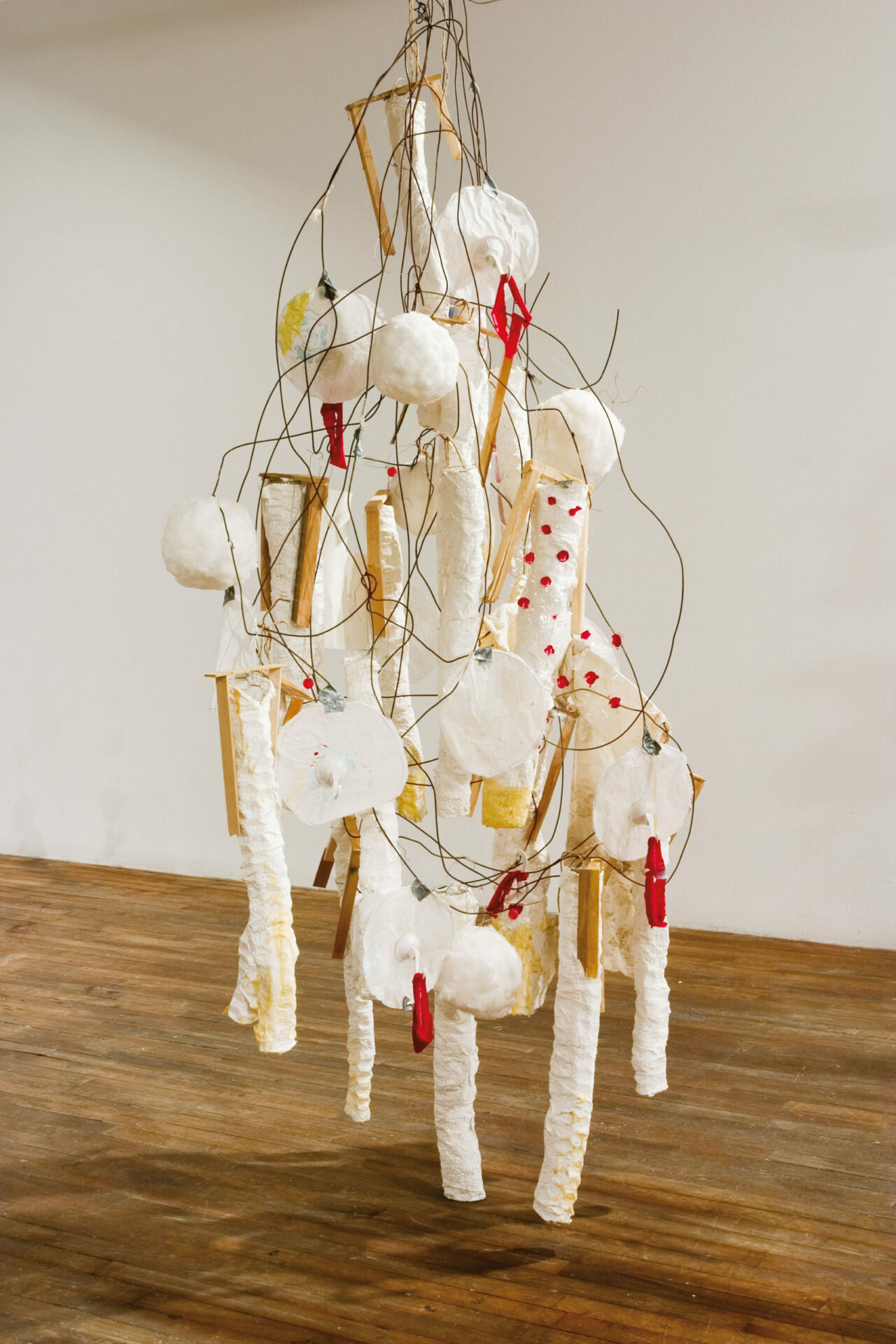
For all their exuberance, Murphy’s sculptures are crammed into single file. Compared with many of his past works — such as Réparations (1999) and Le Songe Végétal (2005), in which loosely built structures sprawled about freely — this installation feels constrained, confined to linearity. The jostling, overfull line becomes an architectural marker, a way to highlight the details of the room and make us feel the uncanny vastness of its dimly lit, empty centre. Even the lighting tracks and the hum of the ventilation system seem brought into focus by the way in which Murphy has lined the space. Akin, in a sense, to a Robert Irwin installation, a large part of Murphy’s act is in framing emptiness, bringing into focus the space’s tacit call to our feeling, its subtle, fleeting atmospheres. Yet unlike Irwin, Murphy’s act is also abundant, present, overfull. His gesture references decoration — relief panels, friezes and wallpaper borders — even if the works’ roughness contradicts decoration’s rote association with exactness, prettiness, polish. As Beatriz Colomina points out, modern architectural discourse was shot through with a hatred of the decorative.5 5 - See Beatriz Colomina, Privacy and Publicity: Architecture as Mass Media (Cambridge: MIT Press, 1996). (The architect Adolf Loos even inflected his hatred of decoration with homophobia, denouncing it as degenerate, effeminate, homosexual). Though often overlooked, decoration can radically challenge the aggressively exclusive “neutrality” of modern space.
Epitomized perhaps by the white cube, modern interiors are designed to be both aggressively “neutral” and conspicuously vacuous. As Norman Bryson argues, their vacuity espouses a particular attitude toward the overabundance of commodities. Whereas the Victorian home, proliferating with shelves and cubbies, sought to absorb as much of the excess as it could, the modern interior ekes out a quietness, a temporary reprieve from excess against which certain carefully chosen trinkets can stand out in high relief.6 6 - Norman Bryson, “Abundance,” in Looking at the Overlooked: Four Essays on Still-Life Painting (London: Reaktion Books, 1990): 97–135. Putting these dialectics into high focus, Murphy playfully links two categorical exclusions of modern space — decoration and trash — and refashions them as probes into the very “neutrality” which surrounds them.
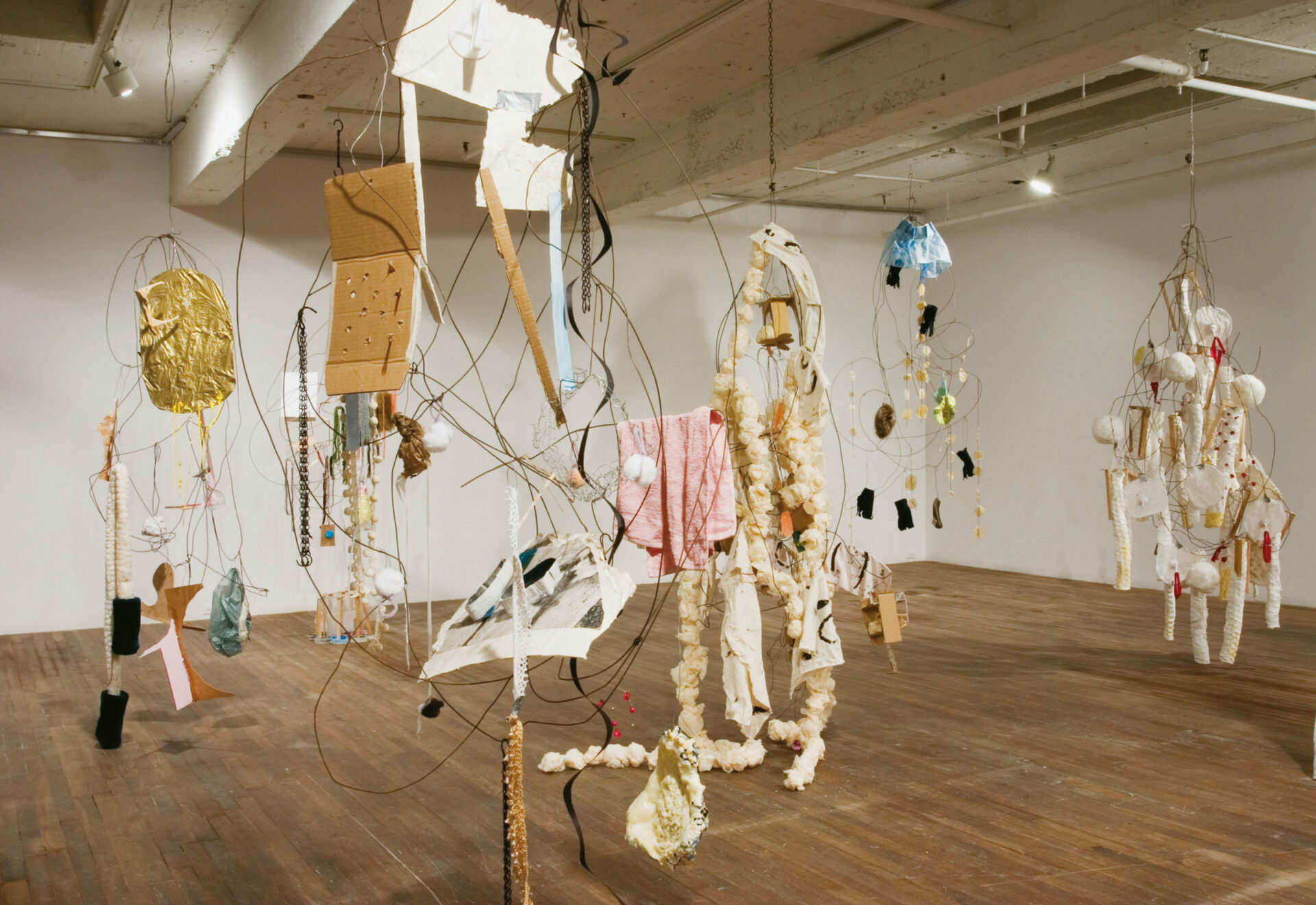
photo : © Richard-Max Tremblay / SODRAC (2011)
Yet the constrained, linear format also reads as a linear progression, drawing out questions about how time is represented in space. Walking along the walls, we might imagine a temporal progression between assemblages; they seem to represent a progression of days (as if each unit stood in for a day) in a direct equation of the artist’s labour with represented time. Yet within each individual unit, a cacophony of temporality spills forth. Cuttings, stackings, and coatings fold time, inflecting the time of looking with the imagined, reconstructed time of the objects’ making. The tension between the linear representation of time and this other, more unwieldy sense of temporality recalls Henri Bergson’s early twentieth-century writings on duration. Whereas, Bergson argued, we are accustomed to measuring time in regular units, these are only abstractions placed overtop our experience of duration: the completely heterogeneous, and completely singular, experience of the rhythmic flux and flow of qualities. To quantify time was to misrepresent it, falsely lending it the illusion of regularity: a regularity that undoes the richness, the unpredictability, the thickness of duration.7 7 - See Henri Bergson, Time and Free Will (London: Elibron Classics, 2005). Murphy’s work suspends us between the representation of time as quantity, and its experience as rhythmic, multifaceted, and durational. In so doing, it challenges us to consider the historical and cultural specificity of our understanding of time. Writing as he did, in the early twentieth century, Bergson’s work stood counter to Taylorism — the streamlined, scientific management of workers’ minute motions on the factory line, meant to maximize efficiency and profit. Murphy’s line of productions plays with expectations of regular outcomes and standardized units of time — yet his works undo these expectations with their lilting, exuberant irregularity.
Breaking down objects, Murphy refashions them as probes into the media in which the very experience of sculpture is suspended: production, architectural space, and time. Carrying strong stylistic ties to Modernity, his work intelligently challenges us to think about the pressing contemporaneity of the modern relationship between production and skill. It also acknowledges and challenges the rational, modern concepts of time and architectural space against which art — which espouses anti-rational production — can become framed as art. Murphy stages the artist’s activity as un-designing, de-rationalizing the object, and in so doing, enunciating the space in which one presents oneself. Yet for all its reflexive panache, for all its anti-rationalism, this work is quite aware that the dichotomy between rational and anti-rational productions is also modern; it doesn’t solve this, but rather holds up the paradox, stretches it and smiles. These works sustain their serious inquiry with lightness, playfulness, and humour — the childlike exuberance of not quite knowing where one is or what to do, but being there, acting there anyway.


