Toxic Intimacies: Extraction, the Nuclear-Industrial Complex, and Contemporary Art

As part of this digital residency carried out in partnership with Érudit, writer and curator Katie Lawson explores the links between extraction, geology, and colonialism. With sustainability in mind, she rethinks the role of exhibition curators as an act of care extended to ecosystems. In dialogue with Indigenous artists, she examines the invisible consequences of the nuclear-industrial context and the capacity of art to reveal and dismantle environmental and colonial violence.
In 2024, I curated an exhibition for Kitchener-Waterloo Art Gallery (KWAG) called Erratic Behaviour, featuring artworks that draw on historic and contemporary entanglements between people and geologic events, processes, or entities, acknowledging rocks as vibrant matter that shape our understanding of time and place. As a title, Erratic Behaviour plays with the two meanings of erratic: on the one hand, it is a geological term for a specific kind of rock that has travelled (often with glacial melt) from one place to another; on the other hand, it is a descriptor of behaviour that is unstable or irregular.
The exhibition suggested that the industrial extraction, processing, consumption, and disposal of natural resources itself is a form of erratic behaviour, as select humans and corporations have produced turbulent conditions globally. I sought to develop a curatorial methodology that would mitigate waste and champion sustainability in all aspects of exhibition design, logistics, and methods of display, as I worked responsively to material sourced in the forgotten corners of storage at the hosting institution and set parameters such as only using ground transportation within a specified radius for the delivery of work (to name but two examples).
The Latin root of curator, curare—to care for and attend to—often surfaces in descriptions of the profession’s roles and responsibilities, whether in the duty of care toward an artwork, an artist, or an audience. But what if this duty of care could extend to the landscapes and resources that enable the materials of art and exhibition production? I am interested in the ways that writing and publication (in its many forms) serve as modes of research dissemination that endure beyond the brevity of temporary exhibitions. How can a text be a space to extend curatorial research without the often-intensive environmental impacts of exhibition-making?
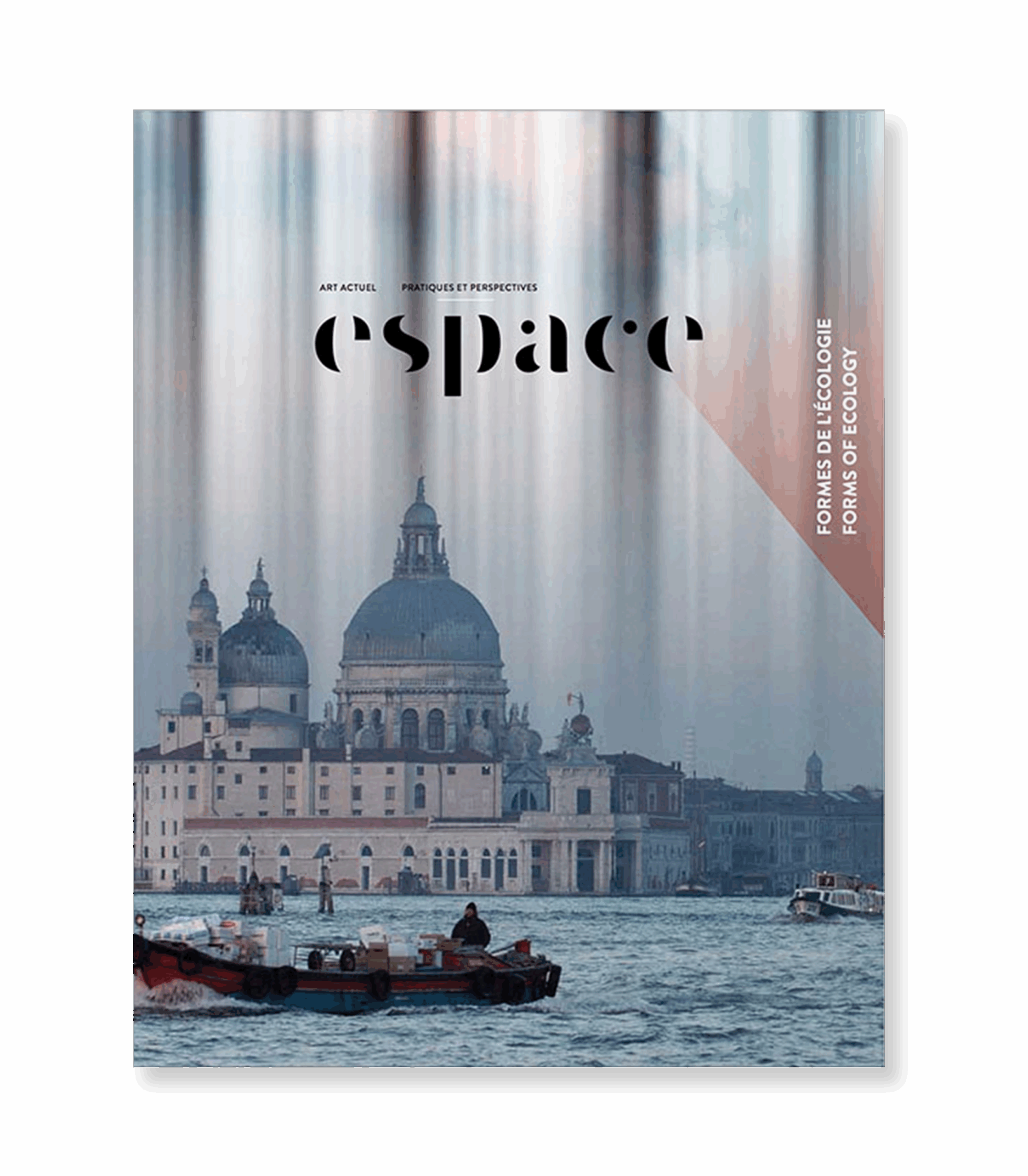
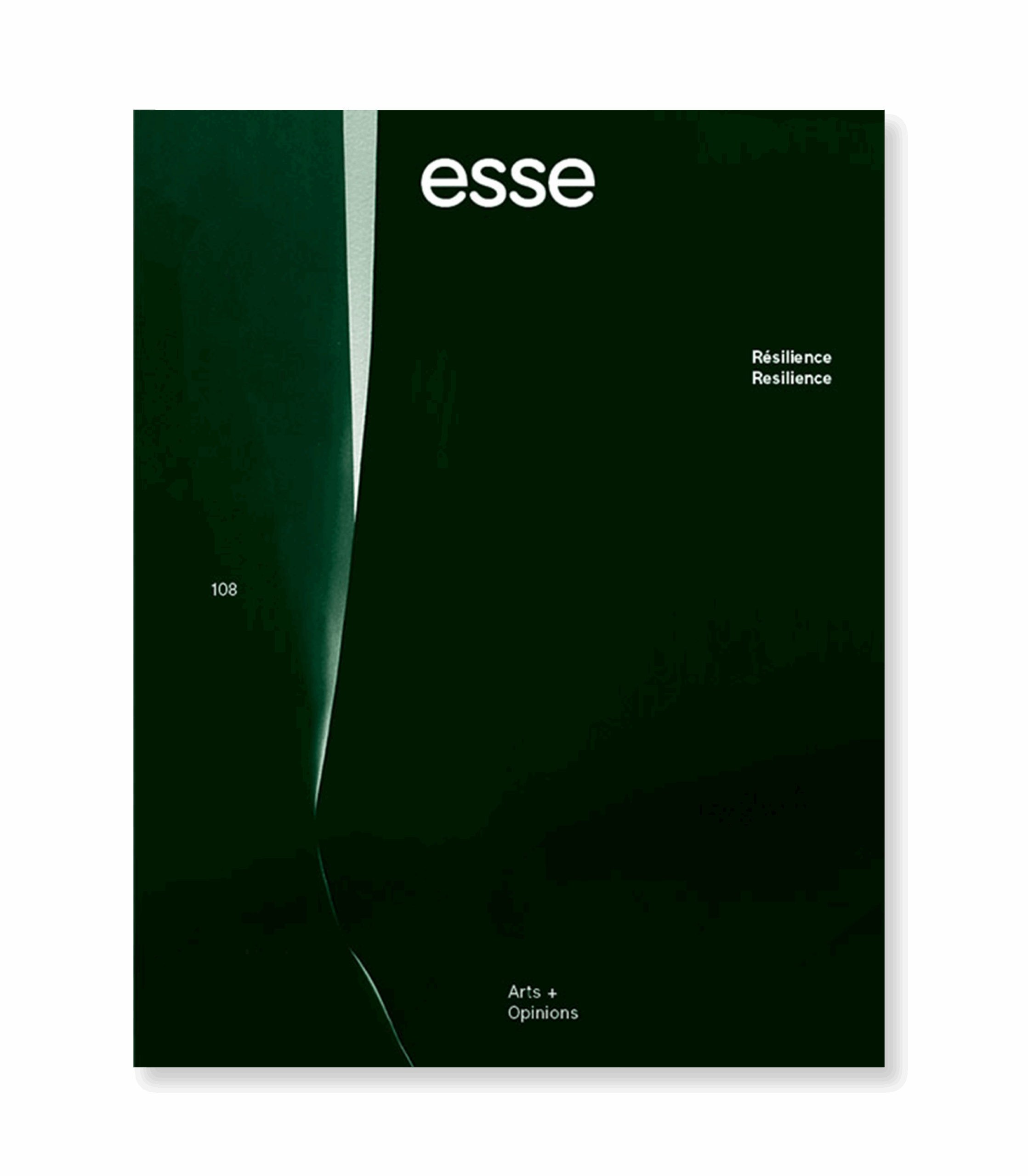
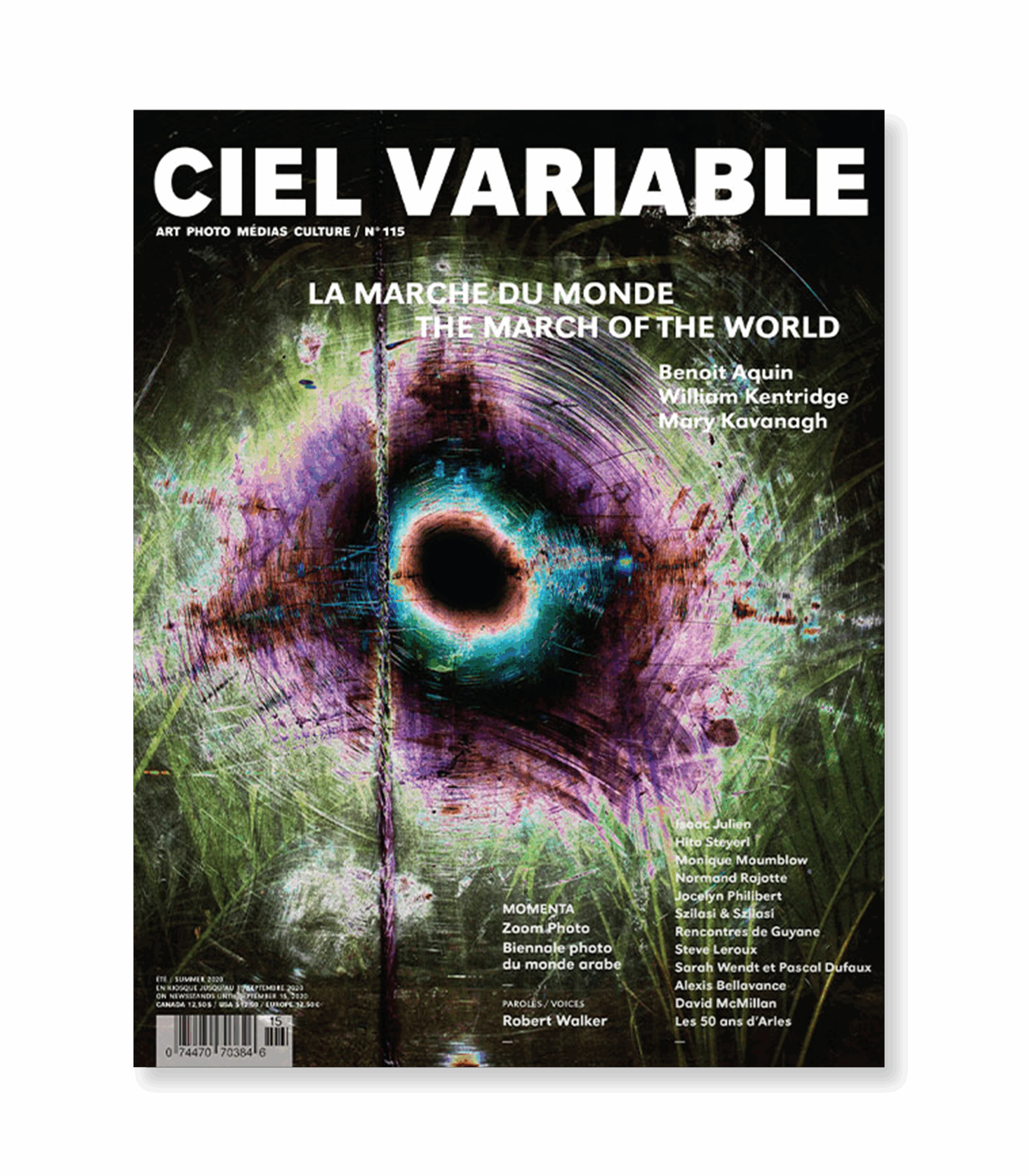
During my residency with Esse, spending time with its archives and the Érudit database, I reflected on how my practice of research and writing could extend the constellation of references that were brought together in Erratic Behaviour. With that exhibition, I was able to explore various issues related to extraction through the work of artists that focused on mining of coal, petroleum, cobalt, and rare earth minerals, connecting disparate geographic contexts. What emerged from tracing the movement of extracted materials globally was the entanglement of these extractive industries with colonialism, capitalism, and imperialism. This was particularly evident in works such as Tsēmā Igharas’s high-grade copper anomalies (2015–ongoing), a series of half-melted piles of pennies that conjure the cultural significance of copper for her community of Tahltan First Nation—and for many Indigenous groups across Turtle Island—but also capitalist economies and the ways that processing of copper ores from igneous and sedimentary rock devastates ecosystems, producing a disproportionate amount of toxic waste. Now, with the time and space to develop a new article for Esse, I have the opportunity to expand on these ideas. I found a companion to Igharas’s work in Caitlin Chaisson’s 2015 article “Black Gold: The Esoteric and the Ecological,” published in ESPACE art actuel. Chaisson discussed pipeline construction and Indigenous trading routes in British Columbia and Alberta in relation to the research-creation project Trading Routes: Grease Trails, Oil Futures (2014–17)led by artist Ruth Beer—an expansive web of practices, public engagement events, and publications.1 1 - Caitlin Chaisson, “Black Gold: The Esoteric and the Ecological,” Espace 110 (Spring–Summer 2015), accessible online. The questions articulated by Chaisson resonate deeply with my own. Most extractive industry infrastructure is hidden; it is therefore out of immediate sight and mind for governments and citizens. This distance effectively erases the violence enacted on bodies and environments by industries that are at odds with the realities of dwindling resources amidst the ongoing climate crisis. And yet, the hard truth of resource extraction is not so distant as it might seem, suggesting a dominance—at least in the West—of ignorance and apathy toward industry impacts that are inescapable for communities living with the “slow violence” of mining and oil and gas extraction.2 2 - Rob Nixon, Slow Violence and the Environmentalism of the Poor (Cambridge: Harvard University Press, 2013).
What role might artists play in contending with these ubiquitous yet largely invisible systems and material dependencies? What artistic strategies for engagement exist beyond the spectacular photojournalistic impulse toward disaster tourism?
Chaisson reminds us that a deeper theoretical question underpins these considerations of contemporary art, by way of Elizabeth DeLoughery and George Handley’s Postcolonial Ecologies: Why are environmental concerns often framed as separate from post-colonial discourse, given the entanglement of systems that link the domination, oppression, and possession of human and more-than-human worlds?3 3 - Chaisson, “Black Gold,” 28.
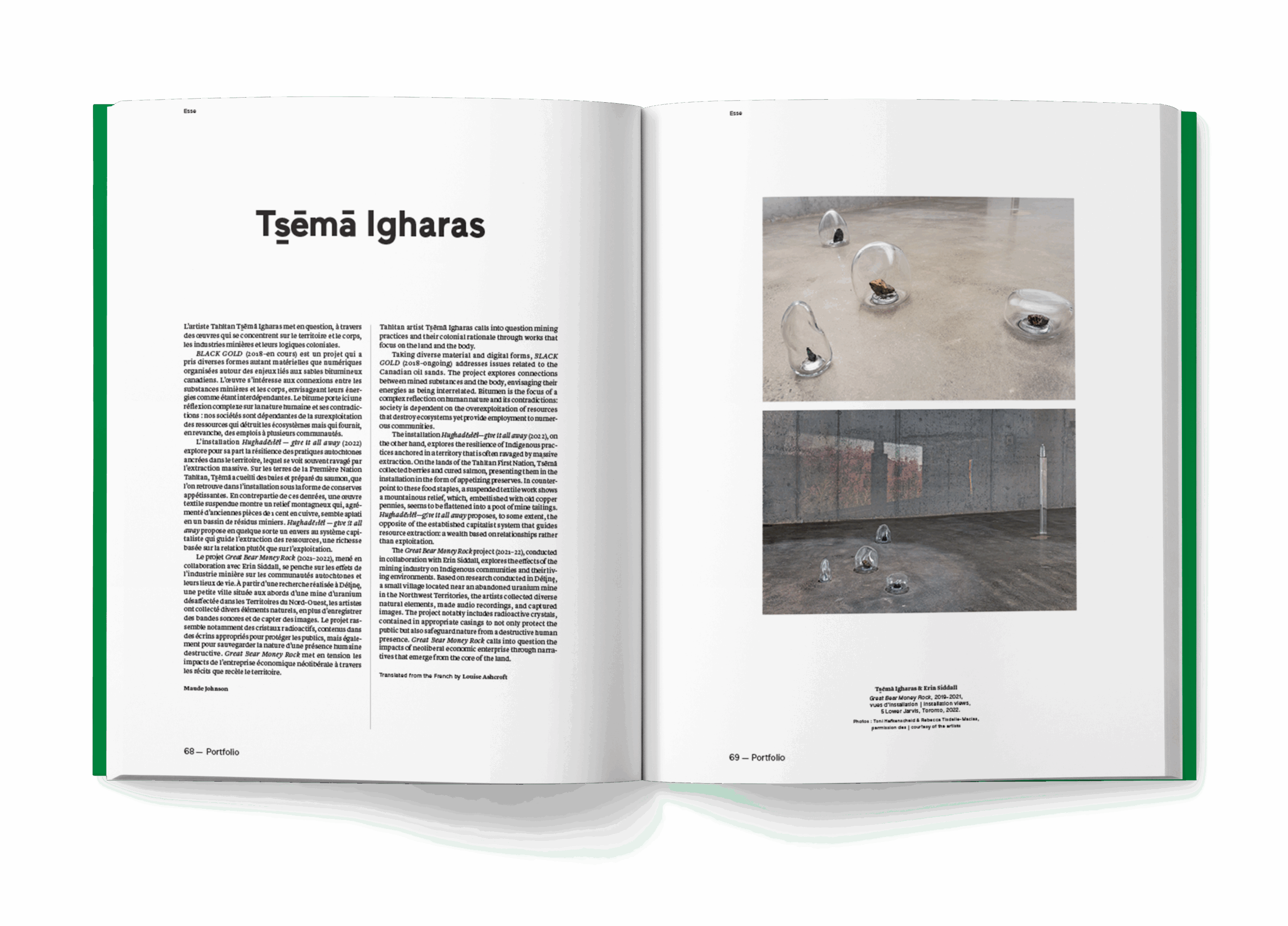
As I spent time thinking about the relationships between Trading Routes and Igharas’s copper work, I was reminded of other kinds of extractive projects that there wasn’t room to explore in the space of Erratic Behaviour but lingered in my mind with increasing urgency—namely, those involving the nuclear-industrial complex. Prior to the show at KWAG, I had worked with Igharas in 2022 through a collaborative commission with Erin Siddall for the Toronto Biennial of Art: What Water Knows, The Land Remembers. It was through this project that I became familiar with the past, present, and future of uranium mining and processing in Canada. In Great Bear Money Rock (2021–22), Igharas and Siddallcontend with the cultural, bodily, and environmental devastation of the Sahtúot’ine Dene community in the Northwest Territories wrought by the Port Radium mine.4 4 - This work was included in an Esse portfolio on Igharas’s work: Maude Johnson, “Tsēmā Igharas,” Esse 108 (2023), accessible online. Initially opened in the 1930s for uranium-based medical research, the site was mined heavily from the 1940s to the 1960s, in part to supply the Manhattan Project, which developed and tested the first atomic bomb. With distinct material outputs, from radioactive crystals to audio recordings, the collaborative installation links the invisible yet irreparable impacts of industry on both body and land.
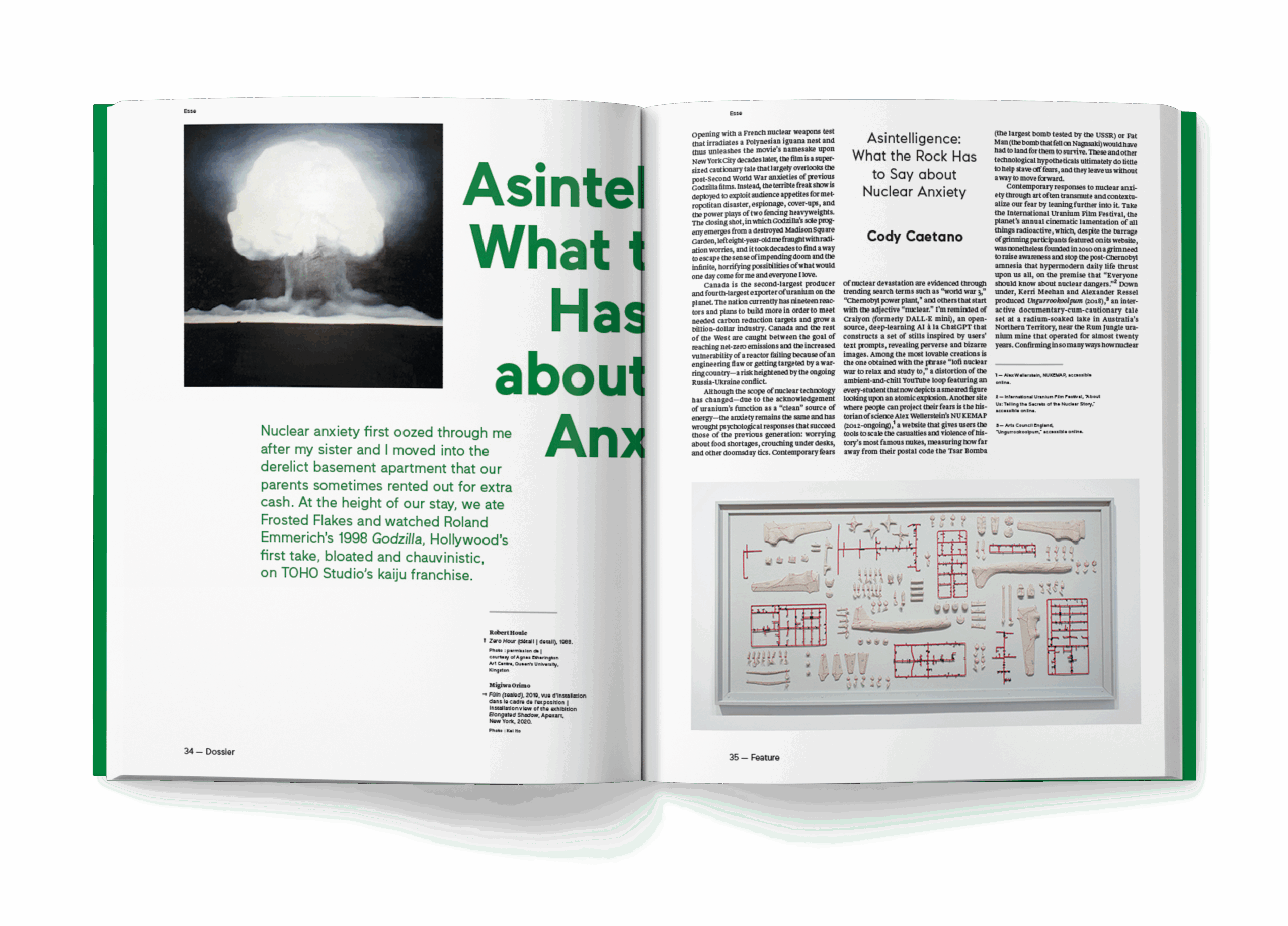
The overtly spectacular imagery of the detonation of nuclear bombs dominates the cultural imaginary, with lens-based media being the medium of choice.5 5 - For more on photography and lens-based media in relation to nuclear weapons, see Jill Glessing, “Deconstructing Nuclear Visions,” Esse 86 (2016), accessible online. But the less visible aspects of the nuclear industrial complex resist representation, whether a given node in the system serves the military or supplies civilians via the electrical grid. This is in part due to the imperceptible nature of radiation and to the by-products of the mines and the secondary industries—processing centres, test sites, generators, and waste-storage facilities—that contaminate environments surrounding them. As the curator and professor Blake Fitzpatrick writes, “Photographs are partial records, and what can be seen carries a deadly inverse in what can’t be seen—cancerous fallout, radiation, trauma, and the truth about it all … How does one see the toxicity of nuclear fallout in the air, the home, or the confines of one’s own body?”6 6 - Blake Fitzpatrick, “Mary Kavanagh, Daughters of Uranium—Embodied Politics,” Ciel Variable 115 (2020): 32–41. The limits of image-making—of representation—in light of irradiated bodies and material evidence are woven through Fitzpatrick’s account of Mary Kavanagh’s exhibition Daughters of Uranium for Ciel variable (2020). Bringing together a series of interconnected works in various media from the 2010s, Kavanagh foregrounds the bodily burden of nuclear activity, the exhibition’s title being a reference to the proliferation of elements in the radioactive decay chain.7 7 - In chemical sciences, “daughters of uranium” is the name given to the decay chain of naturally occurring uranium. Naturally occurring uranium-238 will break down over the course of 4.468 billion years, a scale of time that is inconceivable in relation to the brevity of human life. Through this process of decay, radioactive contamination taps into environmental and biological pathways not only of the present but also of future generations.
I am particularly interested in the ways that glass functions in the material vocabulary used by Kavanagh, as well as by Igharas and Siddall, to signal the embodiment of nuclear contamination. In Great Bear Money Rock, the geologic forms collected from Port Radium are entombed in blown-glass orbs specially formulated to contain the low-level radioactivity that remains—a protective yet translucent barrier between the viewer and the site of extraction. Kavanagh’s Glass Breath (2014) consists of a series of glass vials that she has blown, capturing and making visible the act of breathing in a body that carries the cancerous legacy of environmental contamination. Whereas the former tends to the site of uranium extraction, the latter dwells on sites of nuclear testing and detonation—such as Trinity, New Mexico—adding a further referential layer through its connection to the glassy residue of Trinitite, a radioactive mineral formed through the heat and force of the blast, which fused onto the site’s sand and debris.
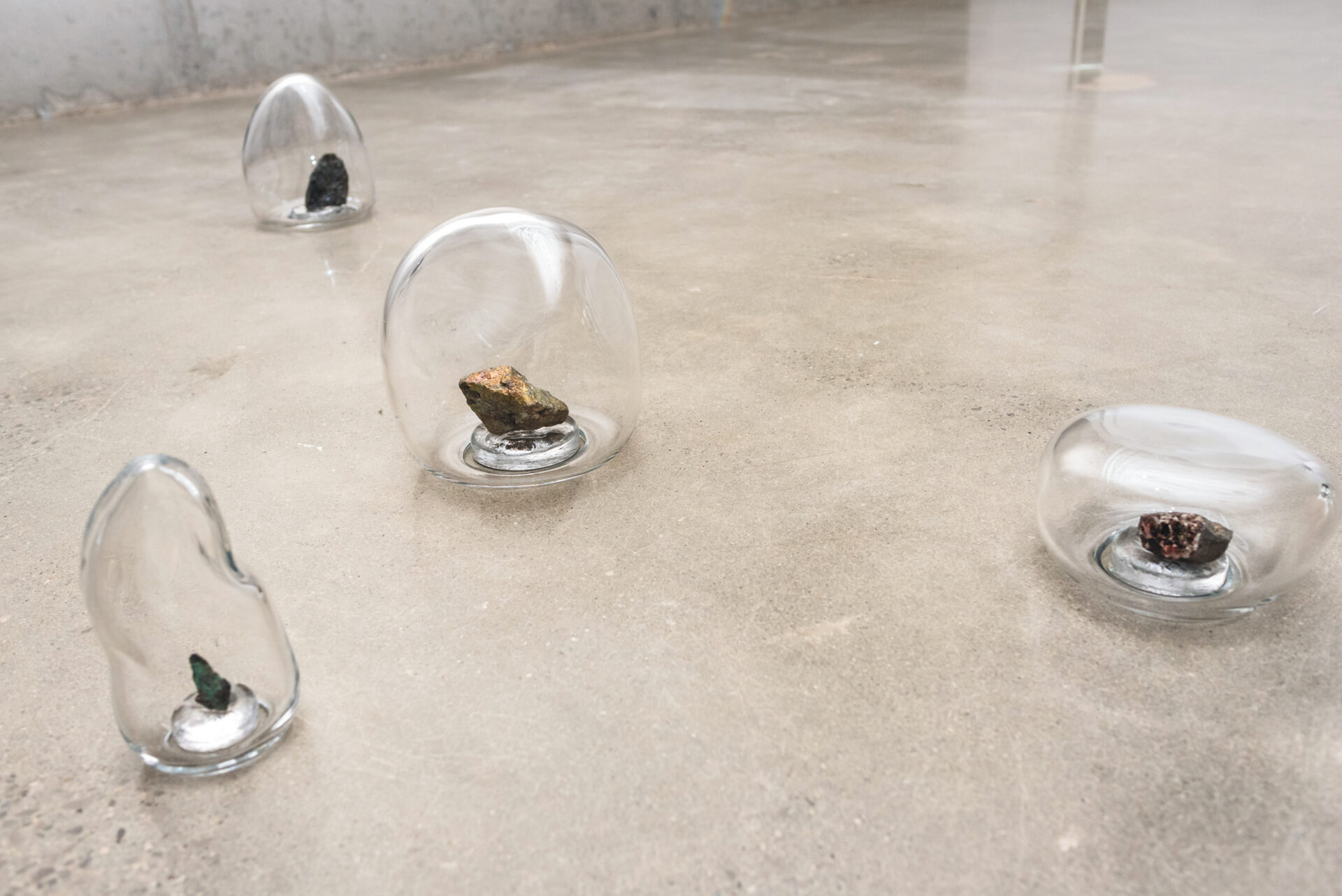
Great Bear Money Rock, 2019-2021, installation view, 5 Lower Jarvis, Toronto, 2022.
Photo: Toni Hafkenscheid & Rebecca Tisdelle-Macias, courtesy of the artists
The sites of the nuclear-industrial complex stretch beyond these examples, particularly in the pursuit of civilian applications as a low-carbon “green energy” alternative to fossil fuels. I’ve driven past the Bruce, Darlington, and Pickering reactors—three of nineteen in my home province of Ontario—countless times. In addition to these sites are those of secondary industry, including isotope production, uranium processing, fuel fabrication, specialized manufacturing and testing, and nuclear waste management and decommissioning. The Port Hope Conversion Facility is the longest-operating facility in Canada; it began with the refinement of uranium from Port Radium in 1932, connecting these two disparate geographies across great distances. The southern Ontario region holds the largest volume of historic low-level radioactive waste in the country, “a result of spillage, leakage and widespread disposal of contaminated fill and other materials.”8 8 - Peter C. Van Wyck, “How Canada Supplied Uranium for the Manhattan Project,” CBC (January 10, 2025), accessible online. But these communities are not alone. Farther north, in the Elliot Lake area, Serpent River First Nation is still feeling the effects of the Noranda Acid Plant, a uranium-processing facility that was operational from 1957 to 1963 yet has continued to contribute to environmental damage and contamination, impacting human and more-than-human lives. This region is still testing for significant levels of radon and gamma radiation far beyond allowable limits.9 9 - For more, see Lianne C. Leddy, Serpent River Resurgence (Toronto: University of Toronto Press, 2022).
I was unaware of the devastation of uranium mining in Elliot Lake until I encountered Bonnie Devine’s installation Phenomenology (2015) shortly after moving to Toronto, as a part of the exhibition Rocks, Stones and Dust at the University of Toronto Justina M. Barnicke Gallery. I was reminded of this work through its thoughtful inclusion in Cody Caetano’s article “Asintelligence: What the Rock Has to Say about Nuclear Anxiety” in Esse (2023). As a member of Serpent River First Nation, Devine has produced work in the context of “Cold War desires for uranium and power, colonial legacies, carcinogenic toxicity and Indigenous resilience” since completing her MFA, which centred these topics, in the late 1990s.10 10 - Zoe Weldon-Yochim, “Mining Matter/s: Bonnie Devine, Anishinaabe Cosmologies, and Uranium Extraction on the Canadian Shield,” Third Text 37.1: 25. accessible online. Phenomenology is composed of a floating glass shelf on which sit a sample of gneiss from the demolished sulphuric-acid plant—responsible for so much harm to Serpent River First Nation land and water—and a sample of uranium ore in a small tin container, the two objects flanked by ninety-two hardwood stakes draped in muslin cloth. Caetano roots his consideration of Devine’s work in Anishinaabe understandings of the world and the interconnected permeability of all beings with “reverence for the seemingly undetectable aspects of being a part of the earth.”11 11 - Cody Caetano, “Asintelligence: What the Rock Has to Say about Nuclear Anxiety,” Esse 108(2023), accessible online.
Revisiting this work by Devine feels especially timely. Even though Caetano’s article is relatively recent, the story of nuclear energy in Ontario and the impact on Indigenous communities has continued to evolve as Canada seeks to scale up its nuclear operations significantly to meet so-called clean energy goals (despite the existing burden of industrial contamination that remains unresolved). In late 2024, the Nuclear Waste Management Organization declared Wabigoon Lake Ojibway Nation and the township of Ignace—250 kilometres northwest of Thunder Bay—as host for Canada’s first deep geological repository. Should it be realized, the ramifications of this infrastructure project will be immense, as highly radioactive waste in the form of millions of nuclear fuel bundles will be transported from dozens of sites across the country. To move all existing waste, it will take approximately forty to fifty years of two to three shipments a day.12 12 - Desmond Brown, “NWMO readies initial project description for proposed nuclear waste disposal site in northwestern Ontario,” CBC (September 22, 2025), accessible online.
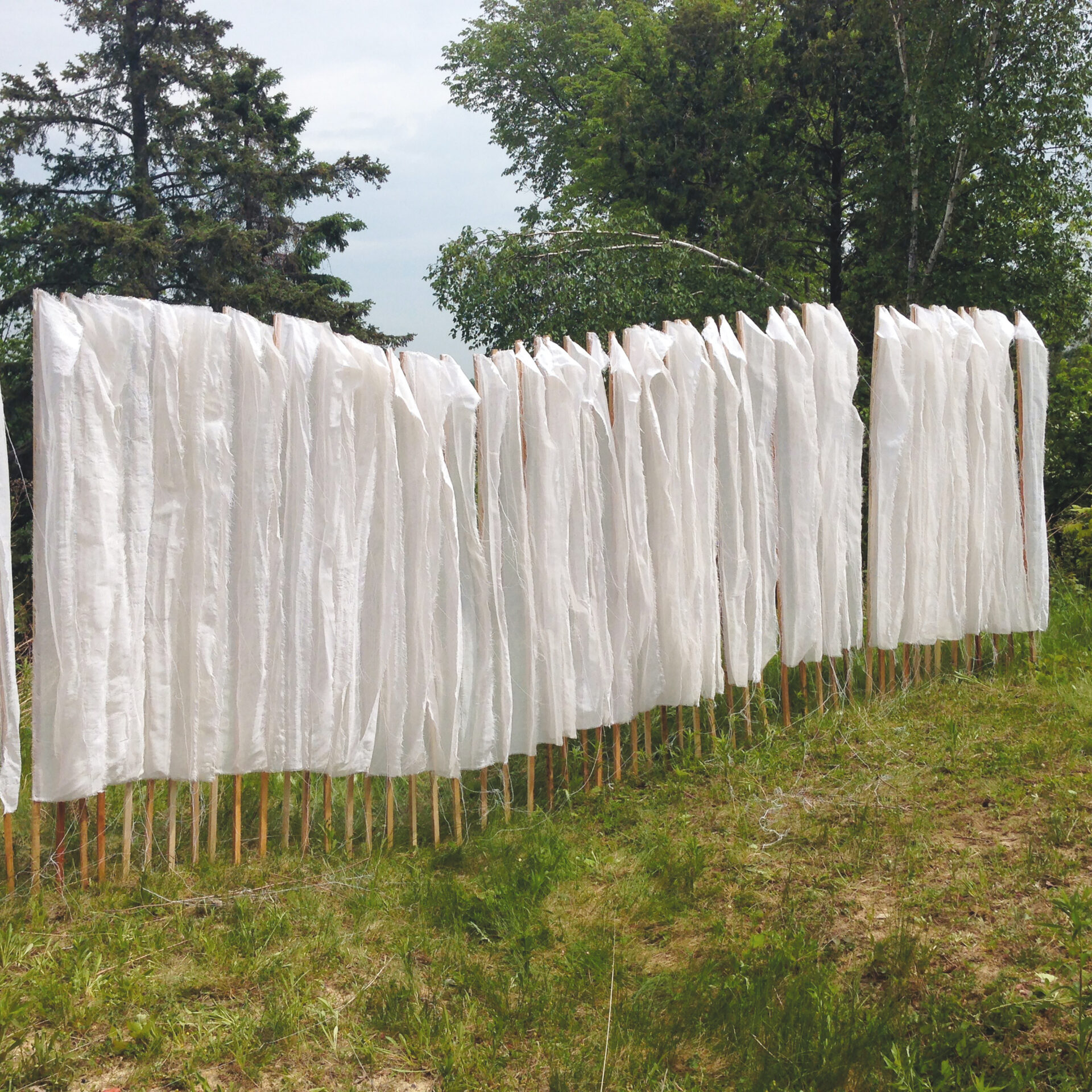
Phenomenology, installation view, McMichael Canadian Art Collection, Vaughan, 2015.
Photo: courtesy of the artist
And so, I come full circle to the kinds of questions I held close during my residency, wondering at the role of the curator, the artist, and the writer in producing a meaningful forum for addressing critical environmental issues. I maintain that, ultimately, artists can make visible the structures, systems, and industries that are so often out of sight, out of mind, particularly in the case of energy regimes in which the human and more-than-human impact is not as visible, as is the case for the nuclear-industrial complex. Curatorial projects are an impactful way of sharing this work with a broader public, although it brings with it the contradictory ways in which exhibitions have a negative environmental impact. This impact can be thoughtfully mitigated but remains unavoidable. Writing, by contrast, forgoes the carbon footprint of a material manifestation, yet similarly relies on resource-intensive technologies. The laptop I write on relies on extractive industries in so-called “sacrifice zones,”13 13 - The phrase “sacrifice zones,” which “originated in the cold war era, when it was used to describe areas rendered uninhabitable by nuclear experiments,” is now understood as places “where residents suffer devastating physical and mental health consequences and human rights violations as a result of living in pollution hotspots and heavily contaminated areas.” David R. Boyd, The Right to a Clean, Healthy and Sustainable Environment: Non-Toxic Environment, report of the Special Rapporteur on human rights and the environment to the United Nations Human Rights Council, 2022, p. 7, accessible online. draws energy that is likely a provincial mix of nuclear and hydroelectricity, and is bound to destructive data centres that support my internet services. There is no singular answer when it comes to sustainability in contemporary art writ large, entangled as we are with systems of extraction, capitalism, and colonialism. But I do believe there is room to consider lowering the environmental impact of the work that artists, curators, and writers do as they continue to make meaningful contributions to this conversation.
Links to the articles cited: Caitlin Chaisson Maude Johnson Blake Fitzpatrick Cody Caetano
Katie Lawson is currently a SSHRC-funded PhD candidate in Art and Visual Culture at Western University, where she works with the Centre for Sustainable Curating. Her research revolves around her longstanding interests in water, waste, geology, environmental justice and justice for people with disabilities, labor, materiality, and modes of feeding. She is a Toronto-based curator and writer. Lawson has organized exhibitions for the Toronto Art Biennial, the Kitchener-Waterloo Art Gallery, Festival Images, the University of Toronto Art Gallery, the Art Gallery of Ontario, and the MacLaren Art Centre. In 2023, Lawson was awarded the Young Curator Residency by the Hnatyshyn Foundation & Fogo Island Arts.


