Pedagogical Entanglements

During my residency in partnership with Art Volt, I approached Esse’s archives looking for different strategies put into play by artists, curators, art critics, and other cultural agents to transform what, where, and how we learn.


Rather than focusing on learning as a theme, my approach aligns with Rita Segato’s notion of pedagogy, which she describes as the “acts and practices that teach, habituate, and program individuals.”1 1  - Rita Segato, Contra-pedagogías de la crueldad (Buenos Aires: Prometeo, 2018), 11 (my translation). I was drawn to authors who initiated conversations regarding how our ways of doing and thinking permeate beyond singular artworks toward the ways we conceive ourselves as artistic communities, shaping our practices, narratives, and institutions. Following Segato, my research is guided by the question “How can we conceive and design counter-pedagogies capable of rescuing a sensibility and interconnectedness that can oppose the pressures of these times and, above all, that allows us to see alternative paths?”2 2  - Ibid., 15 (my translation).
The texts I discuss here give us tools with which to engage in critical practices built on self-knowledge, recognizing that we belong to networks of interdependence and that learning and unlearning go hand in hand. They show us that naming the positions from which we speak allows us to build a collective memory, honour those who came before us, and resist speaking for others. Furthermore, they evidence a drive to generate opportunities for dialogue and encounter that necessarily asks us to consider whom we address through our work. This, in turn, entails a recognition of the other and their voice, a redistribution of power through the possibility of enunciation.
Careful Relations
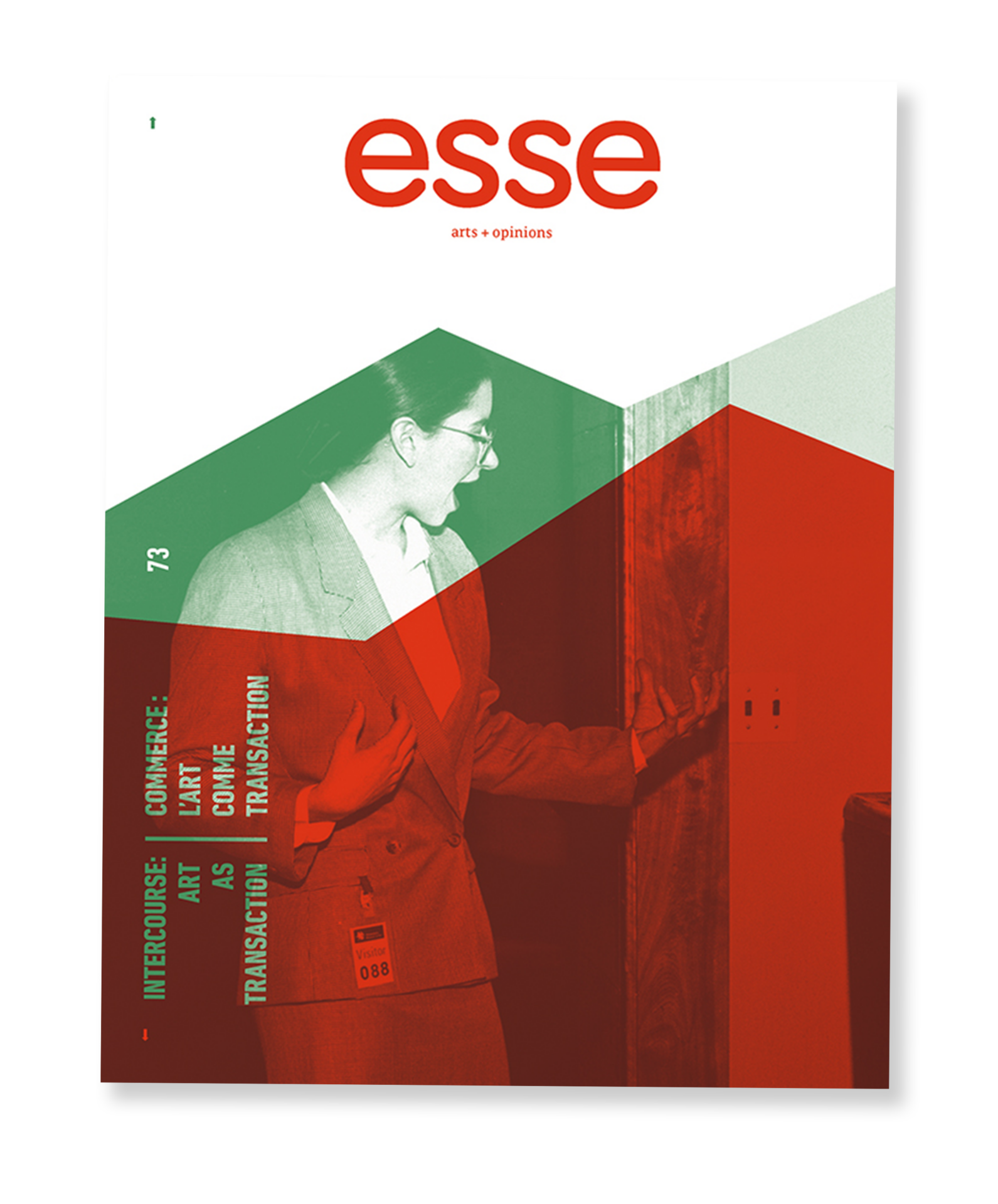
Marie-Josée Lafortune’s article “The Labours of Relational Art” caught my attention in the way she addresses the “disparity between the art world and that of the living”3 3 - Marie-Josée Lafortune, “The Labours of Relational Art,” Esse, No.73, Intercourse: Art as Transaction (Fall 2011). to make a point on the impossibility of detaching the former from the latter. Lafortune takes the hype around Nicolas Bourriaud’s theory of relational aesthetics as an opportunity to exemplify how the local and emergent conditions in which an artwork is produced and exhibited necessarily come into play in what it conveys and how. Alongside this article, throughout Esse’s publications spanning over thirty years, I noticed a significant presence of performance-based practices.
Facing a similar phenomenon in the Latin American context, the Uruguayan artist and thinker Luis Camnitzer analyzed the practices of artists from the 1960s to the 1990s who moved away from the object to focus on interaction and question the authority of the white cube.4 4 - Luis Camnitzer, Didáctica de la liberación. Arte conceptualista latinoamericano (Montevideo: HUM, 2008). Paying close attention to the conditions under which these practices emerged, Camnitzer argues that they cannot be read through the lens of dematerialization generally employed to analyze conceptual art in the Global North and typically describing a search for an artistic essence. Instead, to understand these practices, we need to contextualize them and account for the historical, political, and social dimensions that intersect them. With Camnitzer, I believe not only that the nature of these actions and gestures hints at the aesthetic value of interaction but also that their ephemeral form points toward the relationality of meaning. In other words, art as a ground for the construction of meaning is pervaded by diverse forms of negotiation and resistance.
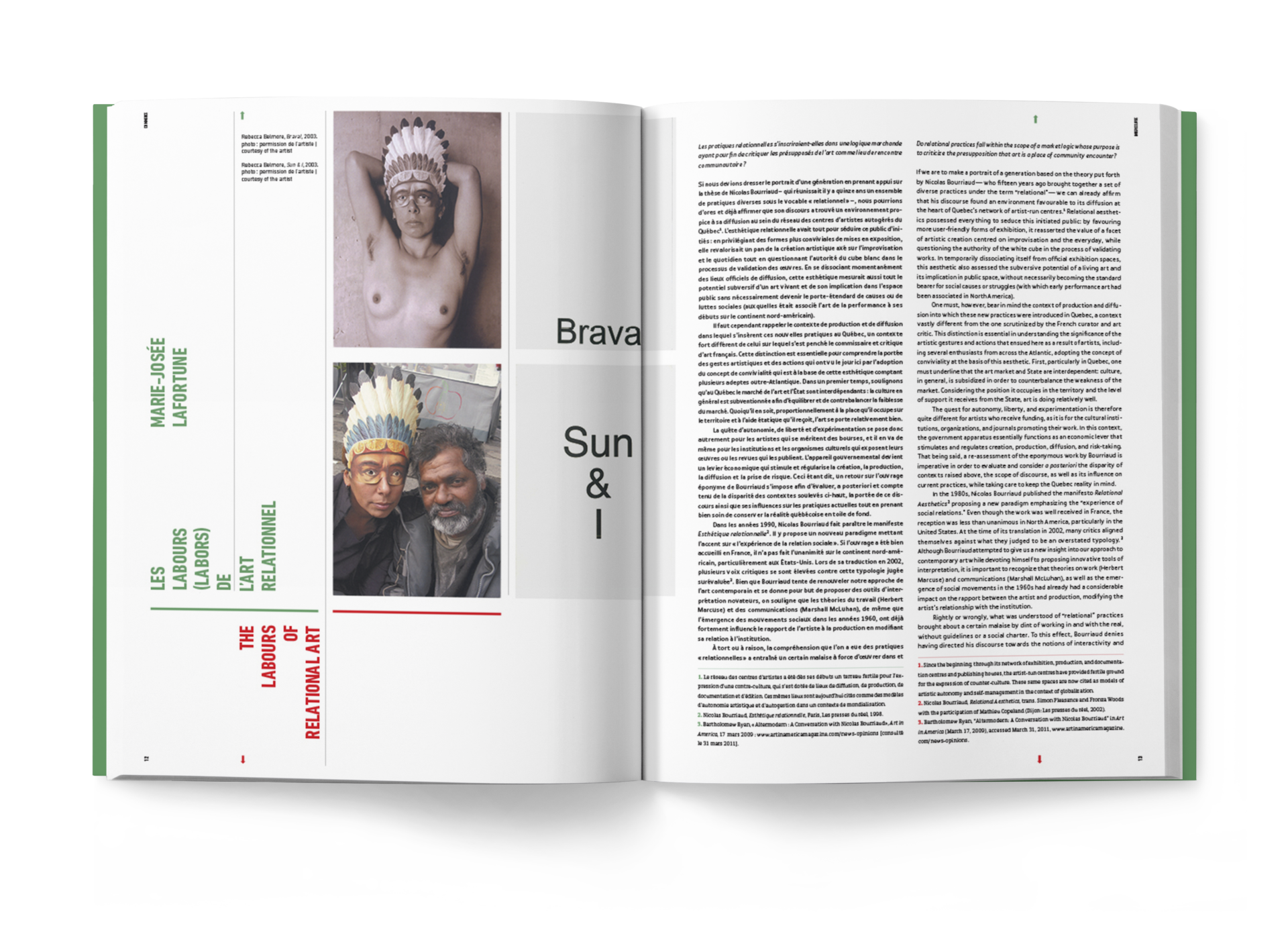
As we learn throughout Lafortune’s article, the sense of relationality that I want to highlight is not the same that motivates Bourriaud. Asserting his work as a “theory of form,”5 5 - Nicolas Bourriaud quoted in Marie-Josée Lafortune, “The Labours of Relational Art,” Esse, No.73, Intercourse: Art as Transaction (Fall 2011). Bourriaud disentangles the interactions set in motion by a relational artwork from its potential ramifications. Nevertheless, in practice, these interactions activate a process of reciprocity in which everyone involved plays a role and that, as such, is never neutral or pure. In contrast, Lafortune offers a perspective situated in the context of Québec, that considers its geography and history for an understanding of the practices that have taken hold here as well as the structures that maintain them, such as the network of artist-run centres and governmental funding. Her essay is both a word of caution about a system that aspires to and perpetuates specific values and power structures regardless of the discourses it purports to defend and an argument for careful relations built on the willingness to be affected by the reflections we put forward as artistic communities.
Space as Pedagogy/Counter-pedagogies of Space
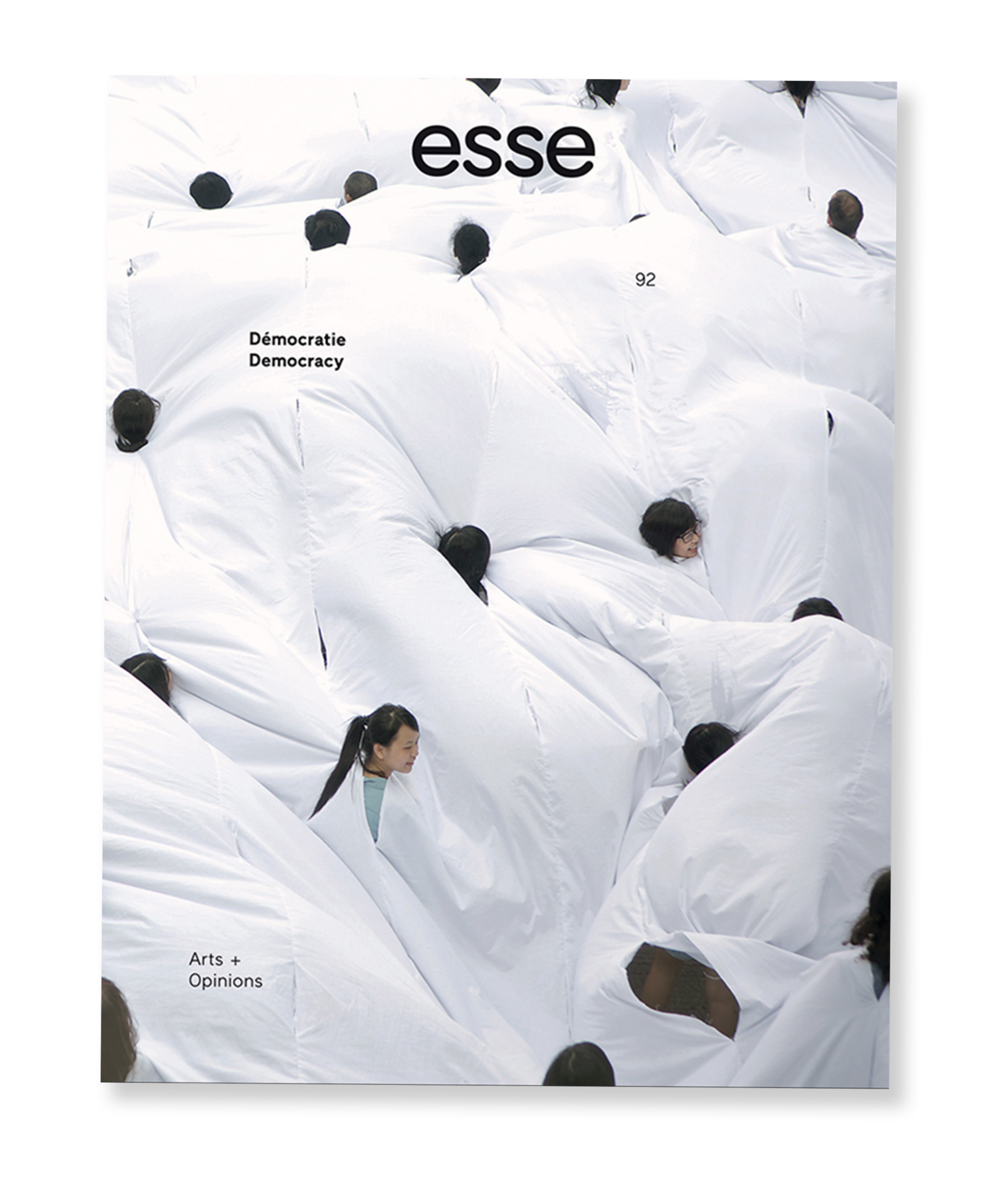
In “(Re)Negotiating Every. Now. Then’s Invisible Centre: Institutional White Spatiality,” Justine Kohleal reminds us that although including the presence and perspectives of BIPOC and LGBTQ2S+ people is essential to reorienting institutions toward non-white models, it is not as simple as that. Tackling the politics of visibility and invisibility that infiltrate exhibition spaces, Kohleal elaborates on the intricate ways in which whiteness willingly goes unperceived in art institutions, as it is positioned as a neutral centre in relation to which “others appear only as deviants or lines of deviation.”6 6 - Sara Ahmed quoted in Justine Kohleal, “(Re)Negotiating Every. Now. Then’s Invisible Centre: Institutional White Spatiality,” Esse, No. 92, Democracy (Winter 2018). At the same time, she follows the thread of these deviant lines to shed light on potential counter-pedagogical strategies. For Kohleal, (re)negotiating an institution’s invisible centre is as much about making power structures visible as it is about decentring power by creating possibilities for exchange beyond the institution’s walls.
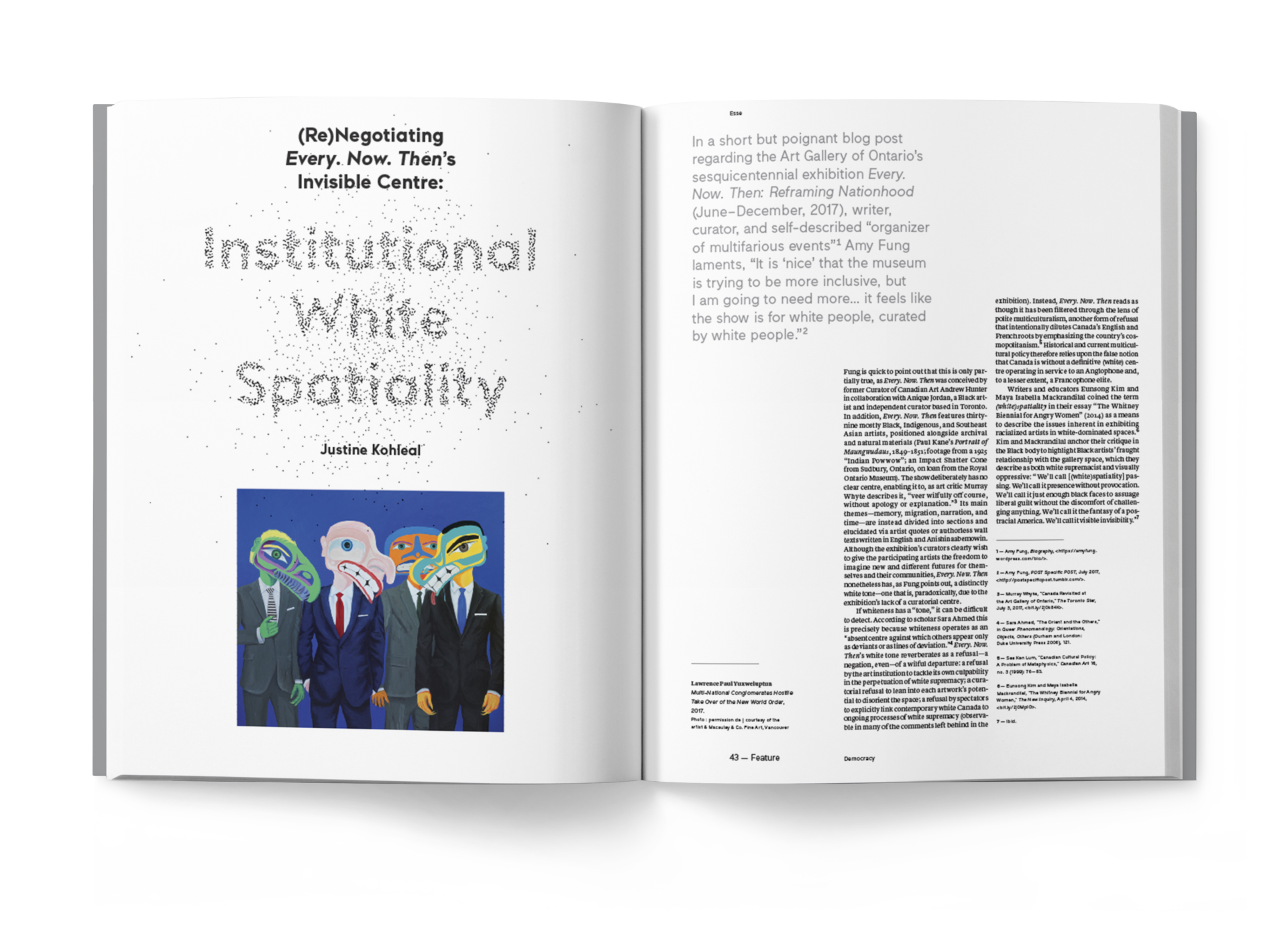
Reorientation, deviation, and (re)negotiation are key terms used by Kohleal to illustrate the resistance put forth through the off-site programming that took place in parallel to the exhibition at the Art Gallery of Ontario. The Public: Land and Body presented a series of performances, panel discussions, and video installations at Y+ Contemporary in Scarborough and Black Creek Community Farm in North York. More than extending the limits of the museum, the decision to carry out programming in other spaces transforms the institutional space as much as our relationship with it. Such a project entails a redistribution of resources that visibilizes sites of knowledge production beyond large art institutions and city centres, bringing forth diverse perspectives and centring different communities’ interests and needs.
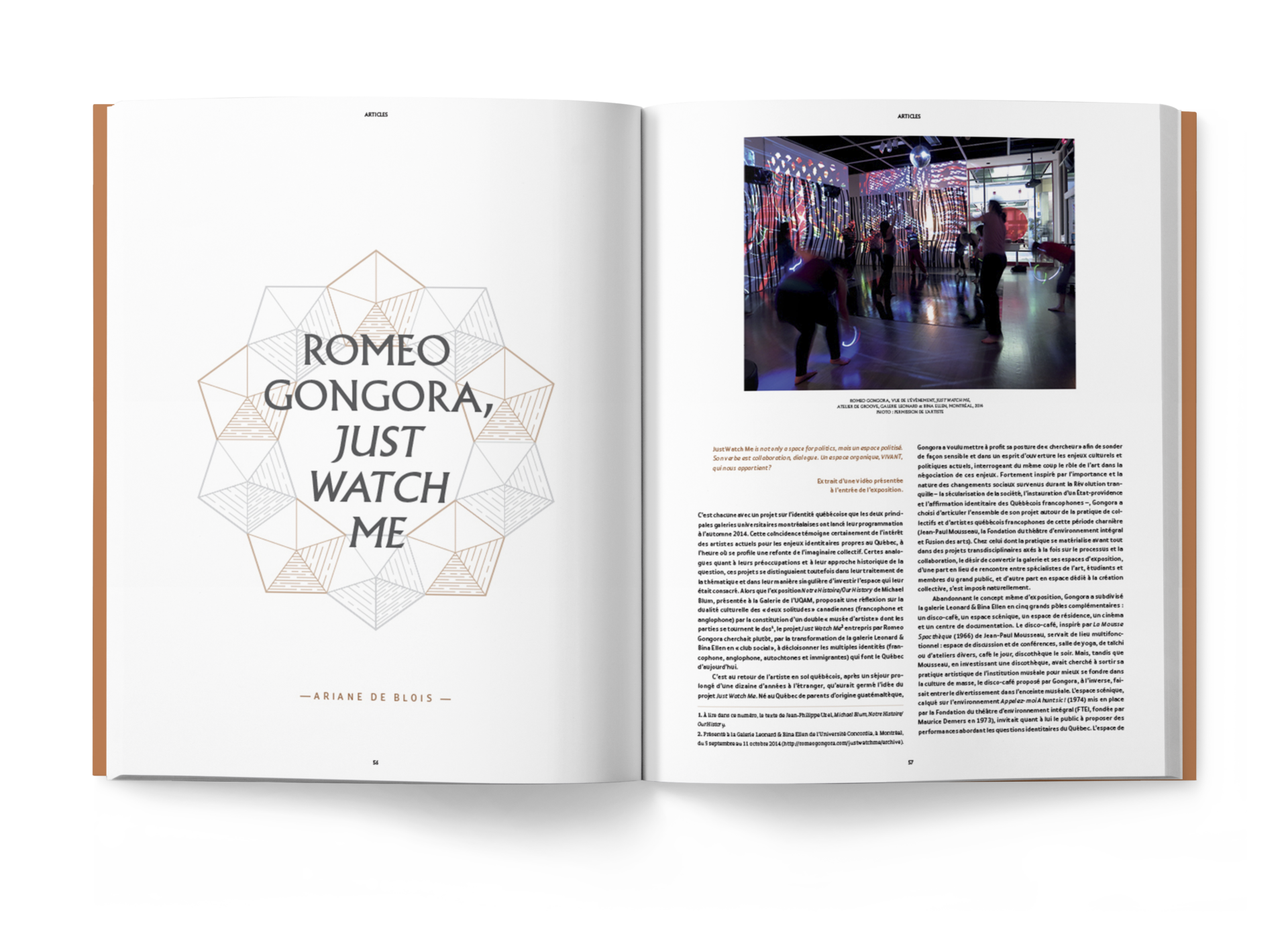
As documented in Ariane De Blois’s review, Romeo Gongora’s exhibition Just Watch Me set in motion a real-time exploration of how spaces dictate possible relationships, delineate the contours of power structures, and set up the conditions for dialogue.7 7 - Ariane De Blois, “Romeo Gongora: Just Watch Me,” Esse, No. 83, Religions (Winter 2015). Decompartmentalizing disciplines, eras, activities, and identities, Gongora transformed the Leonard & Bina Ellen Gallery into a multipurpose space, giving way to diverse forms of social engagement and highlighting the political dimension of gathering. Re-enactments and reinterpretations of works created by artist collectives during the Quiet Revolution took form through a mash-up of political, historical, and art references and the participation of close to a hundred collaborators. The exhibition showed the power of presence, visibility, and encounter to establish a nuanced approach to collective identities that takes into account the multiple and intersecting experiences that shape us as individuals and communities. Gongora emphasizes that in Québec, this necessarily means considering a complexity that goes beyond the anglophone-francophone binary, and in the arts, it includes challenging hierarchies behind roles such as artist, curator, and spectator and questioning a linear and homogeneous progression of history.
Partial Perspectives
Learning with these writers, I can say that the alternative to invisibility as a mechanism of power going unchecked is grounding practices. In Edith Brunette’s “No One Gives a F**k About a Cop and Fredy: Conveying the Voices of the Collectivity,” we grasp the vital difference between assuming a perspective that is immune to the conditions surrounding it and one that is affected by them.8 8 - Edith Brunette, “No One Gives a F**k About a Cop and Fredy: Conveying the Voices of the Collectivity,” Esse, No.104, Collectives (Winter 2022). Brunette’s approach resonates with Donna Haraway’s thesis on situated knowledges. Haraway addresses how the idea of objectivity has been used as a tool for oppression and explains that objectivity and relativism (not to be confused with relationality) hold a perspective from “everywhere and [so] nowhere.”9 9 - Donna Haraway, “Situated Knowledges: The Science Question in Feminism and the Privilege of Partial Perspective,” Feminist Studies 14, No. 3 (Autumn 1988): 584. She argues that the relativist claim of equal perspectives “den[ies] the stakes in location, embodiment, and partial perspective.”10 10 - Ibid. On the other hand, a perspective that is rooted and embodied will always be partial, but it is thanks to this that it can be accountable.
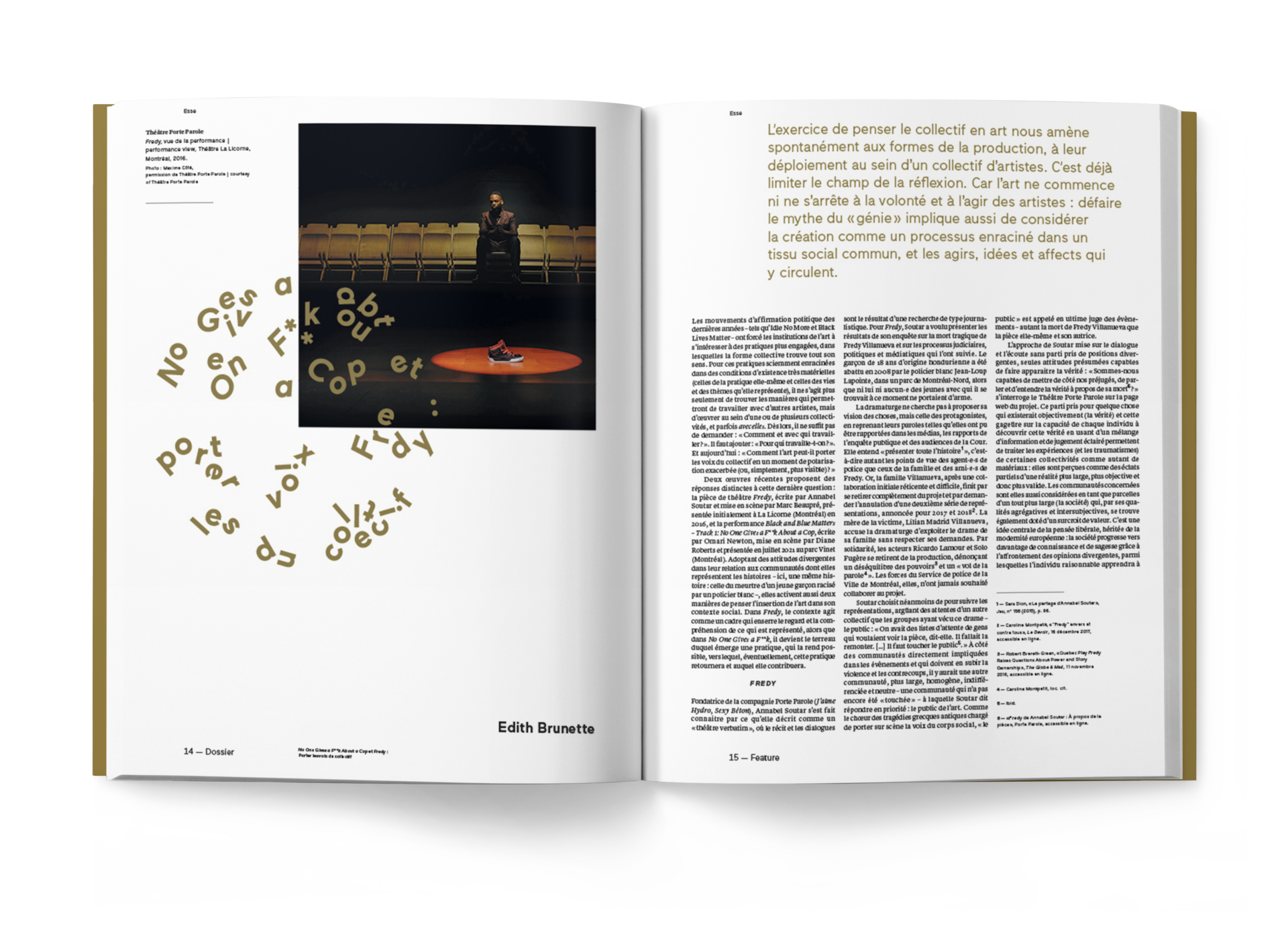
When institutions or artists aspire to present a neutral perspective, they invisibilize the structures that put in place a series of inequalities and oppressions, as well as the bodies these marginalize. Invisibility is not a form of rearticulating possibilities for existence; on the contrary, as Brunette warns us, “neutrality… goes hand in hand with erasure and death.” Reading Kohleal’s article in 2024, the cautious optimism she expresses about the then-recent appointment of Wanda Nanibush as Curator of Indigenous Art at the AGO seems premonitory.11 11 - In November 2023, Wanda Nanibush suddenly departed from the AGO. Much discussion has surrounded this event, and a public petition from the Indigenous Curatorial Collective was submitted to the AGO Board of trustees to “let Wanda speak.” See docs.google.com/forms/d/170FdBydxF7CIRpW7HhhWAOJNelaxXl1dhiKgUwwr5A8/viewform?pli=1&pli=1&edit_requested=true. Pointing out the impossibility of neutrality, Kohleal pleads for a “radical institutional transparency” that is long overdue. Welcoming diverse bodies into art spaces requires, as Kohleal well expresses it, embracing discomfort as a generative experience, a feeling that ensues from betraying a “polite multiculturalism” and calling out whiteness when we see it.12 12 - Kohleal, “(Re)Negotiating Every. Now. Then’s Invisible Centre.” It means recognizing the possibility that a diversity of narratives may coexist and responsibly assuming that the resulting contradictions are direct consequences of the pedagogies of colonialism, racism, extractivism, and patriarchy, which created the conditions in which we live.
It means recognizing the possibility that a diversity of narratives may coexist and responsibly assuming that the resulting contradictions are direct consequences of the pedagogies of colonialism, racism, extractivism, and patriarchy, which created the conditions in which we live.
As Brunette reminds us, objectivity, universality, and neutrality are qualities often associated with the notion of truth. The exhibition The Translation is Approximate by Zinnia Naqvi, reviewed by Dominique Sirois-Rouleau, is an example of how we can debunk the myth that truth is a homogeneous, clear, and precise discourse in which all voices participate equally.13 13 - Dominique Sirois-Rouleau, “Zinnia Naqvi the Translation is Approximate,” Esse, No.104, Collectives (Winter 2022). Naqvi reconstructs narratives around immigration with a sensibility that can be shared by many “othered” identities, rooted in multiplicity and thus ambivalent and contradictory. She draws indiscriminately from documents, memories, and family stories, revealing a perspective that is, as Sirois-Rouleau puts it, “neither perfectly near nor completely far.” The different worlds in which Naqvi is situated and that intersect in her, including Canada and Pakistan, represent different facets of the same story. Furthermore, her works evidence that truth is constantly suffused with affects such as nostalgia, intuition, and the imaginary.
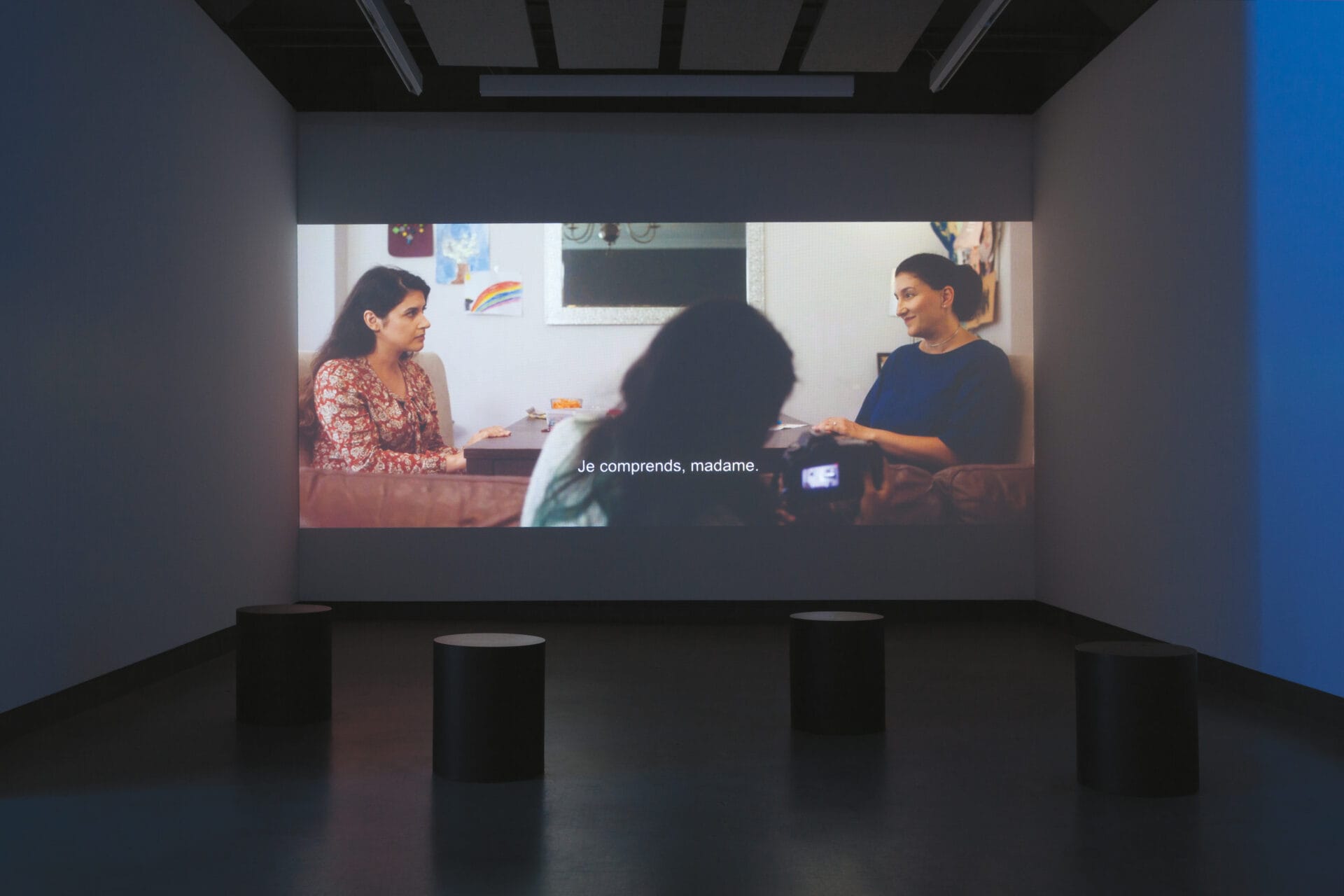
the Translation is Approximate, exhibition views, Dazibao, Montréal, 2021.
Photos: Marilou Crispin
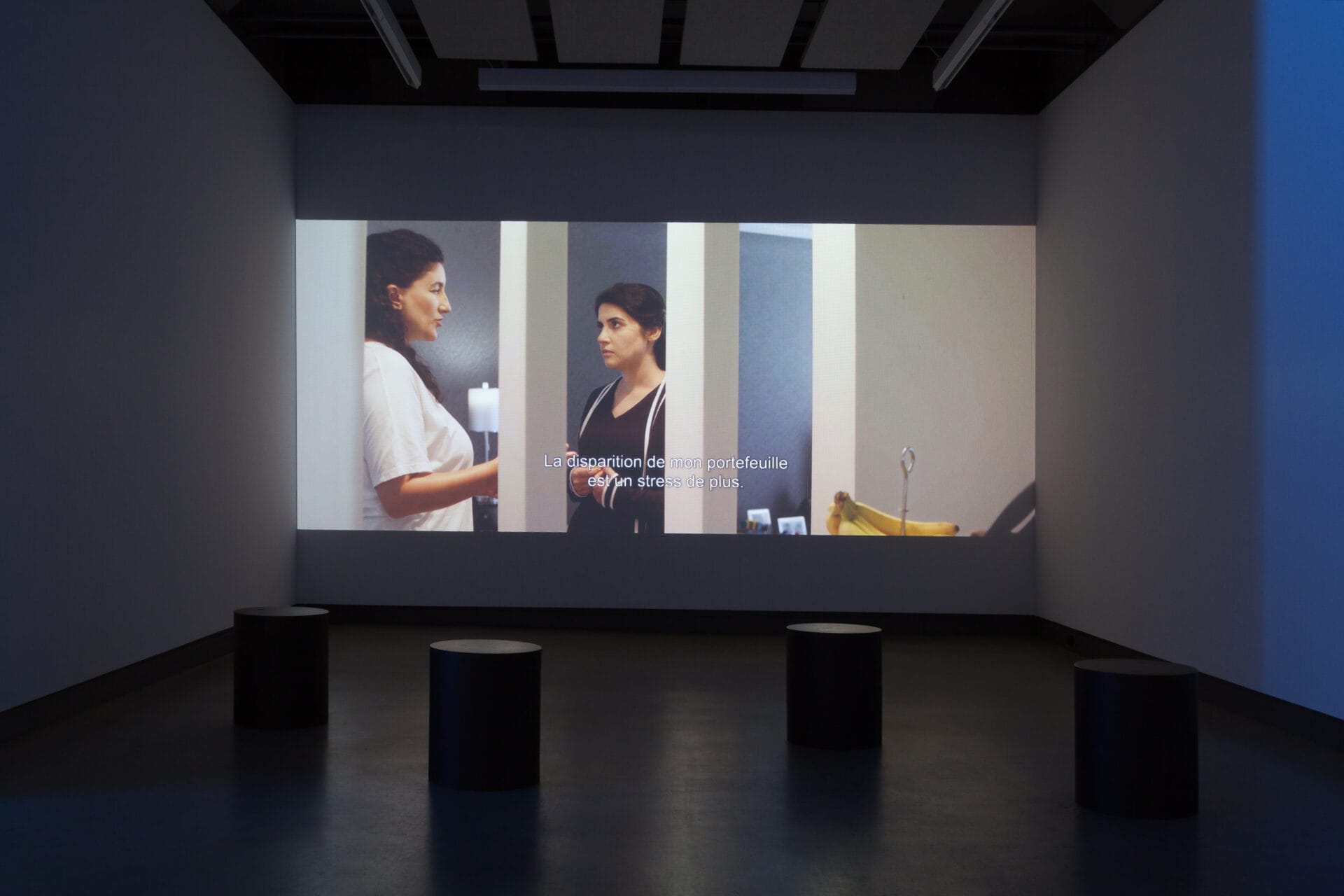
Like Haraway, Naqvi celebrates partial perspectives because they reflect the multidimensionality of subjectivity and “sustai[n] the possibility of webs of connections called solidarity in politics and shared conversations in epistemology.’14 14 - Haraway, “Situated Knowledges,” 584. The dissolution of factuality that Sirois-Rouleau alludes to is not an erasure but a strategy for bringing together and emphasizing the intricacy of experience. Gongora also explores memory, hinting at the non-linearity between past and present and the simultaneous nature of historical and contemporary events that suggest that the past continues to inform and shape the present.
As an exhibition that unfolds through re-enactments, Just Watch Me breaks apart the correlation between contemporary art and novelty to introduce a sense of temporal simultaneity that visibilizes knowledge as a co-construction. It exposes how the imaginaries of collectivities are built through re-appropriations and that owning the past, the present, and the future of the communities we are part of is essential to building a critical perspective and for transformation alike.
De Blois explains that Gongora’s project takes its title from Pierre Elliott Trudeau, who, when questioned on how far he would go in suspending civil liberties to maintain order, replied, “Well, just watch me.” Despite the separation in time and space, Gongora challenges Trudeau’s audacity, distilling the ideas presented here about transforming the structures that inform our practices and discourses by creating spaces to come together, building careful relations, and asserting ourselves as part of collective identities. By appropriating Trudeau’s words, his actions say: just watch me occupy this space, turn it around, mix it up; just watch what happens.
Links to the articles cited:
Marie-Josée Lafortune Justine Kohleal Ariane De Blois Edith Brunette Dominique Sirois-Rouleau
A Mexican cultural worker and artist-educator based in Montréal, Marcela Borquez centres her work around collective engagement and questions surrounding identity and belonging. She has coordinated public programs in collaboration with museums, libraries, and community centres. As part of the collective Cuerpo Estratégico, she explores the format of the workshop as an art practice and the performative corporeal dimensions of learning. She is an active collaborator in the artist network Red de Pedagogías Empáticas and co-founder of Avalokita, a non-profit organization dedicated to disseminating resources for the arts.


