Faire Secret / Keep the Secret

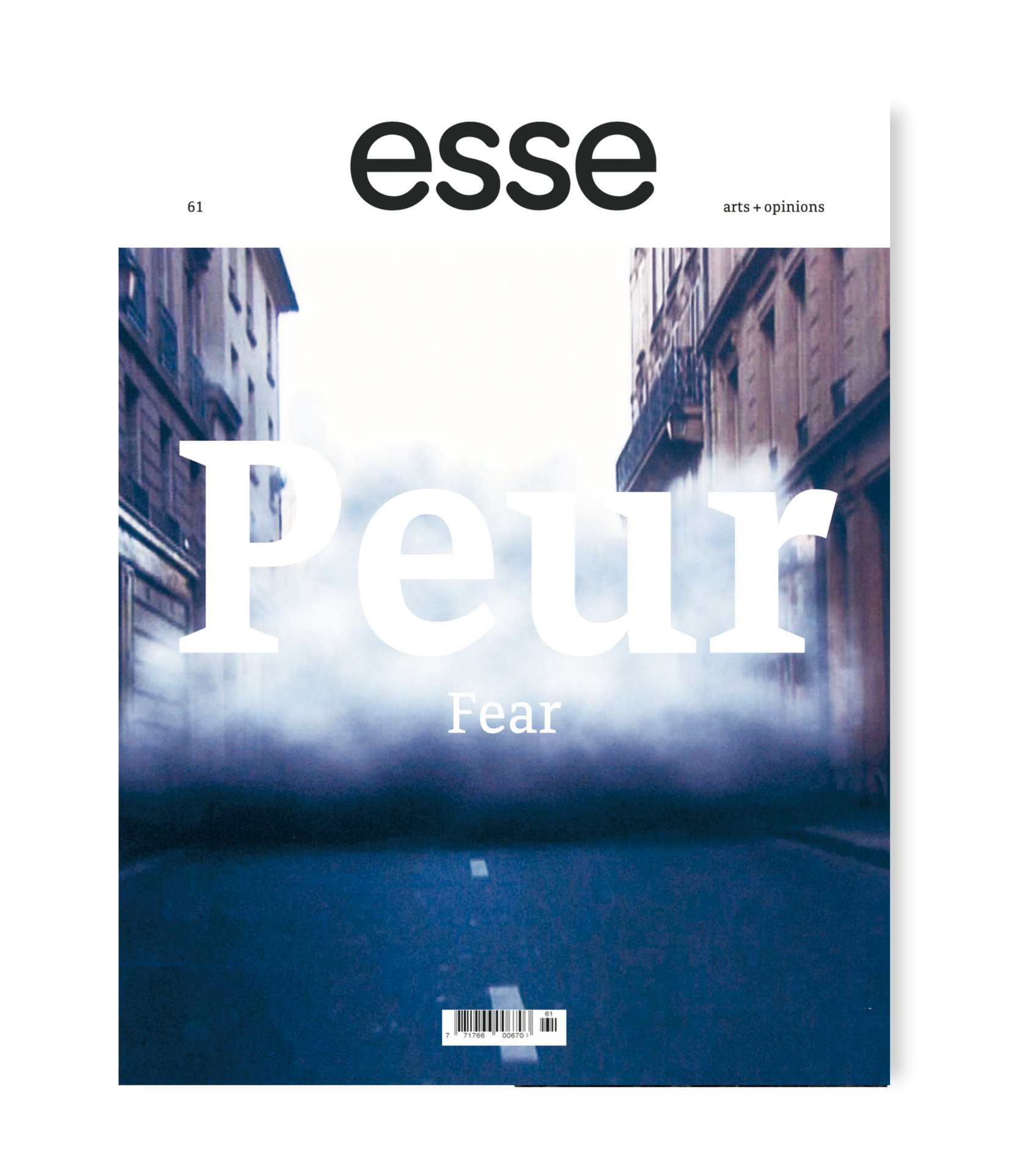
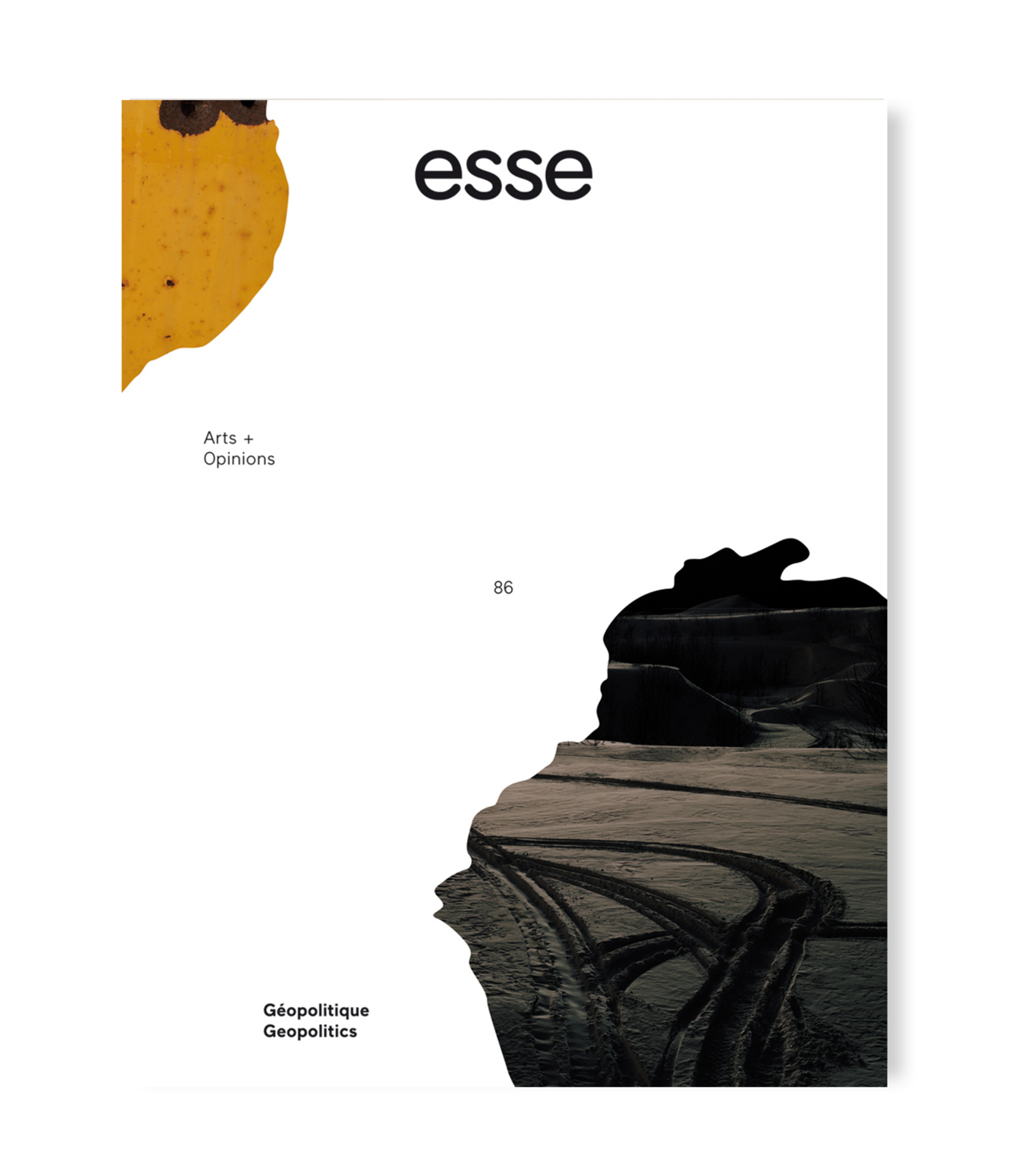
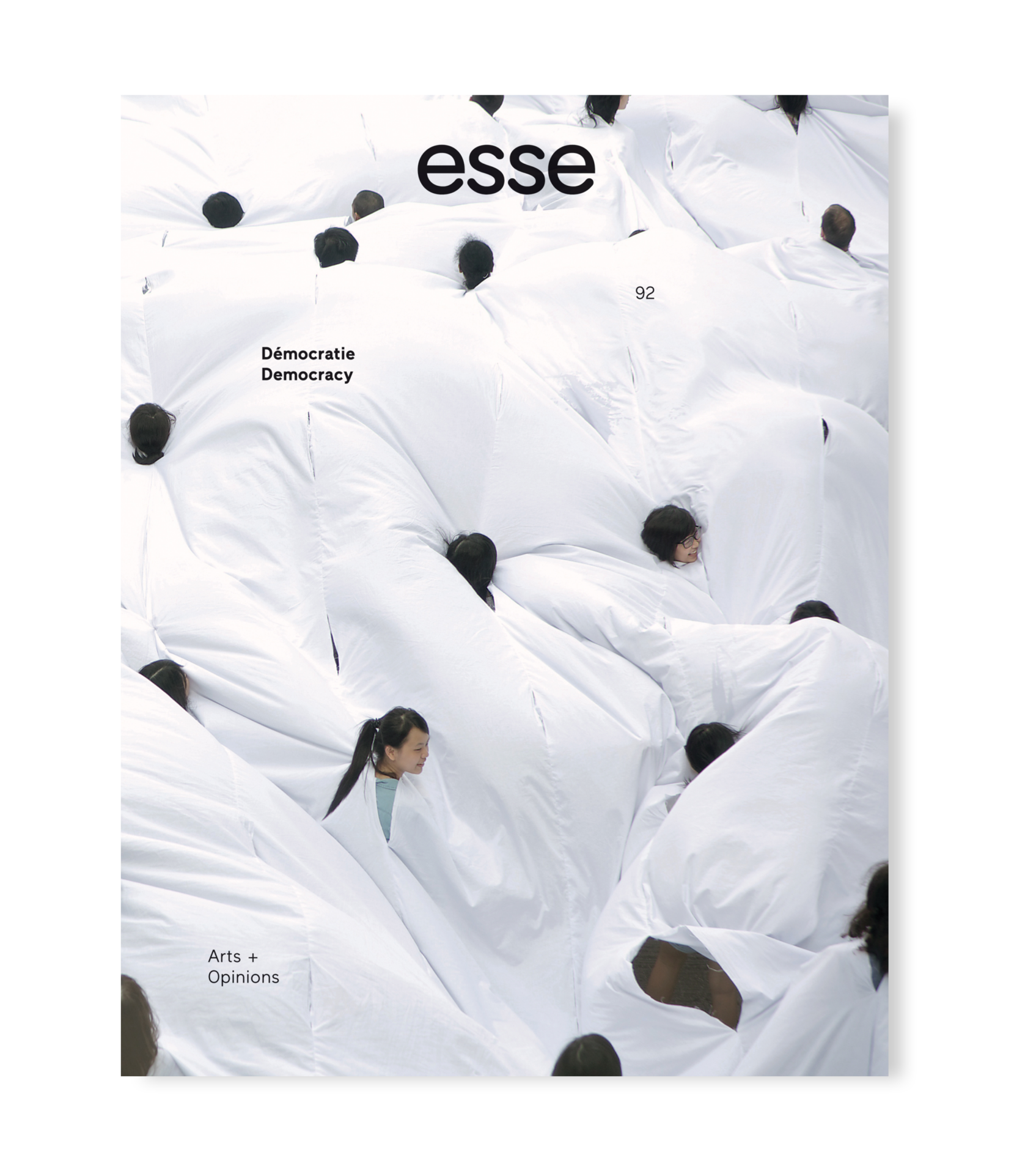
In my digital residency, I consider the theme of the secret across Esse’s archive. From hushed stories and subterranean noises through conspiracy theories and the covert operations of the surveillance state, I question the hidden registers of silence and opacity that animate contemporary art and democratic politics. How does secrecy shape the political? How have artists intervened in state secrecy and data surveillance? Conversely, how do artists appropriate the secret? Secrets tend to multiply, so I need to limit myself to just a few essays—from issues 61, Fear; 86, Geopolitics; 92, Democracy; and 95, Empathy—to draw attention to relations of power that structure the secret.
In what way does the secret underwrite the conceptual organization of the archive? As I trace the thread of the secret circulating beneath the themes that explicitly organize Esse’s archive, I am aware of its slipperiness: the secret pulls in its wake the problems of the unconscious. It slides between words unseen, exerting a disruptive force on the archive’s categorization. Importantly, the secret presents a paradox: when it does appear, it destroys itself. It loses its identity as a secret as soon as it is revealed. But let’s not get ahead of ourselves.
Let’s begin with a provisional definition. The secret is usually understood in opposition to what is exposed. It is related to lying and deception—it is what is concealed or hidden. Secrets are duplicitous. By hiding the truth, we perjure ourselves. We may do so with good reason, but ultimately, keeping a secret is a form of betrayal. This is how the common understanding of the secret usually goes. I know something—and I withhold this knowledge intentionally, deliberately. Can attention to the secret history of the secret in the Esse archive help us to reimagine secrecy otherwise?
Conspiracies
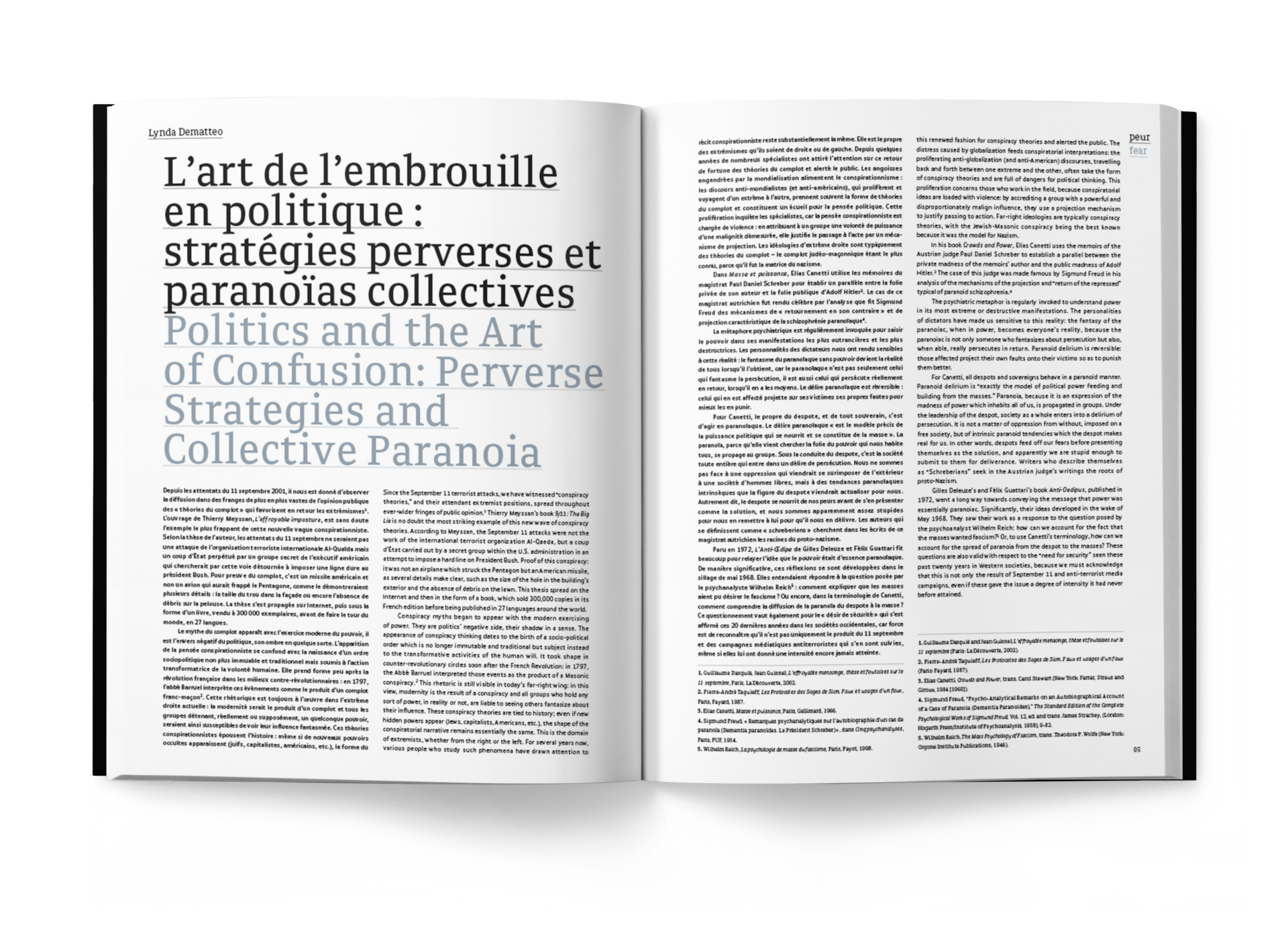
In “Politics and the Art of Confusion: Perverse Strategies and Collective Paranoia” (61, Fear), Lynda Dematteo examines the post-9/11 rise of conspiracy theories. Her essay has lost none of its urgency today in the wake of populist, far-right turns in the US and Europe. Her archaeology of conspiracy theories leads from the counter-revolutionary circles that emerged after the French Revolution, from the Illuminati and Freemasons, to Area 51, QAnon, and the deep state of contemporary alt-right politics. To explain the uptick in new forms of fascism and conspiratorial narratives, Dematteo turns to Elias Canetti’s anthropology of crowds and Richard Hofstadter’s account of paranoia as a pathology suffered by those marginalized by postwar American liberal consensus. She describes how paranoia slips from despotic leaders (who spread conspiracy theories to deflect attention from the conspiracies they are committing) to infect collectivities.
There are (at least) two discourses of the secret at work in Dematteo’s essay, one more explicit than the other. On the one hand, there is the conspiratorial secret that she explicitly tracks—the one that spreads affective dissonance. Conspiracy needs secrecy to spread. But the conspiracy is never completely hidden: its clues proliferate. One speculates on what is hidden to uncover the secret treachery of public power. It takes those who know—or think they know—about alleged conspiracies to recognize the signs of the covert orchestration of world events.
Conspiracy theories are difficult to refute because they invest in an interpretive method of reading that destabilizes a strict dichotomy between the visible and the concealed.
On the other hand, there is an artist’s secret that gnaws at the conscience until it is confessed. Dematteo’s text is interlaced with images from 99 Fears (2007), a series of ink drawings by the Bulgarian artist Nedko Solakov. The images silently punctuate her striking analysis of how paranoia is collectivized. Dematteo does not speak to the images, which were presented the same year at documenta 12. Solokov’s images were added to the text—as a supplement—by Esse’s editorial (a secret history that is not documented in the publication itself, and which only came to my attention retrospectively). Does this addition from the outside supply something that is missing? What modes of reading does it solicit? Indeed, relations emerge between image and text by indirection. The juxtaposition ignites a practice of double—even paranoid—reading that invites us to construct hermeneutic links between Solakov’s fears—of magicians, democracy, clandestine state killings, of flying and the future—and the inner workings of despotic power. Do the drawings exemplify the paranoiac style that moves through contemporary art as much as politics to infiltrate collective desire?1 1 - For an account of the aesthetic and intellectual affinities between art and conspiracy, see Larne Abse Gogarty, What We Do Is Secret: Contemporary Art and the Antinomies of Conspiracy (Berlin: Sternberg Press, 2023).
Perhaps.
But the dark legacy of Bulgaria’s secret police is no conspiracy theory. Solakov is afraid of the secret service. And he should be—he collaborated with them. During the Cold War, the Soviet satellite operated a vast network of informants. Solakov collected intelligence about fellow artists in Sofia for the Bulgarian State Security, which ran a campaign that would crush the possibility of dissident art, while conducting abductions, sabotage, and assassinations.2 2 - Christopher Nehring, “Active and Sharp Measures: Cooperation between the Soviet KGB and Bulgarian State Security,” Journal of Cold War Studies 21, no. 23 (4) (Fall 2021): 3–33, https://doi.org/10.1162/jcws_a_01038. Solakov’s drawings harbour the open secret of this collaboration. His work, Top Secret (1989-90, also presented at documenta 12, is an index-file that contains notes, drawings and small objects that reconstruct the story of the artist’s collaboration between 1976 and 1983.
It is not simply that the images illustrate the conspiratorial paranoia that Dematteo analyses. Rather, they do something more nuanced and complicated: the supplementary images throw us into a “paranoid reading,” as diagnosed by Eve Kosofsky Sedgwick in her seminal contribution to queer theory, Touching Feeling: Affect, Pedagogy, Performativity. And if this makes us into suspicious readers that seek to unlock secrets, if it demonstrates how paranoia spreads, this mode of reading is not simply pathological. Rather, for Sedgwick, paranoid reading is the critical precursor to reparative reading that can shift political conditions. Indeed, for Solakov who publicly confessed his secret collusion with the Bulgarian State Security, paranoia shifts towards the possibility of new forms of organizing the political.
Demo(n)cracies
What is the relationship between the state and the secret? Although secrecy flourishes under conspiracy, it is by no means exclusive to totalitarian regimes. Emily Rosamond explores the role of secrecy in democracy. In “The Surveillance Economy: Toward a Geopolitics of Personalization” (86, Geopolitics), she asks how artists intervened in state secrecy following Edward Snowden’s revelations about the massive scale of the National Security Agency’s data-surveillance operations. Snowden’s leaks epitomize the liberal ideal of holding power accountable that can be traced to Jeremy Bentham’s calls for open press and government in his 1791 treatise Political Tactics.3 3 - Jeremy Bentham, Political Tactics (Oxford: Oxford University Press, 1999). Secrets, according to Bentham, are opposed to transparency, whereas democracy is allied with it. Transparency lives on the side of progress: it fosters accountability and prevents corruption, while the secret is aligned with repression, securitization, and abuse of power. To what extent is our concept of the political bound up with this limited understanding of the secret?
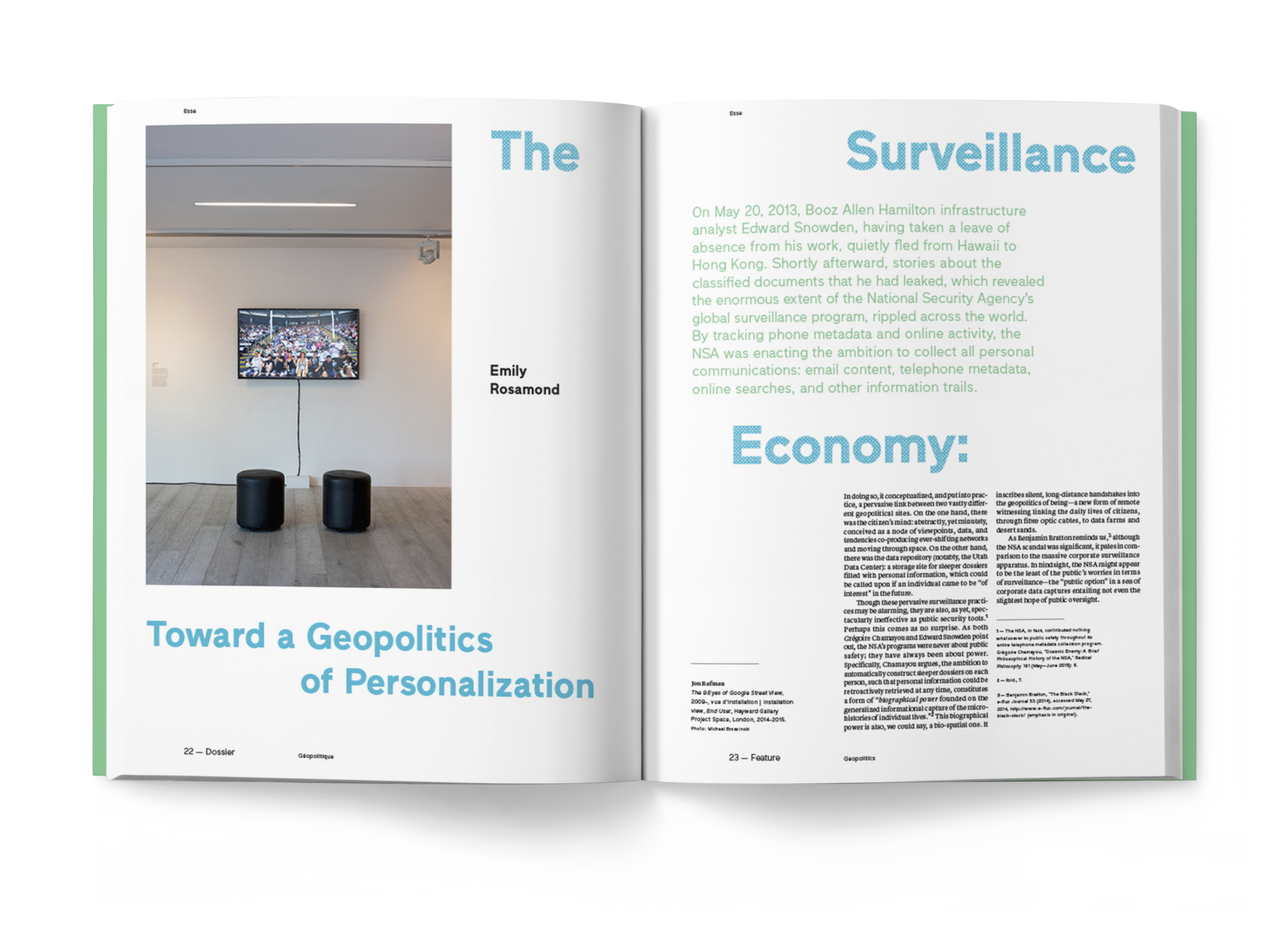
Rosamond complicates the conventional opposition between transparency and secrecy in democratic societies. Examining how secrecy is systematized and technologized, she measures the abuses of secrecy against democracy’s imperatives for transparency. What she calls “the geopolitics of personalization” links two distinct sites: (1) the internal space of “the citizen’s mind,” exposed in its intimate depths to an ever-shifting network of data, and (2) the physical infrastructures that transport, archive, and instrumentalize information: government and corporate data repositories, bunkers, and deep-sea cables that span the ocean floors. “What are the implications of a geopolitics of personalization for art practices?” she asks.
Liz Sterry’s Kay’s Blog (2011) and Jon Rafman’s The 9 Eyes of Google Street View (2009–ongoing) offer a response to this question. Sterry’s installation re-creates the intimate space of a blogger’s bedroom inside the gallery, and Rafman’s screen captures extracted from the continuum of Google Street View reveal anomalous events that resist the flattening of a transparent world of information. Snowden’s revelations prompted both artists to critically intervene in surveillance apparatuses that enact and optimize secrecy in democratic societies. But government control is nothing, argues the political economist Shoshana Zuboff, compared to what Silicon Valley is up to. In her 2018 book The Age of Surveillance Capitalism, she describes a new logic of capitalist accumulation that profits from the capture and instrumentation of private human experience.4 4 - Shoshana Zuboff, The Age of Surveillance Capitalism: The Fight for a Human Future at the New Frontier of Power (London: Profile Books, 2019). In her essay for The New York Times titled “You Are the Object of a Secret Extractive Operation,” she describes surveillance capitalism as “an economic system built on the secret extraction and manipulation of human data” that destroys privacy and weakens liberal democracies.”5 5 - Shoshana Zuboff, “You Are the Object of a Secret Extraction Operation,” The New York Times, November 12, 2021. We—neoliberal subjects—willingly share our lived experiences with tech corporations on social media platforms.
Our experiences are translated into proprietary data points used by AI to predict and shape human behaviour and to guide targeted algorithms that are engineered to capture our attention. As in the totalitarian state, under surveillance capitalism, no one is allowed secrets.
Claudia Mesch does not explicitly engage the theme of the secret in “Probing the Body Politic: Limits, Memory, and Anxiety in Art after Democracy Can no Longer be Assumed” (92, Democracy), but she performatively demonstrates how secrecy shapes the political. Her review of documenta 14: Learning from Athens (2017) calls for an art of empathetic witnessing of democracy’s violent underside of expulsions. She asks if art can serve as a “mechanism through which democracy can be forcefully reasserted” against the backdrop of rising populisms in the Brexit/Trump era. She traces documenta’s preoccupation with democracy to its institutional origins as a US-backed “denazification and public education project” that aimed to return postwar West Germany to the path of democratic capitalism. With the 2017 edition, which unfolded simultaneously in Kassel and Athens, this relationship between art and democracy became the explicit central curatorial theme. Artworks engaged democracy’s origin in the ancient Greek nation-state, while demanding that viewers critically interrogate their lived experience of belonging—and unbelonging.
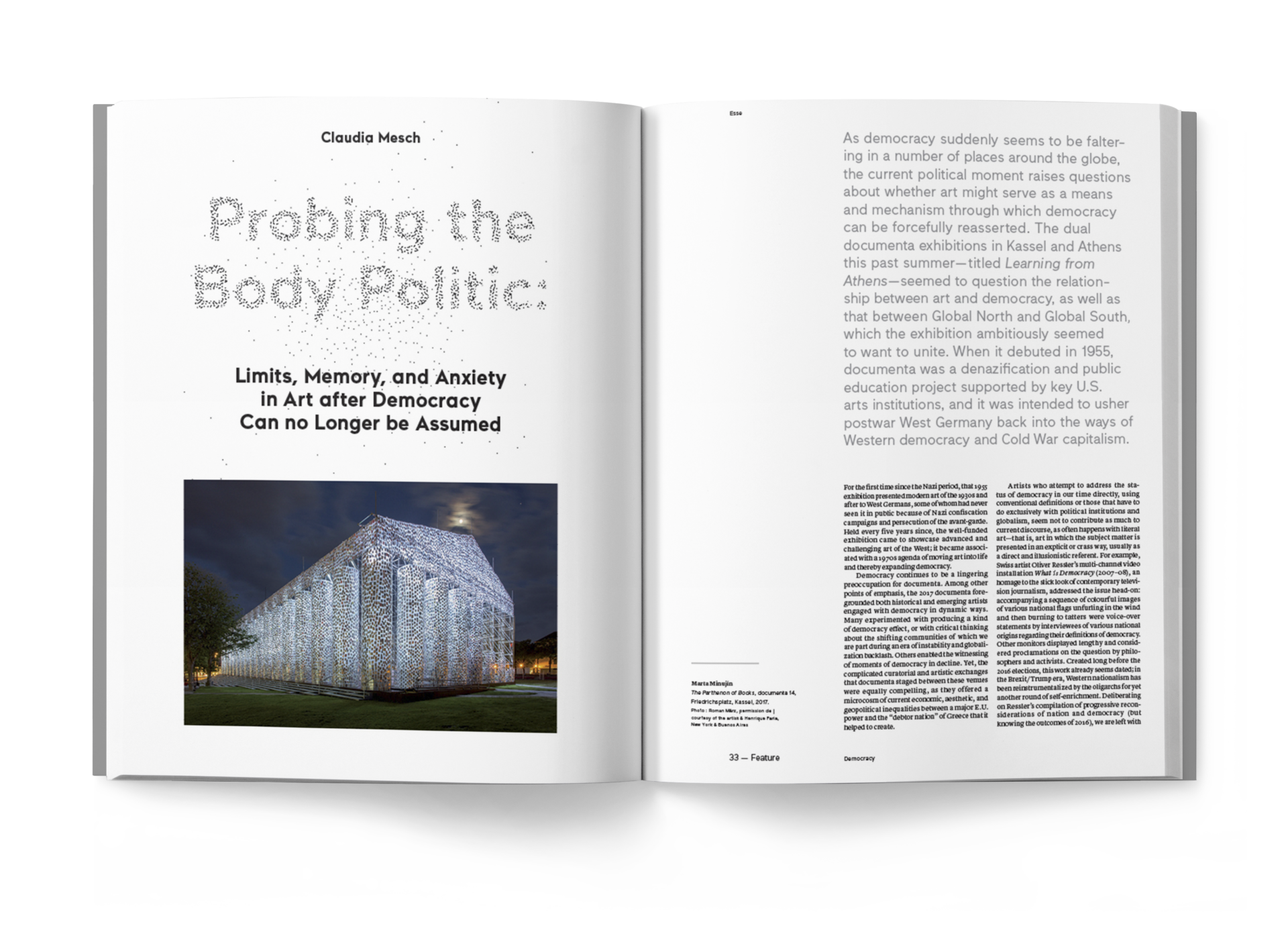
Any definition of the demos excludes as much as it includes. Even the etymology of democracy—quite literally the rule (kratos) of the people (dēmos)— gives rise to dispute. Who were “the people” of Athens? The propertied? The poor? Only male citizens could participate in Athenian direct democracy. In Mesch’s view, democracy is less an existing empirical system of governance than a measure of who can be seen and heard—and who cannot. Democracy has its own secrets: a dark underside of expulsions, of epistemic and physical violence. Mesch draws our attention to Andrea Bowers’s No Olvidado (Not Forgotten) (2010) and Emily Jacir’s Memorial to 418 Palestinian Villages Which Were Destroyed, Depopulated, and Occupied by Israel in 1948 (2001), a family-sized refugee tent on which the names of the villages archived in Walid Khalidi’s 1992 book All That Remains are embroidered by the public as they recount stories of destruction and displacement in what is known as النكبة (Nakba), or “the catastrophe.”6 6 - Walid Khalidi, All That Remains: The Palestinian Villages Occupied and Depopulated by Israel in 1948 (Washington, DC: Institute for Palestine Studies, 1992). Both works testify to what has been lost to preserve democracy: the lives of Mexican migrants attempting to cross the Mexico – US border and Palestinian worlds, dissolved under an exclusionary imperative of settlement. Mesch advocates an expansive understanding of the art of democracy capable of strengthening social inclusivity. Empathy is the key affect for this process: what she calls the “democracy effect” hinges on art’s capacity to witness suffering that “we” ourselves do not know.
Art is a public education in empathy: by rendering visible those who have been excluded from participation, art can reconfigure the political status quo, making democracy more inclusive, more just, and more equal.
Like Mesch, Maude Johnson addresses the relationship between art and democracy in “The Urgency of Debate” (92, Democracy). Yet, the authors’ orientations differ. In her portrait of the French-Algerian artist Kader Attia, Johnson argues that he “condemns democracy as a hegemonic vehicle of Western thought.” In his neon light-installation Demo(n)cracy (2009), Attia slips a silent “n” between the illuminated letters of the demos and kratia. In the title, the burnt-out letter is rendered in parentheses—its curved edges draw my attention to the constitutive exclusions that Mesch hopes empathetic education will illuminate.
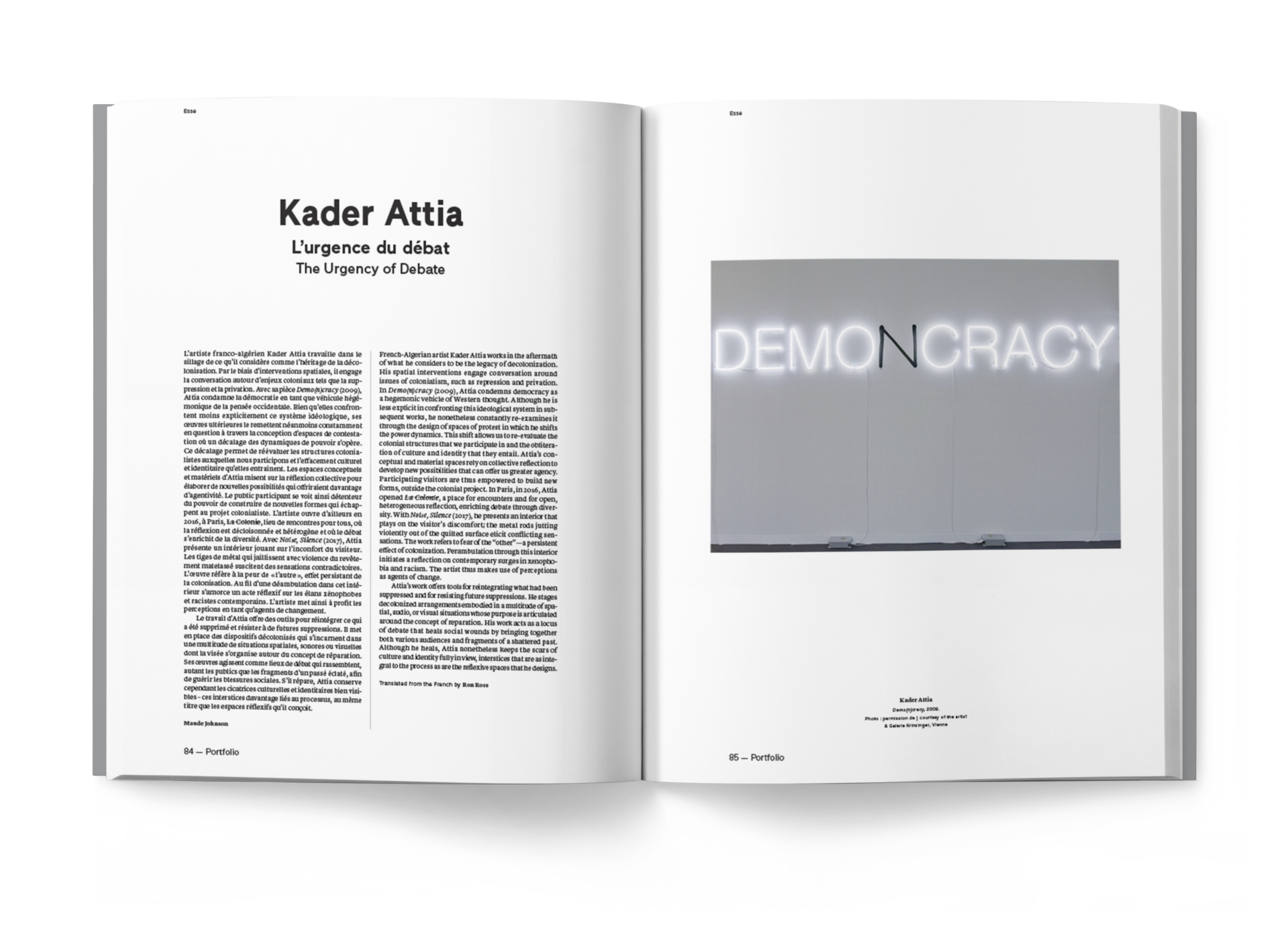
In Attia’s work, we encounter a more complicated understanding of the secret. In 2016, Attia founded La Colonie in a former textile factory in Paris’s 10th arrondissement. The cultural space for listening, sharing, and protest hosted workshops, talks, screenings, and exhibitions with a focus on decolonial praxis. Attia places La Colonie under erasure. Neither concealed nor revealed, his typographical interventions mark the violence that cryptically haunts the bodies of the colonized, who are the very condition of possibility of various democracies. This secret has no intentional subject. Instead of a secret that we are conscious of, here we find an unconscious secret that slips between generations. La Colonie opens a space where transnational histories of colonial violence and oppression can be collectively (un)spoken, while acknowledging the wilful forms of “colonial unknowing” that render these histories unintelligible.7 7 - Manu Vimalassery, Juliana Hu Pegues, and Alyosha Goldstein, “On Colonial Unknowing,” Theory & Event 19, no. 4 (2016), https://muse.jhu.edu/article/633283. Are our deepest secrets those that even we cannot access?
Opacities
Mirna Abiad-Boyadjian’s essay “Opacity Against the Abuses of Empathy” (95, Empathy) helps illuminate the unintentional secret that animates Attia’s political gestures of effacement. Mobilizing opacity against the liberal abuses of empathy, Abiad-Boyadjian calls for a reappropriation of the secret in artistic gestures of refusal. She begins with a quotation from the novelist Clarice Lispector: “I need to be exempt from myself in order to see… the other—the unknown and anonymous.” Scrutinizing the claim to transparency that assumes that individuals can know or encounter themselves—or the other—she carefully deconstructs the desire for immediacy without secrecy, which is at the very heart of the modern concept of the subject. Secrecy, she argues, structures even our relationship with ourselves. Or, as Nietzsche puts it, “We are unknown to ourselves.”8 8 - Fredrich Nietzsche, On the Genealogy of Morals, trans. Walter Kaufman (New York: Vintage Books, 2010), 15.
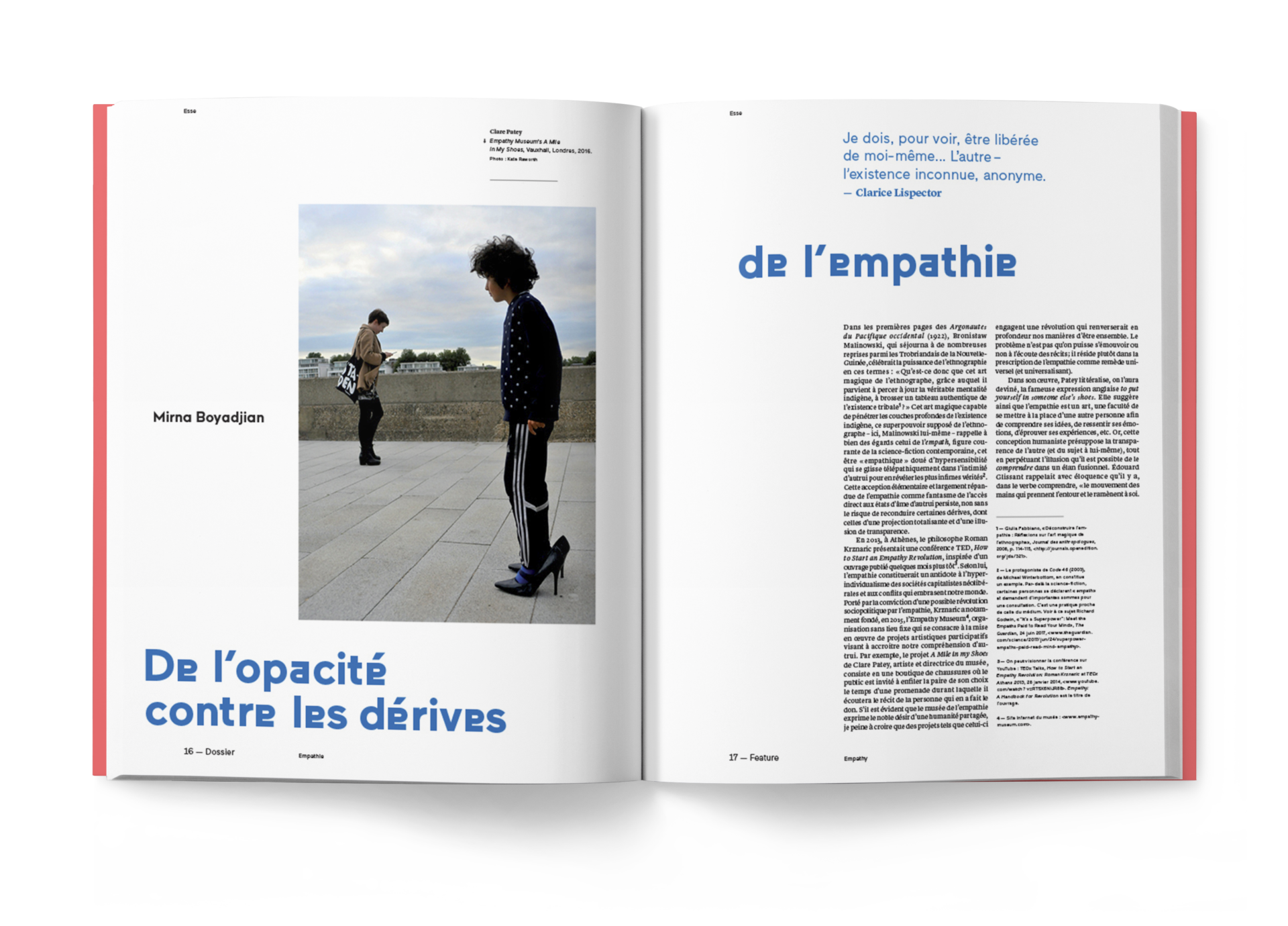
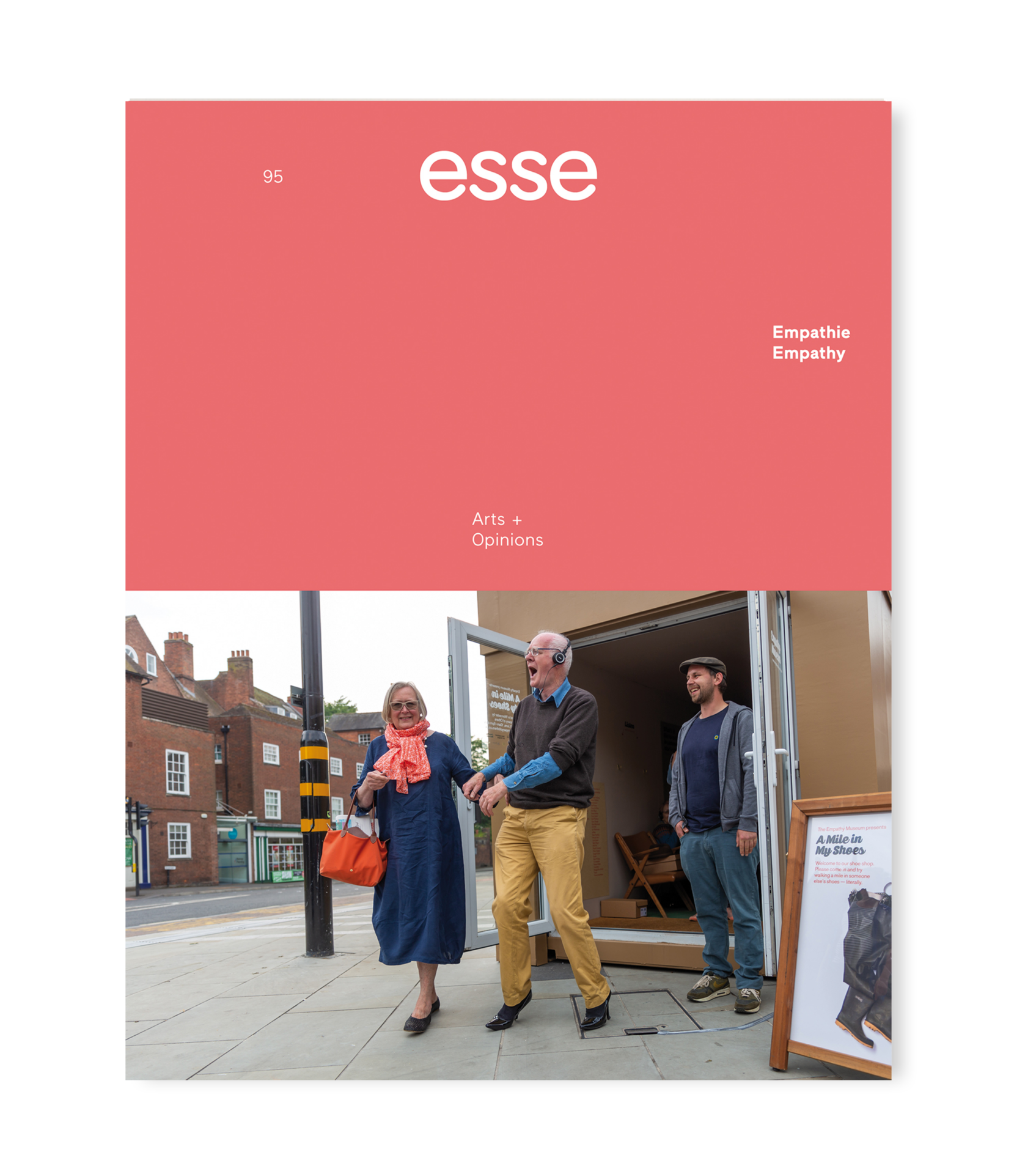
Drawing on Clare Patey’s participatory performance A Mile in My Shoes (2016–ongoing), which quite literally invites the public to walk in someone else’s shoes, Abiad-Boyadjian interrogates the assumption that empathy constitutes an “antidote both to the hyper-individualism of neoliberal capitalist societies and to world conflicts.” Empathy, she argues, presupposes a humanist belief in the fundamental availability of the other. Transparent access—whether it be the ethnographer’s access to the inner world of the Trobrianders of New Guinea or the intimate truths of one’s own self—is not only impossible but a violent intrusion. Black Feminist scholar Saidiya Hartman speaks of the “slipperiness of empathy,” which she identifies as non-consensual mode of relationality whose hegemonic forms claim marginalized experiences for colonialist imaginations.9 9 - Saidiya V. Hartman, Scenes of Subjection: Terror, Slavery, and Self-Making in Nineteenth-century America (New York: Oxford University Press, 2010), 18.
Mobilizing Martinique philosopher and poet Édouard Glissant’s theory of opacity, Abiad-Boyadjian considers anticolonial art practices that resist empathetic appropriation. According to Glissant, the “right to opacity” must be defended.10 10 - Édouard Glissant, “For Opacity,” In Poetics of Relation, trans. Betsy Wing (Ann Arbor: University of Michigan Press, 1997), 189–94.
Opacity refuses the totalizing logic of transparency. The ruses of secrecy are strategies for survival. Indeed, for racialized communities and for queer and trans people, opacity and codeswitching are forms of fugitivity and infra-political resistance.
Drawing our attention to the somatic performances of Brazilian multidisciplinary artist Mariana Marcassa, Abiad-Boyadjian offers clues for an embodied mode of relationality that preserves the opacity of the other as other. Marcassa’s performances include collective acts of listening that create resonant spaces into which the body’s memory of trauma is released in yells, cries, chants, and other vocal expressions. Focusing on the undercurrents of the voice (not the content of language but its grain, its embodied affect), Marcassa, like Attia, gestures toward a secret that remains foreign to speech: to reveal it would be to betray it and to absolve it of its very secrecy. I think this is what multidisciplinary artist and activist Olivier Marboeuf is getting at when, in his 2022 sonic performance, from which this essay takes its title, he instructs us, “Keep the secret” (faire secret).11 11 - Olivier Marboeuf, “The Museum of Breath (Le Musée Du Souffle) Sound #3. Faire Secret. [Keep the Secret],” Berlin Biennale, 2022, https://olivier-marboeuf.com/2022/09/07/faire-secret-keep-the-secret-berlin-biennale/
From opacity emerges another understanding of the secret, not as something opposed to transparency and truth but as an anti-imperial mode of relation. What would a demos be that begins from recognition of something opaque within each person—that links, rather than divides, us? If the other is never fully accessible, then there is always the possibility of an undetected secret—of deceit and lies. On some level, I just need to trust the other who could, in principle, always be deceiving me. We cannot therefore simply do away with secrecy because our collectivities paradoxically rely on a relationship with the part of others that remains hidden. This secret exceeds the intentional understanding of the secret with which we began. It exceeds the control of totalitarian rule and the capitalist surveillance state. Secrecy is not just one way among many that we might decide to engage with others. Rather, it is the general form of all our engagements and all our relations: the secret is the very fabric of our being-together. It even structures our relationship with ourselves.
Links to the articles cited: Lynda Dematteo Emily Rosamond Claudia Mesch Maude Johnson Mirna Abiad-Boyadjian
An image theorist and independent curator based in Tiohtiá:ke/Mooniyang/Montréal, Gwynne Fulton holds an MFA in cinematic arts and a PhD in philosophy and art history from Concordia University. Her research spans critical phenomenology, decolonial aesthetics, and contemporary film and photography. Her writing has appeared in Esse arts + opinions, Mosaic, In/Visible Culture, Éditions J’ai VU, Dazibao editions, Les éditions de Mévius, and ARP Books.